
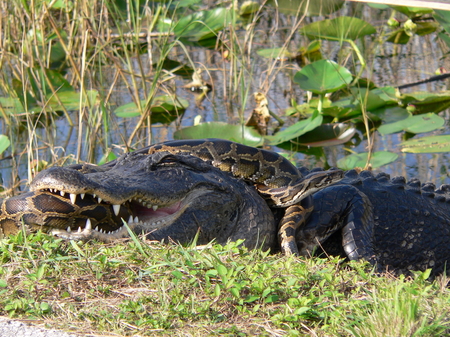
A wildlife drama plays out as a gator tangles with a big Burmese python in Everglades National Park. NPS photo by Lori Oberhofer.
Breeding populations of Burmese pythons have been established in extensive areas of Florida. In vulnerable places like Everglades National Park, limiting the growth and spread of this ecologically disruptive and potentially dangerous invader will be a very daunting task.
The Burmese python (Python molurus bivittatus) is a large constrictor native to the rain forests of Southeast Asia. Because it’s got attractively patterned skin, has a generally docile disposition, and is fairly inexpensive to purchase (about $70), it’s been imported in fairly large numbers here in the United States. It is thought that there are at least 5,000 pet pythons in Florida alone.
Pythons can be difficult to manage in captivity, especially if they are large and poorly kept. Over the years, many of these pet pythons have escaped or been intentionally released into the wild by owners who no longer want them.
Breeding populations have been established in the wild in Everglades National Park and are thought to exists in various other parts of Florida as well. Florida's warm climate is similar to the one that this rain forest species was designed by nature to inhabit.
We don’t want Burmese pythons living wild and free in America. We don’t want them loose in places where they can get at our pets. We don’t want them lurking near our children. We don’t want them living in our national parks and competing with the native predators for food and space.
However, unless we do something to prevent it, it’s only a matter of time before all of these things will be true in at least one-third of the 48-state U.S. They are already true in parts of Florida, including Everglades National Park.
There is a good reason to be concerned about Burmese pythons living in the wild here in America.
The Burmese python is an impressive animal, and that is an understatement by several orders of magnitude. The Burmese python is the world’s sixth-biggest snake species. A python continues to grow all of its life, and it’s not unusual for a fully mature Burmese to weigh 150 pounds and stretch 16 to 18 feet in length. The largest ones on record are much bigger than that.
A captive Burmese python living at the Serpent Safari Park in Gurnee, Illinois, is the largest living snake on record. Tagged with the unlikely name “Baby,” this enormous reptile is 27 feet long and weighs just over 400 pounds. (If you’ve got a tape measure that will reach all the way out to 27 feet, run it out there and see if that doesn’t make you glad that damn thing isn’t on the loose!)
The Burmese python is not just fast growing and long-lived (typically 20 years or so in the wild), it’s also an efficient predator. And as they get bigger these snakes gain the ability to take down and eat ever larger animals. A good-sized python can kill a water bird, a piglet, a fawn, a raccoon, a bobcat, a dog, a child. A whopper is as big around as a telephone pole and can kill and eat a pig, a goat, a deer, a good-sized alligator, a man.
Pythons kill by constriction. In practical terms, this means that they bite their victim and hang on with their sharp, backward-facing teeth while they coil their powerful bodies around the animal and squeeze it until it dies from suffocation.
It’s a bad way to go. Every time the victim exhales, the snake takes up the slack, preventing the intake of a full breath. There is no escape.
The size of the prey that pythons manage to swallow is a constant source of amazement. The secret is in the amazingly stretchy ligaments in the python’s jaws. A python’s jaws aren’t hinged in the manner of human jaws. The python’s jaws just spread further and further apart as the teeth work the victim further and further back. No chewing necessary; the victim is just swallowed whole.
This thing is on the loose in America. Although breeding populations are thought to exist only in Florida at this time, the Burmese python is capable of surviving and reproducing in about one-third of the 48-state U.S. The southern tier of states from Florida to east Texas are in the bullseye right now, and a warming climate, coupled with the species’ already proven adaptability, portends an even larger potential range.
Wildlife biologists are working on a strategy to slow and perhaps reverse the spread of this invasive species, but it’s an uphill task. There are lots of things this snake does that makes it difficult to deal with.
For example, young pythons spend most of their time in trees. Have you ever tried to spot pythons up there in the branches? On the ground the darn thing blends in so well with its surroundings that it can be extremely difficult to spot from only a few feet away. That’s disconcerting. The Burmese is also an excellent swimmer and can cross water bodies of substantial size. Did you know that a python can remain submerged for as long as half an hour?
And boy, are they ever prolific. Females lay clutches of 30-50 or more eggs and guard them for several months. Only a small fraction of the young snakes survive to adulthood, but that’s still a lot of snakes.
The NPS has been dealing with pythons in Everglades National Park for quite a while, and the pace is picking up. The first one, a road-kill on U.S. 41, was discovered 30 years ago, and by the 1990s about a dozen a year were being found. The first baby python was discovered in 1995. The first clutches of python eggs and already hatched nestlings were discovered around three years ago. Python sightings in the park now run to about 250 a year.
Much publicity attended the October 2005 discovery of a 13-foot python in the park that had swallowed a six-foot long alligator. Swollen and sluggish during the digesting of this hefty meal, the python was killed and partially eaten by another gator.
No one knows how many pythons there are in the park at the moment. Some estimates based on presumed densities run into the thousands, but that's little more than a guess.
We’ll have more to say about pythons in Everglades National Park and measures being developed to control them. It's an interesting story in itself.
Postscript: Is an anaconda invasion on the way too? One of these big water loving snakes has been discovered already in Big Cypress National Preserve.
Traveler trivia, no extra charge: About 60 million years ago, a snake of nightmare proportions prowled the tropical forests of northern South America. Dubbed Titanoboa cerrejonensis by paleontologists, this 42-footer (imagine that!) dined on crocodiles and other large prey. It’s still the largest snake species ever discovered.
Story Categories:
A copy of National Parks Traveler's financial statements may be obtained by sending a stamped, self-addressed envelope to: National Parks Traveler, P.O. Box 980452, Park City, Utah 84098. National Parks Traveler was formed in the state of Utah for the purpose of informing and educating about national parks and protected areas.
Residents of the following states may obtain a copy of our financial and additional information as stated below:
- Florida: A COPY OF THE OFFICIAL REGISTRATION AND FINANCIAL INFORMATION FOR NATIONAL PARKS TRAVELER, (REGISTRATION NO. CH 51659), MAY BE OBTAINED FROM THE DIVISION OF CONSUMER SERVICES BY CALLING 800-435-7352 OR VISITING THEIR WEBSITE. REGISTRATION DOES NOT IMPLY ENDORSEMENT, APPROVAL, OR RECOMMENDATION BY THE STATE.
- Georgia: A full and fair description of the programs and financial statement summary of National Parks Traveler is available upon request at the office and phone number indicated above.
- Maryland: Documents and information submitted under the Maryland Solicitations Act are also available, for the cost of postage and copies, from the Secretary of State, State House, Annapolis, MD 21401 (410-974-5534).
- North Carolina: Financial information about this organization and a copy of its license are available from the State Solicitation Licensing Branch at 888-830-4989 or 919-807-2214. The license is not an endorsement by the State.
- Pennsylvania: The official registration and financial information of National Parks Traveler may be obtained from the Pennsylvania Department of State by calling 800-732-0999. Registration does not imply endorsement.
- Virginia: Financial statements are available from the Virginia Department of Agriculture and Consumer Services, 102 Governor Street, Richmond, Virginia 23219.
- Washington: National Parks Traveler is registered with Washington State’s Charities Program as required by law and additional information is available by calling 800-332-4483 or visiting www.sos.wa.gov/charities, or on file at Charities Division, Office of the Secretary of State, State of Washington, Olympia, WA 98504.
INN Member

The easiest way to explore RV-friendly National Park campgrounds.

Here’s the definitive guide to National Park System campgrounds where RVers can park their rigs.
Our app is packed with RVing- specific details on more than 250 campgrounds in more than 70 national parks.
You’ll also find stories about RVing in the parks, tips helpful if you’ve just recently become an RVer, and useful planning suggestions.


Comments
Bob,
The Burmese Python issue absolutely is of critical importance and I'm glad to see it getting some press. The ecological damage is real already, with the potential to escalate exponentially.
All that said, I think your piece here borders on sensationalism in a few areas.
"...See if that doesn’t make you glad that damn thing isn’t on the loose!"
"This thing is on the loose in America."
So are European starlings, emerald ash borers, and marauding herds of feral house cats. If you're referring to the potential ecological calamity, then yes, this "thing" is a menace and we should fear its presence here. But it seems like you're playing to society's supposed innate ophidiophobia and that's not a good thing. Western diamondbacks are pretty dangerous too, and a bite can easily kill a man - nearly as gruesomely as constriction by a python. Should we support rattlesnake roundups where children may be present? I know your answer is no, so let's focus on environmental impacts and not feed a fear of snakes.
-Kirby.....Lansing, MI
Right on! The invasion is a concern but lets not build on the irrational fear of snakes. They need to simply be respected not feared.
$70 pythons can be imported as pets, yet people can't bring a bottle of wine along from their trips to Europe?
Looks like protectionism is rearing its ugly head...
P.S. My browser (for better or worse) only displays the upper half of the picture.
Kirby, I will accept your "borderline sensationalism" criticism at face value, but you and I are going to have to agree to disagree on the rest of it. I contend that it's not fair to compare the Burmese python, an invasive, disruptive non-native, to the diamondback rattlesnake, an indigenous species. You get rid of the former if you possibly can, because it should not be loose in the wild here in America. Period. You protect the latter, which has long occupied its niche in proper balance with other species that share its habitat.
As I was reading this article, for the first time I questioned the idea of "indigenous species." It seems that we often seek to protect certain "indigenous species" because we find them more desirable than, say, a big snake.
However, if the Burmese python does so well in the swamps of the southeast U.S., why not rename it the American python and accept its presence? Yes, we don't like the idea of a species being introduced in a new environment by pet owners dumping their unwanted animal toys, but what about the other ways that species can spread to new habitats naturally?
I guess what I am groping toward here is the idea that newcomers need not be badcomers just because they are new to an environment or introduced in a way that we deem "artificial." We humans need not always intervene unless the ecological balance will be way out of whack as a result.
You do not make a strong case for that here. You do make a case that this new animal is dangerous to child and man. Heck, I would not venture, nor allow my child to venture, into such areas because of the alligators and other nasties that already inhabit those swamps.
There are very few cases of "newcomers" that aren't "badcomers." I can't think of one. The main problem with the pythons is that they are on the top of the ecosystem and have almost no natural predators. They won't stop reproducing until they run out of food. Also, the pythons can live along the coastal zone as far north as Maryland, and south down the Eastern Seaboard, all the way through the Gulf to most of Texas.
Bruce, please explain to me what discipline of science you studied and at what university? You clearly have no idea what you are talking about. Tilting the balance of nature --for the economy or for the love of having a giant useless reptile as a caged pet-- is only going to lead to trouble in the long run. Think of Rome, Or the Maya. Maybe in your supremely enlightened view, it's not a big deal --for apperently no other reason than that it has happened-- but several thousand years of recorded human history would stand against you. Read a book.
If it "does well", accept its presence? Let me see: American climbing fern, American swamp eel, American piranha, American walking catfish, American snakefish, American python, American anaconda..... :-) In a more serious vein, you make a very good point about doing a better job of explaining the disruptive effects of the Burmese python. (Weaselspeak alert!) I will be doing that -- also discussing control strategies and tactics -- in the promised second installment.
I guess this is my response to your list of "American this and that," from my previous post: "We humans need not always intervene unless the ecological balance will be way out of whack as a result." Some on your list definitely meet that criterion, from what I have heard and read (I am no expert). OK, I will read with an open mind your second installment about how disruptive this snake can be to the Everglades and beyond. That should include demonstrating how this new predator will be putting other walks of life out of business. Given the low survival rate of newborn pythons that you cite and the deteriorating ecology in general (a much bigger story) that may be hard to do, I think. Not meaning to challenge your expertise, obviously, just interested in a discussion.
Bob,
I think I failed to articulate where I was going properly. My point was indeed that the Burmese python is a completely different case than the diamondback rattler. One should be protected and one exterminated. I was saying that sensationalisitc accounts of snake problems do nothing to help the cause of the snakes that need protecting. To many folks a snake is a snake and it's a scary, dangerous animal. Reinforcing a fear of Burmese pythons (painful suffocation, eating men whole...) isn't good PR for the rattlers in the eyes of 80% of the public that is ignorant of the value of protecting indigenous species. Let's discuss the ecological impact of invasive pythons without the lurid details of how they'd kill you if they chose to. That's all I'm sayin'. :-)
.
-Kirby.....Lansing, MI
And why shouldn't we know how the python would kill us? Man has survived by knowing how other animals, fowl, reptiles, etc., act. I do not believe that 80% of our population is so stupd that it will equate a rattlesnake with a python. Knowing actions and reactions has been known as survival of the fittest, and I for one, would want to know the actions of this python. Dottie F
Dottie, that's fine. I just then want to see every article mentioning any kind of animal list in detail the ways it could kill you. I feel Bob is using the tactic of describing python feeding behavior to engender distaste for their presence here, when explanations of the facts about the potential ecological damage would serve better. My argument isn't with his facts - which are accurate. It's the delivery. I always appeal to the intellect first before resorting to tapping the emotion - and when that emotion is fear, I try to avoid it altogether. Fear is too powerful, too easy to misuse, and too easily backfires, marginalizing both the message and the messenger.
As for people equating pythons and rattlers - I guess I spend too much time in public education of environmental issues. Convincing people that all snakes aren't evil is quite the uphill battle. That's especially true for adults.
Bob, do understand I'm glad you got this topic up here. The points I'm arguing are just some philosophical questions about writing/education that have been on my mind lately. I had a respected expert slam me for sensationalism on one of my freelance pieces last month, so I've been chewing on this topic a lot.
Bob, I used to work in the Everglades and I was present when the python swallowed the alligator and I want to clarify something. The newspapers (as usual) got the facts wrong. The python did not burst as a result of eating the alligator. The swallowed gator was actually partially digested so the python swallowed it successfully, but with that full belly it was moving rather slowly and another gator came along and ate part of the python. The body burst as a result of decomposition, not the gator it ate.
Invasive species has been something that I have worked to educated the public on. In every park I have worked at (7 total) Ailanthus altissima has been present in every single one. If you drive the BLue Ridge Parkway now, you can't see the view from most of the overlooks because this tree blocks the way. It stops the growth of any other tree and has no value to wildlife at all. In many parts of Virginia, this tree is the only one that can be seen for miles.
For Bruce, who says we should just accept them, invasive species wreck havock on native ecosystems. They are a major problem and cost millions of dollars. They usually have no predators in the area they are invading and will completely take over. Go to www.nps.gov/ever/forteachers and check out the curriculum guide Don't Let it Loose. Yes it's for kids, but it has a lot of background information on the problem.
I should also mention Python Pete. Everglades biologist Lori trained this little beagle to sniff out pythons. So far he's doing a great job!
Thanks for the clarification on the "burst" python, RangerLady. I made the correction in the article so I won't be guilty of perpetuating this error. As for the tree-of-heaven, I see we are in agreement that this is a particularly nasty invader. When I write about python research and control methods I'll be sure to tell about Python Pete and his work. Saw some neat footage about PP while channel-surfing one evening, but I can't remember the program (NGC?). I have some photos of the little guy somewhere. Do you have any PP anecdotes to share?
I do not have many anecdotes about Python Pete. He was just in training when I left my seasonal position there. At that point he was still tracking pythons in net bags and was given a toy once he found them.
All this talk about billions of billions of dollars being spent on the attempt to cut down the population of non-native problems is idiotic. There is no proof of anything in which a burmese is held accountable in the wild other then...raccoons, dogs, cats ect. No human in North america has been killed by a wild burmese ever. They are not the biggest predator and nor do they thrive souly on protected animals. They have the same diet as a aligator...and need i remind you there are 1,000,000 estimated aligators in the everglades. Aligators, snakes, panthers ect...eat whatever presents it's self. They do not target particular animals. Anytime an american can muster up a way to earn a buck they pin the blame on something. Now my question is merely this....when burmese pythons become threatend and are on the verge of nothingless...will we then put them in wild to help build numbers?
The number of burmese pythons in the Everglades has been exagerate. There are reports of 100,000 or 130,000 Where are these numbers from? It has also been reported that they lay 80-100 eggs twice a year. Another gross misinfomation!!!!
Burmese pythions are a non-native species and as such they should be regulated and erradicated from the Everglades. However, pythons in the wild do have predators. A Burmese hatchling would be a tasty morsel for alligators, crocodiles, snapping turtles, otters, ospreys, eagles, and all the herons and egrets in the park.
The python situation in the Everglades is of concern to everyone interested in the environment and our native species, but all the public must be informed and made aware of all the facts. Playing with the public's fears is not right. No python jas ever eaten a man in the US. There have been a few unfortunate examples of baies killed by pythons, but it has always been in captive situations and the owners are the ones to blame.
Don’t forget the Indigo Snakes, Kingsnakes, Storks, Hawks, Gar, Large Mouth Bass, Soft-shell Turtles, Raccoons, Opossum, and Feral Pigs that would also love to make a meal out of these snakes.
Personally I am all for the capture of these snakes instead of the Ban they are trying to put upon these beautiful animals. If they would pay me I would go down there and spend day in and day out to capture these animals so this ban doesn’t go through. I own many Boa Constrictors and a few other varieties of snakes and I love them all to death. I have never had a problem with them that wasn’t my fault. I hope someone finds a logical way to stop the Burms. The Python Ban is not a logical answer to the problem at hand.
I agree with Nate, we shouldn’t try to scare the public because there are unfortunate accidents like that. Besides there is no proof that a Burm or any other large constrictor has ever actually eaten a person. But in the cases of the children who were killed by the snakes it was human error, to even thinking you could keep such a large animal in an improper cage without consequences is absolutely insane.
Anyone who has ever been in contact with Burmese Pythons knows that there are gentle giants, and much less likely to injure humans than most dogs are; everything else is media frenzy.
I have worked a lot with Burmese pythons and used them in may educational events during which kids of all ages play with them. Yes, respect them, like any other animal. But don't fall for the image hollywood and animal planet have painted.
Btw, the original report by the USGS about the Florida problem with Burmese pythons has long been dismissed by scientific review. On the topic, Dave & Tracy Barker have provided several reviews of the issue on:
http://www.vpi.com/publications
Besides, just consider this: Literally millions of boas and pythons are kept as pets in the US, and have been kept since at least 3 decades. No wild populations of any pythons or boas have ever been reported, except for the souther 3 counties of Florida. It is therefore simply a FACT that they are not invasive, except for southern Florida (and btw, pythons in Florida have also been reported over more than a decade). This is therefore state local problem that needs a state local solution. No other location in the US will ever be affected.
From what I've read on the INET, the python is here to stay. The fact that it is a large constrictor and dangerous in certain situations doesn't lessen the fact we will have to learn to live with it. I suspect our own growth, urban sprawl and habitat destruction will restrict their range much as it has for most of our wild life.
I am not a biologist. Last night I saw a program on channel 13 about these Burmese pythons. I want somebody to explain to me, or correct me, how The Everyglades can support an evergrowing popoulation of these cretures, or of any top of the food chain animal. I was always taught that the larger a predator, the larger a terrutory it needs to live in, feed, and breed. In otherwords, these giant creatures need a much larger area in which to live than, proprortionally, than, say, a shrew. So it seems to me, The Everyglades CANNOT SUPPORT a population of thousands of giant snakes. It is ecologically impossible. Somebody do the math for me.
Do they eat kudzu?
Not a whole lot of kudzu in the Everglades, Jon.
I am a biologist (at least the paper on the wall in my mom's den says so), but the answer to the question of how many large pythons can live in the Everglades is mostly simple math.
Roughly 2000 km^2 between Everglades NP and Big Cypress, plus another 3000 km^2 or so in the water management areas, so roughly 5000 km^2 area: there's a lot of swamp out there.
Pythons, like most snakes, are not territorial in terms of staying within and defending a territory; they tend to wander from place to place. Also, pythons, like most constrictors and vipers, eat so infrequently (~once every 1-3 months) that they resorb the villi on their intestinal linings between meals because the metabolic cost of maintaining them exceeds the cost of regenerating them every month or so (google Secor Diamond snake digestive physiology; they even have a couple papers on Burmese pythons). [ok, so there is some biology in my answer.]
The net primary production in the Everglades varies spatially from 20 - 18000 grams per square meter per year. Picking 1000g/m^2/yr, each km^2 fixes ~10^6kg per year. Allowing a relatively low ecological efficiency of .1-1%, that's still 1000-10000kg/km^2/yr of prey.
So, at 4-8 prey per year at 50-80kg per prey, the greater Everglades could easily support 3 to at least 5 (perhaps more) large adult pythons per km^2 at equilibrium, or 15000-25000 large adults. ["Easily" does not mean that there would not be substantial negative effects, only that if alligators and other predators get out-competed, python populations could conceivably grow until reaching numbers in that ballpark.]
I don't know the current best estimates of adult python numbers, and I suspect that there still aren't good estimates based on actual sampling data. My best guess would be somewhere between 500 and 2000 large individuals, where I get to change the cutoff for large (6' plus or minus a couple of feet) to whatever is necessary to make my numbers right.
In contrast, panthers are territorial, actively defend their territories (one of the top causes of mortality of dispersing juvenile panthers), need to eat every few days, and eat a much narrower range of prey. My understanding is that the greater Everglades probably couldn't support a population of even 100 panthers under current conditions.
Hello all,
I just want erverone to think The Native American have had to deal with an invasive species of human beings (Us) that did untold amouts of damage to the Americas ecosystem, and are still doing it today. I do not see what is going on in florida any diffrent. Everyone of you can say what you want to. The truth is the Burmese (American) Python is less invasive on the enviroment than we will ever be. I do not see them as an Invasive species anymore That snake believe it or not has already adapted to living there. This snake is actually listed as prtected in several asian country right now. So lets think about this.... we kill them here and they are dying there this equals no Burmese Python. This is an amazing animal That also needs to be preserved, As it is one of the oldest living animals on earth. This is considered to be a prehistoric snake. i personally have a Burmese Python, and I would not want to see this beautiful animal be wiped off the planet because of a presived imbalance. Let not forget that thy do live with the other oldest predator on the planet. The american Alligator. we need to keep our noses out of it and everything will rebalance itself.