
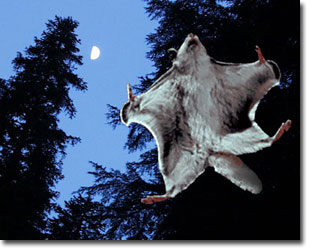
The Northern Red Squirrel could cope with climate change by relying on corridors such as the Appalachian Trail. Maryland Department of Natural Resources photo.
Editor's note: This is the eighth excerpt from the National Parks Conservation Association's latest report on how climate change is impacting national parks. This section focuses on how corridors such as the Appalachian Trail can help species cope with climate change. The entire report can be found at this page.
The climate is not static. Ice ages come and go, pushing rivers of ice south and then pulling them back north across continents as temperatures and snowfalls rise and fall. Animal and plant species either stay ahead of these icy incursions and adapt, or perish. After the glaciers retreat, the plant and animal species that have shifted geographically sometimes remain in their new locations. But when climate change unfolds relatively quickly, as we are seeing today, many animals — like the northern flying squirrel — may not be able to stay ahead of the curve.
Geographic shifts of living communities can be seen at Great Smoky Mountains National Park along the Tennessee-North Carolina border. Hike toward the park’s mountaintops and you’ll find a geographically unusual spruce-fir ecosystem that took hold there about 10,000 years ago when the glaciers of the Wisconsin Ice Age retreated. In the highest and coolest of the Smokies’ elevations there are many plant species that today are more commonly found nearly 1,000 miles to the north in the boreal forests of Maine and Canada. But what will these species do in response to the prospect of higher temperatures resulting from accelerated unnatural climate change? Where will they go? Where can they go? Some species’ ranges have already altered in response to climate change. Some have been pushed to higher elevations or latitudes by a warming climate, while others have expanded into newly hospitable territory.
There have been concerns that national parks will become genetic islands surrounded by roads and development that act as barriers to the mingling of individuals and genes separated by those borders. Such concerns led to the launch of the Yellowstone-to-Yukon land conservation movement in 1997. The effort seeks to protect a corridor of lands from Yellowstone to the Yukon that would facilitate species’ movement and their genetic exchange. Wolverines are one example of a species that might benefit from this corridor as climate change unfolds.
Similar concerns of genetic isolation led to the biologist-assisted infusion of Texas panther genes into the Florida panther population of Big Cypress National Preserve through the introduction of eight female panthers in 1995. National parks are recognized as critical enclaves for the protection of species, but linkages to other protected lands are necessary. Projections show that a doubling of carbon dioxide from baseline levels could cause some national parks to lose up to 20 percent of their mammalian species diversity due to predicted shifts in distribution ranges that would move their habitat beyond a park’s borders. Great Smoky Mountains National Park can expect to lose nearly 17 percent of its mammalian species as the park’s largely temperate deciduous forest is transformed into a warmer mixed forest, similar to those found to the south.
Among the species expected to be lost from the park under this change are the red squirrel, northern flying squirrel, and southern red-back vole. Shenandoah National Park, 469 miles to the north, and connected via the Blue Ridge Parkway, also stands to lose the red squirrel and the southern red-back vole. Just as some of the species currently living in the Smokies and Shenandoah are expected to shift their ranges north as climate change effects accumulate, species currently living farther south can be expected to move north into these parks. However, these movements can occur only if there are corridors connecting suitable habitats.
Fortunately, one north-south linkage already exists: the Appalachian National Scenic Trail. Covering 2,175 miles and 250,000 acres from southern Georgia to northern Maine, the trail passes through Shenandoah National Park, Great Smoky Mountains National Park, and lands administered by various federal and state agencies along the way. It already serves as a vital corridor that provides habitat for flora and fauna up and down the Eastern Seaboard. Warblers, wild turkey, and once-endangered peregrine falcons are among the bird species that rely on the Appalachian Trail corridor. Overall, the corridor provides habitat for more than 2,000 rare, threatened, and endangered species, including more than 80 that are globally rare.
SOLUTIONS
Though protected from development, the Appalachian corridor is not immune from outside impacts, beginning with the estimated 4 million hikers it receives each year. With that in mind, the Appalachian Trail Conservancy, operating under an agreement with the National Park Service, is monitoring the pulse of this corridor to better understand the threats to its environment. With its vast network of volunteers, the Conservancy (through its Appalachian Trail MEGA-Transect project) is assessing how outside factors — invasive species, air pollution, and urban sprawl, for instance — are affecting the leafy corridor. Other entities, such as the Smithsonian Institution Conservation and Research Center, are also involved in projects along the trail.
By monitoring the environmental impacts along the trail corridor, land managers will be better able to manage the landscape for its long-term health. Developing monitoring programs to track climatic, biological, and ecological change will enable managers not just to see what’s changing, but also evaluate the effectiveness of their management strategies and make adjustments in a timely fashion.
It’s expensive to conduct monitoring programs and implement management strategies; therefore, it will be critical for Congress, the Department of Interior, and other entities to provide adequate support to the National Park Service and its partners involved in this work.However well the Appalachian mountain chain has served as a corridor in the past, there is no guarantee that it will function equally well as a corridor under rapidly changing climatic conditions. We must therefore foster cooperation and coordination among government agencies and landowners neighboring national parks to accommodate shifts in species distribution that occur in response to climate change. Cooperation is essential to ensure the preservation of species, and the preservation of functioning ecosystems.
We Can Safeguard Appalachian Wildlife from Climate Change
Stop contributing to climate change
Wildlife species like the northern flying squirrel, red squirrel, and southern red-back vole could be driven out of Great Smoky Mountains and Shenandoah national parks if we fail to reduce carbon dioxide pollution and global warming that is transforming temperate deciduous forests into warmer mixed forests.
Give Appalachian wildlife freedom to roam
Protecting the network of existing federal and state conservation lands throughout the Appalachian Mountains, continuing to monitor wildlife migration patterns, and conserving additional lands that may be needed for the region to support wildlife migration, will help the plants and animals of the Appalachian region secure suitable new habitat as the climate warms.
Reduce and eliminate existing harms that make Appalachian wildlife more vulnerable to climate change
Air and water pollution, as well as encroaching development, are major existing stresses on the forests and wildlife of the Appalachian region. By reducing pollution and keeping inappropriate development at bay, we can help wildlife better cope with the new stresses wrought by climate change.
Tomorrow: Bighorn Sheep in the Southwest
Credits:
LEAD RESEARCHER:
Jennie Hoffman, PhD, Senior Scientist, Climate Adaptation, EcoAdapt
ASSISTANT RESEARCHER:
Eric Mielbrecht, MS, Senior Scientist and Director of Operations, EcoAdapt
POLICY ADVISOR:
Lara Hansen, PhD, Chief Scientist and Executive Director, EcoAdapt
WRITTEN BY:
Kurt Repanshek
NPCA GRATEFULLY ACKNOWLEDGES FINANCIAL SUPPORT FOR THIS REPORT FROM THE FOLLOWING:
Turner Foundation
Merck Family Fund
Ruth and Ben Hammett
Story Categories:
A copy of National Parks Traveler's financial statements may be obtained by sending a stamped, self-addressed envelope to: National Parks Traveler, P.O. Box 980452, Park City, Utah 84098. National Parks Traveler was formed in the state of Utah for the purpose of informing and educating about national parks and protected areas.
Residents of the following states may obtain a copy of our financial and additional information as stated below:
- Florida: A COPY OF THE OFFICIAL REGISTRATION AND FINANCIAL INFORMATION FOR NATIONAL PARKS TRAVELER, (REGISTRATION NO. CH 51659), MAY BE OBTAINED FROM THE DIVISION OF CONSUMER SERVICES BY CALLING 800-435-7352 OR VISITING THEIR WEBSITE. REGISTRATION DOES NOT IMPLY ENDORSEMENT, APPROVAL, OR RECOMMENDATION BY THE STATE.
- Georgia: A full and fair description of the programs and financial statement summary of National Parks Traveler is available upon request at the office and phone number indicated above.
- Maryland: Documents and information submitted under the Maryland Solicitations Act are also available, for the cost of postage and copies, from the Secretary of State, State House, Annapolis, MD 21401 (410-974-5534).
- North Carolina: Financial information about this organization and a copy of its license are available from the State Solicitation Licensing Branch at 888-830-4989 or 919-807-2214. The license is not an endorsement by the State.
- Pennsylvania: The official registration and financial information of National Parks Traveler may be obtained from the Pennsylvania Department of State by calling 800-732-0999. Registration does not imply endorsement.
- Virginia: Financial statements are available from the Virginia Department of Agriculture and Consumer Services, 102 Governor Street, Richmond, Virginia 23219.
- Washington: National Parks Traveler is registered with Washington State’s Charities Program as required by law and additional information is available by calling 800-332-4483 or visiting www.sos.wa.gov/charities, or on file at Charities Division, Office of the Secretary of State, State of Washington, Olympia, WA 98504.
INN Member

The easiest way to explore RV-friendly National Park campgrounds.

Here’s the definitive guide to National Park System campgrounds where RVers can park their rigs.
Our app is packed with RVing- specific details on more than 250 campgrounds in more than 70 national parks.
You’ll also find stories about RVing in the parks, tips helpful if you’ve just recently become an RVer, and useful planning suggestions.


Comments
Another statement listed as a fact that has not been proven in this excerpt. "But what will these species do in response to the prospect of higher temperatures resulting from accelerated unnatural climate change?" How do we know accelerated? How do we know unnatural?
For every scientist that says this is so, there is another that says it is not so.
We could take the cars off the road and planes out of the sky and then less people would be able to visit these great parks we have. Under your scenario, the animals might fare better, but who would know?
Earlier this summer I drove 1,000 miles in my SUV (needed to fit the family) to North Carolina to visit GSMNP. Spent several days there. Had a great time hiking several days and also doing some driving to see the sights. I did not feel guilty about the driving, although based on reading above, I maybe should have stayed home and read about it in a book so I would not add to the pollution.
The science exists to inform us that the warming is accelerated. And the scientists with the International Panel on Climate Change say it's "very likely" (in their definition, greater than 90% chance the result is true) that humans are behind the current global warming. That has been debated, and will continue to be debated.
As for taking "the cars off the road and planes out of the sky," that's not the goal of this report. Rather, the hope (and this is my personal interpretation; I'm not speaking for the NPCA or any other group) is that examples such as these will prompt both policy decisions in Washington, business decisions, and even personal decisions that result in a lighter impact on the environment.
And really, shouldn't we be doing that regardless of the climate?
Global warming is real. Human culpability is undeniable. The rate of change is increasing and may be on the verge of a tipping point that will send it beyond any hope of mitigation. Denial seems to be a common human response to an unpleasant reality. Many European Jews in the late 1930s could not believe that the German Nazis could be capable of the Holocaust. It was literally unthinkable. Denial contributed to the death of millions. This time its consequences could be infinitely greater.
Frank C....the key word in Ray Bane's comment is "denial". He has a point about the ostrich effect or syndrome that some posses.
Frank,
While I admire the effort you're investing, your concern about whether the scientists who advised on this project are "climate scientists" is a reach.
Dr. Steve Running, who was a lead chapter author for the International Panel on Climate Change (2004-2007) and who shared in the Nobel Prize for his efforts, is, in short, a forestry expert (PhD in forest ecophysiology, Master's in forest management, B.S. in botany); Dr. Dan Fagre, a Glacier National Park scientist who has spent the past 15 years working to understand how global-scale environmental changes will affect our mountain ecosystems, is, in short, a wildlife biologist; E.O. Wilson, who knows a thing or two about climate change and who has won two Pulitzer Prizes for his writing, is a biologist who focused his early work on bugs. Since he's not a writer by degree or trade, should his Pulitzers be questioned?
The list, as I'm sure you know, goes on and on.
Beyond that, while you lament the lack of a "climate scientist" on the team that researched this topic for NPCA, you should know that they reviewed upwards of 100 peer-reviewed papers on climate change and wildlife, papers that in turn were written by dozens more scientists from various fields. What scientific credentials do you bring to the table in connection with the citations you mention? If you're not a "climate scientist," should they be summarily dismissed?
The overwhelming majority of scientists that study climate change agree that human activity is responsible for changing the climate. The United Nations Intergovernmental Panel on Climate Change (IPCC) is one of the largest bodies of international scientists ever assembled to study ANY scientific issue (ever), comprised of more than 2,000 scientists from 100 countries. The IPCC has concluded that most of the warming observed during the past 50 years is attributable to human activities. Its findings have been publicly endorsed by the national academies of science of all G-8 countries, as well as those of China, India and Brazil. The Royal Society of Canada – together with the national academies of fifteen other nations – also issued a joint statement on climate change that stated, in part: "The work of the Intergovernmental Panel on Climate Change (IPCC) represents the consensus of the international scientific community on climate change science. We recognize IPCC as the world's most reliable source of information on climate change."
How much evidence do you want? One hundred percent of all scientists everywhere will never agree about anything. If you were to ask why the sky is blue, there would always be some squablers!
Plus we're running out of fossel fuels, and beating the heck out of the environment. Shouldn't we be looking for alternatives, as the gal says in the gum commercial, "No matter what"?
If you will bear with me, here's a little exercise in good sense, no advanced degrees required:
Behind door #1: Forced climate change does not exist, and we don't do anything about it. We don't need to! Everyone is fat, rich, happy, and alive.
Behind door #2: Forced climate change does not exist, and we do something because we think it does exist. We spend tons of money for nothing. We're poorer, not so fat or happy, but alive.
Behind door #3: Forced climate change exists, and we do nothing about it. Fat City keeps their money for all the good it will do them on a dead planet. R.I.P.
Behind door #4: Forced climate change exists, and we do all we can to mitigate the damage. It will take a lot of work, be expensive and inconvenient to give up our habits. However, most will survive and there's a good chance the Earth will recover.
Which door will YOU pick? Do you really want to take that chance? We don't have to hail from Left Blogistan to realize it's time to clean up our toxic mess and go on a reduced carbon diet.
To Frank Not The Other Frank: Pardon me for butting into this party for the second time, but I couldn't help but notice that you might have drawn the wrong inference from your source. If I'm reading it right, Scafetta is saying data used by the IPCC is skewed because the data fails to take into account certain factors and mechanisms that would more accurately show solar effects on climate. He's not denying that greenhouse gases have an impact; what he's complaining about is the lack of accurate solar data. I would have to read his article in its entirety in order to find out what he considers "arbitrary and questionable assumptions", though - bet I can guess what they are.
I don't think it's poor logic at all. As I understand the "fallacy of false choice", it involves choosing between only two alternatives when there are in fact more viable options available. Okay, so what ARE the other options? I see a lot of data cherry-picking to support your position, but I don't see you offering any other answers. I'm not convinced that variations in solar activity are the sole cause of climate change. And the reasons you have for discounting the effects of greenhouse gases don't bear close examination.
Actually in the case of door number two, we spend tons of money and improve our lives by finding cheaper, more sustainable, forms of energy. This results in a cleaner, healthier, planet. It allows our children and our children's children to maintain an advanced lifestyle. It keeps our planet from being drilled and mined to death. It cleans up our air and water. And, ultimately, it allows folks to make millions of dollars by developing, building, installing and selling the new technologies, and saves billions of dollars from being funneled to overseas oil barons. The arctic wildlife refuge and other pristine places remain undrilled (for their few years worth of oil). No one gives anything up, we simply find new and more efficient ways of fueling our lives.
Doors two and four are both win, win.
In a way this is a lot like health care reform. If we do nothing energy (or health care) will become more and more expensive, and scarce. Soon only the rich will be able to afford these "luxuries".
We will continue to send our wealth overseas, and the decline of the United States is inevitable. Or we can take the lead, make bookoo denaro, and tell the Saudis (and others) thanks but no thanks. Cleaning up the planet and alleviating climate change are just bonuses. The choice is ours.
Again, it is always easy to find individual scientists (or even groups of scientists) to support a theory or point of view. It is very difficult to find over two thousand highly respected scientists from one hundred countries to agree about anything.
To The Other Frank: I agree with your interpretation of door #2. I'm all for a cleaner, healthier, and more sustainable world! Thanks for the correction. Some Saudi prince once said that he was unafraid of losing oil revenue to 'green energy', saying "the Stone Age didn't end because we ran out of stones." I think most of us will be able to adapt.
I attended a countywide planning meeting yesterday where the county Planning Commission heard testimony from a number of experts in the fields of community planning, ocean sciences, economics, agriculture and commercial developments. Tourism is the primary economic driver for our county followed by agriculture, science and fishing. The ocean environment is particularly of critical importance to local residents. The meeting was open to the public, and the room was packed with people standing along the walls. We were treated to reports of deterioration of the surrounding coral reefs and loss of marine habitat. The updated countywide plan will include an expected three meter rise in sea level over the coming decades. Such a rise will have devastating impacts on the island coastal ecosystems and on communities and properties adjacent to beaches and within low areas that will be increasingly prone to storm surge flooding. There is also the concern that freshwater aquifers will be contaminated by rising salt water levels invading reserves. These concerns face virtually all coastal areas around the world.