
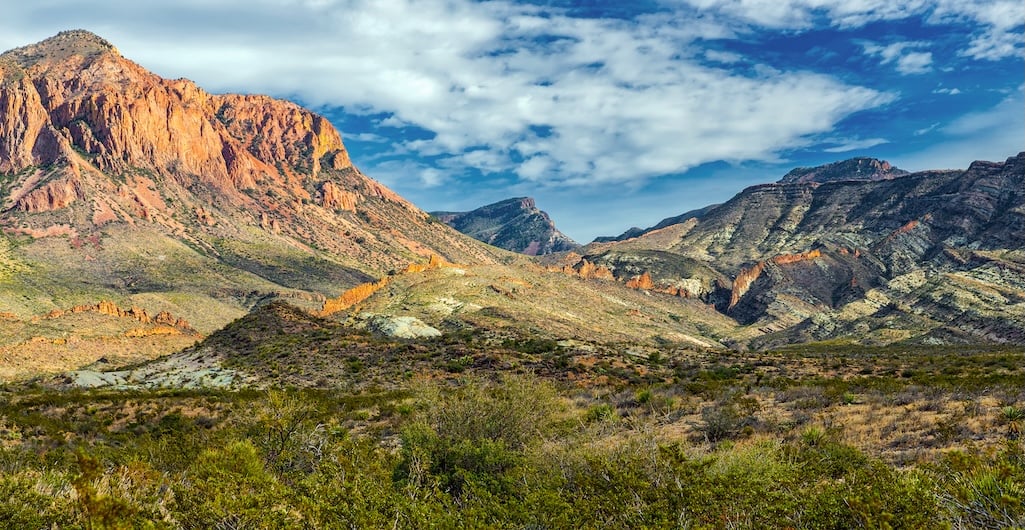
Erecting a Southern border wall through Big Bend National Park would be “the most egregious assault” on the National Park System since a majestic Yosemite National Park valley was flooded by a dam’s construction more than a century ago, a group of retired Big Bend superintendents has told Homeland Security Secretary Markwayne Mullin.
That message, conveyed via a letter (attached below) sent Thursday, urged Mullin not to waive key environmental regulations that serve to protect natural, cultural, archaeological, and historic resources in national parks.
“We all agree that we need a secure border at Big Bend. Collectively, we have spent decades working with the Border Patrol and local law enforcement leaders to ensure so,” said the former park officials, who combined have 259 years of National Park Service experience. “But a physical wall, additional paved roads, vehicle barriers, or other large scale infrastructure projects within the park are not the way to accomplish this.
“… There does not need to be a conflict between a strong border, a thriving local economy, and conservation of the wildest, most intact landscapes of Texas and our nation,” they wrote.
The letter — drafted by Bob Krumenaker, David Elkowitz, Cindy Ott-Jones, Bill Wellman, John H. King, Robert Arnberger, and H. Gilbert Lusk — comes amid conflicting statements as to whether U.S. Customs and Border Protection (CBP) will build a physical wall in the park.
As the Traveler has reported, CPB this week awarded a $1.7 billion contract for border wall construction in the park, just a week after the agency’s commissioner said it would not build a wall there.
“They may be very environmentally sensitive or not," Krumenaker, Big Bend's superintendent from 2018-2023, said of CBP during a phone interview Thursday. "And the Park Service will have no say unless DHS decides to give them that say, but they're under no obligation at this stage. So that's why we're so adamant about don't waive the laws. Existing processes work.”

Insults To Parks
The "most egregious assault" on the park system, in the former superintendents' minds, came when the Hetch Hetchy Valley of Yosemite was flooded by a dam built for a reservoir to serve San Francisco's needs.
Beneath the reservoir backed up by the O'Shaugnessy Dam that was finished in 1923, and raised by 85 more feet in 1938, are 360,000 acre-feet of water to meet the needs of San Francisco’s residents. Submerged by that water is a granite-lined canyon once graced by feathery waterfalls and split by a placid river, the Tuolumne, running through its meadows and forests.
There have been efforts to convince officials to remove the dam and restore Hetch Hetchy, but they have been unsuccessful.
Rob Arnberger, Big Bend's superintendent from 1991-94, said Thursday the threat to Big Bend might also be compared to past proposals to build a dam on the Colorado River inside Grand Canyon National Park.
"The point of the whole thing is that this administration in all its components needs to have a renewed and greater respect for the wild places that have been deliberately set aside by our people to be protected," he said during a phone call from his home in Tucson, Ariz., "We need to respect those decisions. Some of those decisions went clear back to 1872 when Yellowstone was set aside or in the 1860s when (President Abe) Lincoln set aside some land in Yosemite.
"The point is that this country has long, long respected its landscapes, its cultural and natural history," Arnberger continued. "And set them aside for special protection. When you begin nibbling away and chewing at that on a basis of national security, illegal immigration, the real question is where do you stop?"
While Big Bend would not be submerged by a border wall, decisions CBP makes concerning roads that need to be blazed, enlarged, or paved and the form of vehicle barriers could have significant impacts on the park, the former superintendents wrote.
"We also have grave concerns that installing vehicle barriers, building new patrol roads, and paving any existing unpaved roads in the park’s remote backcountry are unnecessary for border security and also very harmful to what people care about in the national park. Not only is there no risk of vehicles crossing the river in these locations, but the landscape would be altered forever for minimal improvements to security, if any," reads the letter. "It would require massive infrastructure installation and significant terrain modification to cross dozens of desert washes subject to flash flooding, and it would be vulnerable to damage in future flash floods. It would likely be a significant visual intrusion and almost certainly damage the plants, animals and iconic desert beauty."
The debate over whether CBP will build a wall through the national park has been ongoing for months, with CBP’s back-and-forth indications that it would, or would not, build a wall fanning the tensions. For months the agency has gone back and forth between proposing a physical bollard wall similar to that built in Organ Pipe Cactus National Monument in Arizona or using less impactful technology to deter cross-border traffic in Big Bend.
Is A Wall Needed?
The former Big Bend officials told Mullin in their letter that if he waives the National Environmental Policy Act, the Clean Air Act, the National Park Service Organic Act, the Wild and Scenic Rivers Act, and the Native American Graves Protection and Repatriation Act, “the unique, nationally significant landscape, natural resources, and cultural heritage of Big Bend National Park, one of the nation’s crown jewels, will be irreparably damaged, and we fear that any sense of commitment to shared stewardship of the nation’s borderland between your agency and the one we devoted our careers to will be as well.”
Mullin has waived the environmental regulations as they apply to the region east of the national park that includes the Rio Grande Wild and Scenic River, saying the area "is an area of high illegal entry. Between fiscal year 2021 and fiscal year 2025, Border Patrol apprehended over 89,000 illegal aliens attempting to enter the United States between border crossings in the Big Bend Sector. In that same time period Border Patrol seized over 87,574 pounds of marijuana, over 867 pounds of cocaine, over 1,156 pounds of methamphetamine, over 12 pounds of heroin, and over 94 pounds of fentanyl."
But local law enforcement officials are among those who say such a wall is unnecessary, and statistics seem to support them.
There has been illegal migration through Big Bend. Between November 25 and December 1 in 2021 more than 200 undocumented migrants were taken into custody in the park, with more than 70 undocumented migrants from Venezuela apprehended on December 6 of that year alone. But Krumenaker says that was an unusual number.
Since 2023, the Border Patrol reports no more than 100-200 migrants being appended over the course of each year in the national park. This is less than 0.05 percent of all the migrant crossings recorded on the entire US-Mexican border, according to Krumenaker.
"I’ve spent my entire life on the border and served 26 years as a Border Patrol agent. I know firsthand the challenges of securing our border, and I absolutely believe in the need for strong protection," Thaddeus Cleveland, the sheriff in Terrell County, just east of the park, said earlier this year. "The Big Bend region is fundamentally different from heavily trafficked border areas. Its mountains, canyons, desert expanses, and the Rio Grande already create a formidable natural barrier.
When the Traveler earlier this year asked the Interior Department if the Park Service, whose main mission is to preserve park lands for future generations, had any concerns about impacts tied to the wall proposal, Interior said to ask the Border Patrol or the "Department of War."
Arnberger wasn't surprised Park Service acting-Director Jessica Bowron wasn't allowed to comment on possible impacts.
"It's hard for the right things to be done when there is a guillotine hanging over your head," he said.
The federal government is facing a lawsuit that aims to block the Department of Homeland Security (DHS) from building the border wall through the Big Bend region of Texas, arguing that the government unconstitutionally waived environmental regulations and laws to fast-track the construction.
Wilderness Impacts?
Whether plans by CBP would impact a large swath of Big Bend that is being promoted for official Wilderness designation remains to be seen.
Krumenaker, who chairs the nonprofit Keep Big Bend Wild that would like to see such a designation placed on nearly 720,000 acres of the park, said it depends on how CBP approaches the task.
"If it truly follows or is very close to the existing river road then whatever they would do along that road would not impact the actual acreage in either the Park Service's (wilderness) recommendation or KBBW's proposed map," he said Thursday. "If they build a road further south, in many areas it would have no impact because most of what's south of the river road is not included in either wilderness map. But it would be close enough to potentially have a pretty significant indirect impact, especially in the sense of wildness and remoteness of that area of the park.”
"But it's not clear they really understand the terrain," he continued. "In the middle of the park, you know, where the river road kind of deviates north around a mountain, maybe they'll figure out they have to do that too. But if they want to build north of Mariscal Canyon there is recommended wilderness and they would be impacting it."

Stories about:
Story Categories:
A copy of National Parks Traveler's financial statements may be obtained by sending a stamped, self-addressed envelope to: National Parks Traveler, P.O. Box 980452, Park City, Utah 84098. National Parks Traveler was formed in the state of Utah for the purpose of informing and educating about national parks and protected areas.
Residents of the following states may obtain a copy of our financial and additional information as stated below:
- Florida: A COPY OF THE OFFICIAL REGISTRATION AND FINANCIAL INFORMATION FOR NATIONAL PARKS TRAVELER, (REGISTRATION NO. CH 51659), MAY BE OBTAINED FROM THE DIVISION OF CONSUMER SERVICES BY CALLING 800-435-7352 OR VISITING THEIR WEBSITE. REGISTRATION DOES NOT IMPLY ENDORSEMENT, APPROVAL, OR RECOMMENDATION BY THE STATE.
- Georgia: A full and fair description of the programs and financial statement summary of National Parks Traveler is available upon request at the office and phone number indicated above.
- Maryland: Documents and information submitted under the Maryland Solicitations Act are also available, for the cost of postage and copies, from the Secretary of State, State House, Annapolis, MD 21401 (410-974-5534).
- North Carolina: Financial information about this organization and a copy of its license are available from the State Solicitation Licensing Branch at 888-830-4989 or 919-807-2214. The license is not an endorsement by the State.
- Pennsylvania: The official registration and financial information of National Parks Traveler may be obtained from the Pennsylvania Department of State by calling 800-732-0999. Registration does not imply endorsement.
- Virginia: Financial statements are available from the Virginia Department of Agriculture and Consumer Services, 102 Governor Street, Richmond, Virginia 23219.
- Washington: National Parks Traveler is registered with Washington State’s Charities Program as required by law and additional information is available by calling 800-332-4483 or visiting www.sos.wa.gov/charities, or on file at Charities Division, Office of the Secretary of State, State of Washington, Olympia, WA 98504.
INN Member

The easiest way to explore RV-friendly National Park campgrounds.

Here’s the definitive guide to National Park System campgrounds where RVers can park their rigs.
Our app is packed with RVing- specific details on more than 250 campgrounds in more than 70 national parks.
You’ll also find stories about RVing in the parks, tips helpful if you’ve just recently become an RVer, and useful planning suggestions.

