
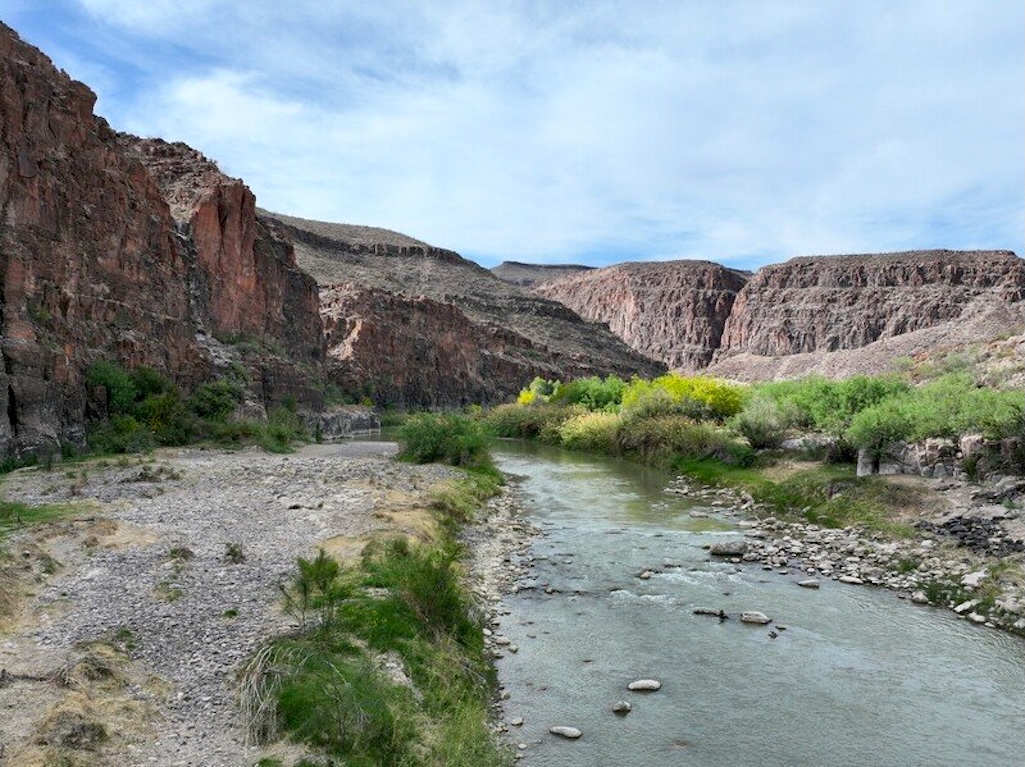
A lawsuit has been filed to block the Department of Homeland Security (DHS) from building a border wall through the Big Bend region of Texas, arguing that the government unconstitutionally waived environmental regulations and laws to fast-track the construction.
“The Department of Homeland Security has unconstitutionally gutted our nation’s bedrock environmental laws to build a wildlife-killing wall that would permanently lock away the Rio Grande,” said Laiken Jordahl, national public lands advocate at the Center for Biological Diversity. “This is straight out of the playbook they used in Arizona, where federal contractors blew up sacred Indigenous sites, bulldozed canyon walls and drained precious aquifers to build border walls. They’re trying to slam an iron curtain through the Big Bend region, gouging a wound that will never heal into one of America’s most beautiful wild places.”
The lawsuit was filed Thursday by the Center, Friends of the Ruidosa Church, and a Big Bend-area river guide and landowner.
The proposal by Customs and Border Protection (CBP) earlier this year to build a bollard wall along the United States' boundary with Mexico that runs through Big Bend National Park and the Rio Grande Wild and Scenic River in Texas similar to that in Organ Pipe Cactus National Monument in Arizona outraged local officials in Texas and raised questions of what impacts such a project might have on the sprawling park in West Texas.
Last fall DHS "waived federal procurement laws for border construction across the entire U.S.-Mexico border, including Big Bend Ranch State Park and Big Bend National Park," said the Center. "In February 2026 the agency issued a separate waiver of environmental, cultural resource and other laws to fast-track wall construction in the Big Bend region."
CBP has not officially commented on what sort of border barrier it intends to build through Big Bend National Park, leading to speculation that it might rely on technology, rather than a physical barrier, to monitor the border in the park.
Bob Krumenaker, a long-time National Park Service employee who retired in 2023 as Big Bend's superintendent, has said there's "already considerable detection technology within the national park."
"The existing systems have worked really well," Krumenaker told the Traveler earlier this year. "In fact, Big Bend National Park is the quietest section of the entire US-Mexico border, and it has nothing to do with the fact that it's a national park. It has to do with the fact that it is the most isolated and most difficult terrain to reach in Mexico."
On Thursday he welcomed the lawsuit.
"I applaud the Center for Biological Diversity and the local plaintiffs in the Big Bend area for filing this suit. While DHS' waiver of all the environmental laws does not — yet— extend downstream to Big Bend National Park, their waiver of the federal laws requiring competition and public disclosure of contracts to build the so-called 'smart wall' does include the national park," said Krumenaker in an email.
"DHS' declaration that the Big Bend area is one of 'high illegal entry,' which is required to justify these waivers, is simply not supported by the facts, and we look forward to the courts examining the actual facts on the ground, quickly we hope," he added. "Big Bend National Park, in fact, has the lowest number of migrant apprehensions of any place on the entire southern border. But since DHS says they want to begin construction soon, time is of the essence for the courts to intercede if the political process can't."
In addition to his past role as Big Bend's superintendent, Krumenaker now chairs Keep Big Bend Wild, a grassroots organization fighting the wall. Keep Big Bend Wild is looking beyond the wall fight, supporting an official wilderness designation for the still-undeveloped four-fifths or more of the national park, which will help keep any wall from ever being built there.
According to a release from the Center, "[A] border wall would sever public access to the Rio Grande, devastating the region’s river outfitters, its recreation economy, dark skies, and natural and cultural heritage. It would also split wildlife populations, including black bears and Carmen Mountains white-tailed deer, leaving populations isolated and vulnerable to decline."
“This place isn’t just where I work, it’s where I’ve built my life and raised my kid. We call the Rio Grande our cathedral,” said Billy Miller, a professional river guide and landowner in Redford, Texas. “I’ve spent more than two decades guiding on the river, and if a border wall cuts off access, that’s the end of my career. No one comes to Big Bend to see steel walls and razor wire. If they build this, they’re not just destroying a landscape, they’re wiping out our way of life.”
The Center's lawsuit (attached below) maintains that DHS needs "clear congressional approval for actions with vast economic and political consequences."
“The federal government is operating with zero regard for the damage a new border wall would bring to Big Bend,” said Rochelle M. Garza, president of the Texas Civil Rights Project. “If the moves DHS has publicly made can be deemed unconstitutional, that inspires little confidence in the ethics of decisions being made behind closed doors. On behalf of all who enjoy its grandeur, Big Bend locals and advocates are demanding clarity and fighting to protect the lands they know best.”

Stories about:
Story Categories:
A copy of National Parks Traveler's financial statements may be obtained by sending a stamped, self-addressed envelope to: National Parks Traveler, P.O. Box 980452, Park City, Utah 84098. National Parks Traveler was formed in the state of Utah for the purpose of informing and educating about national parks and protected areas.
Residents of the following states may obtain a copy of our financial and additional information as stated below:
- Florida: A COPY OF THE OFFICIAL REGISTRATION AND FINANCIAL INFORMATION FOR NATIONAL PARKS TRAVELER, (REGISTRATION NO. CH 51659), MAY BE OBTAINED FROM THE DIVISION OF CONSUMER SERVICES BY CALLING 800-435-7352 OR VISITING THEIR WEBSITE. REGISTRATION DOES NOT IMPLY ENDORSEMENT, APPROVAL, OR RECOMMENDATION BY THE STATE.
- Georgia: A full and fair description of the programs and financial statement summary of National Parks Traveler is available upon request at the office and phone number indicated above.
- Maryland: Documents and information submitted under the Maryland Solicitations Act are also available, for the cost of postage and copies, from the Secretary of State, State House, Annapolis, MD 21401 (410-974-5534).
- North Carolina: Financial information about this organization and a copy of its license are available from the State Solicitation Licensing Branch at 888-830-4989 or 919-807-2214. The license is not an endorsement by the State.
- Pennsylvania: The official registration and financial information of National Parks Traveler may be obtained from the Pennsylvania Department of State by calling 800-732-0999. Registration does not imply endorsement.
- Virginia: Financial statements are available from the Virginia Department of Agriculture and Consumer Services, 102 Governor Street, Richmond, Virginia 23219.
- Washington: National Parks Traveler is registered with Washington State’s Charities Program as required by law and additional information is available by calling 800-332-4483 or visiting www.sos.wa.gov/charities, or on file at Charities Division, Office of the Secretary of State, State of Washington, Olympia, WA 98504.
INN Member

The easiest way to explore RV-friendly National Park campgrounds.

Here’s the definitive guide to National Park System campgrounds where RVers can park their rigs.
Our app is packed with RVing- specific details on more than 250 campgrounds in more than 70 national parks.
You’ll also find stories about RVing in the parks, tips helpful if you’ve just recently become an RVer, and useful planning suggestions.

