

You can learn all sorts of interesting tidbits when you take a guided tour in a national park, or when you wander a museum within a unit of the National Park System. You can also learn things by reading NPS Instagram and Facebook posts. If you’ve ever wondered where I get my information for these Traveler quiz and trivia pieces, now you know.
1. Driving at night or during the pre-sunrise hours of the morning in Yellowstone National Park, you might notice the eerie yellow or red glow coming from a pair of bright circles on or just off the road. That glow comes from the eyes of such wildlife like deer, elk, raccoons, and coyotes.
Bison, however, do not have this characteristic “eyeshine” at night, so they are much more difficult to spot in the dark. This is because their eyes have a significantly reduced _____.
a) Rod density
b) Tapetum lucidum
c) Fovia centralis
d) Pars optica retinae

2. If you’ve ever visited Yellowstone, you’ve probably wandered along the Fountain Paint Pot Trail or Artists Paintpots Trail and have viewed the colorful, bubbling, belching mud bubbles rising and plopping in a liquidy vat of mud. The colors come from minerals in the rocks. Iron sulfate in the rock tints the mud yellow, iron oxides create shades of red, and ___ create black/gray/brown colors.
a) Iron sulfide
b) Manganese
c) Sulfur
d) Silica

3. Yosemite is home to ___ Traditionally Associated American Indian tribes.
a) Five
b) Seven
c) Nine
d) Eleven

4. Visit Zion National Park in Utah and you might come across a Steller’s jay. These beautiful birds live in the park year-round. True or false: Steller’s jays are carnivores.
a) True
b) False
5. True or False: some snakes can actually change colors.
a) True
b) False

6. Honeypot ants (genus Myrmecocystus, specifically M. mexicanus) that you might see on the ground at Joshua Tree National Park in California are specialized desert insects that store food in their abdomens to survive droughts. These ants, often found near Keys View, create ___ that hang from nest ceilings which provides sugary sustenance to the colony during dry, harsh conditions.
a) Formacaries
b) Sugar ceilings
c) Repletes
d) Food sacs

7. How many of you have walked the trail to Little Hebe Crater (located near the larger Ubehebe Crater) at Death Valley National Park in California? True or False: This crater is special because it was created by an asteroid impact.
a) True
b) False
8. The most abundant rock in Yellowstone National Park is ___.
a) Diorite
b) Granite
c) Basalt
d) Rhyolite

9. True or false: Just like giant sequoia trees, the only way lodgepole pines can reproduce is with high temperatures caused by fire.
a) True
b) False
10. Despite the fact that wetlands cover only ___ of the park, wetlands in Rocky Mountain National Park are habitat for approximately 32 percent of park plant species (including approximately 65 percent of rare plant species). Forty-five percent of park birds and 20 percent of mammals use wetlands for key events like foraging and reproduction. Some of the most iconic animals in the park - like elk, beaver, birds, boreal toads, and cutthroat trout - depend on healthy wetlands.
a) 2 percent
b) 4 percent
c) 6 percent
d) 8 percent
Trivia
Visit a unit of the National Park System and you may notice the list of Native Americans calling these areas their home often has the word “rancheria” in their name (example: the North Fork Rancheria of Mono Indians of California). What is a rancheria? Derived from the Spanish ranchería, this term refers to small, rural settlements or indigenous villages.
According to Google:
Starting around 1902, the U.S. government established rancherias to provide land for small, landless bands of California Indians who were displaced from their traditional lands. Almost all rancherias are located in Northern California, and while the term “rancheria” is often used interchangeably with "reservation" today, historically, rancherias were specifically established to provide small homesteads, whereas traditional reservations were larger land areas. Many, but not all, rancherias are now recognized by the federal government as sovereign, self-governing tribes.

Visit White Sands National Park today and you’ll encounter white sand – a lot of sparkly white sand. Believe it or not, this area was once a wetland!
According to Park Staff:
Long before our sweeping gypsum sand dunes formed around 10,000 years ago, the Tularosa Basin was home to a massive lake surrounded by mud flats and grasslands. This lush watering hole attracted Ice Age mammals including American lions, Colombian mammoths, dire wolves, Harlan’s giant ground sloths, and even humans!
Even as the Ice Age ended and the Tularosa Basin warmed and dried, creating their namesake gypsum dunefield, their [wildlife and human] experiences were cemented in the soil beneath the sand. Today, White Sands is home to the largest collection of fossilized Ice Age mammal footprints in the world.

Yellowstone’s hydrothermal features get their start with heated water from magma just a few miles beneath the Earth’s surface. This magma has fueled three huge eruptions 2.1 million years ago, 1.3 million years ago, and 640,000 years ago, blasting volcanic ash across much of the continental United States.
The central portion of Yellowstone is a caldera (immense depression) resulting from that volcanic explosion 640,000 years ago. There are fractures underlying areas within and around the caldera, which makes it much easier for superheated subterranean water to rise to the surface. This may be the reason that many of the park’s hydrothermal areas lie near such fracture zones.
Should you be worrying about Yellowstone Volcano exploding during your visit to this national park? To paraphrase one of my snowcoach driver/guides during my recent winter trip to Yellowstone: “An explosion of Yellowstone Volcano is definitely not likely and it is not what keeps scientists up at night. Instead, scientists are concerned about unpredicted explosions from geysers or hot springs,” such as the one that occurred at Black Diamond Pool in Biscuit Basin in 2024, while people were wandering the boardwalks around it. Luckily, nobody was injured. Biscuit Basin is closed until further notice.
Quiz Answers
1b
Per Mulqueeny Eye Centers:
In some animals, especially those that go out at night, there is a reflective surface right behind the retina called the Tapetum Lucidum. The purpose of this reflective tissue is to act like a mirror. It reflects light as it enters the eye and allowing the rods and cones located in the retina another chance to pick up the limited amount of light available in dim lighting.
The Tapetum Lucidum is an adaptive feature that developed in animals who were hunters, primarily at night and early dawn when light is dim. Dogs, cats, deer, cattle, horses are a few of the animals who possess this feature.
A bison’s ocular structure is designed to function without the bright, reflective, or "glowing" effect seen in other species. They still have excellent night vision because of the high density of rods and can see movement on the horizon much better at night than humans.
2a and 2b
The dark, gray, and black colors om the bubbling mud pots come from iron sulfide (pyrite), which forms when iron oxides react with sulfur in acidic, low-water environments. Manganese and nickel also contribute to the dark brown/black colors.
3b
Yosemite is home to seven Traditionally Associated American Indian tribes: the Southern Sierra Miwuk Nation, the Bishop Paiute Tribe, the Bridgeport Indian Colony, the Mono Lake Kootzakuka’a Tribe, the North Fork Rancheria of Mono Indians of California, the Picayune Rancheria of the Chukchansi Indians, and the Tuolumne Band of Me-Wuk Indians.
4b False
Steller’s jays are omnivores, meaning they eat whatever food is available: nuts, seeds, bugs, berries. They stash their food in caches to be eaten later.
5a True

Hike around Pinnacles National Park in California during May and you might come across a pretty pink snake. This would be the San Joaquin coachwhip, which changes from its usual brown color to a bright pink in May for the mating season.
6c
Honeypot ants create repletes that hang from nest ceilings and provide sugary sustenance to the colony during dry, harsh conditions.
7b False
Little Hebe Crater was formed when magma rose to meet groundwater, resulting in a dramatic steam eruption that sculpted the landscape.
8d

The most abundant rock in Yellowstone National Park is rhyolite. This rock contains about 75 percent silica. When it reacts with hot groundwater, much of the silica ends up in the water that emerges from hot springs and geysers. If you’ve ever visited the Fountain Paint Pot Nature Trail, you will have noticed dead lodgepole pines near the parking lot. They sort of look like upside down matchsticks, with white tips at the bottoms of their trunks. Called “bobby socks trees,” these dead trees soaked up the silica-rich water, turning the lower portion of the trees white.
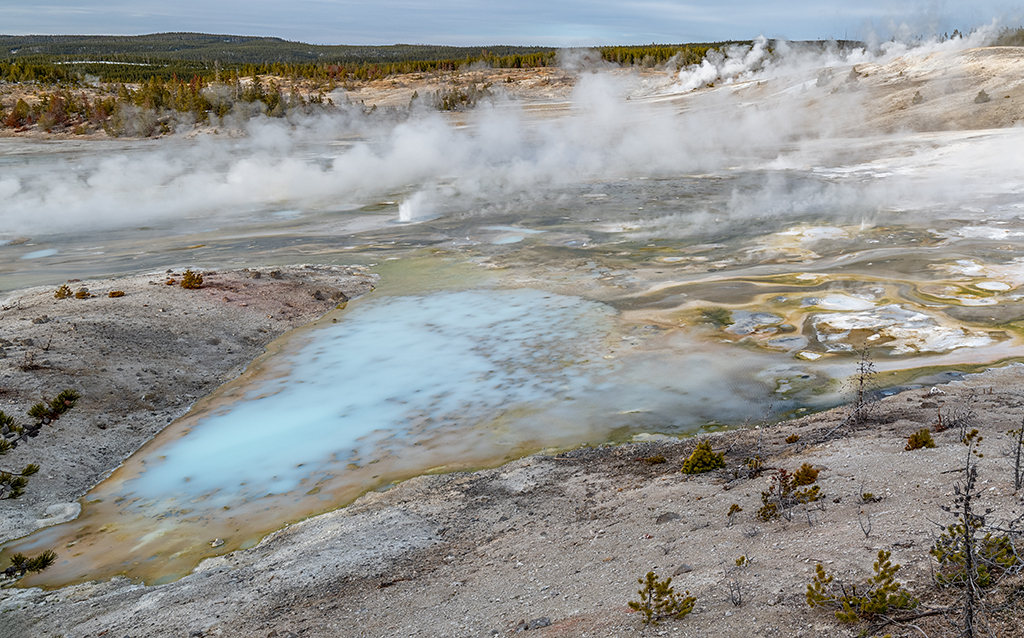
If you’ve ever visited Porcelain Basin, a smaller basin within the larger Norris Geyser Basin complex, you will have seen beautiful, milky-blue pools of water. These pools are saturated with silica, which creates that characteristic blue color from the way sunlight scatters through the silica-rich water.
9b False
According to the NPS:
Lodgepole pines … produce two types of closed cones: serotinous and non-serotinous.
[Serotinous cones are sealed with resin that typically requires temperatures of 115°F to 140°F—often provided by wildfire—to melt, allowing the cones to open and release seeds.]
The bark of lodgepoles is thin, which does not protect the trunks from scorching by fire. They die easily when a fire passes through. However, the serotinous cones give lodgepole pine a special advantage for spreading seeds for the next generation. These cones are closed tight with resin that melts during a fire and releases seeds that have been stored for years. These seeds germinate in conditions that favor the tree’s seedlings, where the forest floor is clear and plenty of sunlight shines through an open canopy. Stand replacement fires in lodgepole pines usually happen every 150 to 400 years, but can be as frequent as 15 years if conditions are dry and windy enough. Due to a warming climate, fires in lodgepole are becoming more frequent and larger.
So, fire is helpful for lodgepole to produce, but it's not necessary for those lodgepole with non-serotinous cones. You’ll find lodgepole pines in many units of the National Park System: Yellowstone, Lassen Volcanic, Grand Teton, Glacier, Crater Lake, Rocky Mountain, and Yosemite national parks, to name just a few.
10b
Wetlands cover only 4 percent of Rocky Mountain National Park.
Stories about:
Story Categories:
A copy of National Parks Traveler's financial statements may be obtained by sending a stamped, self-addressed envelope to: National Parks Traveler, P.O. Box 980452, Park City, Utah 84098. National Parks Traveler was formed in the state of Utah for the purpose of informing and educating about national parks and protected areas.
Residents of the following states may obtain a copy of our financial and additional information as stated below:
- Florida: A COPY OF THE OFFICIAL REGISTRATION AND FINANCIAL INFORMATION FOR NATIONAL PARKS TRAVELER, (REGISTRATION NO. CH 51659), MAY BE OBTAINED FROM THE DIVISION OF CONSUMER SERVICES BY CALLING 800-435-7352 OR VISITING THEIR WEBSITE. REGISTRATION DOES NOT IMPLY ENDORSEMENT, APPROVAL, OR RECOMMENDATION BY THE STATE.
- Georgia: A full and fair description of the programs and financial statement summary of National Parks Traveler is available upon request at the office and phone number indicated above.
- Maryland: Documents and information submitted under the Maryland Solicitations Act are also available, for the cost of postage and copies, from the Secretary of State, State House, Annapolis, MD 21401 (410-974-5534).
- North Carolina: Financial information about this organization and a copy of its license are available from the State Solicitation Licensing Branch at 888-830-4989 or 919-807-2214. The license is not an endorsement by the State.
- Pennsylvania: The official registration and financial information of National Parks Traveler may be obtained from the Pennsylvania Department of State by calling 800-732-0999. Registration does not imply endorsement.
- Virginia: Financial statements are available from the Virginia Department of Agriculture and Consumer Services, 102 Governor Street, Richmond, Virginia 23219.
- Washington: National Parks Traveler is registered with Washington State’s Charities Program as required by law and additional information is available by calling 800-332-4483 or visiting www.sos.wa.gov/charities, or on file at Charities Division, Office of the Secretary of State, State of Washington, Olympia, WA 98504.
INN Member

The easiest way to explore RV-friendly National Park campgrounds.

Here’s the definitive guide to National Park System campgrounds where RVers can park their rigs.
Our app is packed with RVing- specific details on more than 250 campgrounds in more than 70 national parks.
You’ll also find stories about RVing in the parks, tips helpful if you’ve just recently become an RVer, and useful planning suggestions.

