

National parks across the country are preparing for a big year in 2026, bringing with it the 250th anniversary of the United States. The many parks associated with the Revolutionary War are planning unique celebrations to help visitors understand not only historic battles but the lives behind them.
While the country will be focusing on 2026 for its celebrations, considering that the signing of the Declaration of Independence happened on July 4, 1776, parks associated with the Revolutionary War will host multiple celebrations over the coming years to mark important battles, British surrenders, and other historical moments.
Across the National Park System, more than 50 units claim some connection to the Revolutionary War, from Acadia National Park in Maine and Cowpens National Battlefield in South Carolina to Independence National Historical Park in Philadelphia and Valley Forge National Historical Park in Pennsylvania. Some have only tenuous connections — at Acadia, Francis Bernard, the British governor of Massachusetts, tried to gain ownership of Mount Desert Island in 1760, an effort ended by the war — but many others hold incredible stories of the war for independence.
Saratoga National Historical Park, for example, was the site of two intense battles: an eight-mile retreat and a three-day siege in 1777, after which British General John Burgoyne surrendered his entire force, marking the first ever surrender of a British Army. This means that the park will be focusing much of its energy on the 250th anniversary of that surrender in 2027.
“One of the things that will come out of the 250th is a realization for Americans of just how long this struggle for independence was,” explained Garrett Cloer, program manager for interpretation and visitor experience at Saratoga. “Even just leaving out all the continuing challenges and efforts to reach those ideals of the founding, just the war itself was eight years, and it was the longest war in American history until the Vietnam War. And I don't think there's an appreciation of that.”
“If you pick any list of two or three of the most important battles or events during that eight-year-long war, Saratoga is going to be on that list, for the military importance, as well as for its part in cementing that French alliance that enables the Americans to win the war,” continued Cloer. “We think that it's certainly a place and a story that's worth waiting a year to celebrate.”
Ultimately, the park is interested in helping visitors see the lives behind the battles.
“What [were] the impacts on the people that were living here? Who were the people that were participating in these battles?” asked Cloer. These kinds of questions have been guiding the planning process for the celebrations, which began in 2021.
The park is also taking the opportunity to deepen ties with the Indigenous nations that participated in the battles. “This being the land, traditionally, of the Mohawk and Mohican people, we wanted to try to either reestablish ties or deepen the ties with those nations that already existed,” explained Cloer.

For Saratoga, like many historical battlefields, size is an issue. Saratoga is used to receiving approximately 100,000 people each year, which translates to a few hundred people each day. During anniversary celebrations, visitation is expected to far exceed that number.
While the park has faced infrastructure challenges related to hosting such large events in the coming years, those same challenges have helped propel needed park improvements. Cloer pointed out that as the big anniversary approached, the park received a Great American Outdoors Act (GAOA) grant to redo the stops on the park’s tour road, making them fully accessible. The funding also allowed them to put all new interpretive way signs throughout the battlefield.
September 2027 will mark the start of the important celebrations at Saratoga, though the park isn’t quite ready to share details for individual events. As planning continues, Park Service staff are working closely with Saratoga County, New York State, and even the Army. They’re also collaborating with other national park sites, including Fort Stanwix National Monument and Minute Man National Historical Park, which completed its own big anniversary event in 2025.
Minute Man is the site of the opening battle of the Revolutionary War, which took place on April 19, 1775. The park’s big anniversary event this past April drew thousands of people from all over the world.
“It was really quite a sight,” said Jim Hollister, a park ranger at Minute Man.
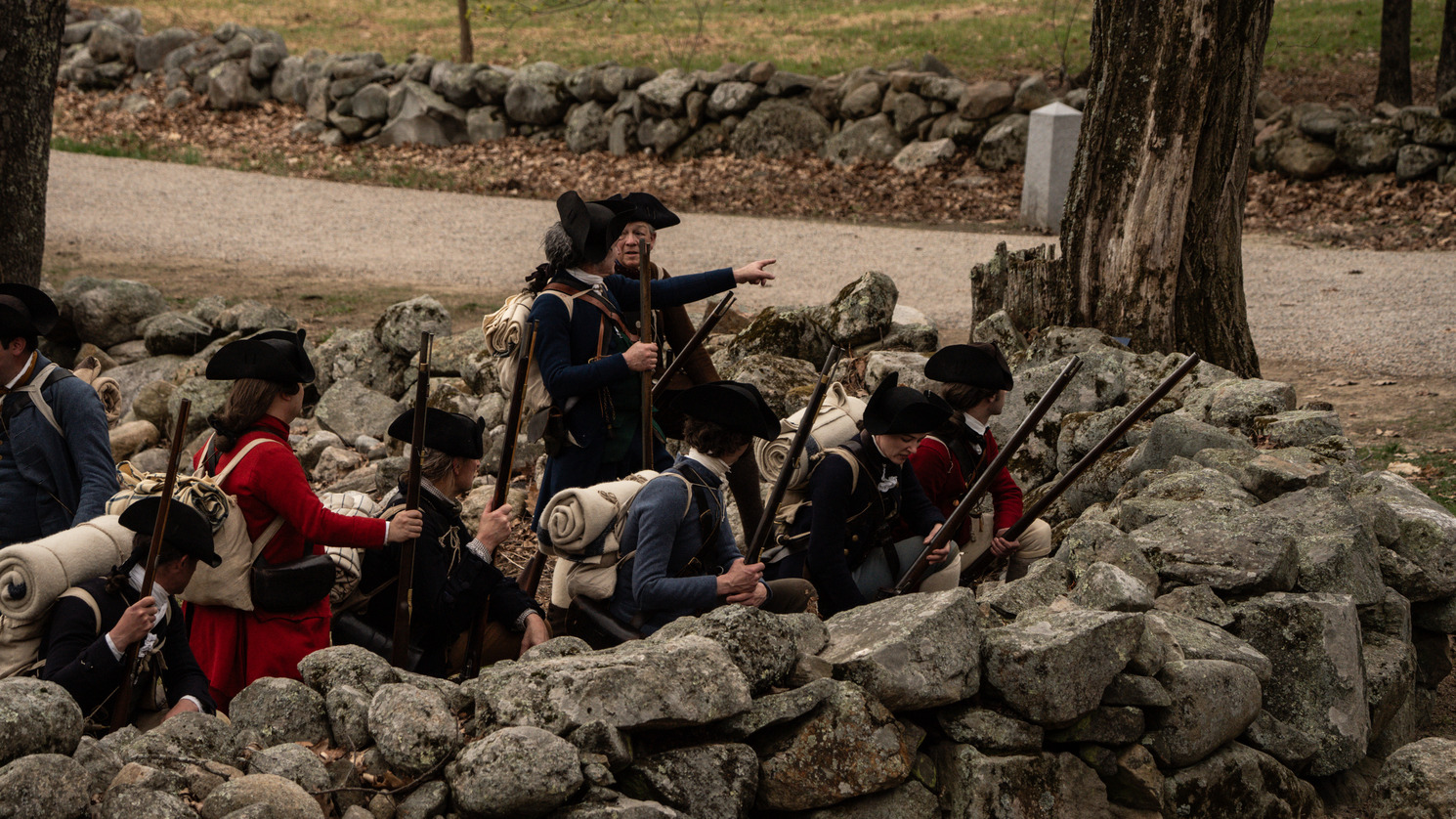
The park will continue its celebrations this year, with special events to mark the progression of the Siege of Boston, which lasted until March 1776. The park will host artillery demonstrations and, like Saratoga, present information about what was going on amongst the people that were in the countryside during the siege.
“What we want to do is approach it from the lived experience, what everyday people were going through, what they were wrestling with, their hopes, their fears, because the only thing that separates us from them is time,” explained Hollister. “I think there's a lot of ways that we can connect with the people of the past through really understanding their narratives.”
For the country’s big day on July 4th, the park plans to continue its tradition of reading the Declaration of Independence at the North Bridge, which is often considered the location where the Revolutionary War began, as the first shots of the war were fired here on the morning of April 19, 1775.
This year the reading will take place at sunset and will be followed by a nighttime artillery firing to mimic a feu de joie, French for “fire of joy.”
“It’s a manner of saluting or marking a celebratory occasion where you have your artillery and your infantry firing off, going down on the line or working into the center and then back out to the flanks, and it's really spectacular,” said Hollister. “To do that at night, where you can see the muzzle flashes and hear the roar and the crack of the muskets, is really going to be something else.”
Hollister says that he hopes people will come away from the anniversary events with a newfound appreciation for their colonial forebearers. “From an interpreter's point of view, I want them to take away a sense of being able to relate to those who are here at the birth of our republic and to understand them in their time, and to feel that they have a part in the story, too.”
Other parks are offering their own unique approaches to the anniversary. In Virginia at Colonial National Historical Park, home to the site of the last major battle of the Revolutionary War, the Park Service has introduced the 250 Adventure Ranger Program, an initiative inspired by the popular Junior Ranger program.

“This interactive quest invites families and friends to embark on a journey through Virginia’s rich revolutionary history, visiting historic sites across the Tidewater region,” explained a spokesperson for the park. “Participants will complete challenges, collect stamps, and deepen their understanding of the people and places that defined America’s fight for independence. Those who collect all 25 stamps will earn a special commemorative medallion—a tangible symbol of their connection to this historic milestone. More than just a fun activity, this program fosters stewardship, civic awareness, and a sense of pride in our shared heritage.”
At George Rogers Clark National Historical Park, where the American army, aided by French residents of the Illinois country, secured a key victory in 1779 and assured United States claims to the frontier, plans are still in the works for July 4th, though the park notes that its location in Indiana makes it an important site for celebrations.
“The American Revolution is often seen as an Eastern conflict between England and the American colonies. The war’s effect goes well beyond the original 13 colonies into what was then regarded as the frontier,” explained a park spokesperson. “It also included French, Spanish, and Native people who inhabited much of the land west of the Appalachians. Many people are surprised by the scope and size of the war. Better understanding this aspect of the story can connect people to the events.”
Events at sites marking important moments in the American Revolution will offer visitors unique opportunities in 2026 and well beyond. Many parks are planning events that extend as far as 2033, which marks the 250th anniversary of the Treaty of Paris that officially ended the Revolutionary War. The parks will continue posting updates on upcoming events on their respective sites.
Related stories from the Traveler’s archives:
The Ex-Soldier Who Bought a Battlefield
Historic Oath of Allegiance Comes Home to Valley Forge National Historical Park
Farm Dating To Revolutionary War Added To Minute Man National Historical Park In Massachusetts
At Cowpens National Battlefield, Site Restoration Helps Take You Back to 1781
Battling Invaders With Fire At National Battlefields
Traveler's Checklist: Guilford Courthouse National Military Park
Ground Broken For Bicentennial Bell In Philadelphia
Two National Park Sites Appear On "Most Endangered" List Of Historic Places
Taking The Road To Parks Less Traveled
A Royal Bell Will Soon Anchor One of Philadelphia’s Hidden Gardens
Two Freedom Trails Of Boston: Urban National Parks
NPS Discovers Nearly 250-Year-Old Musket Balls from ‘Shot Heard Round the World’
Exploring The Parks: General Washington's Headquarters At Morristown
Story Categories:
A copy of National Parks Traveler's financial statements may be obtained by sending a stamped, self-addressed envelope to: National Parks Traveler, P.O. Box 980452, Park City, Utah 84098. National Parks Traveler was formed in the state of Utah for the purpose of informing and educating about national parks and protected areas.
Residents of the following states may obtain a copy of our financial and additional information as stated below:
- Florida: A COPY OF THE OFFICIAL REGISTRATION AND FINANCIAL INFORMATION FOR NATIONAL PARKS TRAVELER, (REGISTRATION NO. CH 51659), MAY BE OBTAINED FROM THE DIVISION OF CONSUMER SERVICES BY CALLING 800-435-7352 OR VISITING THEIR WEBSITE. REGISTRATION DOES NOT IMPLY ENDORSEMENT, APPROVAL, OR RECOMMENDATION BY THE STATE.
- Georgia: A full and fair description of the programs and financial statement summary of National Parks Traveler is available upon request at the office and phone number indicated above.
- Maryland: Documents and information submitted under the Maryland Solicitations Act are also available, for the cost of postage and copies, from the Secretary of State, State House, Annapolis, MD 21401 (410-974-5534).
- North Carolina: Financial information about this organization and a copy of its license are available from the State Solicitation Licensing Branch at 888-830-4989 or 919-807-2214. The license is not an endorsement by the State.
- Pennsylvania: The official registration and financial information of National Parks Traveler may be obtained from the Pennsylvania Department of State by calling 800-732-0999. Registration does not imply endorsement.
- Virginia: Financial statements are available from the Virginia Department of Agriculture and Consumer Services, 102 Governor Street, Richmond, Virginia 23219.
- Washington: National Parks Traveler is registered with Washington State’s Charities Program as required by law and additional information is available by calling 800-332-4483 or visiting www.sos.wa.gov/charities, or on file at Charities Division, Office of the Secretary of State, State of Washington, Olympia, WA 98504.
INN Member

The easiest way to explore RV-friendly National Park campgrounds.

Here’s the definitive guide to National Park System campgrounds where RVers can park their rigs.
Our app is packed with RVing- specific details on more than 250 campgrounds in more than 70 national parks.
You’ll also find stories about RVing in the parks, tips helpful if you’ve just recently become an RVer, and useful planning suggestions.

