

On Saddle Island, a new boardwalk snakes between a memorial to the Basque men who came to Labrador to hunt whales and a reconstructed tryworks where blubber was rendered to produce the oil that once lit the lamps of Europe.
Across the harbor in the town of Red Bay, the Red Bay National Historic Site visitor center is finally open and showcases a 400-year-old wooden whaling boat called a chalupa.
What a difference $6.2 million makes.

That’s the amount of federal funding (in Canadian dollars) pumped into the site to renew how Parks Canada tells 70 years of whaling history from the mid-16th century.
Of that, $3.6 million went towards new interpretive offerings and interactive exhibits. The other $2.6 million was used to amalgamate visitor orientation and interpretation centers to reduce the site’s environmental footprint with one new visitor center.
“It’s quite impressive and has much, much different things than we had previously from the early 90s,” says Loretta Decker, acting manager for national historic sites and visitor experience for two field units in Newfoundland and Labrador. “I’m quite pleased with it.”

Red Bay draws about 13,000 visitors a year, a decent number for such a remote site.
I first visited in July 2023, driving around the island of Newfoundland to learn about Vikings at L’Anse aux Meadows National Historic Site and limestone barrens at Port au Choix National Historic Site. Then I hopped a ferry to Quebec in mainland Canada and drove 50 miles north into Labrador to Red Bay.
Ferry tickets, lodging and restaurants were limited, but it was worth it to see the world’s most complete example of early industrial-scale whaling. The Parks Canada site is part of the larger Red Bay Basque Whaling Station, a UNESCO World Heritage Site that includes bluffs, islands, shoreline and a buffer zone in case of future archaeological finds.
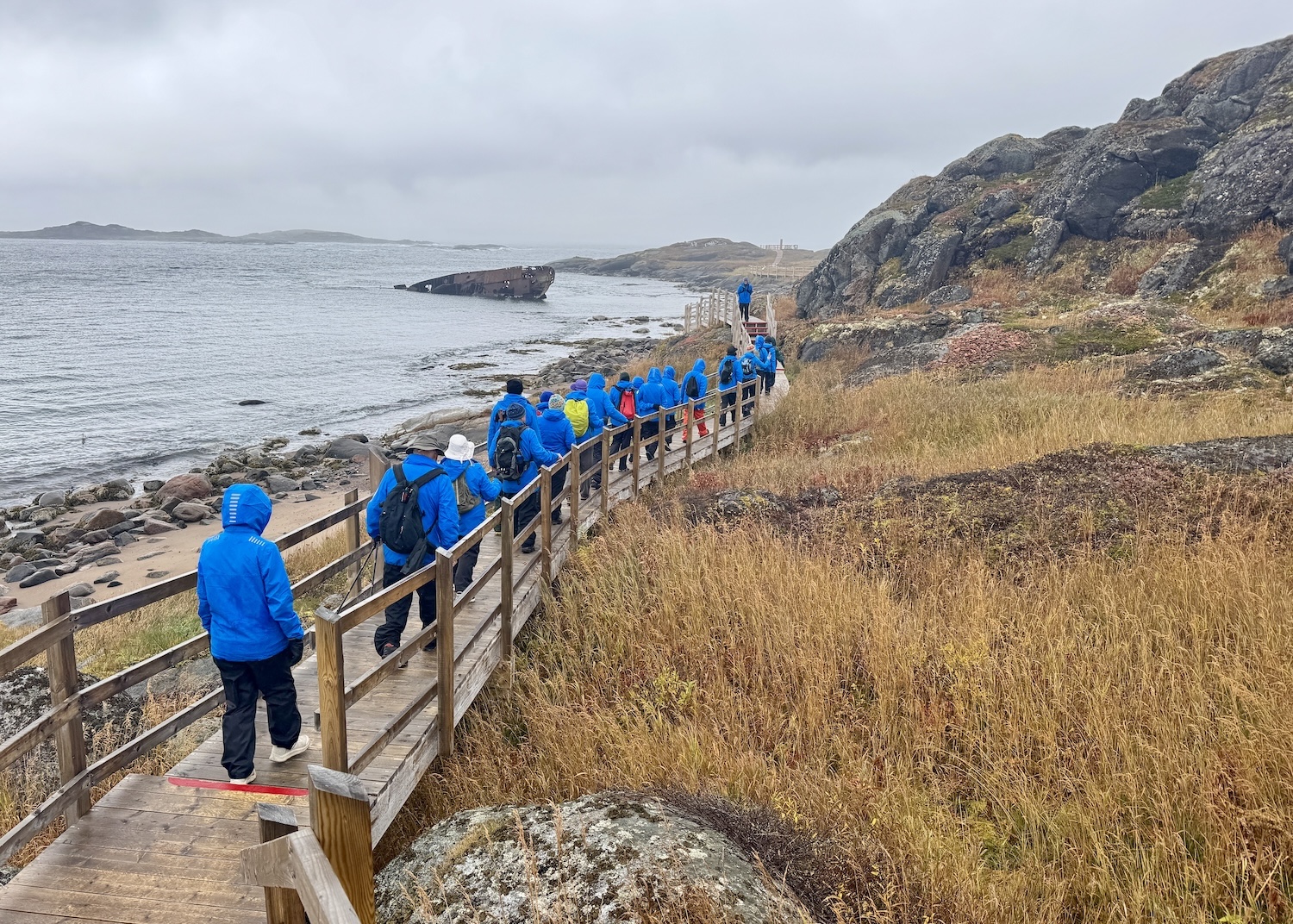
Two years later, I finally returned in early October, this time on an Adventure Canada expedition cruise that circumnavigated Newfoundland and made one quick stop in Labrador after two days exploring Gros Morne National Park.
Red Bay had just closed for the season, but Parks Canada reopened to welcome 200 passengers from our small ship. The town — whose population hovers around 143 — received us at the floating dock and the Whalers Restaurant served fish and chips made with local cod.
High winds almost scuttled our landing. It was so tough to step into bobbing Zodiacs tied to the ship that we were warned the outing would be just for the truly adventurous. We raced to Saddle Island for guided tours and then to town to wander freely, hoping the weather wouldn't worsen and cause the captain to blast the horn for an immediate return to the ship.

“In a tiny fishing village in Labrador, the story of the heyday of Basque whaling is told through ancient whale bones and terracotta tile fragments that still lie scattered along the coastline. But, to be honest, you really need a good imagination to fill in some of the blanks.”
That’s what I wrote in 2023. Now, thanks to that government funding, wisely spent, the story is getting easier to visualize.

“This is a good day to explain the story to people,” heritage presenter Elsie Jones said as she guided one of our groups around Saddle Island that cold and drizzly day. “We’ve got double layers. They only had one layer with a big pair of socks on with what we call short pants. Just think about it — what it would be like. They were hardy people and they just worked themselves to death.”
Jones detailed how the Basque sailed galleons across the Atlantic Ocean each spring from the 1540s to early 1600s in search of North Atlantic right and bowhead (Greenland right) whales that migrate through the Strait of Belle Isle.
They wanted whale oil, which burned brighter than vegetable oil and could also be used for soap, paint and varnish. They also collected baleen — fringed plates that hang in the mouths of filter-feeding whales — for things like corsets and hoop skirts.

Now Parks Canada makes sure to convey that Indigenous Peoples — from the Maritime Archaic to the modern Innu — have lived in this area for more than 6,000 years, and used animal oils to produce heat and light and baleen for things like tools, baskets and roofing.
The whales were 70 feet long, slow swimmers and easy to harpoon. “They were so big, they’d float like balloons,” said Jones. “They would tie them on the tail and roll them in here like a school bus.”
Basque crews created shore stations with wharf-like structures, tryworks with large copper cauldrons to render blubber into oil, and cooperages to reassemble barrels to store the oil. “Once they started cooking, it would be 48 to 72 hours, non-stop for a big whale,” said Jones in a reconstructed tryworks. “One 70-foot whale, the size of a school bus, could produce 60 to 90 barrels of oil.”

Open-air shelters were topped with red clay tiles brought over as ballast to give stability to the whaling ships. Fragments are still scattered throughout the area, as are whale bones that locals once unwittingly salvaged for everything from “sled runners and walking sticks to materials for making art,” according to Parks Canada.
“Please do not remove them or any other evidence of our heritage,” interpretive signs plead.
The late British-Canadian historian/geographer Selma Barkham connected the dots between these roofing tile remnants and Spanish archival documents describing 16th-century Basque whaling. Her discovery sparked archaeology work on land and in the sea that found several galleons, thousands of artifacts and a harbor full of whale bones. It paved the way to making Red Bay a UNESCO-approved place of international significance.

Strolling along more than a mile of boardwalk, before checking out the wilder backside of Saddle Island, we were asked to imagine the Basque whalers. “You’ve got to take away the boardwalk and imagine what it would have been like in the 1500s,” said Jones. “When you go to our museum and see the clothes and boots they wore on a day like today, it wasn’t very good.”
We heard how an oil barrel-laden galleon believed to be the San Juan was driven ashore by a storm and sank over a chalupa in 1565. Underwater archaeologists disassembled and recorded the galleon's remains, then reburied them under a protective covering at the original site.
They shared their findings with Basque shipbuilders, who’re now making a replica of the ship (known by archaeologists as 24M or the presumed San Juan) in Pasaia. Once it passes sea trials, the ship will sail here and spark a bonanza of attention for Red Bay. You can hear a recording of the passionate galleon builder Xabier Agote as part of a "Perspectives on This Place" exhibit at the visitor center.

Parks Canada’s Wanita Stone traveled to Spain nearly a decade ago while she was mayor to check in on the galleon project and hammer two nails into the ship. “She showed me where,” confided Jones with a chuckle. “If it leaks it’s your fault, I said.”
As for the sunken chalupa — an ingenious wooden row boat that held a seven-man whaling crew — it was well protected and preserved by the icy waters and blanketing silt. It was removed, plank by plank, sent to Ottawa for restoration and then eventually returned to Red Bay for display.
I didn’t get to see the new corten steel sculpture of a chalupa crew, but did see the Saddle Island hill where it was placed a few days after my visit. It’s at a spot once used as a whale lookout and it's close to an unmarked cemetery for more than 140 whalers who got caught here one winter. It should be said that bowhead and North Atlantic right whales are now endangered and rarely seen.

Water taxis usually ferry visitors between town and Saddle Island as part of the price of admission to the national historic site, but we came with our own fleet of Zodiacs. As Jones saw our group off, she said “you’ll have to come back. If it’s not on a ship, come on a bus.”
Up to 25 cruise ships can visit Red Bay each year and the town welcomed 12 in 2025. L’Anse aux Meadows (which isn’t far away by sea) gets about 35 ships at its two ports, so there’s room to piggyback on its popularity. Red Bay also attracted 160 bus tours plus walk-ins this year.
“There’s increased interest in Labrador and we’re also seeing an uptick in RV traffic,” noted Decker, who said people are already bringing picnics and staying longer on Saddle Island thanks to the stroller-friendly and more accessible boardwalk.

On shore, the “Red Bay and the Whale” exhibit has moved into a waterfront building run by the town. While Parks Canada focuses on the whalers, this exhibit tells the story of the whales and features the articulated skeleton of a bowhead whale.
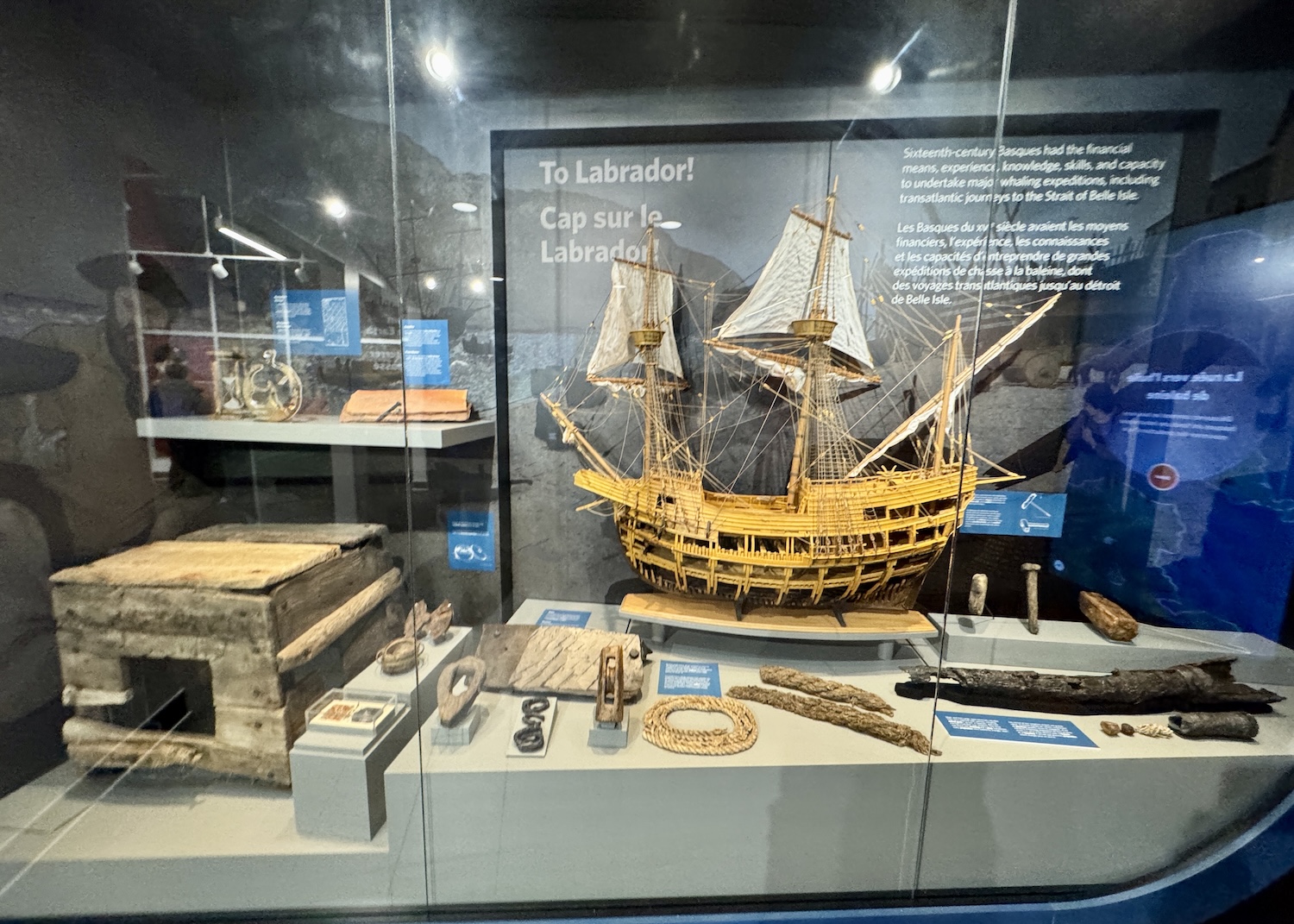
At the sun-splashed visitor center, some terrestrial and underwater artifacts discovered during excavations are being displayed publicly for the first time. Others are being displayed in more impactful ways. The chalupa, for instance, is shown in front of an AV presentation that illustrates how whalers hunted from these tiny boats.
I got to chat with Stone, the former mayor who I first met in 2023, as well as Parks Canada's Karen Buckle and Dennis Yetman, who summered on Saddle Island as a child when his father was lightkeeper.
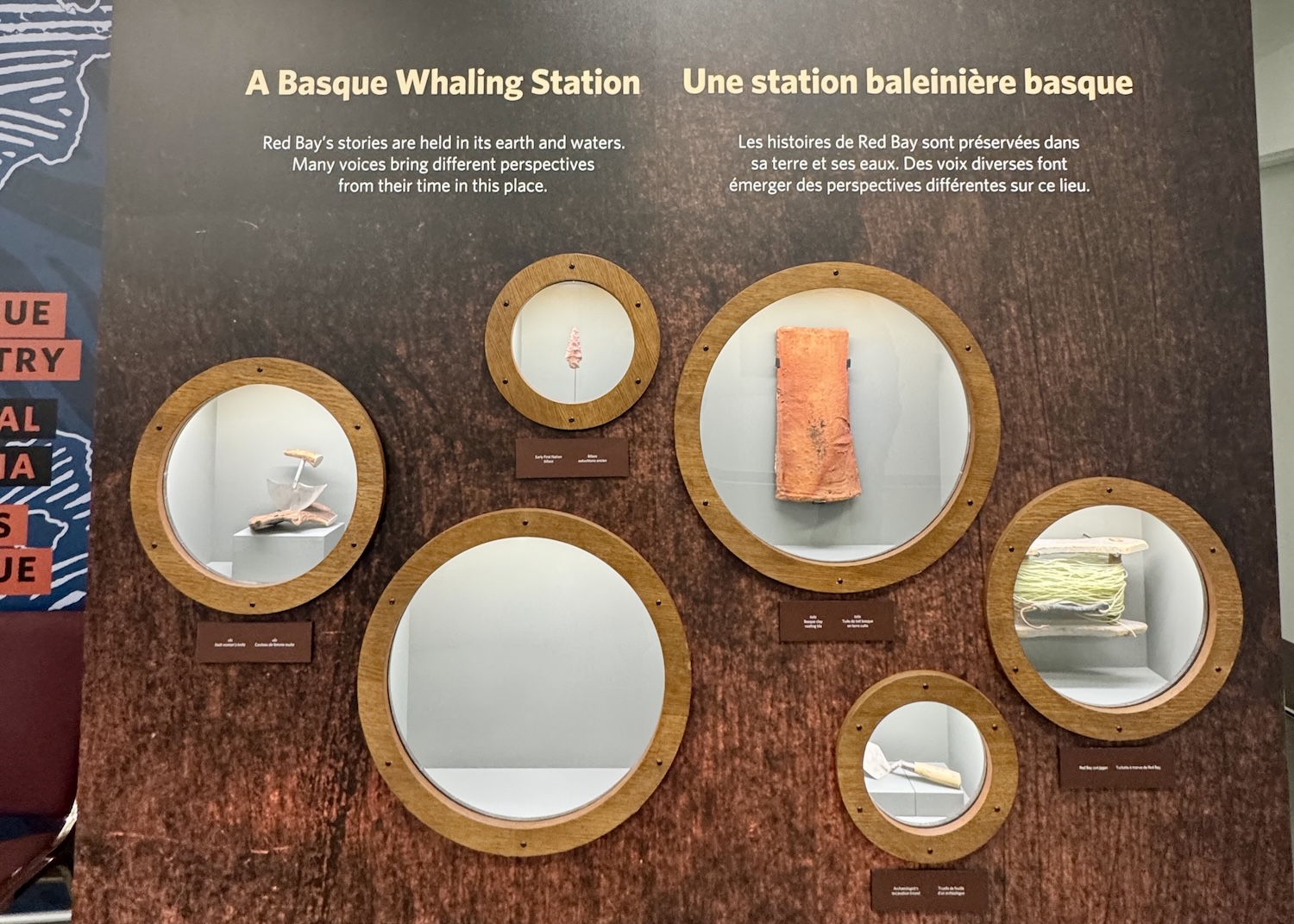
Interesting signage delves into an issue that museums everywhere are grappling with. “Out of respect for the deceased and any descendants, Parks Canada no longer displays human remains, objects, photographs or drawings associated with excavated burial sites.”
There was one known victim of the sunken San Juan — a black rat. Some of the poor creature's bones used to be displayed in a dish, but nobody really understood what it was. Now thanks to a 3D printer, the rat has been fully reassembled and deemed fit for display.
The only catch? It wasn’t ready until just after my visit so I'll have to wait to see it when Red Bay reopens next June.
Stories about:
Story Categories:
A copy of National Parks Traveler's financial statements may be obtained by sending a stamped, self-addressed envelope to: National Parks Traveler, P.O. Box 980452, Park City, Utah 84098. National Parks Traveler was formed in the state of Utah for the purpose of informing and educating about national parks and protected areas.
Residents of the following states may obtain a copy of our financial and additional information as stated below:
- Florida: A COPY OF THE OFFICIAL REGISTRATION AND FINANCIAL INFORMATION FOR NATIONAL PARKS TRAVELER, (REGISTRATION NO. CH 51659), MAY BE OBTAINED FROM THE DIVISION OF CONSUMER SERVICES BY CALLING 800-435-7352 OR VISITING THEIR WEBSITE. REGISTRATION DOES NOT IMPLY ENDORSEMENT, APPROVAL, OR RECOMMENDATION BY THE STATE.
- Georgia: A full and fair description of the programs and financial statement summary of National Parks Traveler is available upon request at the office and phone number indicated above.
- Maryland: Documents and information submitted under the Maryland Solicitations Act are also available, for the cost of postage and copies, from the Secretary of State, State House, Annapolis, MD 21401 (410-974-5534).
- North Carolina: Financial information about this organization and a copy of its license are available from the State Solicitation Licensing Branch at 888-830-4989 or 919-807-2214. The license is not an endorsement by the State.
- Pennsylvania: The official registration and financial information of National Parks Traveler may be obtained from the Pennsylvania Department of State by calling 800-732-0999. Registration does not imply endorsement.
- Virginia: Financial statements are available from the Virginia Department of Agriculture and Consumer Services, 102 Governor Street, Richmond, Virginia 23219.
- Washington: National Parks Traveler is registered with Washington State’s Charities Program as required by law and additional information is available by calling 800-332-4483 or visiting www.sos.wa.gov/charities, or on file at Charities Division, Office of the Secretary of State, State of Washington, Olympia, WA 98504.
INN Member

The easiest way to explore RV-friendly National Park campgrounds.

Here’s the definitive guide to National Park System campgrounds where RVers can park their rigs.
Our app is packed with RVing- specific details on more than 250 campgrounds in more than 70 national parks.
You’ll also find stories about RVing in the parks, tips helpful if you’ve just recently become an RVer, and useful planning suggestions.

