
Editor's note: This updates with information on two hiker deaths.
A summertime hike to the bottom of the Grand Canyon is never just a walk in the park, but trail closures and detours amid construction of a new water pipeline are prompting additional safety concerns this year.
"The main impact is for hikers going to Phantom Ranch because there’s displacement and an alternative reroute," Rob Parrish, chief of planning, environment and projects at Grand Canyon National Park, said in an email.
"Depending on which alternate hikers choose, they may be adding up to 4.5 additional miles to their route."
Two hikers have died in the area in less than two months.
Phantom Ranch is a historic lodging area in the bottom canyon so in demand that people often wait years for reservations. One of the most popular ways to reach Phantom Ranch from the South Rim is a 10-mile route via the Bright Angel Trail, River Trail and Silver Bridge. But the River Trail and Silver Bridge are closed due to the construction.
"Some hikers are choosing to use an alternate route of Bright Angel Trail, Tonto Trail and South Kaibab Trail that is about 12 miles," Parrish said.
Hikers to Phantom Ranch can also take a 7.5-mile route on South Kaibab Trail, Black Bridge and North Kaibab Trail. But that comes with its own challenges.
"While the South Kaibab route is a shorter distance, the only water filling station for South Kaibab Trail is at the trailhead," Parrish said.
A hiker headed to Phantom Ranch died Tuesday on the South Kaibab Trail. In May, a man described as an "avid and experienced" hiker died on the North Kaibab Trail.
Some of the alternate routes are also considered more strenuous. Temperatures at Phantom Ranch can reach 120 degrees in the summer, making challenging terrain and a lack of water an even more dangerous combination.
"It’s always important for hikers to use caution and check the park website for the water availability status of the filling stations at the trailheads and inner canyon before they begin hiking," Parrish said. "There are signs with QR codes at the trailheads that pull up the key hiking updates for closures, weather forecast and water status ... Visitors need to plan to have enough water to safely make it through their hike and have a plan and a contingency plan."
Pipeline breaks and other system issues with the Transcanyon Waterline can also impact the availability of water in the inner canyon, he said. Work started in 2023 to replace the leaky, antiquated water system. The 12.5-mile pipeline was built in the 1960s to carry water from its source at Roaring Springs on the North Rim across to the South Rim. It provides drinking water and fire suppression for all facilities on the South Rim and some inner canyon facilities including more than 800 historic buildings.
But it's been beset by dozens of leaks in recent years and park officials say it's past its useful life. Replacement is expected to take four years and cost more than $200 million.
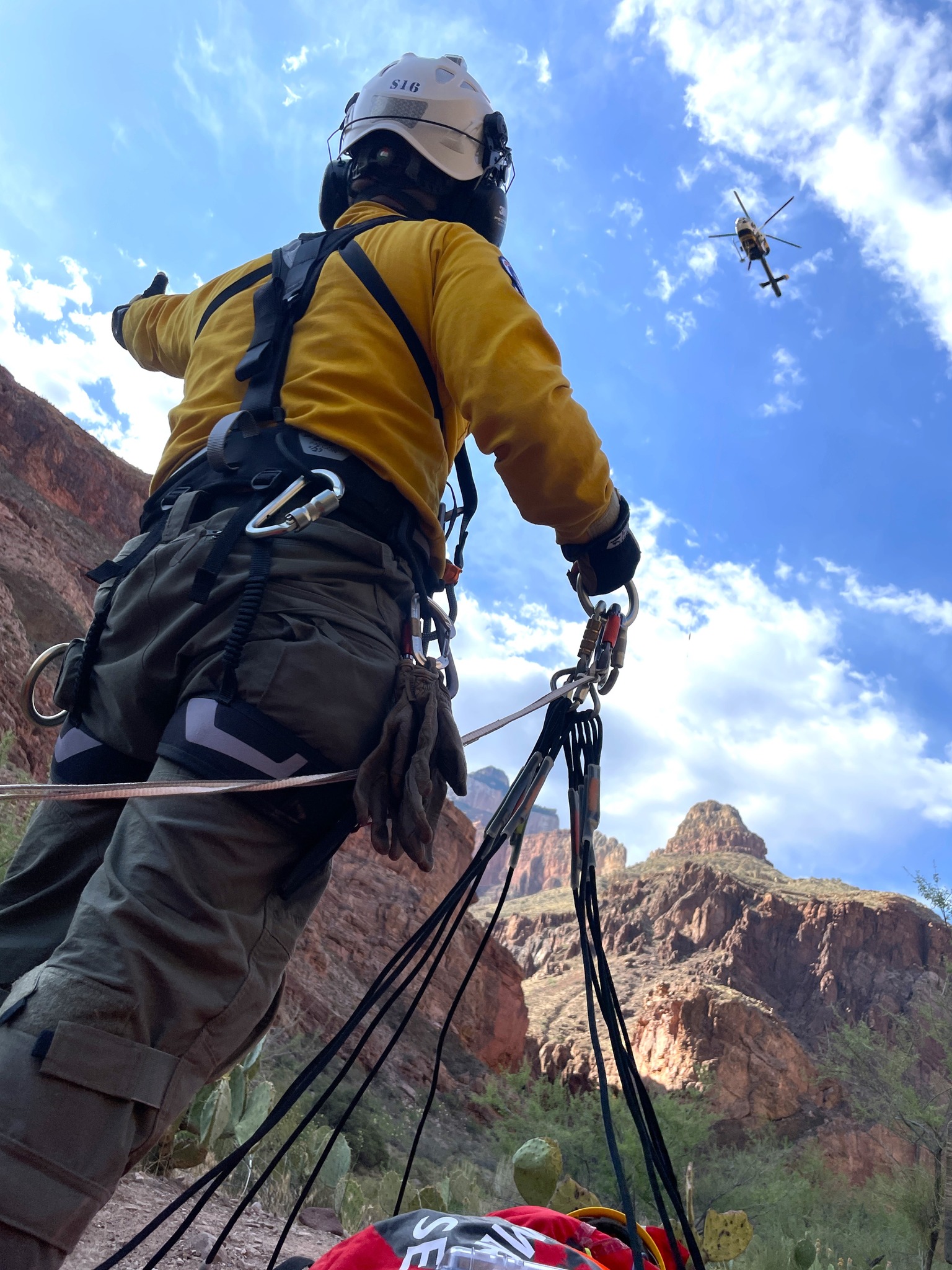
Meghan Smith, preventive search and rescue supervisor for Grand Canyon National Park, told Outside Magazine that the project was creating challenges for rescue personnel and contributed to a string of 13 helicopter rescues in a single week in May .
“Construction on our pipeline has closed key sections of main trails that people would otherwise use as routes in and out of the canyon,” Smith told Outside. “And it’s rerouting people into areas they don’t normally go, which is causing problems for us.”
The park logged 182 search and rescue calls from May 25 to June 24, with 33 of those considered major incidents, according to Parrish. He said the overall number for the year so far was average.
"People are injured or incur a heat related illness nearly every day in the canyon during the summer," Parrish said.
"Also, the search and rescue staff can receive multiple call outs, especially on summer days with high visitation or high temperatures. They must triage and respond accordingly, so visitors need to be prepared to self-rescue."
That's why it's so important for visitors to respect both the weather and their own limitations before venturing into the canyon.
"As part of personal preparation, I’d recommend completing some hikes with your gear and water weight in as many similar conditions as possible," Parrish said. "Remember that there’s about a 20-degree F increase in temperature and elevation difference about 4,500 - 5,850 feet from the rims and Phantom Ranch, and that there’s little to no shade."
He recommends hikers consider breaking their trip into segments around the heat of the day, resting between 10 a.m. and 4 p.m. at Havasupai Gardens, Tip Off, Phantom Ranch, other highly shaded areas or by a creek.
"Beginning before sunrise and using a headlamp is another good option," Parrish said.
Anyone visiting the Grand Canyon should check the park website for the latest updates on weather, trail closures and other important safety information. The Grand Canyon hiking brochure is also an essential reference.
Stories about:
Story Categories:
A copy of National Parks Traveler's financial statements may be obtained by sending a stamped, self-addressed envelope to: National Parks Traveler, P.O. Box 980452, Park City, Utah 84098. National Parks Traveler was formed in the state of Utah for the purpose of informing and educating about national parks and protected areas.
Residents of the following states may obtain a copy of our financial and additional information as stated below:
- Florida: A COPY OF THE OFFICIAL REGISTRATION AND FINANCIAL INFORMATION FOR NATIONAL PARKS TRAVELER, (REGISTRATION NO. CH 51659), MAY BE OBTAINED FROM THE DIVISION OF CONSUMER SERVICES BY CALLING 800-435-7352 OR VISITING THEIR WEBSITE. REGISTRATION DOES NOT IMPLY ENDORSEMENT, APPROVAL, OR RECOMMENDATION BY THE STATE.
- Georgia: A full and fair description of the programs and financial statement summary of National Parks Traveler is available upon request at the office and phone number indicated above.
- Maryland: Documents and information submitted under the Maryland Solicitations Act are also available, for the cost of postage and copies, from the Secretary of State, State House, Annapolis, MD 21401 (410-974-5534).
- North Carolina: Financial information about this organization and a copy of its license are available from the State Solicitation Licensing Branch at 888-830-4989 or 919-807-2214. The license is not an endorsement by the State.
- Pennsylvania: The official registration and financial information of National Parks Traveler may be obtained from the Pennsylvania Department of State by calling 800-732-0999. Registration does not imply endorsement.
- Virginia: Financial statements are available from the Virginia Department of Agriculture and Consumer Services, 102 Governor Street, Richmond, Virginia 23219.
- Washington: National Parks Traveler is registered with Washington State’s Charities Program as required by law and additional information is available by calling 800-332-4483 or visiting www.sos.wa.gov/charities, or on file at Charities Division, Office of the Secretary of State, State of Washington, Olympia, WA 98504.
INN Member

The easiest way to explore RV-friendly National Park campgrounds.

Here’s the definitive guide to National Park System campgrounds where RVers can park their rigs.
Our app is packed with RVing- specific details on more than 250 campgrounds in more than 70 national parks.
You’ll also find stories about RVing in the parks, tips helpful if you’ve just recently become an RVer, and useful planning suggestions.

