

For the past couple of months, I’ve taken a break from the continuing series of photography around Yellowstone National Park’s Grand Loop Road. Now it’s time to resume the journey. What if you only had a day or two to spend in Yellowstone National Park? Where would you go? What would you photograph? You could decide upon a single location in this 2.2-million-acre park and spend most or all your time there, or you could get a nice snapshot of the park’s offerings by driving the Grand Loop Road. This 142-mile (229-kilometer) route provides glimpses into many of Yellowstone’s ecosystems.
What might you see and photograph? This Part 3, along with Parts 1 and 2 published previously, will show you, providing tips for great shots using you own camera, be it smartphone, point-and-shoot, or SLR.
Before we start, here’s a reminder that the route covered in this series does not consider other roads like the northeast route to Lamar Valley, or south toward Grand Teton National Park, or east and west of the Grand Loop.
Here’s another reminder: if you visit Yellowstone in the winter, you will find the Grand Loop Road is closed to private vehicles (except for that portion of the loop route from Mammoth Hot Springs to Tower-Junction). The only way to see more of the sights along the road will be to reserve a spot on a snowcoach tour.
This month’s photo column covers 50 miles (80.5 kilometers) from Grant Village and West Thumb Geyser Basin at the western portion of Yellowstone Lake, all the way up to Norris Geyser Basin.
Approximately seven miles (11.27 kilometers) into your drive, you’ll see the sign marking the Continental Divide, that invisible line of demarcation separating the watersheds flowing west and draining into the Pacific Ocean from those waterways running east, ultimately flowing into the Arctic and Atlantic oceans. Here, you might wish to capture a photo of yourself and/or family standing next to the sign.

Drive 11 miles further and you’ll arrive at the Kepler Cascades view area, where the Firehole River drops 150 feet (45.7 meters) over three tiers of forested outcrops. A series of stairs lead visitors to a small view area of the frothy flowing water named after Kepler Hoyt, the 12-year-old son of Wyoming’s territorial governor, who visited Yellowstone National Park in 1881.
The view area is not that large and gets crowded, so attempting to set up your tripod for a silky water image might be a little problematic. If you use a newer-model iPhone, however, you can capture a regular photo of the cascades and convert it to a silky water iPhone shot. You’ll need to turn on the Live Photo feature when using your camera (it’s the concentric circles icon). Once you capture your flowing water image, go into your photo album, select the photo you just captured, tap that “Live Photo” in the upper left of the screen, and you’ll see a series of choices. Tap “Long Exposure” and a couple of seconds later, you’ll have that satiny-silky water look.

From Kepler Cascades, it’s a little under four miles (6.4 kilometers) to Lower Geyser Basin and Old Faithful. No matter how much or little time you have within the park, this is a definite must-see stop. Of course, you might be challenged locating an open parking space – particularly during the summer – but this iconic geyser basin just off the Grand Loop Road cannot be missed. The photo ops of smoking geysers and color-saturated hot springs like Morning Glory Pool are numerous. If you are close to the predicted time of Old Faithful’s next eruption, stick around to hear crowds cheer and clap as Old Faithful shoots a frothy curtain of steam and boiling water up to 184 feet (56 meters) into the air.
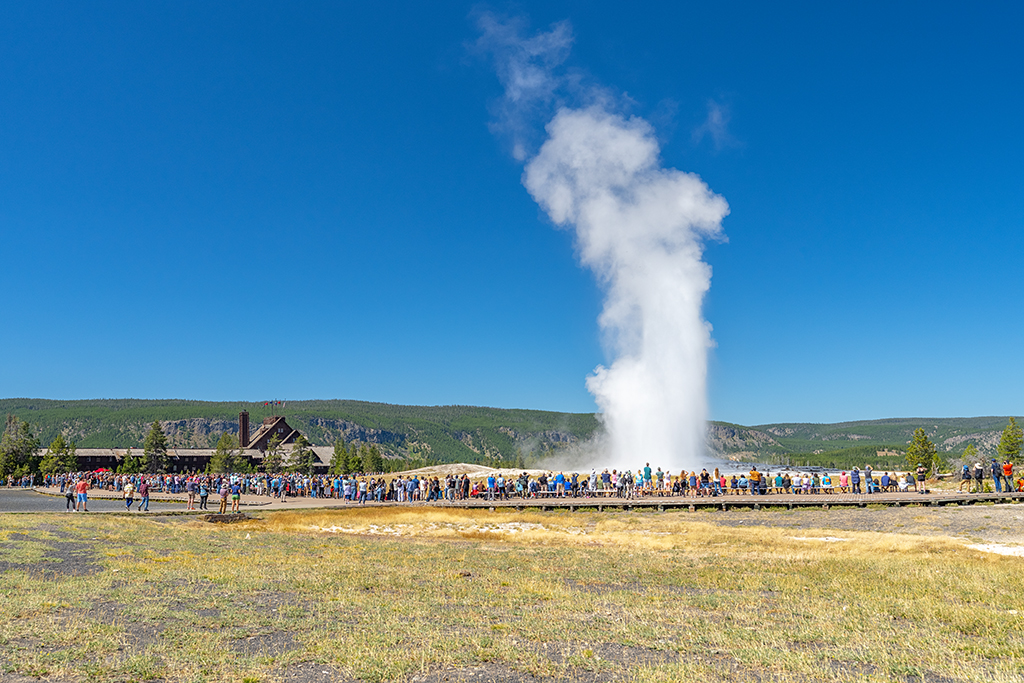
Oh yeah, did I mention that it's OK to get a few people shots, here and there? People and other human-made objects are great for showing the scale of, and providing recognizable reference to, a natural feature like a geyser erupting.
All along this stretch of the Grand Loop Road, you will be tempted to find an empty parking space, get out of your vehicle, and wander the boardwalks around Black Sand Basin, Biscuit Basin (currently closed due to a 2024 hydrothermal explosion), and Midway Geyser Basin (site of the famous Grand Prismatic Spring). I highly encourage you to explore at least one of these geyser basins, even if you are short on time. Hopefully, you can return some day for a longer visit.

Along the way from Upper and Lower geyser basins, you will be driving parallel to the Firehole River, where you might spot a trumpeter swan. Grab your camera with its telephoto lens or smartphone with its telephoto setting and capture an image of these gorgeous, graceful birds. There are only about 70 trumpeter swans living within the park, and they are considered a species of concern. This designation identifies a native species at risk which does not (yet) meet the criteria for being listed as threatened or endangered.
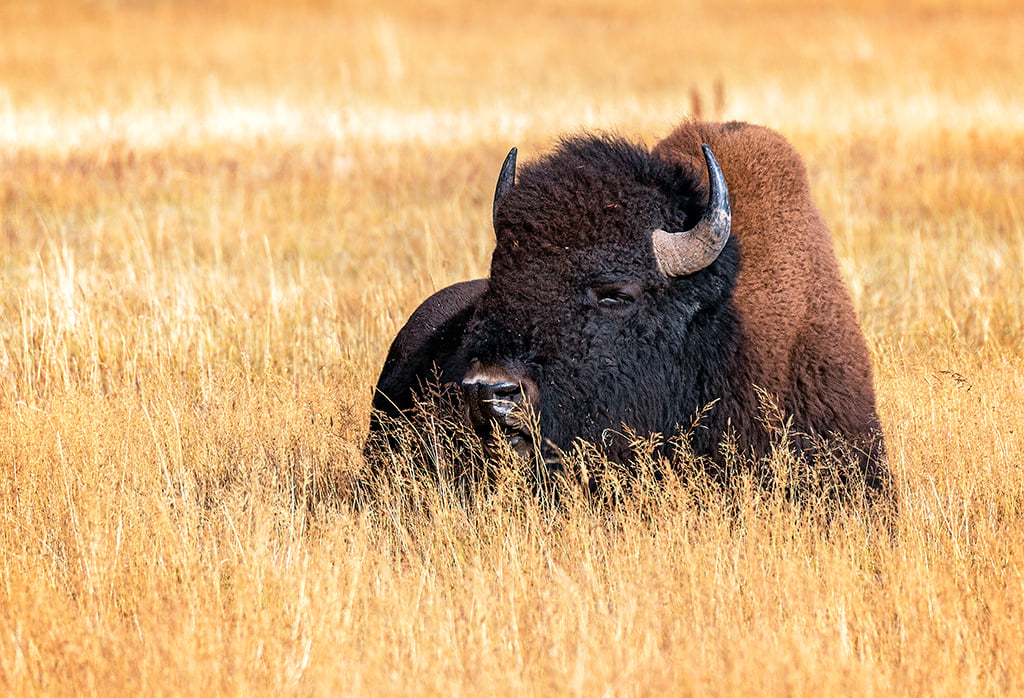
Between Fountain Paintpots and the Madison turnoff toward West Yellowstone is an expansive stretch of meadowland. Bison are often found grazing the grass. The shoulders along this stretch are wide enough for parking, plus there are some pullouts. The area around Fountain Flat Drive is a great stop to stretch your legs and look for bison herds frequenting the area.

If you are capturing shots of bison, keep your distance (don’t try to pet or get selfies with the fluffy cows). If your telephoto lens or setting still doesn’t have the reach for a close-up headshot, don’t despair (as if you ever would despair, right?). Instead, get a landscape image with the bison in it to show your viewing audience the stunning vista in which bison live and roam.
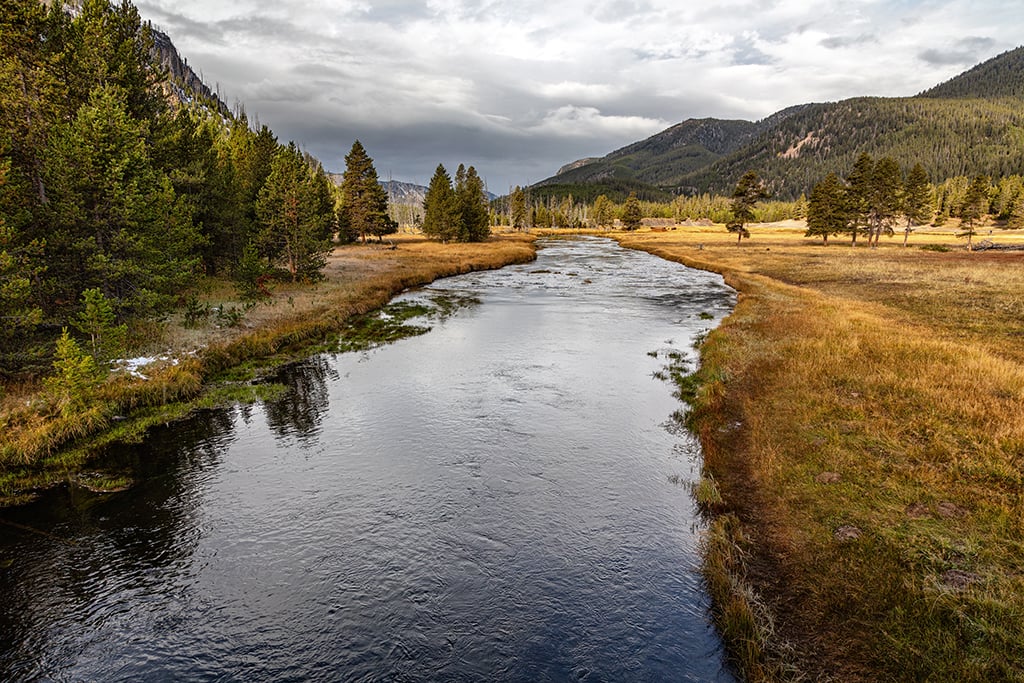
Just before you arrive at the intersection of U.S. Routes 191 (the road paralleling the Madison River to West Yellowstone) and 89 (the Grand Loop Road), there’s a bridge over the clear, placidly-flowing Madison River as it meets up with the Gibbon and Firehole rivers. Park along the wide shoulder or available pullouts before or after the bridge and go photograph the clear water, broad vistas including a view of National Park Mountain (elevation 7,500 feet / 2,286 meters), and any bison herds in the distance. FYI, rivers make great leading lines. Leading lines are a photo technique using rivers, fences, trails, or some other line that leads the viewer's eye from Point A to Point B within an image.
You are now driving parallel to the Gibbon River. There are numerous picnic areas offering wonderful water views. There’s even a nice pullout between Madison and Norris to capture an image or two of a “chocolate pot” hugging the riverbank. Chocolate pots are colorful thermal cone-shaped mounds streaked with yellow, brown, and orange (colors created by heat-loving bacteria and algae), looking for all the world like messy chocolate fountains into which you might dip fruit chunks for dessert.

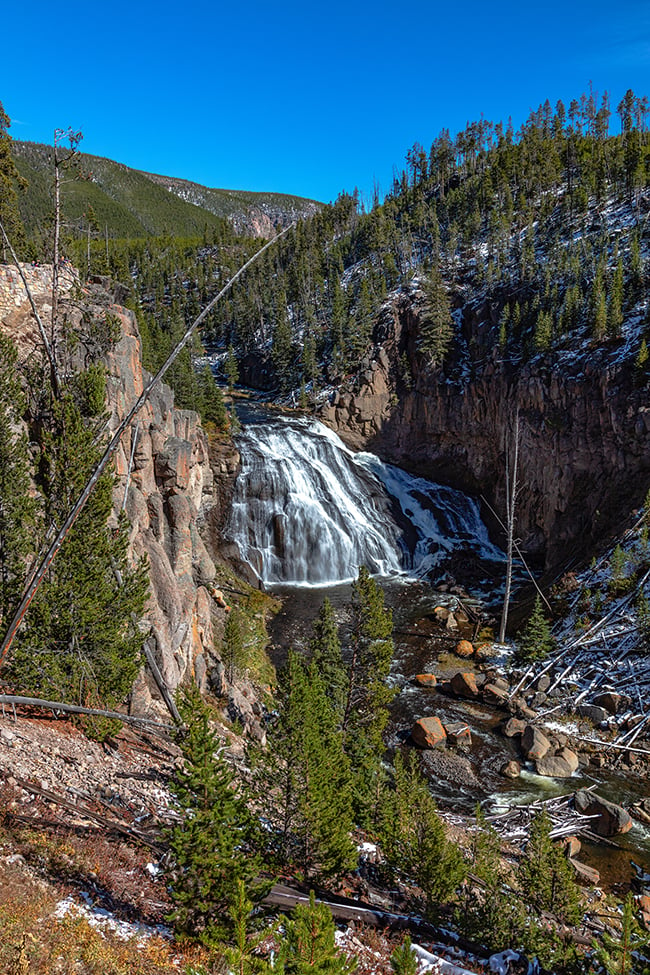
As you head toward Norris Basin, you’ll be ascending, then driving parallel to the Yellowstone Caldera rim. Five miles (8 kilometers) east of the Madison River/Gibbon River intersection, the Gibbon Falls overlook on the right side of the road is a lovely stop for another photo op and attempt at getting a silky water shot. Luckily, the parking area is large and there are plenty of spots from which to set your tripod.
Another 3.4 miles (5.5 kilometers) brings you to Beryl Springs on the left-hand side of the road. The parking area is very small and expect crowds at this stop, depending upon your arrival time. The lack of parking space plus the fact that most people only stick around long enough for a selfie, means you won’t have too long of a wait to view this bright blue-green, active hot spring named after a gemstone by a member of the 1883 USGS Hague expedition. Fun fact: Beryl Spring reaches a temperature of 196 degrees Fahrenheit (91degrees Celsius) which is greater than boiling point, making it one of the hottest hot springs in Yellowstone.

For a photo of this constantly-steaming waterbody, I suggest using a wide-angle lens with a focal length of between 14mm – 20mm to capture the entire hot spring including the steam escaping upward. To freeze the steam’s movement, use a fast shutter speed. If you want to make the steam look silkier, use a slower shutter speed.
A few miles further is the right-hand turnoff to the Artists Paintpots parking area and trailhead. From there, it’s a one-mile (1.6-kilometer) walk to the colorful hydrothermal area filled with hot springs, geysers, and mudpots. A tour of this area takes some time, so you might want to save this for another visit.
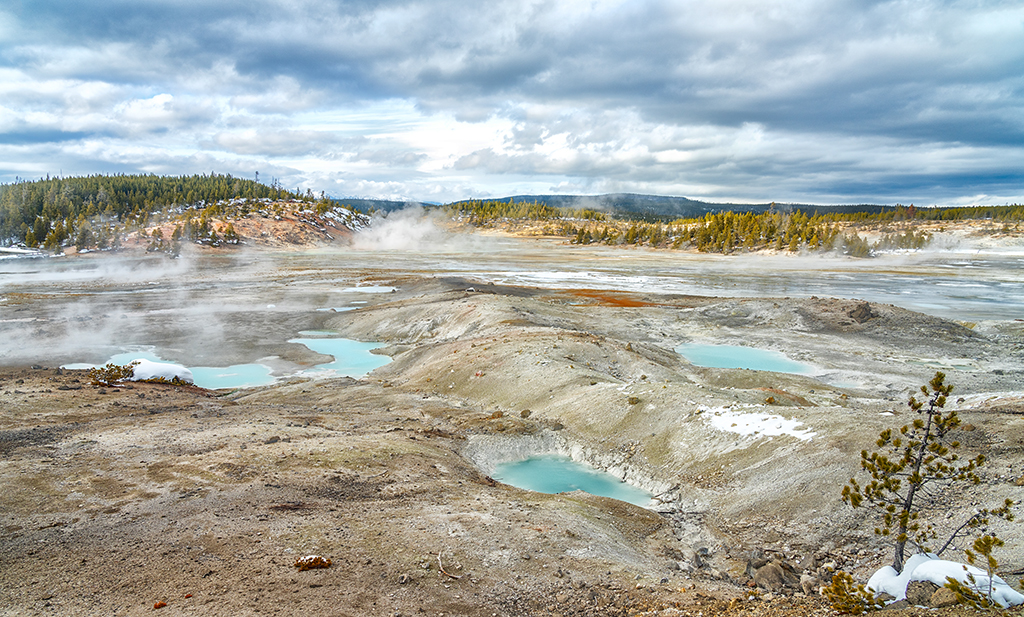
If you want to stop and really take the time to view Yellowstone’s hydrothermal features, I highly encourage you to explore Norris Geyser Basin. While not as iconic as Upper Geyser Basin with its Old Faithful geyser and historic lodges, Norris Geyser Basin is the oldest, hottest, and most dynamic thermal area within the entire park. Porcelain Basin, located within the larger Norris Geyser Basin purview, is a personal photographic favorite of mine.
According to Park Staff:
The highest temperature yet recorded in any geothermal area in Yellowstone was measured in a scientific drill hole at Norris: 459°F (237°C) just 1,087 feet (326 meters) below the surface!
Norris shows evidence of having had thermal features for at least 115,000 years. The features in the basin change daily, with frequent disturbances from seismic activity and water fluctuations. The vast majority of the waters at Norris are acidic, including acid geysers which are very rare. Steamboat Geyser, the tallest geyser in the world at 300–400 feet (91–122 m) and Echinus Geyser (pH 3.5 or so) are the most popular features.
Norris Basin is also the location of Steamboat Geyser, the world’s tallest active geyser, with major eruptions shooting water more than 300 feet (91 meters) skyward. These eruptions are unpredictable, but on the off chance this geyser does erupt during your visit to this spot, be aware there are dissolved minerals in the steamy spray which can damage glass and paint on your vehicle. Yes, the geyser’s steam particulates do reach out as far as the parking lot.

Ok, that ends Part 3 of this series. In addition to the spots I recommend, always remember to photograph what you find interesting. Don’t stop just because you see some photographer out there with camera to eye. They could be capturing an image of something you might not find the least bit interesting.
The final part to this series will close the Grand Loop with the drive from Norris Basin back up to Mammoth Hot Springs.
Remember, be curious, be observant, and have a grand time along the Grand Loop Road.
Stories about:
Story Categories:
A copy of National Parks Traveler's financial statements may be obtained by sending a stamped, self-addressed envelope to: National Parks Traveler, P.O. Box 980452, Park City, Utah 84098. National Parks Traveler was formed in the state of Utah for the purpose of informing and educating about national parks and protected areas.
Residents of the following states may obtain a copy of our financial and additional information as stated below:
- Florida: A COPY OF THE OFFICIAL REGISTRATION AND FINANCIAL INFORMATION FOR NATIONAL PARKS TRAVELER, (REGISTRATION NO. CH 51659), MAY BE OBTAINED FROM THE DIVISION OF CONSUMER SERVICES BY CALLING 800-435-7352 OR VISITING THEIR WEBSITE. REGISTRATION DOES NOT IMPLY ENDORSEMENT, APPROVAL, OR RECOMMENDATION BY THE STATE.
- Georgia: A full and fair description of the programs and financial statement summary of National Parks Traveler is available upon request at the office and phone number indicated above.
- Maryland: Documents and information submitted under the Maryland Solicitations Act are also available, for the cost of postage and copies, from the Secretary of State, State House, Annapolis, MD 21401 (410-974-5534).
- North Carolina: Financial information about this organization and a copy of its license are available from the State Solicitation Licensing Branch at 888-830-4989 or 919-807-2214. The license is not an endorsement by the State.
- Pennsylvania: The official registration and financial information of National Parks Traveler may be obtained from the Pennsylvania Department of State by calling 800-732-0999. Registration does not imply endorsement.
- Virginia: Financial statements are available from the Virginia Department of Agriculture and Consumer Services, 102 Governor Street, Richmond, Virginia 23219.
- Washington: National Parks Traveler is registered with Washington State’s Charities Program as required by law and additional information is available by calling 800-332-4483 or visiting www.sos.wa.gov/charities, or on file at Charities Division, Office of the Secretary of State, State of Washington, Olympia, WA 98504.
INN Member

The easiest way to explore RV-friendly National Park campgrounds.

Here’s the definitive guide to National Park System campgrounds where RVers can park their rigs.
Our app is packed with RVing- specific details on more than 250 campgrounds in more than 70 national parks.
You’ll also find stories about RVing in the parks, tips helpful if you’ve just recently become an RVer, and useful planning suggestions.

