
Editor's note: The following is from the U.S. Geological Survey.
Visitors to backcountry areas of Grand Canyon National Park can now subscribe to a new emergency warning system that works in areas where cell phone signals are absent. The Grand Canyon River Alert System is a free, subscription-based service specifically designed to send custom hazard-related alerts to satellite messaging devices, the first system of its kind in the nation. Visitors can also get the alerts through a cell phone when reception is available.
Alerts may include information on boating hazards, missing persons, critical streamflow-related operations for the Colorado River and flash flood warnings. The system was developed by the USGS in collaboration with Arizona’s Coconino County Emergency Management department, the National Weather Service, and the National Park Service, drawing on the unique capabilities and data resources of each organization.
“Information about impending flash floods, debris flows or boating hazards have not previously been accessible to backcountry visitors in Grand Canyon,” said Tom Gushue, USGS GIS Coordinator. “This warning system provides National Weather Service or Park Service alerts ahead of events, so that visitors can respond accordingly.”
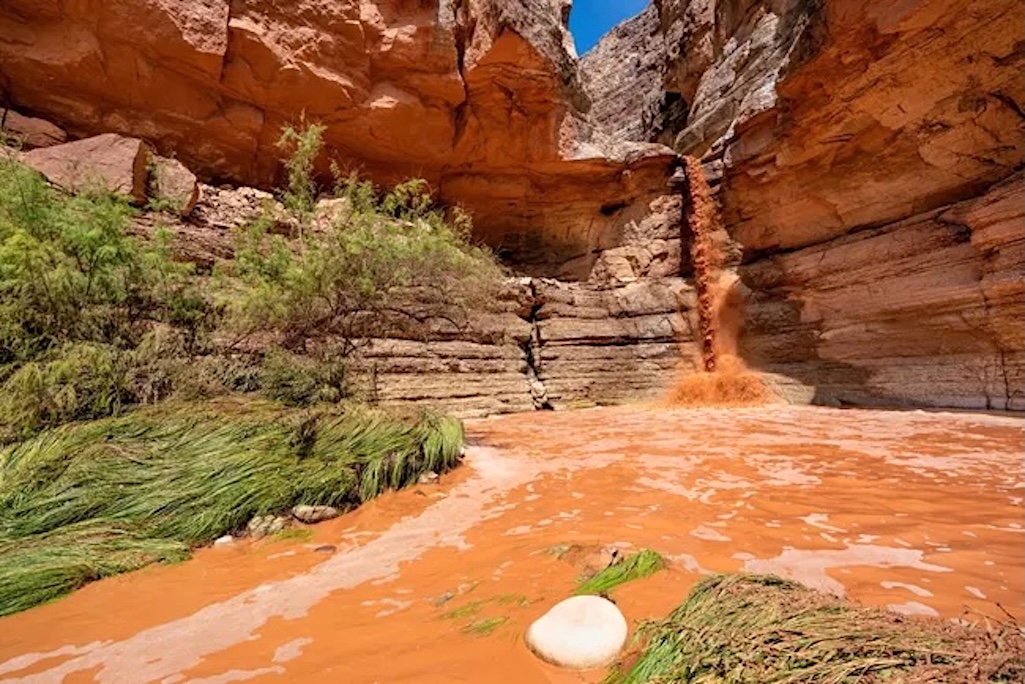
Flash floods triggered by strong rainfall can cause loose rock and sediment to mobilize and pour off cliffs and flow down tributary drainages, especially during intense summer monsoon storms. These events present an extreme hazard to hikers and river campers and have resulted in fatalities, injuries and property damage.
"We have never been able to reach people in Grand Canyon with flash flood warnings like this before. We are grateful for the coordination to make this possible and have the chance to save lives," said Megan Taylor, Lead Meteorologist at the National Weather Service Flagstaff Field Office.
The USGS provided expertise in satellite communication technology and applied geospatial data analysis that integrated river campsites, tributary drainages, geology at campsites and the Colorado River Mile System. The scientists drew on decades of USGS research and firsthand experience working in the Grand Canyon backcountry to incorporate the kinds of data that would be most meaningful to river users. The alert system is a vital piece of a larger risk communication plan designed to increase awareness around the risk to public safety posed by flash flood and debris flow events in the Grand Canyon region.
While the new alert system was developed specifically for Grand Canyon, the framework it uses could apply to most wilderness areas and be utilized by land management agencies, search and rescue units and those concerned with public safety to increase communication with people visiting or living in areas that are outside of cellular signal coverage. More than a million people spend the night in National Park Service-managed backcountry wilderness areas every year.
“This new alert system provides a critical communication link in remote areas, giving backcountry users timely information about flash floods or other hazards they may encounter," said Ed Keable, Superintendent of Grand Canyon National Park. “At the same time, no technology replaces the need for personal preparation and situational awareness. Visitors should always research their route, understand the risks, and be ready to adapt when conditions change.”
To subscribe for alerts, visitors can text GCRIVERALERTS to 928-707-7842 from the device they wish to subscribe to be added to the Grand Canyon River Alerts list that is maintained by Coconino County Emergency Management. Subscriptions must be made prior to leaving on a backcountry visit. For more information about how to subscribe, click here.
Stories about:
Story Categories:
A copy of National Parks Traveler's financial statements may be obtained by sending a stamped, self-addressed envelope to: National Parks Traveler, P.O. Box 980452, Park City, Utah 84098. National Parks Traveler was formed in the state of Utah for the purpose of informing and educating about national parks and protected areas.
Residents of the following states may obtain a copy of our financial and additional information as stated below:
- Florida: A COPY OF THE OFFICIAL REGISTRATION AND FINANCIAL INFORMATION FOR NATIONAL PARKS TRAVELER, (REGISTRATION NO. CH 51659), MAY BE OBTAINED FROM THE DIVISION OF CONSUMER SERVICES BY CALLING 800-435-7352 OR VISITING THEIR WEBSITE. REGISTRATION DOES NOT IMPLY ENDORSEMENT, APPROVAL, OR RECOMMENDATION BY THE STATE.
- Georgia: A full and fair description of the programs and financial statement summary of National Parks Traveler is available upon request at the office and phone number indicated above.
- Maryland: Documents and information submitted under the Maryland Solicitations Act are also available, for the cost of postage and copies, from the Secretary of State, State House, Annapolis, MD 21401 (410-974-5534).
- North Carolina: Financial information about this organization and a copy of its license are available from the State Solicitation Licensing Branch at 888-830-4989 or 919-807-2214. The license is not an endorsement by the State.
- Pennsylvania: The official registration and financial information of National Parks Traveler may be obtained from the Pennsylvania Department of State by calling 800-732-0999. Registration does not imply endorsement.
- Virginia: Financial statements are available from the Virginia Department of Agriculture and Consumer Services, 102 Governor Street, Richmond, Virginia 23219.
- Washington: National Parks Traveler is registered with Washington State’s Charities Program as required by law and additional information is available by calling 800-332-4483 or visiting www.sos.wa.gov/charities, or on file at Charities Division, Office of the Secretary of State, State of Washington, Olympia, WA 98504.


National parks and their natural resources belong to you. The National Parks Traveler works to ensure you know how these essential places are being cared for.
Sign Up For Our Weekly Newsletter
Unsubscribe at any time.
INN Member

The easiest way to explore RV-friendly National Park campgrounds.

Here’s the definitive guide to National Park System campgrounds where RVers can park their rigs.
Our app is packed with RVing- specific details on more than 250 campgrounds in more than 70 national parks.
You’ll also find stories about RVing in the parks, tips helpful if you’ve just recently become an RVer, and useful planning suggestions.

