

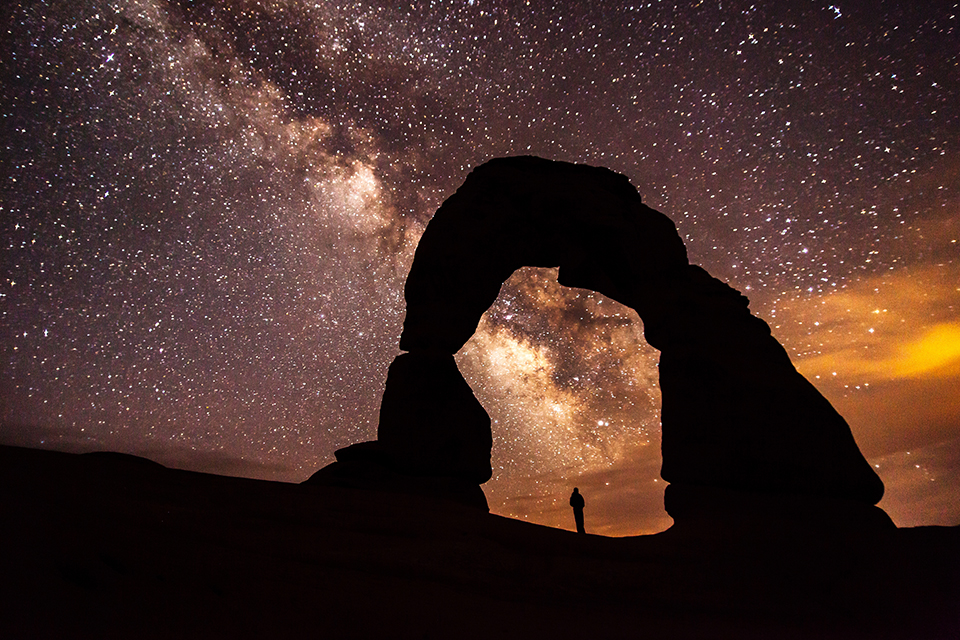
There are must-do hikes in many national parks. These iconic trails are almost a requirement before stating you’ve visited a park: Hidden Lake Overlook and Grinnell Glacier trails in Glacier National Park in Montana, Canyon Overlook and Angels Landing (well, at least up to Scouts Lookout) trails in Zion National Park in Utah, Bumpass Hell and Lassen Peak trails in Lassen Volcanic National Park in California, and the list goes on and on. Arches National Park in Utah has its own share of bucket list hikes, and Delicate Arch Trail is one of them. This 3-mile (4.8 km) roundtrip hike up and over slickrock to a sandstone arch so famous it’s on the Utah state license plate is extremely popular and with good reason. It’s a trail I’ve hiked and you can, too.
Before starting your hike, you should know there’s a difference between the Delicate Arch Viewpoint Trail (.5-mile roundtrip) and the actual Delicate Arch Trail, each located in different portions of the park. You can hit both trails on the same day, but if you are determined to only do a single hike, check the park map before heading out.

The parking lot is sizeable, but this trail is so popular it’s a good idea to arrive early in the morning or much later in the evening to snag a spot. Parking might even still be problematic in the evening due to stargazers and night photographers hiking up to this arch. These early / later arrival hours are helpful temperature-wise too, since it truly feels like a furnace during the height of the day in summer.
Sturdy footwear is important. They don’t call it slickrock for nothing, and slickrock becomes slicker with ice, so traction devices for your boots are a good idea on chilly days (trust me on this one). Don’t forget to pack along plenty of water, and I don’t mean carrying a couple of store-bought bottled waters. The park website advises packing at least two quarts of water to keep you hydrated. That much water is also handy for washing down those salty snacks replacing the salt lost through sweating along the exposed, treeless trail. Speaking of exposed, you might want to wear a hat and/or sunscreen.
The trailhead will lead you to and past historic Wolfe Ranch (aka Turnbow Cabin), a primitive one-room cabin used by John Wolfe.

You’ll also walk near a petroglyph panel and cross a bridge over brackish Salt Valley Wash.


The trail begins in earnest as you ascend slickrock landscape marked by small cairns pointing the way toward the arch. A walking stick is helpful going up and returning down, because, well, slickrock. Do watch your step and keep to the trail, although it’s easy to move in the wrong direction if you aren’t paying attention. Btw, don’t mess with the existing trail-marking cairns or build one yourself.


The last 200 feet of trail narrows along a ledge, so be especially mindful of foot placement. Cautious hiking is even more important on a very cold day, when patches of ice may cover a portion of that tapering trail.


Rounding that last corner, you’ll see Delicate Arch to your right. All you need to do is heft yourself over a short rock ledge and carefully wend your way down the slickrock “bowl” slanting toward the arch. It’s steeper than it looks in most photos of this iconic location. FYI, according to the blog site rockdoctravel.com, you’re basically walking upon eroded sand dunes as you descend to that famous stand-alone arch.

Prepare for people once you are there – a couple or 20 (or 30 or 40). If you are lucky, though, depending upon the time of your arrival, you might have the place all to yourself for a bit.

There are over 2,000 documented arches in Arches National Park, and Delicate Arch is probably the most famous of them all, making it a hike worth taking to see this emblem of the Southwest.
Stories about:
Story Categories:
A copy of National Parks Traveler's financial statements may be obtained by sending a stamped, self-addressed envelope to: National Parks Traveler, P.O. Box 980452, Park City, Utah 84098. National Parks Traveler was formed in the state of Utah for the purpose of informing and educating about national parks and protected areas.
Residents of the following states may obtain a copy of our financial and additional information as stated below:
- Florida: A COPY OF THE OFFICIAL REGISTRATION AND FINANCIAL INFORMATION FOR NATIONAL PARKS TRAVELER, (REGISTRATION NO. CH 51659), MAY BE OBTAINED FROM THE DIVISION OF CONSUMER SERVICES BY CALLING 800-435-7352 OR VISITING THEIR WEBSITE. REGISTRATION DOES NOT IMPLY ENDORSEMENT, APPROVAL, OR RECOMMENDATION BY THE STATE.
- Georgia: A full and fair description of the programs and financial statement summary of National Parks Traveler is available upon request at the office and phone number indicated above.
- Maryland: Documents and information submitted under the Maryland Solicitations Act are also available, for the cost of postage and copies, from the Secretary of State, State House, Annapolis, MD 21401 (410-974-5534).
- North Carolina: Financial information about this organization and a copy of its license are available from the State Solicitation Licensing Branch at 888-830-4989 or 919-807-2214. The license is not an endorsement by the State.
- Pennsylvania: The official registration and financial information of National Parks Traveler may be obtained from the Pennsylvania Department of State by calling 800-732-0999. Registration does not imply endorsement.
- Virginia: Financial statements are available from the Virginia Department of Agriculture and Consumer Services, 102 Governor Street, Richmond, Virginia 23219.
- Washington: National Parks Traveler is registered with Washington State’s Charities Program as required by law and additional information is available by calling 800-332-4483 or visiting www.sos.wa.gov/charities, or on file at Charities Division, Office of the Secretary of State, State of Washington, Olympia, WA 98504.
INN Member

The easiest way to explore RV-friendly National Park campgrounds.

Here’s the definitive guide to National Park System campgrounds where RVers can park their rigs.
Our app is packed with RVing- specific details on more than 250 campgrounds in more than 70 national parks.
You’ll also find stories about RVing in the parks, tips helpful if you’ve just recently become an RVer, and useful planning suggestions.

