
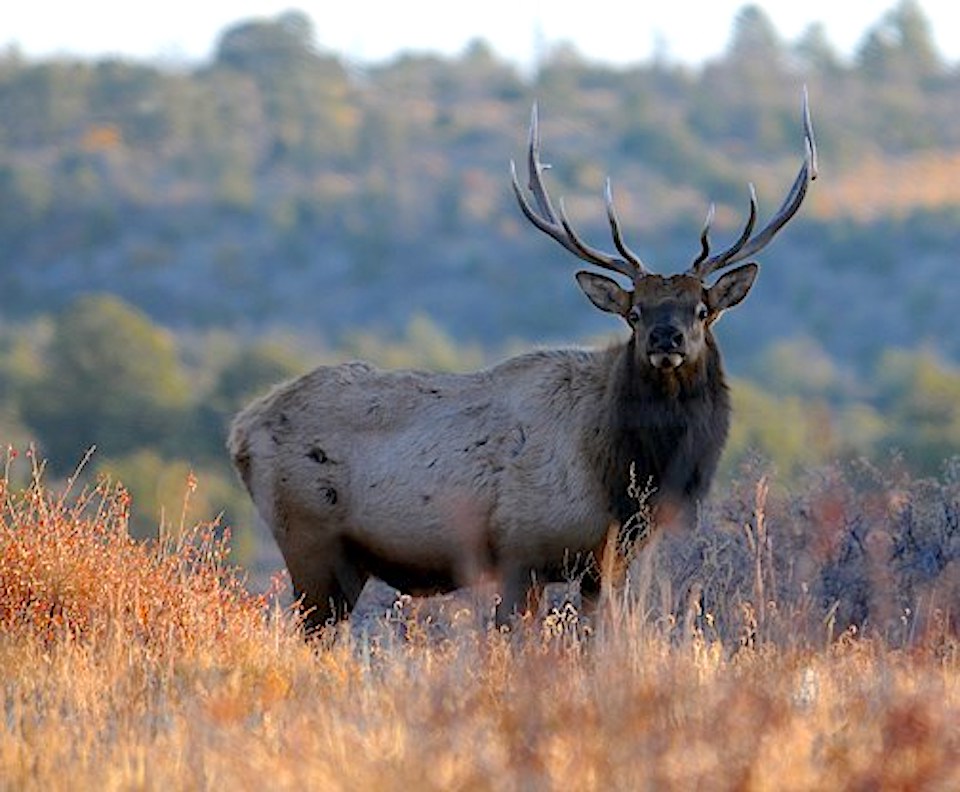
Should part of Bandelier National Monument be given over to hunting?/NPS, Sally King
Editor's note: The following column on whether a portion of Bandelier National Monument in New Mexico should be opened to hunting comes from Frank Buono, a former Park Service assistant superintendent who has kept atop issues involving the national parks.
Four-thousand acres does not sound like much in a National Park System of nearly 85 million acres. It is a pittance; small potatoes; inconsequential. That is the number of acres U.S. Sen. Martin Heinrich (D-NM) wishes to open to hunting in the Bandelier National Monument of northern New Mexico.
Congress has authorized recreational sport hunting in the National Park System before, explained Shawn Benge, the acting deputy director of operations for the National Park Service. This is nothing unprecedented, he said, in testimony before a Senate subcommittee on March 4.
That is incorrect. Congress has indeed authorized recreational sport hunting in approximately 66 or 67 areas of the National Park System (and subsistence take of wildlife in several more in Alaska). But Congress, outside of Alaska parks, has NEVER before taken lands now closed to sport hunting in the National Park System and opened them to hunting.
That is precisely what Heinrich's bill would do and it is unprecedented. The 4,000-acre allowance for hunting is hidden in the bill Heinrich has introduced to rename Bandelier National Monument a "national park and preserve" (S.2924). It is within the "preserve," now closed to hunting as part of the Bandelier National Monument, that Heinrich proposes to allow hunting.
Bandelier in a Nutshell
Bandelier National Monument is a 34,000-acre area of the National Park System, proclaimed in 1916 by President Woodrow Wilson, enlarged by President Hoover in 1932, and transferred to NPS administration in 1933 by President Franklin D. Roosevelt. Bandelier was expanded by President Eisenhower in 1961. President Kennedy in 1963 both added and subtracted lands, resulting in a net reduction of over 1,000 acres. Congress designated wilderness of 23,000 acres in 1976, and also expanded the boundary that same year, incorporating the Canada de Cochiti to the south and the headwaters of the Frijoles Creek to the northwest. In 1997, Congress added a small administrative tract transferred from the Department of Energy and a larger tract, nearly 1,000 acres in size, in the Upper Alamo drainage.
Under NPS laws and regulations, Bandelier National Monument, and lands since the time of their subsequent inclusion in the national monument, have been closed to recreational sport hunting for decades, if not generations.
Other National Parks and Preserves
Yes, Congress has re-designated national monuments as "national parks and preserves" outside of Alaska. Great Sand Dunes (2000), Craters of the Moon (2002), and Oregon Caves (2014) come to mind. But in these cases, Congress ADDED to the existing national monuments lands transferred from the national forest system or Bureau of Land Management, on which hunting was already occurring. Wishing to maintain the status quo, Congress designated much of the land transferred from the national forest or BLM to the national monument as "national preserves" so EXISTING hunting could continue.This is not the what Heinrich's proposes. Heinrich proposes to take National Park System lands now closed to hunting and open them to hunting. This is without precedent outside of Alaska.
The Alaska Precedent
On December 1, 1978, President Jimmy Carter employed The Antiquities Act of 1906 to reserve the largest number of acres ever for numerous national monuments. He did so in Alaska. Carter acted quickly to cement the protected and reserved status of the lands that were only temporarily protected under section 17(d)(2) of the Alaska Native Claims Settlement Act of 1971. In October 1978 Congress adjourned without acting on proposed legislation to add recommended federal lands to parks, refuges and other national systems. Congress had a deadline to act by December 17, 1978.
With one exception (Kenai Fjords) all of Carter's proclamations assigning lands to the Secretary of the Interior as new national monuments authorized subsistence hunting but NOT recreational sport hunting (Aniackchak, Bering Land Bridge, Cape Krusenstern, Denali, Gates of the Arctic, Glacier Bay, Katmai, Kobuk Valley, Lake Clark, Noatak, Wrangell-St. Elias, Yukon Charley).
In 1980, Congress, whose hands had been forced by Carter's action, addressed the new monuments in Alaska in the Alaska National Interest Lands Conservation Act. Congress elected to allow recreational sport hunting on much of the lands in Carter's proclamations where Carter had authorized only the subsistence take of wildlife. Congress titled these areas "national preserves." So, it can be said that Congress, prior to Heinrich's bill, has taken National Park System lands NOT open to recreational sport hunting and opened them by law to such conduct. But all comparison ends there. Carter's action was an emergency exigent action to which Congress properly responded under its plenary power in the Constitution's Property Clause to regularize Carter's emergency national monuments. There is no such circumstance motivating or justifying Heinrich's proposal.
Conclusion
If anyone has knowledge of an instance where Congress (outside of Alaska) has taken National Park System lands closed to recreational sport hunting and opened them, I would like to learn of that.
Congress can, if it so chooses, enact the Heinrich proposal. Congress can also designate any part of Yellowstone, Glacier, or Big Bend as open to hunting and retitle the open portions as “national preserves.” The question is not if Congress can do so. Of course Congress can.
The question is has this been done before?
The answer is that, outside of Alaska, whose circumstances were very peculiar to Alaska, Congress has never done this before.
The last question is this: Is it wise to begin unraveling the National Park System this way for the addition of such paltry hunting opportunities? Most of us who care about parks would say "NO." What is Heinrich thinking?
Stories about:
Story Categories:
A copy of National Parks Traveler's financial statements may be obtained by sending a stamped, self-addressed envelope to: National Parks Traveler, P.O. Box 980452, Park City, Utah 84098. National Parks Traveler was formed in the state of Utah for the purpose of informing and educating about national parks and protected areas.
Residents of the following states may obtain a copy of our financial and additional information as stated below:
- Florida: A COPY OF THE OFFICIAL REGISTRATION AND FINANCIAL INFORMATION FOR NATIONAL PARKS TRAVELER, (REGISTRATION NO. CH 51659), MAY BE OBTAINED FROM THE DIVISION OF CONSUMER SERVICES BY CALLING 800-435-7352 OR VISITING THEIR WEBSITE. REGISTRATION DOES NOT IMPLY ENDORSEMENT, APPROVAL, OR RECOMMENDATION BY THE STATE.
- Georgia: A full and fair description of the programs and financial statement summary of National Parks Traveler is available upon request at the office and phone number indicated above.
- Maryland: Documents and information submitted under the Maryland Solicitations Act are also available, for the cost of postage and copies, from the Secretary of State, State House, Annapolis, MD 21401 (410-974-5534).
- North Carolina: Financial information about this organization and a copy of its license are available from the State Solicitation Licensing Branch at 888-830-4989 or 919-807-2214. The license is not an endorsement by the State.
- Pennsylvania: The official registration and financial information of National Parks Traveler may be obtained from the Pennsylvania Department of State by calling 800-732-0999. Registration does not imply endorsement.
- Virginia: Financial statements are available from the Virginia Department of Agriculture and Consumer Services, 102 Governor Street, Richmond, Virginia 23219.
- Washington: National Parks Traveler is registered with Washington State’s Charities Program as required by law and additional information is available by calling 800-332-4483 or visiting www.sos.wa.gov/charities, or on file at Charities Division, Office of the Secretary of State, State of Washington, Olympia, WA 98504.
INN Member

The easiest way to explore RV-friendly National Park campgrounds.

Here’s the definitive guide to National Park System campgrounds where RVers can park their rigs.
Our app is packed with RVing- specific details on more than 250 campgrounds in more than 70 national parks.
You’ll also find stories about RVing in the parks, tips helpful if you’ve just recently become an RVer, and useful planning suggestions.


Comments
And why is that a question? What difference does it make? Either hunting makes sense in the area or it doesn't. The exact order of acquistion and designation is meaningless, except to those that might be more interested in the process than in the result.
It makes no sense in the area. The Valles Caldera National Preserve on the other side of the boundary allows hunting. However, it's closed in that area due to risks. There are in holdings within the proposed area along with several popular trails and extremely steep canyons. The proposal makes no sense at all.
Yes indeed, what is Heinrich thinking? Senator Heinrich has been a staunch advocate for conservation and environmental protection since, well, at least his teens and he's orchestrated or helped orchestrate some serious conservation victories. Personally, I've been in favor of simplifying the many different and often confusing "flavors" of NPS assets, like this "preserve" nonsense, by upgrading as many of them as possible to a higher, stricter, more impervious, protection category and, considering the history of national monument designations in Wyoming and at Olympic and what the Trump Administration and the State of Utah more recently did to national monuments in Utah, I initially supported these full national park protections for Bandelier; but, this "recreational sport hunting" thing has me also unsure of what Heinrich is thinking.
Giving Senator Heinrich the benefit of the doubt, he may have gotten himself entangled in some sort of "horse trade" in which he ended up willing to accept this 4,000 acre elk killing ground in exchange for winning support for the national park conversion. He or his staff may have misunderstood or misjudged the full risk posed by dealing with "collaborators" who might want this kind of exchange and this precedent to be set. This may have been the "circumstance motivating" or at least in his mind or his staff's minds "justifying Heinrich's proposal" and, if so, it might be more understandable; but, it still needs to be blocked. At a time when "recreational sport hunting" is actually dying out, opening the last small pieces of choice habitat so that the last and best parts of the remaining game animal gene pools can be killed, primarily just for fun, is absolutely inappropriate.
However, at the other end of the spectrum, if Senator Heinrich has or some part of his staff have allowed political, business, social, or even religious affiliations or objectives to intrude on what has hitherto been a trusted conservation record, then individuals who have gone to him or his office for help and support on conservation or environmental protection issues unfortunately need to know that, to reassess their situation, and to begin to act accordingly. I believe that would be a proverbially sufficient "word to the wise" so to speak.
And, either way, this proposal to carve a 4,000 acre elk killing ground out of what is now Bandelier National Monument needs to be stricken from the proposal or the proposal needs to be firmly blocked.
Yeah, with more time and surprisingly little further investigation, "collaborators" are revealing themselves to be just flat drooling to get this bad precedent set. I hope Martin realizes he's stumbled into courting the wrong constituency on this one. At the rate and in the direction he's going, he's on his way to having a ridiculous cartoon painted machine gun to show off in his office too. From Ossining to Windsor, a family spreading enlightenment everywhere.
Perhaps unfairly, this 'action' makes me think of the line from All The President's Men - "Follow the Money"!!!
Elk are far from being one of the worst conservation issues that hunting aggravates; but, even in the case of elk, two subspecies of North American elk have already been hunted to extinction within the last couple of centuries. The genetic heritage of those two subspecies has been lost forever. For other species, trumpeter swans, grizzly bears, or some wolf subspecies for example, hunting, legal and illegal, remains a major threat. Modern "sport" hunting, which is nothing more than killing off, just for the fun of it, what are often the last remnant gene pools of species that were many times more plentiful (well over a million times more plentiful in the case of bison) in very recent evolutionary timeframes, is what makes no sense at all.
I think Rumpel may be on to something in that Senator Heinrich might be giving his support for the full conversion of Bandelier National Monument to Bandelier National Park and Preserve in exchange for 4,000 acres of hunting in the Preserve. I'm not against hunting being a bow hunter myself, but this sets a poor precedent in the lower 48. I almost guarantee you that by doing this there will be future calls to re-designate portions of Yellowstone, Yosemite, Big Bend, Glacier, Olympics, North Rim of Grand Canyon on the Kaibab Plateau, North Cascades, etc as National Park and Preserves. Preserve the integrity of the parks, while keeping hunting to the National Forests and vast Wilderness Areas that surround these parks.
Yes, good point, national parks and other such areas, imperfect as they are, often serve as valuable breeding areas that replenish populations and genetic diversity in the areas around them. For many species facing extirpation if not extinction at the end of the 19th century, including elk and bison, the closure of Yellowstone to hunting saved, not only hunting opportunities for the future, but the species themselves. The elk you hunt today, almost wherever in America you hunt them, may be there because their ancestors were transplanted from the herds protected and preserved in Yellowstone.
However, in addition to being cautious about the potential hidden precedents, agendas, or consequences behind opening these areas, do your research on the natural history, habits, needs, and population dynamics of whatever you hunt, wherever you hunt it. Think about how much of their gene pool they may have lost in recent times (think in biological time, not your time). Think about their remaining habitat, their distribution, their needs into the future, and the threats they may be facing. Except for Tule elk or perhaps some other isolated Distinct Population Segment, our remaining elk are generally in pretty good shape; but, it still doesn't hurt for even elk hunters to keep these questions in mind. And, also take a second to ponder whether you can really trust the conservation assurances of people, groups, or agencies that may have vested political, social, business, funding, or cultural interests in the goods, services, licenses, or general "hooplah" behind getting you into the field and blasting or "twanging" away.
To answer Frank's question, I can think of one instance in which Congress allowed recreational hunting to an area of the National Park System in which hunting had not previously been permitted. When Hagerman Fossil Beds National Monument in Idaho was established on November 18, 1988, language in the enabling legislation was that used in most new park legislation. Section 303 of Public Law 100-696, Title III, states that: "The Secretary shall administer the monument established pursuant to this title in accordance with the Act entitled "An Act to establish a National Park Service, and for other purposes," approved August 25, 1916 (39 Stat. 535; 16 U.S.C 1 et seq.), as amended and supplemented." I was working at Great Basin National Park in neighboring Nevada at the time, and I recall hearing reports that the Idaho senators who had supported the HAFO legislation were mortified when they learned, after the legislation passed and was signed into law, that administration under the NPS Organic Act meant that there would be no hunting allowed. They vowed to correct what they saw as their error. They accomplished this about two years later, on November 5, 1990, with the passage of PL 101-512 (104 Stat. 1924). A provision in that law states: "that with respect to lands and waters under the jurisdiction of the Secretary within the Hagerman Fossil Beds National Monument, established by title III of Public Law 100-696, the Secretary shall hereafter permit hunting and fishing as well as maintenance of structures necessary to undertake such activities, including but not limited to duck and goose blinds on those lands within an area fifty feet in elevation above the high water level of the Snake River in accordance with otherwise applicable laws of the United States and the State of Idaho."
So, it has happened before outside of Alaska. For about two week shy of two years, Hagerman Fossil Beds National Monument was closed to all hunting. Then, a small portion of the monument upslope 50 feet from the Snake River was opened to recreational hunting, and this provision continues to this day.
Of course, none of this means that opening a portion of HAFO or Bandelier to hunting is a good idea. In the Bandelier proposal it sounds like the area opened to hunting would be re-designated as a National Preserve. That did not happen at Hagerman, where the hunting is permitted within a portion of the overall national monument.
All of the legislation referenced here, as well as the park brochure map that delineates the hunting area within the monument can be found on the park's website: nps.gov/hafo
Al Hendricks
All the more reasons, first, to stop the establishment of any and all of these precedents in their tracks from the very start and, second, to simplify NPS designations into fewer categories with less "weasel room" for mischief and the most stringent possible protections whenever and wherever possible (apply the "never negotiate with terrorists" principle).