
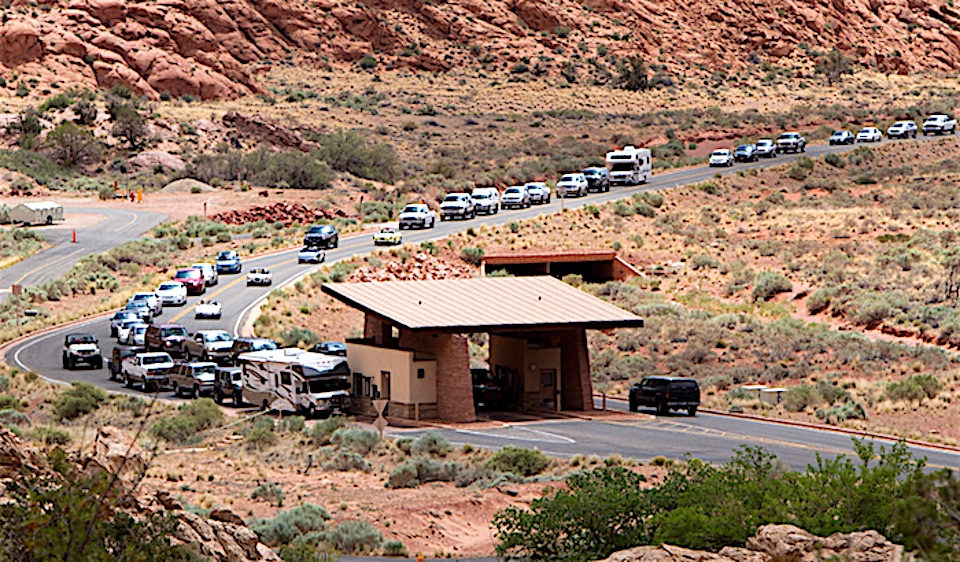
A proposal to require reservations at peak times for visitors to Arches National Park could lead to a substantial economic impact to the area, according to an economist/NPS file
If Arches National Park moves forward with a plan to require advance reservations for visitors, it could lead to an initial economic hit of as much as $22 million to the Moab, Utah, area, according to an economic analysis. That dollar figure is far from firm, the economist cautioned, and could be greatly reduced as people get used to whatever traffic management plan the park settles on.
At the same time, however, such a reservation system "may enhance visitor experience and increase the economic value of trips to" the national park, noted Robert Paterson, who works for Industrial Economics, Incorporated, out of Cambridge, Massachusetts.
Arches is one of a handful of national parks -- others include Yellowstone, Zion, Yosemite, Acadia, Grand Canyon, Glacier -- that struggle at times during the year with overcrowding. Zion officials have been working on their own management plan for some time, and it, too, includes provisions for reservations, though they might not be included in the final proposal.
Overcrowding can lead to natural resource impacts. In Zion Canyon, for instance, where there are roughly 13 miles of official trails, visitors going off trail have created another 30 miles of unofficial "social" trails. Complicating the planning process at Zion are concerns over how a visitation cap would impact area businesses.
“I think people realize that there are crowding problems, and would like to see some solutions to that," Superintendent Jeff Bradybaugh told the Traveler in December. "But there’s a great amount of concern that that could have negative economic impacts on the tourism industry. And we certainly are taking that into account and have those concerns as well."
As with their counterparts at Zion, officials at Arches have been trying to figure out how to manage visitors and protect park resources and values for some time. Back in November 2017 they released a draft plan that proposed reservations during peak visitation months. Such a plan is needed, they say, to address vehicle traffic and parking congestion problems that affect visitor access, visitor enjoyment, and resource conditions.
Visitation to Arches National Park doubled in the past 11 years, reaching approximately 1.6 million visitors in 2016. During high-visitation season, March through October, visitors routinely wait in long lines to enter the park and then must search for empty parking spaces at all popular sites. Long lines to enter the park cause congestion at the intersection of U.S. 191 and the park entrance road, which can be a serious traffic hazard.
The reservation proposal is viewed as a way to give visitors certainty of entry, reduce or eliminate long entrance lines, spread visitation more evenly across the day, and improve the visitor experience by ensuring available parking space.
But Paterson pointed to some uncertainties in reaching his conclusions over the economic fallout such a plan would create.
"(R)epresentatives from the International Inbound Travel Association Board have suggested that regardless of whether a system is implemented next year or not, there will likely be a reduction in foreign bus tours booked due to concerns about the system," the economist said in a report sent to the park last summer.
The report was just publicly identified by park officials last month when they announced plans for a public meeting this summer about the progress being made on the management plan. Paterson is expected to be at the meeting.
The economist acknowledged that his work so far could not predict the long-term impact to the area's economy. He predicated his estimate based on other national parks that used various approaches to deal with congestion.
"While they are all qualitatively different circumstances ... they may be similar in an economic sense in that they created uncertainty that in turn affected visitation," he wrote. "Based on these analyses, relevant literature, and professional judgment, it is my opinion that visitation to Arches may be reduced by 5 to 10 percent of what it otherwise would be during the first year that a system is implemented. ... Relying on (National Park Service) estimates of Arches visitor spending, this could result in a reduction in spending of $11 to $22 million relative to what otherwise would be predicted in that first year, which in turn could reduce overall output, employment, wages, and tax receipts through associated multipliers."
With that said, he added that after the first year of the reservation system commercial operators and individual park visitors would adapt to the system and "visitation would revert to what it would otherwise be under the system by year three."
But, reflecting the overall lack of rigorous economic analysis, was Paterson's comment that "(T)here are a number of important caveats and uncertainties associated with these estimates. Foremost is that they are based solely on existing data and information regarding imperfect analogies. In addition, they do not account for the potential to mitigate impacts through additional education and outreach regarding the proposed system."
Stories about:
Story Categories:
A copy of National Parks Traveler's financial statements may be obtained by sending a stamped, self-addressed envelope to: National Parks Traveler, P.O. Box 980452, Park City, Utah 84098. National Parks Traveler was formed in the state of Utah for the purpose of informing and educating about national parks and protected areas.
Residents of the following states may obtain a copy of our financial and additional information as stated below:
- Florida: A COPY OF THE OFFICIAL REGISTRATION AND FINANCIAL INFORMATION FOR NATIONAL PARKS TRAVELER, (REGISTRATION NO. CH 51659), MAY BE OBTAINED FROM THE DIVISION OF CONSUMER SERVICES BY CALLING 800-435-7352 OR VISITING THEIR WEBSITE. REGISTRATION DOES NOT IMPLY ENDORSEMENT, APPROVAL, OR RECOMMENDATION BY THE STATE.
- Georgia: A full and fair description of the programs and financial statement summary of National Parks Traveler is available upon request at the office and phone number indicated above.
- Maryland: Documents and information submitted under the Maryland Solicitations Act are also available, for the cost of postage and copies, from the Secretary of State, State House, Annapolis, MD 21401 (410-974-5534).
- North Carolina: Financial information about this organization and a copy of its license are available from the State Solicitation Licensing Branch at 888-830-4989 or 919-807-2214. The license is not an endorsement by the State.
- Pennsylvania: The official registration and financial information of National Parks Traveler may be obtained from the Pennsylvania Department of State by calling 800-732-0999. Registration does not imply endorsement.
- Virginia: Financial statements are available from the Virginia Department of Agriculture and Consumer Services, 102 Governor Street, Richmond, Virginia 23219.
- Washington: National Parks Traveler is registered with Washington State’s Charities Program as required by law and additional information is available by calling 800-332-4483 or visiting www.sos.wa.gov/charities, or on file at Charities Division, Office of the Secretary of State, State of Washington, Olympia, WA 98504.


National parks and their natural resources belong to you. The National Parks Traveler works to ensure you know how these essential places are being cared for.
Sign Up For Our Weekly Newsletter
Unsubscribe at any time.
INN Member

The easiest way to explore RV-friendly National Park campgrounds.

Here’s the definitive guide to National Park System campgrounds where RVers can park their rigs.
Our app is packed with RVing- specific details on more than 250 campgrounds in more than 70 national parks.
You’ll also find stories about RVing in the parks, tips helpful if you’ve just recently become an RVer, and useful planning suggestions.


Comments
Not to say all foreigners are bad for the parks or that all Americans are bad for them, but the NPs I have been in had mostly foreigners visiting at the time & they were mostly very disrespectful to the park. By this I mean throwing trash on ground, getting off trails where they were not supposed to, etc. Some were very nice & respectful, but those were few. I know a lot of Americans are the same way also, so that being said I would agree with reducing the number of foreigners allowed in the parks since we the people pay taxes to support them along with entrance fees & should be the first to be allowed to visit them. I would be very upset if I planned to take my family to say Grand Canyon & was told I couldn't & yet find out on that day/week that someone from France got to bring their family.
I'm a park ranger and I can tell you for certain that when it comes to problematic behavior, Americans are equal in all respects to visitors from other countries. Sometimes even worse.
Always remember to be careful not to stand in front of the door to a restroom when a tour bus pulls in. You'll be trampled regardless of whether the bus unloads a herd of people from Beijing or Boston.
When I visited there was no admission fee and no crowds. That's the benefit of being being born at the right time. It was a big mistake to put it on the license plate. And now the only consideration is revenue loss?
Bill Baehr, I AM one of those foreign visitors that plans going to Arches NP this summer, as well as a whole range of other parks in the wide area. Actually, my family and I will be spending quite a few dollars on not only visiting parks, but also on hotels, restaurants, shops,... And just like the spendings of all other foreign visitors, I think that's good for the American economy.
So please think again before you start ranting about apartheid-measurements. I'm not always happy when coming in Belgian cities like Brussels or Bruges which are flocked with foreign tourists, but should we start closing those cities to foreigners too?!
The people running Utah have shown by their actions that they are mainly concerned with exploiting public lands for private profit. They want to pack in as many tourists as possible or, if they can’t do that, open the lands to mining or other industrial activity (e.g. Bears Ears). Their massive advertising campaigns, especially abroad, have contributed significantly to the current overcrowding. So I find it hard to have much sympathy for locals who say they can’t get in – you voted for those politicians. I do have sympathy for those with National Park passes as they seem to be people who are really concerned about park welfare, and for low income families who are excluded from the parks economically.
I’m not sure what the answer is. Shuttles certainly help. They are a pain in Zion (I have waited in a line of over 100 at 8 am in the morning to board), but the experience in the park would be much worse without them. Reservations also might help and if the local tourism industry has to take a small drop in their profits for a while then so be it, but I think there should be exemptions for pass holders.
How about a fleet of tour buses, similar to Zion, that haul people in/out and stop at each overlook to pick up/drop off during peak times of the year? That would alleviate the traffic congestion.
I like your solution! It would allow those want hike to do so plus the ones who just want picture to just take I e ir what ever.
WRT shuttles, the video on the ANP website explains why they thought shuttles would not work, although I am not sure I entirely agree. They say that only a small percent of visitors will use the shuttles. This would be solved by making them mandatory (as at GC-South Rim and Zion where some roads are not open to the general public). The other problem is the distances involved are much greater than Zion and GC. This is true if the shuttles started at the Visitor's Center. What if shuttles radiated out from a central hub where the roads to the campground, entrance, and Delicate Arch converge. This is central to the most used trailheads and would cut down on shuttle distances. However it would require building a large parking lot there (although there is probably more room than by the park entrance).
On the other hand, I agree that a reservation systems isn't as horrible as people would make it sound. I for one plan my trips months in advance. People who just show up expecting to be able to to whatever they want whenever they want are going to be inconvenienced the most, but then again, it is that type of visitor that is creating most of the problem. Also I find the headline of this article to be guilty of fear mongering. Note that the drop in spending is only an estimate for the first year and could be lower. Buried at the end of the article is the statement from the report that predicts after the first year of implementing a reservation system, visitation would probably revert to what it would have been. I think the NPS should be planning for the long-term whereas this article focuses on a very short-term issue.
I feel diheartened by comments from those whould would restrict foreigners. Such sentiment is horribly misguided. This sentence from today's article on wildelife brigade volunteers at Teton especially resonated with me: "The people behind me gasp as the bear appears. For most of them, this is their first sighting. About half are from overseas and they are ecstatic. Their expressions, especially the kids’, are priceless." I have met many international visitors at my NP visits and I am always so proud to be able to share my riches with them. I go out of my way to be welcoming and hospitible to those visiting my parks. My interactions with them have greatly enhanced my visits as well. Because these are National Parks, I feel that, as an American, I am a co-owner and thus the international visitors are my guests. Shame on those whould whould slam the door in their face and treat their guests so badly.
I would note that some of the best interactions I've had in US national parks was with the employees here on J-1 visas. That included workers from China, Singapore, Taiwan, Hong Kong, Russia, and even Finland. I even discussed a little ice hockey with the Finnish clerk at Roosevelt Lodge who was wearing their standard uniform that included a cowboy hat.
But yeah - bad behavior is bad behavior regardless of who does it. The important thing is to educate all visitors on what the expected behavior is. My experience with international visitors has generally been good, including a Korean schoolteacher in the US on an exchange program who I met at Lassen Volcanic NP.
I think in the long run this is the way. We visited Arches & ZION IN Sept. 2016 for the first time. Love the park but the over crowding was horrendous! Unfortunately it was so miserable we left after 2 days so missed a lot. Yellowstone at that time also overcrowded. No parking traffic bumper to bumper. Left to soon then too. So disappointed !
Most of the foreigners my wife and I encountered have been enthuastic and friendly... except for the busloads of Aisians. Two years ago at Yellowstone's Artist's Point five bus loads of Asians arrived at the same time. They pushed us, yelled at us and were extreamly rude. Needless to say it ruined our experience and we had to leave. After speaking to several park employees thay just stated that there is nothing they can do and there is no plan put in place to control these situations. In my opinion this isn't rocket science. Limit the umber of busses permitted per day into the parks. My suggestion is one buss pe day.
Some thoughts.
* In 1968 I studied at Cambridge University in England. While there I traveled around England quite a lot. On many occasions I observed bad behaviors by “ugly” Americans.
* Banning foreign visitors is un-American. However, would the following suggestion help manage this situation? Ban the large tourist buses; allow 9 to 12 person vans only, each with a guide who would stay with the group and “baby sit” them. Expensive? Yes, but maybe travel has become too cheap. By the by, I also favor banning large (over 20-21 feet) RV’s, fifth wheels, and trailers; people who have to bring their entire houses with them should have to leave them outside the parks.
* Reservation systems are coming to the busiest parks if attendance keeps rising. That’s just the way it’s going to have to be. The NPS cannot out build or out manage the rising numbers. I’ve been traveling for over 30 years. I loved just making up my itinerary as I went along, but that was then; this is now. I remember driving 494 through Eden Prairie and Bloomington (Minneapolis suburbs) in the middle of the afternoon with hardly any traffic. Not any more. Our world has become a crowded place and gets more crowded every day. This is the new reality. Get used to it!
* Our national parks do not exist for the benefit of local businesses. Local businesses exist to benefit off our national parks. Businesses come and go all the time (Geez, Donald Trump declared bankruptcy six times.). That’s capitalism. There are no guarantees. Therefore, park administrators should manage parks for the enjoyment of the people and the preservation of the resources as the law directs and let the tourist industry rise or fall as it may. The law says nothing about managing parks for the benefit of the tourist industry.
They're called National Parks not International Parks, so let's focus on our interests as a National People not on national commerce, Most of us will never be able to afford a trip to a foreign counntry or do not want to leave our country anyway, Most working Americans can barely afford to visit their National Parks , so we don't need wealthy foreginers overcrowding the Parks and driving up the cost of local accomadations. Our overcrowded Parks don;t need foreigners, so please stay home, we don't need you or your money.
Submitted by Bill Baehr on March 7, 2019 - 7:13pm.
Most working Americans can barely afford to visit their National Parks , so we don't need wealthy foreginers overcrowding the Parks and driving up the cost of local accomadations. Our overcrowded Parks don;t need foreigners, so please stay home, we don't need you or your money.
Well, this just about perfectly sums up the predicament that we have found ourselves in here in the US. People scared of leaving home being scared of others who aren’t afraid to leave home coming here. As a middle aged white guy I can’t wait until the US is majority minority - going to be a lot of terrified xenophobes with nowhere to go.
And yes there is at least one international park (Waterton-Glacier International Peace Park) as well as at least 20 UNESCO World Heritage sites managed by the National Park Service.
So what do we need to do under your rules? Start asking for ID for everyone in a party? Keep out US permanent residents? A US citizen can bring foreign guests or not? Start setting up ID checkpoints at parks where they currently don't have entrance stations (Great Smoky Mountains, Golden Gate NRA, etc)? Arrest anyone for trespassing if they manage to get in and aren't eligible? And who pays for this - especially at parks (the majority of NPS units) where there's no entrance fee? Will we need 24 hour manned entrance stations given that many allow visitors to enter after hours. Heck - when I visited Arches the entrance station was unmanned and one could pay for entrance via an automated kiosk. So will they need to scan a passport? Birth certificate? Maybe just a SSN card?
What about Death Valley? Legally there's a state highway going through and as long as one doesn't stop at an NPS area it's free to enter. What to do about those foreigners who just want to pass through? I guess no using Tioga Road as a shortcut when it's open? And I guess there are NPS managed roads such as the Blue Ridge Parkway and Baltimore-Washington Parkway. Plus they'll need to set up checkpoints that I'm sure the commuters will love.
So no exceptions? How about foreign dignitaries? I remember there was talk about Prince William visiting Yosemite. I guess that would be out of the question. And foreign visitors can no longer visit the Smithsonian museums since that means crossing through the National Mall.
How about making things simpler. It's pretty obvious that our crowded parks don't need you to add to their crowding.
The NPS already requiress ID when entering a pay area with a pass. Banning foreigners could be easily enforced like any permit or licensee. If you get stopped you better be legal or you get a ticket or arrested. No need for checkpoints. When they get caught, punish them and make an example out of them. There is no perfect enforcement system for any laws. I don't care about Prince William or foreign dignitaries visiting; who needs them making it harder for The People to visit their Parks?. I don't kowtow to royalty or foreign dignitaries and neither should our Parks. Banning foreingers is a simpler system than reservations. You are making it sound complicated with ridiculous objections. What's so obvious that our crowded parks don't need me? Is it because you don't like ny views?
Your views are silly and unworkable. They're knee-jerk, xenophobic, and unrealistic. Your proposal is more of a "show your papers" scheme that's generally illegal under the Fourth Amendment. And again, who gets IDed? Every passenger? Even children? Or can they get around your ban by bringing along a US citizen?
All parks too? What about the National Mall? A foreign visitor won't be able to attend a performance (or even perform) at Wolf Trap? Can't visit the presidential memorials in DC? USS Arizona Memorial? Statue of Liberty? There's irony for you.
And absolutely there are economic concerns. It's up to you to decide that foreign tourist dollars are unimportant? And the possibility that there may be reciprocity. Whether or not you visit other countries, Americans do and enjoy similar parks around the world.
Besides that, it's not going to make much of a dent anyways. A study of Yellowstone estimated about 17% of visitors were international. And if international visitors are banned it's likely that more American visitors will decide to come and we're back where we started. As well as a likelihood that foreign visitors decide to skip the US altogether.
"And if international visitors are banned it's likely that more American visitors will decide to come and we're back where we started." You know it! I'll take that problem and be glad to get a reservation if the overcrowding is from our People. 17% of 3 million visitors to Yellowstone is quite a dent, that's 510,000 people. As long as there is not an overcrowding problem, I am fine with foreign visitors visiting Parks. I am not against foreigners visiting the US. Foreigners just have to realize they are our guests and not entitled to our National Parks and need to behave according to our culture. Should we cater to the Chinese and put in squat toilets so they don't stand on our toilets and defecate on the seat or break them? How far to we need to go for foreigners in our National Parks? Maybe a better solution would be for foreigners to have to get reservations and limit their numbers? This is all just brainstorming. What's wrong with that? Something has to be done about the overcrowding and it make sense that foreigners should be elimanted before citizens have to suffer overcrowding
OK. Now we're getting somewhere. The problem of foreign visitors behaving badly isn't isolated to those visiting the United States. I'm certainly not for locking out visitors simply based on where they come from.
Our most popular national parks are recognized as highly desirable places to visit. If they want to visit and tell their friends about it then more power to them. In fact meeting foreign visitors has often been some of the best aspects I've experienced.
I know many people from China and have been to China. I assure you that most people there know how to use a sit-down toilet. I've been a guest in a middle class home and it even had American and Japanese branded toilets like Kohler or Toto. It's a very small subset of visitors (although I've heard they've caused damage) that seem to find it puzzling. Certainly European of Japanese visitors aren't going to treat a sit down toilet like a squat toilet.
Yellowstone is already catering to foreign squaters to avoid damage and filth on sit down toilets. So get ready to squat, it's healthier too. https://www.wyomingpublicmedia.org/post/you-might-not-want-sit-down-squa...
"In Internet slang, a troll is a person who starts quarrels or upsets people on the Internet to distract and sow discord by posting inflammatory and digressive, extraneous, or off-topic messages in an online community (such as a newsgroup, forum, chat room, or blog) with the intent of provoking readers into displaying emotional responses and normalizing tangential discussion, whether for the troll's amusement or a specific gain."
That is one thing I dislike about the Donald Trumping of America. It normalizes the racist xenophobia that previously sat just under the skin, and was gradually eradicated. Now it is ok to be that way openly, which isn't ok, and my fear is that it will last longer.
Rick - people aren't trolls just because they disagree with you. I don't agree with Bill but recognize that calling people names is no way to win an argument or change peoples' minds.
Submitted by ecbuck on March 9, 2019 - 8:37am.
Rick - people aren't trolls just because they disagree with you. I don't agree with Bill but recognize that calling people names is no way to win an argument or change peoples' minds.
So why not practice what you preach?
OK, Anon, I'll bite. Who and when have I every called names?
Name calling someone a troll is the ad hominem fallacy. Attack the person rather than the merits of the argument. In this age of Trump, attacking the person rather than the argument seems to be the common tactic of many in a disagreement. I don't like Trump but not everything he says or does is wrong because he says it. I don't suggest that anyone is a troll just because i disagree with them. Part of having a good discussion should involve entertaining opposing viewpoints in order to get to the truth, If we all just agree, we learn nothing new.
Most nations that have strongly differential rates for residents and foreigners (not "Domestic students free, residents free on Sundays, etc." which is nigh universal in some form) for heritage sites tend to be impoverished states like the various East African authoritarian regimes. Unsurprisingly. right-wingers like ecbuck and Baehr want the US to be more like Third World dictatorships and less like other rich countries or, even, Mexico. Six days a week, everyone foreign and domestic pays 75 pesos (about $4) to visit Teotihuacan. On the other day, Mexican citizens and residents get a discount (to free) but the base price doesn't change.
Given that Bill and I desagree on this issue how is it you stick us in the same basket? What exactly about my position on this issue is comparable to "Third World dictatorships"?
I am not a right winger and I am not against foreigners visiting. I do want the the US to be more like a Third World dictatorship. Please read what I post carefully and don't lie about me. Thank you.
Because both of your solutions are designed to make parks more exclusive. His by raising fees on just foreigners and yours by raising fees. Period. Notice in the above example that entrance to one of Mexico's and the world's great patrimonies is free for Mexican residents one day per week and the price every other day of the week is equivalent to an hour and half of work at the median Mexican wage. An hour and a half of work at the median US wage is about $30 which is pretty similar to what flagship parks charge today.
The real solution is to fund the government appropriately to care for these national and global treasures. A good first step would be restoring tax rates to what they were during the Eisenhower administration so that it could be done without deficit spending.
Unsurprised - I too am concerned with deficits and have been long before the never trumpers came on board. But the problem isn't taxes too low (they are being collected at record levels), it is spending is too high. Would I like to see more spent on Parks, absolutely, but not until the other spending is brought into check. And no, I am not trying to make the Parks "exclusive", I just think that those that use them should pay. Obviously you are more of an entitlements guy.
The usual "libertarian" wank. As a percentage of GDP, taxes collected are way below average for the postwar period (outside recessions). It may surprise you, but a raw dollar number might be larger because of things like inflation and the expansion of population and GDP. It also may surprise you but the total percentage of federal employees (including military) has been flat for almost two decades.
Not accounting for the current tax cuts, you can see the trendline (or, maybe you can't) since the Bush tax cuts:
https://fred.stlouisfed.org/series/FYFRGDA188S
Hey, how about these trendlines?
https://fred.stlouisfed.org/series/CES9091000001
Getting off topic but, looking over the history of the chart, I would say we are at or above the average. But that is moot. Why should the tax collections be measured against GDP? Is the defense of our nation based on GDP? Is the management of federal lands based on GDP? Fact is the cost per personfor a family of four in a major NPS park is barely over $1 a day. You could spend 3 months in a park for the cost of a ticket to Disney World. Four months for a day of sking for a CO ski area (ski pass only, not including rental and food which could easily be another four months.) Better than a week for the cost of a movie ticket. A couple of months for the cost of cable TV service. Four days for a pack of cigarettes or a Big Mac. Our Parks are an absolute bargain.
Look, Article 3 of the North Atlantic Treaty is the basis of that organization indexing national defense spending targets to a percentage of GDP. Even your orange hero was ranting about how other nations haven't been meeting their targets not long ago. So, yes, percentage of GDP is a good enough metric because it allows comparison across time and against larger and smaller economies.
Regardless, parks should be a bargain. They don't exist merely to boost the value of neighbors properties and local businesses - though that's a nice benefit. But they represent landscapes and histories of national and global significance by whatever measure. A park is not an addictive substance or a purely recreational experience that does indeed shut out lower income people. Bad choices of examples but they reveal your cramped mindset.
This comment was edited to remove gratuitous language.--Ed.
What was bad about my choices of examples? At $1 dollar per day per person, we aren't shutting anybody out.
George, I don't see anything in Bill's comments that suggest he is "scared" or is xenophobic. I don't agree with his position but making false accusations doesn't help yours.
It would be good thing if the moderator did not allow posts that are mendacious in regard to me and others.
Certains américains sont tellement ethnocentristes. Et son tous les autres pays les excluaient comme touristes, ils crieraient au scandale. Pour certains d'entre eux, ce serait bien mérité.
[Some Americans are so ethnocentric. And if all the other countries excluded them as tourists, they would cry scandal. For some of them, it would be well deserved.]
Pages