
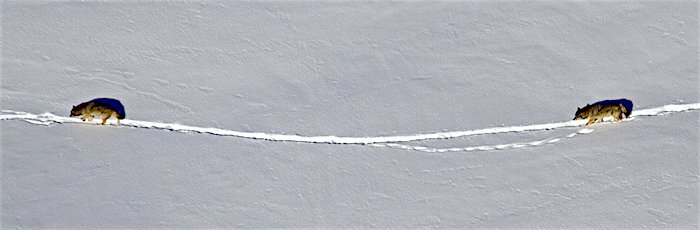
Wolves could begin returning to Isle Royale National Park this fall under a plan envisioned as a way to provide for a more dynamic "prey vs. predator" relationship in the park.
Twenty or 30 wolves, brought in from Michigan, Wisconsin, Minnesota, or possibly Canada, will be captured and released in the park over the next three years in a bid to tamp down the moose population that has exploded as inbreeding has reduced the existing wolf population on the island to just two related animals.
During a media call Thursday, the park superintendent, Phyllis Green, said the recovery program has "never been about genetic rescue. It’s really been about population management."
As the moose numbers have grown, Balsam fir forests on Isle Royale, an island in Michigan's Lake Superior, are vanishing in large part due to heavy browsing.
"The wolf population is also almost certainly headed for extinction, and wolf predation has been effectively absent as an ecological process for the past seven years," reads the summary of Ecological Studies of Wolves on Isle Royale, an annual report of which the latest edition was released last month. "Moose abundance probably increased over the past year even though the most recent point estimate declined from 1,600 to 1,475 moose based on the moose census in 2018. In the absence of wolf predation, moose abundance may double over the next four or five years. If that happens, it will be the largest number of moose ever observed during the six-decade history of the wolf-moose project."
Chronic inbreeding long has impacted the health of the wolf population. There was hope that "ice bridges" that formed between the Lake Superior island and the Canadian mainland during the winter of 2013-14 would enable wolves to arrive from Canada with new genes. But no new wolves reached the island, while one female left and was killed by a gunshot wound in February 2014 near Grand Portage National Monument in Minnesota.
Isle Royale wolves have been in decline for more than a decade. In recent years, park managers have discussed island and wolf management with wildlife managers and geneticists from across the United States and Canada, and have received input during public meetings and from Native American tribes of the area. Those discussions have examined the question of whether wolves should be physically transported to Isle Royale, in large part due to concerns that a loss of the predators would lead to a boom in the moose population that likely would over-browse island vegetation.
With the park's Final Environmental Impact Statement on a wolf recovery plan formally signed off on by Park Service officials, Isle Royale staff are now turning to implementing the plan.
“We have been speaking with potential partners for this reintroduction effort," said Mark Romanski, the park's natural resources chief, during the phone call. "Those partners include Department of Natural Resources (staff) from Michigan, Minnesota, Wisconsin. We’ve also been speaking with partners in Canada, and also tribal entities as we move forward, trying to figure out how we’re going to implement reintroduction.
“We’ll be capturing wolves on the mainland around the Great Lakes region," he continued. "We hope to capture from as many wide-ranging geographic areas as possible to maximize the genetic variability of the population that we end up putting into the park. We’ll be using leg-hold traps as well as cable restraints. We’ll also be considering darting from helicopters. We’re basically going to be keeping our toolkit wide open so that we have as much opportunity as possible to implement this plan.”
Once wolves are trapped for the recovery effort, they'll be checked by wildlife biologists and veterinarians, who will vaccinate them against canine parvovirus, distemper, and heartworm, said the chief.
It's expected that once trapping begins, wolves will be transported to Isle Royale quickly via plane, helicopter, or perhaps boat, and released, rather than being penned at a staging area. Both individual animals, as well as packs, will be considered for the effort. Depending on trapping success, that could mean one wolf at a time or several.
“NPCA has long-believed that wolves are critical to maintaining a healthy landscape at Isle Royale National Park," said Lynn McClure, senior regional director for the Midwest office of the National Parks Conservation Association. "We have supported the National Park Service’s process based in sound science. Today’s actions will help ensure this iconic species won’t disappear from the park.
“This tremendous outcome has been thoroughly researched and we appreciate the Park Service’s leadership, commitment to protecting park resources, transparent public process and in-depth scientific analysis to bring wolves back to the park," she added.
How the two wolves now in the park will be impacted by the new arrivals remains to be seen. Wolves are extremely territorial, and efforts will be made to release the newcomers away from the two, said Mr. Romanski.
“There won’t be a sudden influx of multiple animals," said Superintendent Green. "It’s probably going to be animals over time, and they will be sorting out territory and their own dynamics once they’re there.”
The plan, while applauded by many who long to hear the howl of a wolf, is not without detractors who wonder what happened to the Park Service's general tendency to let natural processes run their course. Superintendent Green acknowledged those concerns Thursday.
“I think that’s a valid concern that’s been expressed throughout the planning process," she said. "Especially from folks who are strong wilderness advocates, who even in the face of human-caused change want to try to minimize those changes."
Asked whether the recovery plan, which carries a $660,000 budget for the next three years, would require the staff to manage Isle Royale as a sort of open air zoo, where wolf numbers are added to or subtracted to maintain genetic variability or so as not to overrun the moose numbers, the superintendent didn't see that happening.
“We let wolves be wolves for the continuation of the next 20 years or so, or possibility longer if the genetics work the way our science tells us it has the possibility of working," said Superintendent Green.
She did, though, acknowledge the intervention brings some tradeoffs: What you lose in wilderness character, you gain in keeping the ecosystem functioning as it has been for the life of the park.
“What we’re really trying to preserve here is the dynamic between the two," said Mr. Romanski. "The number that we decided upon within the EIS process was 20-30 because that bracket (is) our long-term average with respect to wolves. Moose will do what they do in the presence of wolves. And their numbers will swing more, and that is largely dependent upon severe winters, or lack of severe winters, what kind of available forage they have. But the long-term average of moose is around 1,100 or 1,200 animals."
How the numbers play out in the long run, said the superintendent, will be left to nature.
“It’s a very hard path to predict. So it’s not a matter of stabilization so much as it’s a matter of dynamic opportunity for the apex predator and prey roles to continue," she said.
Stories about:
Story Categories:
A copy of National Parks Traveler's financial statements may be obtained by sending a stamped, self-addressed envelope to: National Parks Traveler, P.O. Box 980452, Park City, Utah 84098. National Parks Traveler was formed in the state of Utah for the purpose of informing and educating about national parks and protected areas.
Residents of the following states may obtain a copy of our financial and additional information as stated below:
- Florida: A COPY OF THE OFFICIAL REGISTRATION AND FINANCIAL INFORMATION FOR NATIONAL PARKS TRAVELER, (REGISTRATION NO. CH 51659), MAY BE OBTAINED FROM THE DIVISION OF CONSUMER SERVICES BY CALLING 800-435-7352 OR VISITING THEIR WEBSITE. REGISTRATION DOES NOT IMPLY ENDORSEMENT, APPROVAL, OR RECOMMENDATION BY THE STATE.
- Georgia: A full and fair description of the programs and financial statement summary of National Parks Traveler is available upon request at the office and phone number indicated above.
- Maryland: Documents and information submitted under the Maryland Solicitations Act are also available, for the cost of postage and copies, from the Secretary of State, State House, Annapolis, MD 21401 (410-974-5534).
- North Carolina: Financial information about this organization and a copy of its license are available from the State Solicitation Licensing Branch at 888-830-4989 or 919-807-2214. The license is not an endorsement by the State.
- Pennsylvania: The official registration and financial information of National Parks Traveler may be obtained from the Pennsylvania Department of State by calling 800-732-0999. Registration does not imply endorsement.
- Virginia: Financial statements are available from the Virginia Department of Agriculture and Consumer Services, 102 Governor Street, Richmond, Virginia 23219.
- Washington: National Parks Traveler is registered with Washington State’s Charities Program as required by law and additional information is available by calling 800-332-4483 or visiting www.sos.wa.gov/charities, or on file at Charities Division, Office of the Secretary of State, State of Washington, Olympia, WA 98504.
INN Member

The easiest way to explore RV-friendly National Park campgrounds.

Here’s the definitive guide to National Park System campgrounds where RVers can park their rigs.
Our app is packed with RVing- specific details on more than 250 campgrounds in more than 70 national parks.
You’ll also find stories about RVing in the parks, tips helpful if you’ve just recently become an RVer, and useful planning suggestions.


Comments
“How the numbers play out in the long run, said the superintendent, will be left to nature.”.
So why not leave it to nature now? After reading the article below I am even more opposed to interfering.
http://www.startribune.com/national-park-service-to-announce-long-awaite...
This is very good news. Glad to see the ongoing restoration of wolves to the Great Lakes region, and Isle Royale as a site for this.
Thank goodness this plan is finally approved and moving ahead. Inaction, a hands-off approach, would very likely lead to severe overbrowsiong from an exponentially growing moose population, with eventual weakening of the moose as they face near starvation. Non-interference is already a non-option; climate change, exposure of the wolf population to canine parvovirus, and other factors driven by humans have already interfered with this ecosystem and its predator/prey relationship.