
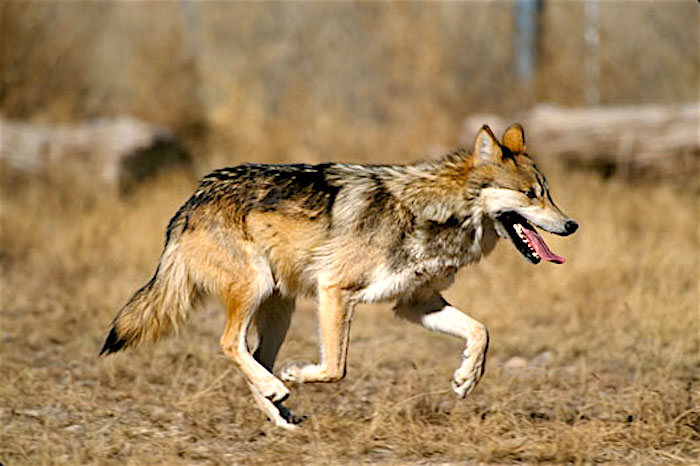
Smaller cousins of North American gray wolves, Mexican wolves long have been endangered. But conservation groups are hoping that a recent comment period on a draft recovery plan for the predators could lead to an effort to restore these wolves to the Southwestern landscape.
According to the Endangered Species Coalition, of the more than 100,000 comments received on the draft plan, more than 99 percent were in favor of implementing a recovery plan for the wolf.
“We wanted to be able to definitively say that the recovery of the Mexican gray wolf is important to Americans, and we can,” said Hailey Hawkins, Southern Rockies Field Representative for the Endangered Species Coalition. “Americans overwhelmingly support Mexican wolf recovery and the U.S. Fish and Wildlife Service’s recovery plan needs to reflect that,” said Hawkins.
Mexican wolves historically ranged "throughout mountainous regions from central Mexico, through southeastern Arizona, southern New Mexico, and southwestern Texas," according to the U.S. Fish and Wildlife Service. "More recent information obtained from examining historical wolf specimens however, suggests that Mexican wolves may have roamed farther north. The Mexican wolf was common throughout its core range through the mid-1800s."
Within that range falls Saguaro National Park, Big Bend National Park, and Guadalupe Mountains National Park, and Organ Pipe Cactus National Monument is on the fringe of the range. The Mexican wolf is said to prefer mountain woodlands, such as that found in the Rincon District of Saguaro and the high country of Big Bend and Guadalupe Mountains national parks.
In examining the recovery program proposal, Fish and Wildlife officials say if implemented it would greatly help the genetic diversity of the species, as captive populations have higher genetic diversity than wolves in the Mexican Wolf Experimental Population Area in the United States and northern Sierra Madre Occidental area in Mexico.
The comment period on the recovery plan was held during this past summer. After it ended, seven organizations and dozens of volunteers came together to tally the comments, publicly available on the government comment portal, Regulations.gov. The organizations included the Endangered Species Coalition, Grand Canyon Wolf Recovery Project, Lobos of the Southwest, Wolf Conservation Center, White Mountain Conservation League, Sierra Club’s Grand Canyon Chapter, and Sierra Club’s Rio Grande Chapter. It took weeks and over a hundred hours for the volunteers to tally the thousands of comments, which came from all 50 states, according to an Endangered Species Coalition release.
The last recovery plan was drafted in 1982 and has been in critical need of updating, the coalition said. The current draft recovery plan must be completed by November 30, as mandated by a court order.
According to the conservation groups' review of the comments, most voiced concern that "the USFWS draft recovery plan wasn’t based on the best available science in its calculation of wolf recovery goals, and that barriers to habitat connectivity weren’t adequately addressed. For instance, the proposed plan calls for only about 300 wolves in the Southwest United States, even though biologists on the USFWS’ own Science and Planning Subgroup calculated that a population of at least 750 wolves should be established before delisting. This was just one of a number of intentional blind spots on the science of wolf recovery adopted in the proposed plan."
“Folks across the country want a wolf recovery plan based on the best available science--one that accounts for habitat fragmentation, severely low genetic diversity, poaching, and a potentially disastrous border wall,” said Ms. Hawkins. “The proposed draft recovery plan does not allow Mexican wolves to fully recover in the Southwest.”
The Mexican gray wolf is one of the rarest mammals in North America, with only 113 individuals thought to be in the wild. There are many hurdles hindering the recovery of the Mexican wolf, including poaching, declining genetic diversity, and federal legislation aimed at removing protections for the wolf.
The Mexican gray wolf was almost completely extinct when it was listed under the Endangered Species Act in 1976. Shortly after, a captive breeding program was initiated with the only five remaining individuals. After 30 years of absence, the Mexican wolf finally returned to the American Southwest when they were released to the wild in 1998. However, after almost 20 years, the endangered Mexican wolf is still struggling to recover due to a lack of investment in scientific recovery requirements. Without a strong recovery plan from US Fish and Wildlife Service, it is unlikely the Mexican wolf will fully recover from the brink of extinction.
Stories about:
Story Categories:
A copy of National Parks Traveler's financial statements may be obtained by sending a stamped, self-addressed envelope to: National Parks Traveler, P.O. Box 980452, Park City, Utah 84098. National Parks Traveler was formed in the state of Utah for the purpose of informing and educating about national parks and protected areas.
Residents of the following states may obtain a copy of our financial and additional information as stated below:
- Florida: A COPY OF THE OFFICIAL REGISTRATION AND FINANCIAL INFORMATION FOR NATIONAL PARKS TRAVELER, (REGISTRATION NO. CH 51659), MAY BE OBTAINED FROM THE DIVISION OF CONSUMER SERVICES BY CALLING 800-435-7352 OR VISITING THEIR WEBSITE. REGISTRATION DOES NOT IMPLY ENDORSEMENT, APPROVAL, OR RECOMMENDATION BY THE STATE.
- Georgia: A full and fair description of the programs and financial statement summary of National Parks Traveler is available upon request at the office and phone number indicated above.
- Maryland: Documents and information submitted under the Maryland Solicitations Act are also available, for the cost of postage and copies, from the Secretary of State, State House, Annapolis, MD 21401 (410-974-5534).
- North Carolina: Financial information about this organization and a copy of its license are available from the State Solicitation Licensing Branch at 888-830-4989 or 919-807-2214. The license is not an endorsement by the State.
- Pennsylvania: The official registration and financial information of National Parks Traveler may be obtained from the Pennsylvania Department of State by calling 800-732-0999. Registration does not imply endorsement.
- Virginia: Financial statements are available from the Virginia Department of Agriculture and Consumer Services, 102 Governor Street, Richmond, Virginia 23219.
- Washington: National Parks Traveler is registered with Washington State’s Charities Program as required by law and additional information is available by calling 800-332-4483 or visiting www.sos.wa.gov/charities, or on file at Charities Division, Office of the Secretary of State, State of Washington, Olympia, WA 98504.
INN Member

The easiest way to explore RV-friendly National Park campgrounds.

Here’s the definitive guide to National Park System campgrounds where RVers can park their rigs.
Our app is packed with RVing- specific details on more than 250 campgrounds in more than 70 national parks.
You’ll also find stories about RVing in the parks, tips helpful if you’ve just recently become an RVer, and useful planning suggestions.


Comments
We need Mexican wolves in southern Utah and southern Colorado, too.