
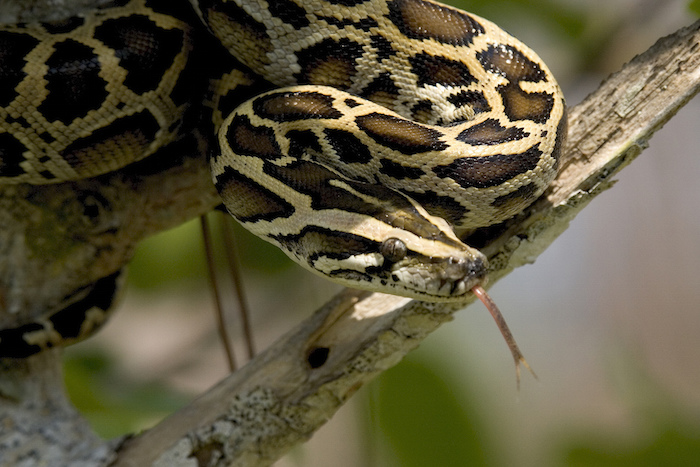
A plan to open Everglades National Park up to the "Python Challenge" early next year is both wrong and probably illegal, according to Public Employees for Environmental Responsibility, which wants the National Park Service to prevent the hunt from being conducted within the park.
While the snake hunt is intended to reduce the number of non-native Burmese pythons in south Florida, PEER officials maintain the hunt won't likely reduce the number of pythons in the park, that it's unsupported by scientific review, and could lead to similar "hunts" in other parks with non-native species problems, such as Great Smoky Mountains National Park where a feral pig population lives.
The first Python Challenge, sponsored by the Florida Fish and Wildlife Conservation Commission, was held in 2013 in lands outside the national park. It led to the capture of 68 snakes, including one more than 14 feet in length.
In supporting next year's hunt, Everglades Superintendent Pedro Ramos said he and his staff "look forward to expanding access into the park and to providing more opportunities for members of the public to become approved authorized python agents."
However, according to PEER, "only once in NPS history has Congress approved the use of deputized agents for removal of wildlife – back in 1950, to reduce the elk population in Grand Teton National Park."
"The Everglades python hunt of 2016 is a misguided publicity stunt that would not improve, let alone solve, the python problem,” said Jeff Ruch, PEER's executive director. “This would set a terrible precedent for no good reason. Unfortunately, what this episode really reflects is an advancing institutional decay in the quality of national park leadership.”
The aim of the 2016 Python Challenge™ is to promote Everglades conservation through invasive species removal, and the FWC and the Fish and Wildlife Foundation of Florida, Inc., see the hunt as one way to provide training to members of the public so they can help. Training events will teach participants how to identify, report, and then safely and humanely capture Burmese pythons.
While no one disputes that pythons introduced into Everglades National Park are a non-native, invasive species that has altered the park ecosystem, PEER said in a release issued Tuesday, the organization believes some significant obstacles stand in the way of the plan:
* As in most national parks, it is illegal for anyone other than National Park Service employees or contractors to hunt animals of any kind inside Everglades National Park;
* The park has not done the environmental reviews, together with opportunities for public comment, required by federal law, and;
* Despite claiming that the snakes collected will aid scientific research, there is no study design or research proposition to be validated.
Superintendent Ramos' comments in support of the hunt, said PEER's Mr. Ruch, are misguided.
“Superintendent Ramos appears to be making this up as he goes along, but national parks are not supposed to be run from the seat of someone’s pants,” he said. “Most people already know that Everglades has a python problem, but it is utterly mysterious why putting on a contest will avert the arrival of more invasive species.
"... The Everglades python hunt of 2016 is a misguided publicity stunt that would not improve, let alone solve, the python problem,” added Mr. Ruch. “This would set a terrible precedent for no good reason. Unfortunately, what this episode really reflects is an advancing institutional decay in the quality of national park leadership.”
Stories about:
Story Categories:
A copy of National Parks Traveler's financial statements may be obtained by sending a stamped, self-addressed envelope to: National Parks Traveler, P.O. Box 980452, Park City, Utah 84098. National Parks Traveler was formed in the state of Utah for the purpose of informing and educating about national parks and protected areas.
Residents of the following states may obtain a copy of our financial and additional information as stated below:
- Florida: A COPY OF THE OFFICIAL REGISTRATION AND FINANCIAL INFORMATION FOR NATIONAL PARKS TRAVELER, (REGISTRATION NO. CH 51659), MAY BE OBTAINED FROM THE DIVISION OF CONSUMER SERVICES BY CALLING 800-435-7352 OR VISITING THEIR WEBSITE. REGISTRATION DOES NOT IMPLY ENDORSEMENT, APPROVAL, OR RECOMMENDATION BY THE STATE.
- Georgia: A full and fair description of the programs and financial statement summary of National Parks Traveler is available upon request at the office and phone number indicated above.
- Maryland: Documents and information submitted under the Maryland Solicitations Act are also available, for the cost of postage and copies, from the Secretary of State, State House, Annapolis, MD 21401 (410-974-5534).
- North Carolina: Financial information about this organization and a copy of its license are available from the State Solicitation Licensing Branch at 888-830-4989 or 919-807-2214. The license is not an endorsement by the State.
- Pennsylvania: The official registration and financial information of National Parks Traveler may be obtained from the Pennsylvania Department of State by calling 800-732-0999. Registration does not imply endorsement.
- Virginia: Financial statements are available from the Virginia Department of Agriculture and Consumer Services, 102 Governor Street, Richmond, Virginia 23219.
- Washington: National Parks Traveler is registered with Washington State’s Charities Program as required by law and additional information is available by calling 800-332-4483 or visiting www.sos.wa.gov/charities, or on file at Charities Division, Office of the Secretary of State, State of Washington, Olympia, WA 98504.
INN Member

The easiest way to explore RV-friendly National Park campgrounds.

Here’s the definitive guide to National Park System campgrounds where RVers can park their rigs.
Our app is packed with RVing- specific details on more than 250 campgrounds in more than 70 national parks.
You’ll also find stories about RVing in the parks, tips helpful if you’ve just recently become an RVer, and useful planning suggestions.


Comments
It's easy to criticize from a distance, and while I often agree with PEER, I have to ask if Mr. Ruch has a better idea?
Yes we do, employ a team of 6 to 10 specially trained seasonal NPS employees to actively capture kill and remove pythons from the park under the auspices of the National Park Service.
The NPS has no money? Well, PEER believes the python situation in the Everglades is too important for gimmicks. It demands that the NPS leadership pay attention to it in a serious way and fund a real effort. Parks like Halaeakala NP in Hawaii employ NPS staff specifically to reduce feral goats, non-native deer and other exotic species. It can and has been done in other parks.
Perhaps the NPS should devote some of its resources from the donors for the Centennial or the National Park Foundation for this very important task.
As good an objective as python removal is - and it is - the NPS must accomplish it without kicking away some of the most important underpinnings that support our concept of National Parks
Other than offending Mr. Ruch's distain for hunting. What exactly is the downside of this "hunt"?
The downside? Well the downside people would need kill pythons and the problem is they might have to use guns you know guns is a bad thing guns of something this country should never have had after all if we hadn't had guns maybe we would be speaking German now I don't know maybe people just don't like other people to enjoy their favorite pastime and many people are truly power hungry I've been to the Everglades it doesn't appear that's going to infringe upon anyone whatsoever except some people just hate the idea that other people might enjoy a sport they can't understand
They must be removed and the issue of preventing arrival of additional Pythons depends on education, PSAs, signs, classroom programs, etc.
This is Jeff Rucks qualifications...Please note he has never held a job connected to the outdoors nor does it seem he has ever spent any time outdoors since he has been a political activist pundit his entire career. So he is qualified to tell the professionals at NPS how to do their job? This is what is wrong in the US. I bet tqxpaqyers pay his salary!
Jeff Ruch has been the Executive Director of PEER since 1997. With Jeff DeBonis, he helped to start PEER and for its first four years served as General Counsel & Program Director. Prior to that Jeff was the Policy Director and a staff attorney at the Government Accountability Project representing whistleblowers from both the public and private sector. Before coming to DC, Jeff worked in California state government for 17 years, mostly in the State Legislature as counsel to various committees where he drafted literally hundreds of laws on topics ranging from energy conservation to the rights of employed inventors. Jeff served stints as a deputy district attorney, an appellate court clerk and is a graduate of the California Correctional Officers Academy.
opportunity to reduce invasive aninimal population while educating public and getting them to experience the park. All at minimal cost and little to no liability. This is a problem how?
What does python taste like? Might be some marketing opportunities there.
Python burgers. Python steaks. Hmmmm.
Great Idea. Lets get them all and send any extra pythons to PEERS.
Harry Butowsky
One idea would be to have the park do some environmental compliance on the issue. As far as I can tell, there has been none. This idea deserves at least an Environmental Assessment, if not an EIS. Opening a park to hunting is certainly a significant action and is controversial.
Rick - can you even conceive of a negative enviromental impact? Sometimes common sense needs to overcome beauracracy.
EC--It's not beauracracy; it's the law.
"it's the law. "
Is it? What is the trigger point that requires an EIS? If they pull invasive weeds do they need an EIS?
This sounds like PEER advocating on behalf of the union. I suspect that if public employees were hired to eradicate the snakes they wouldn't have an issue.
They have been hiring professional hog hunters in the Smokies for years. Many of us have come upon them. It is common knowledge here. Not that they have made any dent whatsoever in the population. They are like coyotes. You can't kill enough of them. I suspect the pythons are a similarly no eradicatable pest.
I asked today, Eric about your weed/EIS question. There are books of regulations for compliance specialists to be aware of. Specifically to your question,. some weeds, some places yes, some weeds some places no.
"There are books of regulations for compliance"
There in lies one of the problems.
Speaking as someone who manages compliance for an NPS site I find it amazing that a park of this size couldn't put together a compliance package for this that concluded no historic properties were effected and that this action, the removal of individuals of a non T/E species that were threating resources, was covered by a categorical conclusion. This would have taken all of an hour of somebody's time. The superintendent could have easily signed off on this and moved on. This appears not to be the case. And this is the same kind of decision making process that led to the Effigy Mounds fiasco. Too many managers in the agency do not meet their legal obligations because of a desire to see their decisions put into action without any possible delay or criticism from their staff. This is exacerbated by the reality of an agency that desires to not hold its managers accountable in public. There is nothing wrong with removing or killing invasive snakes in the Everglades. There is nothing in the law that prohibits the NPS from undertaking such a program. But starting such a program while apparently not following the legally mandated compliance process, all for the sake of the appearance of a superintendent's career and their ability to "get things done," is the problem. And its not just happening at Everglades.