
Top Interior Department and National Park Service officials used Earth Day to promote the National Park System as an economic engine with an annual output of $30 billion and which serves as a carbon sink with an additional value of nearly $600 million.
The report, released at 6 a.m. Eastern on Wednesday, comes at the mid-point of National Park Week and as the National Park Service builds on its campaign to mark its centennial in August 2016.
Along with touting the economic value of the park system, a clutch of accompanying reports pointed to $26 million in improvements to parks from coast to coast, the president's "Every Kid in a Park" initiative that will see 4th graders this fall receive an annual parks pass, and the "Find Your Park" campaign to connect all Americans to the country's system of public parks and recreation lands.
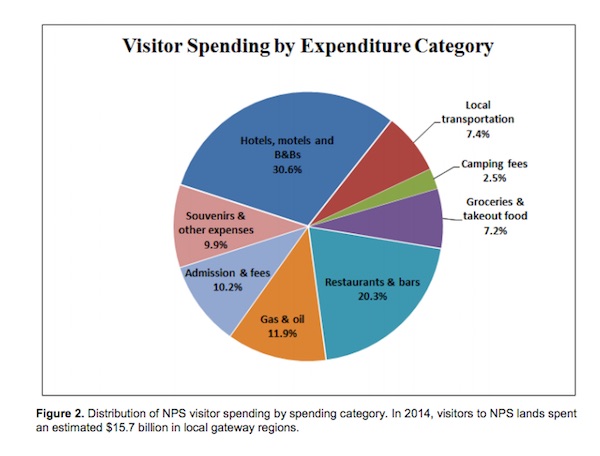
In 2014, the National Park System received over 292 million recreation visits. NPS visitors spent $15.7 billion in local gateway regions (defined as communities within 60 miles of a park). The contribution of this spending to the national economy was 277 thousand jobs, $10.3 billion in labor income, $17.1 billion in value added, and $29.7 billion in output. The lodging sector saw the highest direct contributions with 48 thousand jobs and $4.8 billion in output directly contributed to local gateway economies nationally. The sector with the next greatest direct contributions was restaurants and bars, with 60 thousand jobs and $3.2 billion in output directly contributed to local gateway economies nationally.
In a prepared statement, Interior Secretary Sally Jewell said the economic data underscore that, 'Our national parks often serve as economic engines for local communities, drawing tourists from around the world who pump money into area stores, restaurants, hotels and more. At the same time, these treasured landscapes have shown they support strong public health by absorbing carbon pollution that contributes to climate change. When we invest in our parks, we're not only preserving our natural and historic sites, we're supporting strong economic growth and healthier communities.'
Gateway communities to the parks were a large benefactor of this spending, as motels and hotels in those communities received $9.5 billion in business from park visitors, while commercial campgrounds in those communities saw $922 million in business, according to the economic report.
The economic news was welcomed by the National Park Hospitality Association, which represents national park concessionaires.
'We applaud NPS efforts to describe the importance of park visits to regional and national economies ' it is significant, indeed," said Derrick Crandall, the association's counselor, in an email. "Even beyond the important figures contained in the report, national parks play an important role in prompting purchases of recreational equipment well beyond the 60-mile region around parks ' including major goods like RVs and boats and clothing. We also note that this report does not assess the value of our parks on inbound tourism to the United States ' a major and growing positive influence on our national economy.
'Best of all, the economic value of national parks to the nation can be enhanced without threats to the natural, cultural and historic resources of park units with management changes like longer operating hours and seasons and investment in appropriate visitor facilities designed to be low impact and efficient to operate.'
The news was also welcomed at the National Parks Conservation Association, where Craig Obey, the group's senior vice president for government, noted that, "It's clear that when our national parks are a priority, our economy benefits. The $3 billion increase in economic impact over 2013 is because more people visited parks, parks and communities didn't suffer the negative impact of a federal government shutdown, and the sequester cuts to parks were temporarily addressed.
'We had a record-breaking number of visits to national parks in 2014, and even more visits are likely with the approaching park centennial. This is the time to permanently end the sequester, reverse annual funding shortfalls, and fix park infrastructure with a pro-park transportation bill," he added in a prepared statement.
The report noted that its figures were best estimates based on various models, and that were likely over-estimated in some areas, and under-estimated in others.
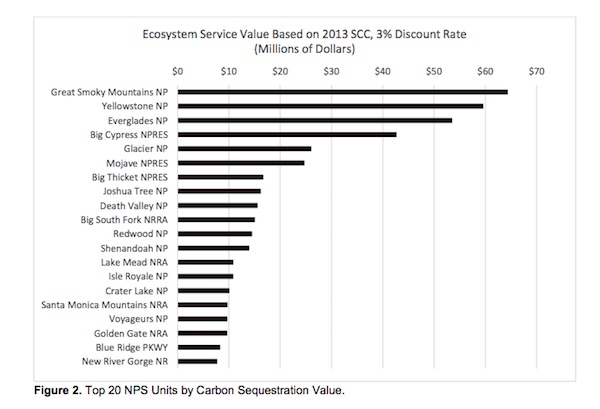
As for parks serving as carbon dioxide sinks, the press release said, "Scientists found that 78 percent of the parks studied functioned as net carbon sinks, meaning that more CO2 is stored, or sequestered, than is released. Great Smoky Mountains National Park stored the largest amount of CO2, 1.6 million metric tons, valued at $64.4 million, each year."
"...in aggregate, NPS lands in the conterminous United States are a net carbon sink, sequestering more than 14.8 million metric tons of carbon dioxide annually. The associated societal value of this service is estimated at approximately $582.5 million per year," the report added.
Stories about:
Story Categories:
A copy of National Parks Traveler's financial statements may be obtained by sending a stamped, self-addressed envelope to: National Parks Traveler, P.O. Box 980452, Park City, Utah 84098. National Parks Traveler was formed in the state of Utah for the purpose of informing and educating about national parks and protected areas.
Residents of the following states may obtain a copy of our financial and additional information as stated below:
- Florida: A COPY OF THE OFFICIAL REGISTRATION AND FINANCIAL INFORMATION FOR NATIONAL PARKS TRAVELER, (REGISTRATION NO. CH 51659), MAY BE OBTAINED FROM THE DIVISION OF CONSUMER SERVICES BY CALLING 800-435-7352 OR VISITING THEIR WEBSITE. REGISTRATION DOES NOT IMPLY ENDORSEMENT, APPROVAL, OR RECOMMENDATION BY THE STATE.
- Georgia: A full and fair description of the programs and financial statement summary of National Parks Traveler is available upon request at the office and phone number indicated above.
- Maryland: Documents and information submitted under the Maryland Solicitations Act are also available, for the cost of postage and copies, from the Secretary of State, State House, Annapolis, MD 21401 (410-974-5534).
- North Carolina: Financial information about this organization and a copy of its license are available from the State Solicitation Licensing Branch at 888-830-4989 or 919-807-2214. The license is not an endorsement by the State.
- Pennsylvania: The official registration and financial information of National Parks Traveler may be obtained from the Pennsylvania Department of State by calling 800-732-0999. Registration does not imply endorsement.
- Virginia: Financial statements are available from the Virginia Department of Agriculture and Consumer Services, 102 Governor Street, Richmond, Virginia 23219.
- Washington: National Parks Traveler is registered with Washington State’s Charities Program as required by law and additional information is available by calling 800-332-4483 or visiting www.sos.wa.gov/charities, or on file at Charities Division, Office of the Secretary of State, State of Washington, Olympia, WA 98504.


National parks and their natural resources belong to you. The National Parks Traveler works to ensure you know how these essential places are being cared for.
Sign Up For Our Weekly Newsletter
Unsubscribe at any time.
INN Member

The easiest way to explore RV-friendly National Park campgrounds.

Here’s the definitive guide to National Park System campgrounds where RVers can park their rigs.
Our app is packed with RVing- specific details on more than 250 campgrounds in more than 70 national parks.
You’ll also find stories about RVing in the parks, tips helpful if you’ve just recently become an RVer, and useful planning suggestions.


Comments
I would feel a whole lot better about this "carbon dioxide sink" business if Interior Secretary Jewell, et al., conceded that this applies to ALL open land, including the public lands surrounding the national parks currently targeted for massive, renewable energy projects. So, how about it, Secretary Jewell? Can we do those environmental impact statements properly for a change, or is it just the national parks you intend to credit for reducing carbon?
Forty-five years ago, Earth Day meant the earth. I would like to hear how that "economic engine" is doing, but yes, that may be above everyone's pay grade. That level of preservation would take real discipline. Just don't preach to me about reducing my carbon footprint if you think the problem is resolved with a boundary. Inside the parks--we will save the land. Outside the parks, have at it.
Earth Day. The most important thing about the national parks they can think of for Earth Day is that they're an economic engine. This is so wrong on so many levels I can't even begin to list them all.
i agree Megaera and Dr. Runte, the secretary should have started with the ecological value of parks and public lands and the importance of thinking about that in our daily lives. Thanks for posting Traveler.
But Dr. Runte, doesn't there have to be a starting place? And aren't parks a good one -- hopefully of many?
Shouldn't the U.S. be a leader in this and not be dragged, kicking and screaming, into efforts to become the best Earth stewards we can be?
Even if the only thing important to some is money, our reluctance to look forward and our insistence on looking backward is costing us many opportunities for jobs and businesses.
Again, let me highly recommend the book, The Human Age by Diane Ackerman.
But mega, in America if it's not tied to money, it just doesn't merit any attention at all.
The dollarizing distresses me. I've mentioned before that I feel the National Parks are one of those places where the nation decides the intangibles are self valued. A scenic overlook should inspire a 'wow', rather than looking around for the box to drop a quarter into or quibbling over the price of the turn-out's parking lot. The more such sights that are lost due to unscrupulous development or factory smokestacks, the more priceless value the remaining ones build.
That, to me, is the meaning of Earth Day in the National Parks.
Lee, I am all for "starting" somewhere, so long as the somewhere makes biological sense. Where is it written that I have to give up my public lands to "save" planet earth from disaster? Ms. Ackerman is a stray following the herd on that issue. Many greater minds--greater scientists--have forewarned us about destroying any part of the natural world, whether or not it was "preserved" in parks.
I say again: If the national parks are worth preserving as "carbon sinks," ALL land is worth preserving as carbon sinks. If land (and plants) absorb carbon, it would seem incumbent on us to be protecting the land itself, no matter what it is called.
That is "old-style" environmentalism, I know. Pardon me, then, for being an old-style environmentalist. It was Aldo Leopold who taught me to know the difference between preservation and expedience. In which case, I fear that my government prefers the latter, since it was my government that just drew a distinction between preserving the earth and preserving parks. I do not draw that distinction--and never have. I have forever believed that we need a "land ethic" as much as we need the national parks.
But thier dishonest ideological, not science or ecological, driven rules and policies are continuing to reverse and slow down that engine in many cases.
I don't disagree with you on what you wrote here, Alfred, but I'm not sure sometimes just what you're getting at in some of your posts. This time, you were clear and it's just the same as what I've been pushing. Our parks are not the only places that need to be preserved -- it's the entire ball of water, rock, and air upon which we all live.
Diane Ackerman's book does NOT advocate saving only parks. It does an excellent job of pointing out ways in which we could help with the preservation of the entire planet -- and we humans who infest it. Have you read the book?
Lee, I have not yet read the book. I note that she has 23 books. I take 10 years to write one of mine. I looked in her table of contents, index, and bibliography for the topics and books that have always mattered to me. Not finding most of them I am left to wonder. What is so revolutionary about her thoughts? She is a popularizer. Fine. I get it. She pulls other books together and writes a book. Scholars are taught to be definitive. We don't get to pick and choose our sources.
So, what are the "ways in which we could help with the preservation of the entire planet" that so motivate you to love this book? I have loved many books, but only a few of them are brutally honest about this fact. If human population continues to increase, all of it is "over." The numbers will overwhelm us beyond the ability to "play with others," including a sandbox that is "green."
Is Ms. Ackerman saying that, or providing us with another "fix?" I see the fixes her sources have in mind, and yes, some of them may buy us a little time. But not if we don't address the numbers, because the numbers keep going up. And planet earth is fixed. As I speak, two neighboring houses are being turned into an apartment complex, while Seattle still lacks for decent streets. We've "desensified" and are saving farmland (allegedly), but life in the city is becoming a mess.
It's not in a book, Lee. It's all around us. There is nothing new to be said. "We have met the enemy, and he is us." But yes, I will read the book--as soon as I finish my current book review for Kurt.
Dr. Runte - Your rant or argument or whatever it is seems incredibly contrived. The report simply points out (and promotes) some data about the NPs being carbon sinks. Why should Sec Jewell have to "concede" anything about other lands? While I agree and understand that other lands can act as carbon sinks as well, I see nothing in this article that denies that or merits your response. Maybe I'm missing it? Also note that in the case of surrounding Nat Forest lands, as well as state parks or other state conservation lands, Sec Int has nothing to do with them anyway. I guess I understand some of your points, but I don't understand your attack.
There are extensive public lands that merit consideration for designation as carbon preserves under National Park Service protection. Today, they are releasing massive amounts of carbon due to industrial logging and other resource extraction. It is highly unlikely that these carbon forests will be protected anytime soon under their current development-oriented land agencies.
Examples that have carbon preserve National Park potential include:
• The ancient National Forests of the Pacific Northwest
• the Bureau of Land Managment's "O & C" forest lands in Oregon
• high-biomass-density National Forests in the East, such as the Allegheny (PA), Chequamegon-Nicolet (WI), Green Mountain (VT), Mississippi (MS), and Ottawa (MI)
• many of our National Grasslands, which are under Forest Service administration
• state lands with high carbon storage potential, such as the Quabbin in Massachusetts
Scott, You are obviously unaware that the Secretary of the Interior manages 267 million acres under BLM (Bureau of Land Management). Over there, Interior cannot part with those lands fast enough for large-scale wind and solar projects. In fact, Secretary Jewell just denied the Sage Grouse endangered status so more of those projects can move forward. She alleges it is because those populations are "recovering," but really, I think I smell another million acres of sagebrush and desert "wasteland" about to be coverted into something more "productive."
My rant, as you call it, is that. Yesterday (April 22) was Earth Day. Ms. Jewell is in charge of 350 million acres of the American Earth. In my opinion, it makes no sense to separate out the acres--or wildlife populations--she is willing to preserve. Her duty is to be preserving all of them, subject to economic allowances that make biological sense. Of course she is not "denying" that other lands act as carbon sinks, but there, the biology is being conveniently muzzled. It's a trick as old as the public lands. Point to what the public loves the most and say you love it, too, hoping the public will not ask what is happening to the rest of it. Remember James Watt? Oh, how he loved Yellowstone, while protesting that everything else under his charge was a waste.
Two percent of the American Earth is in national parks. Good for us, but what about the other 98 percent? On Earth Day, I want to see a news release talking about that for a change.
I ask the Wizard to show me everything behind the curtain. I will leave you with two specific examples of landscapes the country has lost, or remains about to lose. East of Searchlight, Nevada, on public lands managed by BLM, Duke Energy, et al., have planned a wind farm abutting Lake Mead National Recreation Area. Just over the hill, at Ivanpah, California/Nevada, a 390-megawatt thermal solar power plant is cooking next to the Mojave National Preserve, again, on lands managed by BLM.
How are these projects "good" for the desert, wildlife, natural beauty, and yes, the preservation of natural carbon sinks? And if they're not good for them, why did Interior approve those projects? I await Secretary Jewell telling me that. And until she tells me, I would just as soon she not deflect my attention by "reinventing" the national parks. This reinvention is bogus. The issue remains the land. Interior is not preserving it; under this administration they have rather been converting it. And it is time the public knew just how much.
I would feel a whole lot better about this "carbon dioxide sink" business if the President did not take Air Force One and a back up plane to Florida to make his speech. Air Force One burns 4 gallons for every mile flown. Just think about how much CO2 President Obama put into the atmosphere for his "Photo Op" moment at the Everglades. Perhaps a speech given from the Oval Office and broadcast to Florida might have been more appropriate for this occasion. What about it Mr. Obama?
Agreed, Alfred, WE are the enemy. And yes, overpopulation of the planet is our biggest threat. And yes, we are dithering instead of even trying to think of solutions. Books like Ackerman's are at least attempting to get the story out in understandable terms to average people. Unfortunately, average people are too busy being entertained to pay attention.
I'm glad I won't be here when the fit hits the shan, but I do worry about my grand and great grand kids. The future looks pretty bleak from where we now stand.
Dr. Runte - All the points you site in your response to my post are excellent, except for one: I am aware of Interior managing BLM lands. You are again doing precisely what I had a problem with in the first place. I specifically stated: "..in the case of surrounding NF lands..." which you then twisted into me being "obviously unaware...of BLM". I really just wish you would could get past this kind of stuff.
Anyway, all very good points, as are Michael Kellet's which are presented without any other distractions.
For the record, in my opinion places like Lake Mead suck anyway because those big fat reservoirs shouldn't be there in the first place. I'd like to see both the dam busted and the wind farm taken off the table.
I am in complete agreement that population explosion is #1 problem. But it's not going away any time soon so we are tasked with figuring out ways to handle it, unfortunately. At the same time we certainly should be trying to rein it in.
Scott,
What would you use to replace that water? Given the current drought conditions in CA and elsewhere in the west and the shortage of water exaserbated by inadequate reservoir storage, that doesn't seem like such a great idea.
EC -
You are correct it would be a colossally bad idea to go bust up the dam tomorrow. I was being very flippant and general in my response.
I would advocate for a well planned destruction of the reservoir that necessarily includes planning for the welfare of the people impacted. It also would necessarily include a more common sense approach to people living in such arid lands.
EC and Scott,
By all credible projections, there will never again be enough water to fill both Lake Powell and Lake Mead reservoirs, due to the impacts of climate change, reduced Colorado River flow, and rising demand for water. Glen Canyon Institute has proposed the Fill Mead First plan, which would designate Lake Mead as the primary water storage and distribution facility for the upper and lower Colorado River basins. Operation of Glen Canyon Dam would be changed to allow water to flow through as a run-of-river facility, filling Lake Mead reservoir before impounding water upstream in Lake Powell.
Fill Mead First would significantly reduce evaporation and seepage into the Lake Powell reservoir basin, saving or recovering 300,000 acre-feet or more of water per year. It would allow Glen Canyon to recover its natural integrity, allowing it to eventually be designated as a magnificent National Park. It would also benefit the Grand Canyon ecosystem, which is declining because 90 percent of life-giving sediment is being held back by Glen Canyon Dam. And it would store the water where it is needed, in Lake Mead, which supplies water to millions of people in Nevada, Arizona, and California — and holds water allocated to Mexico by international treaty.
With the growing impacts of climate change, Fill Mead First is already happening, without any change in water management policy. Dan Beard, former Commissioner of Reclamation says it is time to recognize the inevitable. He says we should acknowledge that building Glen Canyon Dam was a collossal mistake, and we should tear it down and restore a free-flowing river through Glen and Grand Canyons. His new book, Deadbeat Dams, makes the case for this strategy, as well the abolishment of the Bureau of Reclamation, which he argues is obsolete.
All of those projections have so far been completely incorrect. Poor water management practices, environmental policies and low rainfall are the problem.
beachdumb,
Really? You left off the rest of my sentence: "due to the impacts of climate change, reduced Colorado River flow, and rising demand for water."
Even with the best management practices, the demand for water from the Colorado River has outstripped the supply. This is because the population has grown exponentially over the last half century. Better management can help, but not without a dramatic reduction in demand.
Most of the Colorado River's flow is from snowpack during the winter, not rainfall. The amount of snowpack has been decreasing and what does accumulate is melting sooner and losing more water to evaporation, because of the impacts of an unprecedented, 1,000-year drought, exacerbated by climate change.
As to projections being incorrect, maybe you have not seen the peer-reviewed paper published in 2008 by scientists at Scripps Institute of Oceanography, which predicted that Lake Mead could go dry by 2021, if existing trends continue. The continuing decline of Lakes Powell and Mead are consistent with this report's findings. Maybe you have not read the 2013 Colorado River Supply and Demand Study, which concluded that there is already a significant water deficit, and it is likely to rise to 3.2 million acre-feet by 2060. Since then, the trend is consistent with what they projected.
Perhaps you can share your sources of information that prove that these projections or the data they are based on to be incorrect, because I have not seen any.
Scott, it's the old professor in me, and I apologize. These days, I wouldn't last a day in a university. Simply, when you called my lecture a rant, well, I reverted to type. All of my lectures come to a conclusion that makes sense. You simply have to put down the smart phone and listen! I love The Traveler because people listen, and yes, for the most part intelligently respond. As for what is happening these days in universities, that is a lecture for another time.
You make excellent points, as well. And here is the point about Lake Mead--dam and all. It's beautiful. During the summer, I pass through there practically every week on my way to give lectures in Zion. It's blazing hot, but still beautiful. Those landscapes (especially the red rocks) are a gem. I can't get enough of seeing them, just as I can't get enough of the Mojave National Preserve and the great desert landscapes along historic Route 66.
Twenty years ago, we were right to expand our great desert parks, just as we are now wrong to forget the rest of the desert. I am not against wind and solar per se, but yes, they need to be sited carefully. Instead, we have Siemens and other companies this week taking out full-page ads in THE WALL STREET JOURNAL, informing us that concentrated solar and wind power are "good," because the land costs "out there" are so "reasonable." Again, I read between the lines. If the Interior Department were not leasing those lands so "reasonably," would wind and solar--as presently conceived--pencil out?
We already know the answer. No. That is why the "innovators" need the public lands and tax credits. That is why Interior does not call THESE lands "carbon dioxide sinks."
Every time my good friend Garrett Hardin was challenged in class (Biology and Human Ecology, UC Santa Barbara), he responded in this way: "What would you think of a man about to jump off the Empire State Building, assuring you he would invent a parachute on the way down?" He might well know the "invention" he needed, but could he pull it off in time?
That's us--promising ourselves the inventions, but can we pull enough of them off in time? And if we don't, what have we destroyed in the process? Why don't we simply wait and perfect the inventions before proceeding? We did that with the transcontinental railroads and the Space Program. We insisted the technology work. Then we gave the land grants and the government contracts. Only when the risk was reasonable did we take the risk.
What happened? Well, we have been discussing that, haven't we? These days, the politicians feel obligated to leave their mark on the fire hydrant, even when they have no pee. Look what I brought YOU! The point remains: It's our money they're spending. Those are our public lands.
Don't tell us that you see "carbon sinks," when what you really see is dollar signs. Kurt's editorial this morning says it all. And it's time we the public said it, too. You haven't given me a thing that I didn't already have. If you want to take credit for stealing it, at least be honest that your parachute might not open in time.
Apparently not:
"Precipitation on the Colorado Plateau is biseasonal, having both winter and summer regimes (Hereford and others, 2002). In the headwaters, precipitation generally is evenly distributed across the four seasons, accumulating mostly in snowpacks."
http://pubs.usgs.gov/fs/2004/3062/
Best you go back and reread that report.
"being exhausted by a 14-year drought, unprecedented in the last 1,000 years"
The report claims a 14 year drought which has been unprecedented in 1000 years. Very different statements.
EC,
I do not see how your citation from Hereford, et al 2002 refutes what I wrote.
I do stand corrected for carelessly citing the statement in the WRA report. The quote, as you accurately cited it, is bad enough that it does not need any embellishment.
You wrote that the water is primarily from winter snows. The report clearly states that the water contributrion is equivalent through the four seasons. That is important as the non-winter precipitation isn't held for any considerable period, it just flows. Without resevoirs it flows on by.
You want to base our water policy based on 14 years?
EC,
Perhaps you didn't read the USGS web page that you cited closely enough. Here is what it says (emphasis added):
Or, if there is still any doubt,
Your other question is totally spurious.
Seriously? I suggest that you read the studies that I cited, which draw on historic data as well as tree-ring data going back more than 1,000 years. The last 15 years is just the real-life confirmation of what hydrologists have been projecting for years. I do not know of any other reputable studies that disagree with the basic trends projected in these studies.
If you have anything factual information that contradicts these projections, which reflect overwhelming scientific consensus on this issue, by all means share it with us.
The last 15 years is just the real-life confirmation of what hydrologists have been projecting for years.
Can you show me the study where the body of hydrologists 20 or more years ago predicted the current western drought?
Okay, good people. Let's get back to basics. Whether or not the current drought is being exaccerbated by climate change, a prolonged drought in the Colorado Basin is not unusual. Now 41 years ago, the PBS film "Where Did the Colorado Go?" (NOVA) was predicting the crisis we have today. It's even on You Tube, I believe. I used the film every year in my American Environmental History class as my introduction to the big-dam era. So, what's new about today's debate? Nothing. If you build in a desert, you had better get used to drought. Or is there something about the term "desert" you don't happen to understand?
But no, we were smarter than Mother Nature and started building dams. And now those dams are drying up. Oops! Should we blame our own stupidity? Of course not. Because now we can scream climate change! The subliminal in play is what? That now we must remake the earth again. If the dams didn't work, perhaps 100 desalination plants will work. We get to "tinker" with the West all over again.
Of course, our "base line" data needs a comfortable floor, and so we make it 1,000 years. I have not watched the film since the 1980s, but I believe the data goes back much farther than that. I recall the film talking about 30-, 50-, and 100-year drought cycles, based on the tree rings of the Bristlecone pine. The point is: That "desert" did not form overnight, and in earth time, 1,000 years is the blink of an eye.
Again, I fear that the introduction of climate change is to "make the sale," now to industrialize the West to death. Without climate change, what would the Wizard have to sell us? Dorothy, you should not be here, but now that you are, click your heels together and repeat after me: "There is no place like my home in the desert! There is no place like my home in the desert!" Good, Dorothy, now go to Washington, D.C., and ask for $100 billion to save the desert from climate change. And don't forget to share with the Wizard!
I am all for tearing down Glen Canyon Dam, but then what? How will that solve the problem, either? Certainly, if I must trade Glen Canyon Dam for what the Interior and Energy Departments now plan for the desert in its place, I'll stick with the dam and take my chances. Perhaps it will snow, and perhaps it won't, but at least I won't be denying it is a desert. It's the denial, good people, not climate change, and yes, we started denying it the moment we read the Bible and determined to make our desert bloom like the rose.
EC,
You ask,
I previously asked you for any reputable studies that disagree with the basic trends projected in the peer-reviewed paper published in 2008 by scientists at Scripps Institute of Oceanography, which predicted that Lake Mead could go dry by 2021, if existing trends continue; the 2013 Colorado River Supply and Demand Study, which found that there is already a significant water deficit, and that it is likely to rise to 3.2 million acre-feet by 2060; or numerous other studies that have come to consistent conclusions. You still have not answered my question.
I do not and have not looked for any. One study hardly reflects the conclusion of the entire industry. In 2021 we will know if they were right. As Beach noted earlier, there have been many other chicken little studies about our climate and most have been wrong.
Even if that study's conclusion is true, how would blowing up the dam fix the problem?
EC,
I just discussed that question in my response to Alfred Runte's comments on our dialog. However, just to be clear, I am not calling for blowing up Glen Canyon Dam. Perhaps the dam should be torn down some day, but that would have major environmental, cost, and logistical ramifications that would need to be analyzed carefully. I do support a dramatic change in its operations, including a partial or complete bypassing of the dam.
Alfred,
You are certainly right that drought is nothing new to the Colorado Basin. However, I disagree that climate change is just being introduced to "make the sale." There is a rapidly growing body of scientific evidence that the Colorado River deficit caused by rising water demand and what is probably the worst drought in the last 1,000 years is being greatly exacerbated by the impacts of climate change — and that these impacts are going to get a lot worse in coming years. Because of climate change, we potentially face droughts that are far worse than any experienced in the human history of the Colorado Basin.
My main point has been that this situation renders Glen Canyon Dam unnecessary and we should take advantage of this second chance to restore Glen Canyon — one of the most biodiverse and culturally significant portions of the Colorado River. Of course, developing mega-solar energy facilities in inappropriate places is not acceptable and I join you in strongly opposing them. But those projects can happen with or without the dam. We should oppose them for what they are, whether or not the dam is producing hydropower.
Because of declining river flows, both Glen Canyon and Hoover Dams are already producing at least one-third less electricity than their capacity. Glen Canyon Dam represents a tiny portion of the western power grid and that number continues to decline. In contrast, Hoover Dam has a significantly greater generating capacity, so just from a hydropwer standpoint, it makes more sense to keep Lake Mead full instead of Lake Powell. That is aside from the huge water savings that would result from storing water in Mead instead of Powell.
Morover, the operation of Glen Canyon Dam continues to degrade the Grand Canyon ecosystem downstream. No viable option has been proposed that would solve this problem as long as the dam continues to operate as it does. If for no other reason, everyone who cares about Grand Canyon should support the goal of partly or completely bypassing Glen Canyon Dam — or tearing it down if need be —to protect and restore the Grand Canyon ecosystem.
So I totally agree with your condemnation of the foolishness of trying to continue water business as usual in a desert. But the growing water supply-demand imbalance is an opportunity to save and recover some of the extraordindary natural places that have been damaged by the unbridled quest for Colorado River water. I contend that we need to take advantage of that opportunity.
Best,
Michael
Michael,
At first I thought your objection was to damming in general. As our discussion has progressed I have realized your issue is more with the Glen Canyon Dam in particular. As I understand, you deem it redundant since Mead will never be filled.
I will admit I don't know enough about either of those bodies of water or their watersheds to decide if that is true or not. However, given how wrong climate predictions have been (remember the ice age predictions of the 70s) I don't know that I am ready to declare we will never need/want, Glen Canyon Dam in the future. And certainly not based on a supposed 14 year drought. I must say where I live in the Colorado River headwaters, the precipitation has been pretty darn good the last few years.
I would also note, I know far more people that like Lake Powell as a lake than want it to be returned to a dry canyon.
But, keep the data coming, I am always willing to learn.
EC,
Thanks. will do.
No none has mentioned the fact that both Lakes Powell and Mead evaporate enough water every day of the summer to supply the needs of Las Vegas or Los Angeles for a day. In addition, the evaporation leaves behind water so saline by the time it reaches Yuma that farmers find their fields being slowly destroyed by saltation.
What was that slogan that was so popular a few years ago? Something about It Ain't Nice To Fool Mother Nature.
Yup. But we keep trying.
Yes, Michael, I do agree. As "Where Did the Colorado Go?" makes clear, Lake Powell exists principally to distribute the water downstream, a role that was never really "necessary." You have my support in bypassing the dam, of course. I was simply making the point that with or without it, the problem of "living" in a desert persists. Eventually, climate change or not, a drought would come along that would repeat the past. We do appear to be "rebuilding" such a drought. Meanwhile, I applaud any effort to restore these magnificent canyons--as well as Grand Canyon itself. Now, aren't we glad we had David Brower? May he (and Edward Abbey) rest in peace.
Nice post Alfred, there are still many trying to educate citizens for the need for conservation, family planning, you name it. It is a tough nut to crack, even the issue of banning plastic water bottles in National Parks is seen as inconvenient or worse. Small steps taken can add up to big ones, many communities here in California are now banning the use of plastic shopping bags in markets, etc., it works. The town my son resides in is one such area, you learn to take your recyclable bags with you or be prepared to buy one at the store. It is no big deal. Fifty plus thousand residents of this town are doing it.
I agree, the issue of population and the pressure for growth to accommodate it is challenging. Many citizens are working hard for women empowerment and equality. Family planning (sex education), is on every educators agenda. many obstacles to overcome, but there have been some areas of success. Interestingly enough, there are still many political leaders calling for less government intrusion in peoples lives, but are only to eager to legislate mandates on a women's right to make her own reproductive health care decisions. Please excuse, getting off topic, an interesting discussion.
Works doing what? What does it accomplish? Food poisoning?
http://www.huffingtonpost.com/2013/02/07/plastic-bag-ban_n_2641430.html