
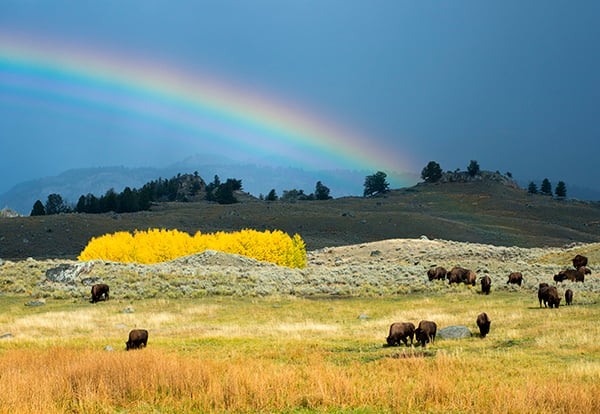
Even rainy days can turn into a pot of gold/Deby Dixon
In Yellowstone National Park today the wind was blowing cold air, snow, and rain into my face as I stood in Lamar Valley and watched as the 'new' Lamar Canyon pack, two adults and six pups, made their first public appearance in their valley. The pack visited an old carcass, ran, played, and hunted a 7-point bull elk.
If I were a fair-weather photographer, I would have been at home with a fire going in the wood stove, the window open a crack so that the sounds of the Yellowstone River filled my ears, and working on the computer, oblivious to the day's events. That is until I read about it on Facebook, at which time I would be kicking myself and extremely jealous of those who were there.
I am a full-time nature and wildlife -- primarily wildlife -- photographer living right outside of the North Gate of Yellowstone, and one would think that I could pick and choose my days in the park, based on weather and activity. But it does not work that way for me. I get up nearly every morning, well before dawn, and head out to see what the day will bring, never, ever, checking the weather forecast.
Some envy me and get a little jealous because of my access to the park, thinking that I have the dream job - that I am living their dream and so life is not fair to them.
While I am living my dream, it is not an easy life. Wildlife photography does not even cover its own expenses, let alone pay my living costs. And, I am out in all kinds of weather, driving, hiking, waiting, and watching, hoping that the day will bring fabulous wildlife sightings with stellar photographic opportunities that include subject, light, and background. But, those days and those opportunities are few and far between, and often I have the subject but not the light or the right setting.
But, most people do not live near Yellowstone or another national park and so do not have the luxury of looking outside and deciding if they want to venture into the park to take photos that day or not. They are here for a short time. As a result, most people will go out and make the best out of what the weather brings, rather than sit in their motel rooms, motor homes, or tents.
Recently, I went down to Grand Teton National Park in hopes of capturing some landscapes that included the mountains and the fall colors. My second wish was to capture some environmental wildlife photos of the animals in some of the most spectacular landscape I have ever photographed. I reached the Tetons in the middle of the afternoon, with blue skies, warm temperatures, and the mountains in full view, just ahead of a rain storm that would last for days. My plan was to just stay a day or two, tent camping at Gros Ventre Campground.

Having an umbrella handy will help keep your camera, and you, dry/Melba Coleman
My timing was bad for a couple of reasons - the rain came and stayed for days, and the Park Service had just put down a cow moose that had been injured when it ran into a picnic table and then fell into a fire grate. The moose was severely injured, and at the time of her accident she and the bull moose were surrounded by photographers.
A photographer is anyone with a camera who is taking a picture, and is not a title reserved for the pros with the big lenses. Photographers with the big lenses were initially accused of causing the moose to injure herself, but were later cleared of wrong doing when it was discovered that the moose had an eye infection and probably did not have good vision.
As a professional photographer, I purchased a big lens so that it was possible to stand back from the animals and give them space, yet still get the shots. And, while some photographers do push the limits and give the rest of us a bad name, the worse photography behavior comes from those with cell phone cameras and point-and-shoots who have decided that they should get the same, close shots that we get with our telephoto lenses. Time and again this summer I watched as visitors walked right up to dangerous animals and stuck cell phones in their faces, while crowding them so badly that the animal could not move about freely.
So, there I was in the Tetons, unwelcome because of being a photographer, and it was raining so no mountains and no pretty landscape/wildlife scenery shots. Home was only three hours away, so I could have left. But I instead chose to stay and see what the days would bring. And, despite the rain, I stayed much longer than my plan. As long as I am in a national park, I am happy, no matter what the weather is doing.
Until this year I have not had to deal with much rain in the parks and so had been quite lucky. Still, I was prepared for keeping my camera equipment safe with a rain cover that was specially made for me by the wife of friend and photographer, Max Waugh. I keep this rain cover on the camera and lens at all time because the weather can be sunny and warm one minute and cold and snowing the next. Besides, it protects my equipment from scratches and it makes my lens look bigger than it is. If you are interested in purchasing one let me know and I will put you in contact with Max. I found the rain covers at the camera stores to be very expensive and not the right color. I am not a camouflage sort of gal!
Other than a rain cover and some dry towels kept in the car, along with a beautiful and large umbrella given to me for my volunteer service at Yosemite National Park, I just have coats, hats, gloves and a change of clothes. I have yet to invest in rain gear.
The thing with shooting in low light is that if you bump up your shutter speed too high, you will get a lot of noise/grain in your images and if you shoot too low you risk images that are not sharp. Either way you will have unusable images.
My time in the Tetons, photographing the moose in the rain, gave me the opportunity to hone my low-light photography skills and stretch the limits of my camera. I found that as long as it was possible to keep the camera still, I could get some great shots at slower shutter speeds, and the rain added a different sense of atmosphere to the images, along with enhancing the texture of the animal's coat.
One of the techniques that I have found most useful for avoiding camera shake is the use of a bean bag, which absorbs the movement of the camera. And, so, whenever possible, I stayed in the car, which kept me fairly dry and warm, and used the bean bag over the window sill, instead of the tripod.
But, when I did use the tripod, I found that despite it being of good quality, it is near impossible not to get movement when pressing the shutter. Which is why I keep my hand over the top of the lens, to minimize movement. The best technique, and one that I don't use often because I have a hard time keeping track of them, is the use of a camera remote so that you don't have to push the shutter on the camera. Instead of the remote, I often use a 2-second timer, which delays the shot some but also keeps the camera steady and is useful when the subject is fairly stable. And, believe or not, those moose chose to stand in the same spots for long periods of time. Or, they were lying down.
One of the benefits of not having the beautiful Teton mountain range to place behind any landscape shot was that it challenged me to go out and find something beautiful in the soggy world, and so I explored the park from a completely different viewpoint and was quite happy with the outcome.
Now, I must admit that the entire time I was in Grand Teton National Park my mind was dreaming of the storm breaking and light streaming in front of dark and ominous skies, along with rainbows arcing from one end of the park to the other, but that never happened. Nothing wrong with dreaming.
So, don't let the weather keep you in. I have found some of my best landscape shots in the midst of a rainstorm.

Despite rainy weather, photo ops abound, such as this one from Grand Teton National Park/Deby Dixon
Story Categories:
A copy of National Parks Traveler's financial statements may be obtained by sending a stamped, self-addressed envelope to: National Parks Traveler, P.O. Box 980452, Park City, Utah 84098. National Parks Traveler was formed in the state of Utah for the purpose of informing and educating about national parks and protected areas.
Residents of the following states may obtain a copy of our financial and additional information as stated below:
- Florida: A COPY OF THE OFFICIAL REGISTRATION AND FINANCIAL INFORMATION FOR NATIONAL PARKS TRAVELER, (REGISTRATION NO. CH 51659), MAY BE OBTAINED FROM THE DIVISION OF CONSUMER SERVICES BY CALLING 800-435-7352 OR VISITING THEIR WEBSITE. REGISTRATION DOES NOT IMPLY ENDORSEMENT, APPROVAL, OR RECOMMENDATION BY THE STATE.
- Georgia: A full and fair description of the programs and financial statement summary of National Parks Traveler is available upon request at the office and phone number indicated above.
- Maryland: Documents and information submitted under the Maryland Solicitations Act are also available, for the cost of postage and copies, from the Secretary of State, State House, Annapolis, MD 21401 (410-974-5534).
- North Carolina: Financial information about this organization and a copy of its license are available from the State Solicitation Licensing Branch at 888-830-4989 or 919-807-2214. The license is not an endorsement by the State.
- Pennsylvania: The official registration and financial information of National Parks Traveler may be obtained from the Pennsylvania Department of State by calling 800-732-0999. Registration does not imply endorsement.
- Virginia: Financial statements are available from the Virginia Department of Agriculture and Consumer Services, 102 Governor Street, Richmond, Virginia 23219.
- Washington: National Parks Traveler is registered with Washington State’s Charities Program as required by law and additional information is available by calling 800-332-4483 or visiting www.sos.wa.gov/charities, or on file at Charities Division, Office of the Secretary of State, State of Washington, Olympia, WA 98504.
INN Member

The easiest way to explore RV-friendly National Park campgrounds.

Here’s the definitive guide to National Park System campgrounds where RVers can park their rigs.
Our app is packed with RVing- specific details on more than 250 campgrounds in more than 70 national parks.
You’ll also find stories about RVing in the parks, tips helpful if you’ve just recently become an RVer, and useful planning suggestions.


Comments
A good reminder to be flexible with plans, especially in situations where we've made a long trip to a park, and have only a few days to enjoy the area, despite the weather. Bad weather can have a plus, too. This past summer in Yellowstone, a rainstorm on a busy day partially cleared out the parking lot at a popular stop; we waited out the rain and enjoyed the area without the crowds :-)
Great article. Some of my best shots have been in cloudy, yukky weather. May I ask what bean bag you use? I've often thought of getting one.
Thanks.
Jim, the rain does have those benefits also. I love the rain, normally, but we got more than our share this year.
Was looking for the type of bean bag and don't see a brand on it at all but it was a heavy duty one with a plate mount (which I don't use) from B&H, about $70, I think. My bag is filled with black oil sunflower seeds, which seems to do well with absorbing the movement.
Enjoy your articles. Nice reminder that rainy days are a time to look at nature in a different way. I put the camera down more on those days and just listen to the sounds.
I always look forward to reading the articles on National Parks Traveler, for both content and quality. This article is an exception. To me there is no substance to the content, it seems as though the author is complaining more than anything. Complaining about photography not being easy, or not covering expenses, to many rainy days, etc, etc. If that is so, then why not choose another profession? And I'm sorry, but just because you own expensive equipment does not make you a professional photographer. The photography on display here is much more on par with amateur work at best.
May I disagree, Tyler? What I read was frustrations that I think a lot of us who like to push a shutter button now and then have experienced. There were a lot of familiar things in this article.
On top of that, Deby tosses in little tidbits of information and tips that I've found very useful -- if I can remember all of them.
So keep it up, Deby. I, for one, appreciate your contributions.
I agree Lee, Keep up the good work Deby. On a side note there are lots of stories about tourist taking dangerous selfies with wildlife; http://www.digitaltrends.com/photography/forest-service-says-no-more-bea...
Lee, so if you "bump up your shutter speed too high" it will lead to noise and grain in your images... Really? I always thought that had to do with ISO and not shutter speed or aperture at all. Hmmm.
Just asked a friend who knows a lot more than I do. He says that some cameras are built to try to automatically compensate exposures at high speeds by adjusting ISO to match. He says it depends upon which setting you use. So I guess it's possible in some cases.
And if Deby did, indeed, make a small technical error here, I'll still enjoy her photos and her other tips and stories.
Most folks around here enjoy Deby's pictures and commentary. Perhaps, Tyler, if your pictures and commentary are worthy you should propose your own article to Kurt. I know he enjoys getting submissions from other than his staff.
In digital photography, Higher ISO will result in faster shutter speed.
Being a cheapskate, I made my own beanbag. Filled a large baggie with a combination of dried beans and styrofoam pellets, thoroughly mixed, leaving a little room so the bag can mold itself to whatever it's sitting on. Sealed the bag (used some glue to make double sure) and then sewed the entire thing into a leg section from a pair of old jeans. It's the exact size I want, the styrofoam pellets cut the weight a little but not too much and if (as my husband predicts) I get lost someday pursuing the perfect photo, I can rip it all open and eat the beans.
Great idea on the bean bag. Truthfully, yours might hold up better than mine.
Rick B., I prefer getting paid for my photography, not giving it away for free, I guess it's a pro thing.
Tyler, thanks for your observations. Definitely no complaints on my part, was just stating the facts of photography, facts that no one can deny. And, yes, I chose to say "shutter," instead of ISO (Thanks David Crowl) because the photogrpahy column is to provide tips for everyone, not just the pros. I try to mix it up so, hopefully, everyone finds something that they can use. Most non-pros don't really know what ISO is but they do push a shutter button. If there is nothing here that you can use, well, you know the saying, not everyone can be pleased. And, it is an honor to provide content to National Parks Traveler once a month. A big portion of my photography is educating people about wildlife and advocating for the national parks, so this is just one more thing that I do for visitors to our parks. I get paid for some other things and live simply so that I can follow my passion - it isn't all about money, it is all about feeling good when I lay my head down at night.
Thank you Lee, David and Rick, much appreciated. And, David, I have been watching that selfie with wildlife trick repeat itself in terrifying ways. Think I will start digging through images and talk about that in my next column. Thanks for the idea.
Deby, thanks for the reply. I still do not understand how a faster shutter speed results in a noisy image, especially if you're adjusting the shutter speed, aperture, and ISO yourself. David is correct in that a higher ISO will, in some cases, result in a faster shutter speed, I say "in some cases" because you could also adjust the aperture to compensate. But again, that only happens if you're using the camera on some type of auto exposure mode, and I'm not sure why any photographer would want to leave everything up to the camera, unless of course they do not understand how exposure works in the first place.
Tyler, my experience is that I adjust the ISO in order to increase the shutter speed, particularly on moving animals, or in low light situations. When I get up to 1000 ISO or above then there is a risk of noise/grain, but I would never put it up that high if there was not a need to capture a sharp image in low light, thereby creating the necessity for a higher shutter speed. You are free to visit my Facebook Photography page to determine if I know anything about proper exposure or not. Of course, not every image is perfect because not every day is perfect, and I often post photos that are just meant for storytelling/education. Good luck with coming to understand your camera better.