
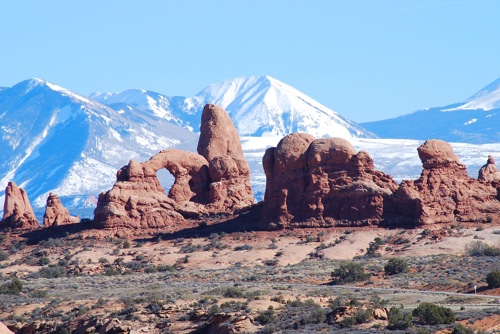
Would these settings become irrelevant if only a handful of people saw them? NPT file photos.
Rel⋅e⋅vant -- /ˈrɛləvənt/ [rel-uh-vuhnt] –-adjective-- bearing upon or connected with the matter in hand; pertinent: a relevant remark.
Are our national parks losing their relevancy?
I raise that question because on one hand we saw an upwelling of interest last fall when The National Parks: America's Best Idea riveted many to their television sets for six consecutive nights, and yet on the other hand National Park Service Director Jon Jarvis shortly after he was appointed cited a need to prevent the parks from becoming irrelevant.
"I have conducted over 200 interviews with superintendent candidates, and I always ask, 'What is the biggest issue facing the NPS into the future?' The majority answer, 'relevancy,' the director said back in September in a system-wide email to his staff. "There is deep concern out there that national parks will become irrelevant to a society that is disconnected from nature and history. We need to help all Americans – especially young people – discover a personal connection to their national parks.
"While the places are spectacular, it is our people that make parks come alive. In Ken Burns’s documentary The National Parks: America’s Best Idea he focuses as much on the people as on the parks: employees, residents of gateway communities, scientists, scholars, politicians, indigenous people, activists, concessioners, volunteers, partners and, of course, visitors. Without them, the National Park System would not exist, many parks would never have been established, and the National Park Service would not have the deep support of the American people that we enjoy. I believe every American will relate to and cherish their national parks if given the chance to connect, by technology or by visiting. Beyond parks, our recreation and historic preservation community assistance programs reach and benefit families near their homes in ways that the parks cannot. I plan to expand these programs."
Is the park system struggling with being relevant in the 21st century? Equally worried about the relevancy of parks are the concessionaires that work in them.
"Visitation has declined significantly over twenty years even as the overall population has grown and diversified, and even as a higher percentage of the visits has shifted to close-to-urban center units like Golden Gate National Recreation Area and Lake Mead National Recreation Area," said a white paper prepared last summer for the National Park Hospitality Association, which represents the concessionaires. "Equally importantly, lengths of stays have shortened, and visitation to parks remains largely homogeneous: Caucasian, affluent and educated. There are exceptions. But the exceptions are invariably linked to park units that have worked hard to be visible and relevant regionally.
"...We have already lost a generation – perhaps two generations – of Americans who regularly utilize parks and the Great Outdoors for relaxation and recharging – mental and physical. Large portions of the post-Boomer adult generations have turned to shopping malls and electronic entertainment for leisure pursuits and have limited traditions or skills in the outdoors. And absent intervention and assistance, this pattern will repeat, as parents fail to introduce kids to the outdoors. The truth is that there are major and potent competitors for the leisure time of all Americans, and especially youth. These competitors use advertising and other promotion extensively, and have effectively 'hidden' many traditional leisure choices, including park visits. National park visits can’t compete ad for ad, but there are strategies for making parks and fun outdoors more 'top of mind.'"
The white paper, which promoted creation of a National Parks Promotion Council, said particular focus should be placed on (1) youth; (2) urban; (3) lower income; (4) non-Caucasian; (5) seniors and (6) new Americans.
Of course, to answer this question I suppose one has to define how relevancy, when it comes to national parks, looks. In 2008 the Park Service counted nearly 275 million recreational visits to the parks. Would 300 million visits reflect better relevancy? Three-hundred-fifty million? Four-hundred-million? Or are the parks relevant no matter what the level of visitation?
Do the settings in the accompanying photos lose relevancy if only ten people view them?
Tell us what you think. Are the national parks in danger of becoming irrelevant? And if you think so, what should be done?
Story Categories:
A copy of National Parks Traveler's financial statements may be obtained by sending a stamped, self-addressed envelope to: National Parks Traveler, P.O. Box 980452, Park City, Utah 84098. National Parks Traveler was formed in the state of Utah for the purpose of informing and educating about national parks and protected areas.
Residents of the following states may obtain a copy of our financial and additional information as stated below:
- Florida: A COPY OF THE OFFICIAL REGISTRATION AND FINANCIAL INFORMATION FOR NATIONAL PARKS TRAVELER, (REGISTRATION NO. CH 51659), MAY BE OBTAINED FROM THE DIVISION OF CONSUMER SERVICES BY CALLING 800-435-7352 OR VISITING THEIR WEBSITE. REGISTRATION DOES NOT IMPLY ENDORSEMENT, APPROVAL, OR RECOMMENDATION BY THE STATE.
- Georgia: A full and fair description of the programs and financial statement summary of National Parks Traveler is available upon request at the office and phone number indicated above.
- Maryland: Documents and information submitted under the Maryland Solicitations Act are also available, for the cost of postage and copies, from the Secretary of State, State House, Annapolis, MD 21401 (410-974-5534).
- North Carolina: Financial information about this organization and a copy of its license are available from the State Solicitation Licensing Branch at 888-830-4989 or 919-807-2214. The license is not an endorsement by the State.
- Pennsylvania: The official registration and financial information of National Parks Traveler may be obtained from the Pennsylvania Department of State by calling 800-732-0999. Registration does not imply endorsement.
- Virginia: Financial statements are available from the Virginia Department of Agriculture and Consumer Services, 102 Governor Street, Richmond, Virginia 23219.
- Washington: National Parks Traveler is registered with Washington State’s Charities Program as required by law and additional information is available by calling 800-332-4483 or visiting www.sos.wa.gov/charities, or on file at Charities Division, Office of the Secretary of State, State of Washington, Olympia, WA 98504.
INN Member

The easiest way to explore RV-friendly National Park campgrounds.

Here’s the definitive guide to National Park System campgrounds where RVers can park their rigs.
Our app is packed with RVing- specific details on more than 250 campgrounds in more than 70 national parks.
You’ll also find stories about RVing in the parks, tips helpful if you’ve just recently become an RVer, and useful planning suggestions.


Comments
Although some of our parks have shown a decline in visitation, some have had record crowds in 2009. As our population grows and ages so too will park attendance increase. Even the wife and I did not start visiting our national parks until our early thirties excluding those within a reasonable drive from our home here in NY. The present economy has much to do with it as anything else. We were just two of the record numbers visiting Yellowstone & Grand Teton this past summer. Look at the cost of traveling cross-country to visit our parks, especially those with children in tow. The money needed to travel to and stay and eat in places like Jackson and Teton Village,WY are just too cost prohibitive for so many. As the younger population ages and their incomes increase they will only then have the means to visit parks that are not in their immediate home areas. Our national parks will always be relevant for the majority of Americans whether or not they can afford the trip right now.
Kurt - in my opinion, I believe the National Parks have loss some of it's respect in what it stands for and it's spiritual reverence. The parks have now become a economic business mecca instead of a spiritual mecca.
"Are parks relevant no matter what the level of visitation? ... Do the settings in the accompanying photos lose relevancy if only ten people view them?"
Good topic; good questions. I absolutely believe relevancy is a key to the future of the national park system, for practical reasons ... they are publicly funded and people won't support being taxed for irrelevancies. So, for elected representatives to support funding to reduce the maintenance backlog or add new parks or programs, they need to believe their constituents see some value in doing it.
The "how" of relevancy is quite another matter! Visitation in the physical-presence-in-the-park sense is not the be-all and end-all of park relevancy. In fact, I submit it can be a bankrupt strategy that degrades park resources and the park experience and distracts us from other, perhaps more important, relevancy.
Example: When I first met the Internet, more than 15 years ago (when many managers thought it would go the way of 8-track tapes), I can still remember the thrill I felt when I pulled up the Library of Congress image of a pencil-written draft of the Gettysburg Address. I felt like I was looking at a piece of the True Cross! Could I have that thrill at Gettysburg NMP? I don't think so. I could go to GETT on a peak summer day, fight the traffic and the crowds, overwork the staff and be one more set of feet and hands impacting the resource. Increasing visitation increases impact, drains resources and, arguably, lessens the quality of visitor experience in many instances.
Being there is not the only measure of the relevancy of a park.
Our park system is an amazing mosaic of U.S. natural and cultural history. Every piece of that mosaic is multi-faceted ... there are SO many stories that can be told at every one of the NPS units! No one visitor can get all the stories; no visitor WANTS all the stories. But, through books, images, videos and the Internet the world can have all those stories at their fingertips, going where they want, making use of the stories they're interested in ... creating their own relevancy!
But have you ever seen park statistics on Web site hits, interpretive materials sold, etc.? No, we're still back in the Stone Age, relying on counting physical bodies and assuming that means something, whatever it is.
Intresting precept that you have raised. Why visit a natural park when you can visit a virtual park? and all the materials that are available, photos, images,books, etc. on the internet. Certainly you can. But you then remain fixed at your keyboard, inactive, a passive visitor, with only one sense engaged, two at most. The giant redwoods and sequoias have a texture, the geysers at Yellowstone have an oder, the berries by the trail in the Great Smokey Mountains have a sweet flavor....these are experiences that are individual, but are also shared with friends and family when you visit a park in real life. As a nation of immigrants, we have always traveled, seeking what is promised over the horizon and in the journey we created self-reliance, stamina, cooperation and spirit. Don't let your fellow traveler keep you from experiencing the parks with all your sensations...and for those of us that have fewer than 5, the exercie alone has benefits in terms of mental, spiritual and physical health. No matter how fantastic the virtual lands visited by an "avatar" are, in then end, a real person and a real experience is needed to make it relevant.
Couple things -
1. Consider the proliferation of virtual tours and other such experiences that let you see what is at these places on the web. Is this a good thing and does it come at the expense of in-person visitation?
2. Do we need to rethink the idea of traveling great distances in our autos and planes to see the parks, due to the effect that such travel has on these places? It's worth asking how much pollution is caused by such travel but it's still there. Should we be rethinking how we visit these places? See #1 and also will the push for more high speed rail be a good thing for the parks if it happens?
I've wrestled with the question as to whether a virtual tour would provide an excuse for someone not to visit, but I feel I have settled this question for myself. First, we all know that a virtual tour is not the same as a real tour, just like how seeing a bear in a zoo versus in the wild is not the same thing. Sure, it's the same animal, but one doesn't get the same feeling from it. Zoos might inspire some interest in the real, wild thing, though, just as a virtual tour might pique some interest in that place for someone who was not aware of it. Websites, webcams, blogs, etc., provide people a way of staying connected with parks when they can't physically be there. The person's interest and values are what matter, not necessarily their constant physical presence in the park. My feeling is that we can reach out to youth and urban populations through web-based media and provide an engaging experience that can inspire interest; the web is where kids go for information now, anyway, so we might as well provide the means for them to connect with parks virtually and use that as a springboard to get them physically into the parks.
Thank you for asking this question and for offering us the opportunity to voice our views.
I don't think it is useful to measure the relevancy of the national parks by the number of visitors or the dollars collected and spent. I agree with two previous posters, one who pointed out that it is the spiritual aspects that we should be focused on, and with Tom, who offered a way to educate and inform people without the need to build more brick and mortar structures, parking lots, and motels to handle more visitors.
We should not take a theme park approach to our national park heritage. I feel it is more important to protect and defend them against deterioration and spoilage, preserving them as places people can go to get away from the stresses of modern life, get back in touch with what is real and beautiful, and renew their connection with the deep, nourishing spirit of nature. That would be "relevant" from my perspective.
The settings pictured in the photos will always be relevant, no matter how few people see them. It is the depth and quality of the experience, not the quantity of viewers, that can make a difference.
I predict that the creation of a National Parks Promotion Council will be a big waste of money.
BUT if Jarvis is serious about increasing visitation by "(1) youth; (2) urban; (3) lower income; and (6) new Americans" the NPS should offer a discount to young people who visit national parks. IE: a Golden Age Passport for people under 25.
But then more Seniors vote than college students...so I don't see this ever happening.
maybe a nice tax break for young and old who can spend a week "in service" at a park doing whatever jobs that would otherwise cost the park system $. In my opinion even a week of scrubbing toilets at one of our national parks would be an excellent way "to get em' hooked".
As someone who deals with visitors is several of the ways mentioned above, I say lets count them all. Visitors actually in the parks, visitors to our websites, long distance learning students and students who send mail or e-mail requests. Shouldn't we be serving the public however they visit?
I agree with many of the points mentioned already. But, for me, the most important common thread in these responses, and other discussions on the same topic, relates to the importance assigned to visitation statistics. I couldn't agree more that physical visitation is only loosely, if at all, related to relevancy of the national parks. In fact, many of the "reasons" for suggesting the parks are losing their relevance are, in my opinion, actually reasons for why the parks ARE still very relevant. In some cases, too much physical visitation actually hurts the park experience. As mentioned and discussed many times, it's a very tricky balance for the parks between visitation numbers and protecting the resources the park was created for. I've been fortunate enough to visit many NPS sites across the country (and have not intention of stopping) - but I do know that I certainly don't go there to see the crowds. So in some ways simply increases visitation numbers, without increases the ability to effectively handled those visitors, actually could hurt the parks, and the resources their trying to protect, in the long run.
Also, the concern that the concessionaires are concerned about relevancy I beleive is a bit off base. I respect the fact that they're a business and are there to make money. But I've seen many cases where they do that in a way that supports and improves the park. But I've unfortunately seen too many cases where they actually hurt the park. If there's value in the service or product they provide and they're able to sell that at a fair price (which is all to often an issue), then that's great. But if they cannot run a profitable business, then that's probably an indication that they're not providing enough value to the customer and/or the price is just too high. It's NOT a function of the relevance of the park itself.
My last point - regardless of which definition or measurement we use for "relevance", I think everyone can agree that once a park, and the significant resources that park protects, we can't get it back. So we should be protecting and maintaining our parks. Some people may not want their tax dollars being spent on that. But I'd bet all of us can come up with a list of things we don't want out tax dollars to be spent on - but they are anyway!
Probably an entire book could be written to discuss Kurt's question. I will avoid trying to give a substantive answer here because no matter what I say it will have been thought of and thought about, so I won't be contributing anything new. I'd rather comment that the National Park Service should be congratulated simply for asking this question. Not all park bureaucracies do that. We have a parks agency in the Bay Area that, in my opinion, is too indifferent (though not entirely so) about the topic as long as it continues to get tax revenue. The result is a number of parks with few amenities, few trails, and lots of ruinous cattle-grazing. In effect, they're cattle ranches masquerading as public parks. It's a vicious cycle: because relatively few Bay Area residents visit these barren cattle-oriented sacrifice areas, they're indifferent about them. As long as they're indifferent, business as usual carries on and the agency can ignore its relatively few critics. I congratulate NPS for recognizing that, in the long term, that kind of strategy would lead to (if nothing else) budgetary problems.
I think there is too much focus on individual national parks becoming less relevant. What's important is that the idea of national parks remains relevant. When an entire generation dismisses the national park idea because they have little connection with nature, then we begin to have problems. Once that occurs, visitation numbers to individual parks matter much less because the underlying system of values for not just national parks but wilderness areas and all public land begins to fall apart. And that has tremendous environmental implications all across the country. Therefore, the issue of relevance is much greater than the parks themselves.
Even if an entire generation finds protected landscapes and connection with nature irrelevant, certainly many of those those who do venture into a national park will find it both relevant and something worth preserving and celebrating. Even if the parks are relevant to only a few people, they'll be worth preserving regardless, particularly in hope that relevance will increase in future generations.
Incidentally, I doubt worries that fewer people are visiting national parks are actually coming to fruition, at least not nationwide. Preliminary 2009 visitation figures show that visitation increased at Rocky Mountain National Park by 2.4 percent over 2008. Great Sand Dunes saw a more than 5 percent increase in visitors. Arches saw a 7.3 percent increase to a record-breaking 996,000 visitors.
That's just a small sample of preliminary 2009 vistiation numbers, but if visitation is any metric for relevance, especially during a recession, it seems to be a hard argument to make that national parks are becoming less so.
Just to clarify, as far as virtual tours - this applies more to national historic sites and other places like this than actual "national parks." Always hard to know if we're talking about the specific units that are "national parks" or the entire system, which has 392 units right now plus affiliated areas.
I think what is interesting is this idea of redefining and reorganizing the nomenclature. When the proposal came up to redesignate Pinnacles, one of the responses was "wait, because we are awating a reccomendation on changing the nomenclature." In other words will we have a whole new definition of national park that is a lower standard than the old definition? Or was this just a stalling tactic to hope the bill dies...
Relevance depends on a lot of factors. I suppose it depends a lot on where one lives and proximity to NPS sites.
I happen to live near several NPS sites (Golden Gate, Point Reyes, and Muir Woods are three) within an hour's drive of home (San Francisco Bay Area). I also happen to live in a major population center. I find myself fortunate. Perhaps these aren't the grand destinations such as Yosemite, Yellowstone, or Grand Canyon, but they are special to me.
Within a long day's drive I can find myself as far as Crater Lake or even Death Valley. These places are relevant to me even if I've only visited them for less than a full day.
Along with others posting here, I find the measure of relevance by head count a little misleading. The traditional methods fail to register impact and effect. Is every visitor one more chance for a positive impact or as some have complained, is the count a negative for the crowding, visual degredation, etc.? The fact is that modern methods of assessing impact or "favorables" is a fairly well vetted strategy in the world of politics and commercial marketing. The decision makers would be well served to have these tools and measures available and the creation of a National Parks Promotion Council will bring these to the table in ways that the government alone cannot do.
And then there is the whole issue of ways that actually experiencing the natural world helps to improve mental, physical and spiritual health. As a nation tending too much to the sedentarly life and the heavy toll that obeisity and chronic disease, often based on life style choices (lung cancer, heart disease, etc.), it seems to me that the national interest in exposing as many of our citizens to healthy alternative behaviors should be a part of the health care debate.
I support the initiative to tell the park story and encourage more to get up and get out. If it takes a little strategic marketing or product incentives or celebrity spokespersons to make the case, then welcome to the world of global communications and 24/7 information cycles!! We are poorer if we fail to see the important physical connection to the land provided by the park experience.
Kurt - I found your article to be very interesting, and you posed some excellent questions. In my opinion, there is a very simple answer to your primary question about whether the parks are relevant. Absolutely and unequivocally, the national parks were relevant when they were created, they are relevant now, and will be forever relevant if our society can adequately preserve them. We are so fortunate in our country that a number of brilliant, concerned and determined individuals had the sense to set aside these incredible locations for future generations, and we are deeply indebted to people such as Teddy Roosevelt, Stephen Mather, John Muir and countless others through the years for their efforts in doing so.
Recently while visiting Death Valley, I ran into a visitor from the U.K. on vacation for ten days in California. She looked out over the desert and across to the Panamint Range and Telescope Peak and exclaimed what a stunning location the park was. The awesome, stark magnificence of Death Valley almost defies description and truly is a place that you have to see in person to appreciate. No visit to an internet site will ever, ever compare to being there in person, no matter how vivid the verbiage or powerful the photos may be. Being there in person stimulates and heightens the senses in a way that cannot be duplicated by a two-dimensional man-made computer screen. When one stands in Yosemite Valley, drives Trail Ridge Road in Rocky Mountain National Park, or kayaks through the ice-strewn waters of Glacier Bay, that authenticity cannot be duplicated through other means.
This fall, my wife and I were visiting Yellowstone and while driving through Hayden Valley we witnessed a pack of gray wolves suddenly attack a wary herd of elk. The fact that anyone (no matter their age, race, religion, etc) can still experience such an event is a direct result of the parks' existence. (By the way, the elk eluded capture). And for anyone who has walked up the steps of the Lincoln Memorial and read the fabled Gettysburg Address engraved in the granite walls of the memorial, they understand the value of setting aside historical and cultural sites along with natural locations as the park service has done over the years. At last count, 391 locations are now managed by the NPS and it is incumbent on our country to preserve these incredible locations not only for Americans, but for all humanity. Our national parks have become world parks. They are world treasures, and we, their custodians.
So are the parks relevant? Always. Do we have a responsiblity to promote their relevance? Absolutely. Ken Burns recent production helped reinstill or introduce, as the case may be, the importance of the parks to millions of people. Efforts such as his are vitally important in keeping the parks in the forefront of our society's consciousness. So what can we collectively do to ensure promotion and education such as this continues to happen? What will the next great installment be that continues to communicate information to society about the worldwide treasures that we hold in trust? That, in part, is where we should focus some of our attention. Guiding people across the globe in how to enjoy and appreciate the outdoors ultimately will lead to improved physical and mental health, as many others have pointed out in previously posted comments about your article.
Lastly, our world has finite resources and as more than one person has said, "They aren't making any more land." Given that fact combined with continued population growth and it is evident that the resources available, per person, are diminishing. That means less land, less water...and less nature. Sustainability must, absolutely must, become one of the primary goals for every living person on this planet. Everyone must become more accountable and responsible for their impacts on the planet. The parks can help play a very prominent role of being the "poster child" of what we are trying to save. The NPS, NPHA, NPCA and NPF other related organizations have an opportunity to lead the way in showing the world how sustainability can manifest itself through countless applications and actions. Our "highly relevant" parks were envisioned in the past by great leaders who foresaw their value, and we must take up that mantle of leadership to continue the preservation of these irreplaceable resources.
Interesting discussion, veering in the usual direction of equating "national parks" with National Parks and natural areas. (I, for one, would welcome a streamlining of designations.)
If we look at the totality of resources and areas in the care of the National Park Service, the picture is different, as MikeD pointed out above. Roughly 2/3 of the units were set aside for their historic and cultural values and even the areas that are preserved primarily for their natural values have significant historical resources ... Old Faithful Inn, Fort Yellowstone, pioneer structures in Grand Teton, Native Hawaiian sites in Hawaii Volcanoes.
It may well be, as MikeD said, that those stories of the Mosaic of America lend themselves more to access by media. I'm an old interpreter. I can spin a pretty good story about the people who lived in Pueblo Bonito at Chaco Canyon while standing in the east plaza of Bonito. BUT, I cannot begin to help people understand life in that pueblo at a given time, and the way their cosmological understanding was reflected in their architecture, anywhere near as well as some digital presentations have been able to do. And what is our purpose at that park ... to count the most number of people we can get in the park, to limit the attendance to the least number possible (as some would do) or to make available to the world the stories (and there are many, many, MANY) of what happened there?
When speaking of "relevance", it helps to have common parameters. Evidently many of these posts are from those who are in (or were in) the pro class, and know whereof you speak. Obviously you care deeply and have dozens of valid reasons why the parks are relevant. So I have a question for you: How many of you got into this park business in hopes of gaining rock star status and scads of cash? Anybody?
I didn't think so. Whatever reasons you had for signing up, it wasn't to get rich.
On the other hand, the concessionaires are ALL about the money. As an industry, they truly only care about the bottom line. They don't really have to care about the Organic Act and all it implies. So their idea of "relevance" fundamentally differs from the "relevance" the NPS might be concerned with. It's like comparing apples and oranges.
If NPS is willing to make keeping infrastructure as well as public presentations up to date a priority, then by definition they will be relevant. Similarly, if they invest in their staff, the staff will relate better to the public. If NPS can show the public that they value the parks and their guardians enough to invest in them, then they won't need to be so concerned with visitation. We will come to them.
I have lived and worked at the Grand Canyon at the South Rim for the past nine years. Prior to my move here, I did a ten day backpacking trip down the Tanner Trail in the fall of 2000. I had recently experienced a divorce and remembered my aunt getting into a shape for her Grand Canyon post-divorce hike and it seemed liked a logical thing to do. When I returned to the rim from my backpacking trip, I "accidently" discovered that is was possible to actually live and work at the Grand Canyon. I moved here three months later and have loved it!
I work for Xanterra South Rim, who is the concessionaire here. I have a great job in that I work in the Sales Office and get to work with people from all over the world. I have been humbled on numerous occasions by the initial reaction to the Grand Canyon by people from various places. The reactions differ, but the common thread is that one cannot experience the Grand Canyon in some way and not be affected.
Relevant was originally a Scottish legal term meaning "take up, take possession of property." Any visitor who ventures to a national park feels some sense of ownership and pride, regardless of where they come from.
Our company hosts an annual Awards Ceremony dinner honoring employees for years of service and others who are worthy of special recognition. Last evening, we had our event honoring 72 employees who collectively have provided 805 years of service. This is pretty impressive. Each employee's Director gave a short speech outlining their achievements and often their reason for coming to work here at the Grand Canyon. I was struck by how many people have been here or another national park for the majority of their career. The stories were all different, but the final result is that our long-term employees are here working in a national park because being here is relevant to their lives. Our GM gave a short speech at the end of the ceremony thanking everyone for their participation, commitment and dedication in making the Grand Canyon a memorable place for our guests. He noted that it would not be possible without the help of each and every person in that room. That is relevant.
My family has long-term history with the national parks. I have a picture of my grandmother in my office riding the mules to Phantom Ranch in 1964. My mom lived in Yellowstone when she was little. My family went on many vacations to national parks when I was growing up. When I was raising my family, we took them on many vacations to national parks. My mom, daughter, son-in-law and two grandkids were here enjoying the national park at Christmas. They did the mule ride and I don't think my grandson will ever forget the thrill of riding through the forest in the snow to the Abyss Overlook. National parks are the places these valuable memories are created. I don't ever anticipate a time in future generations that my family will not enjoy the national parks. It is part of our history and relevant to us.
I'll echo an earlier poster and say "why is relevance measured by attendance?"
The national park service is America's museum. It protects and contains things of importance and value so folks can see them whenever they want. They're as relevant as the National Archives, the Smithsonian, or the Metropolitan Museum of Art. Everything in these institutions is valuable as a historic and/or natural artifact.
In my view, the only time a National Park System site loses relevance would be in one of the following cases:
1) the value is actually lost or destroyed. Example: that old park (I forget the name) with cycad fossils that was despoiled and vandalized. It obviously lost its relevance.
2) a historic site that was originally thought to be important, but either was proven not to be or was replaced by something that better showed that particular facet of history.
Otherwise, it doesn't matter if only a few hundred people visit.
======================
My travels through the National Park System: americaincontext.com
The "value destroyed" site Barky referred to is South Dakota's defunct Fossil Cycad National Monument (1922-1956), which was delisted after being stripped of the surface deposits of fossils that once made the site nationally significant. For more details, visit this site.
Wow, Diane, that's quite a story. It sounds like you've got a dream job. Thanks for sharing.
The entire concept of this thread is jarringly off to me. I see 'relevance' as a subjective judgement - more of a concept than a thing, and questioning relevance sounds appropriate to a first year philosophy major. If someone has no experience in or access to a park then relevance becomes a "if a tree falls and no one is there to hear it" question. And if one is experienced with parks and have access to them the question barely needs be asked.
I see the National Parks as a solid reality of self evident value, with both tangible and intangible qualities. The only real question is helping more to be in the woods to hear the tree fall, while ensuring that those same opportunities are available to our great-grandchildren.
[In my humble opinion], and meaning no offense to the others who have other opinions.
@NK and Second Life; I like the concept of the virtual tour as "springboard" into the national parks. Virtual tours are intrinsically neither good nor bad for the national parks. From the managerial perspective, they can be viewed as a problem (people will think that virtual tours are an OK substitute for park visits) or as a promotional tool (virtual tours whet the appetite for first-hand experience), but it seems wisest to quit obsessing about the first concept (which you can't do anything about anyway!) and focus on the latter. I believe there is no doubt whatsoever that the National Park Service can, in a proactive way, use virtual tours to make people want to visit national parks. What you need to do is heighten awareness of the experiences, thoughts, feelings, emotions, etc. that an actual park visit can give you and vicarious experience cannot[/it. The National Park Service is not doing anywhere near as good a job as it could in this area.
@ arms. "..... serving the public however they visit?" ??????? Would you please restate your central idea? I have read your comment seventy-leven times and I still cannot fathom what you are trying to say. One way to read your comment is that it matters not a whit if people ever actually visit a national park -- we can still count it as a "visit" if they vicariously experience parks. If that's what you mean, I couldn't possibly disagree with you more and will take that opinion to my grave. If you mean that the National Park Service needs to take more credit for ways that the system benefits people who never visit a national park, that's a completely different notion. Or perhaps there's some other idea in there? Again, I remain puzzled about your central idea and would be interested to know more about the reasoning that goes with it.
Anon wrote:
Bat's comment-in-reply also addressed the concessionaire "conflict of interest" arising from obsession with the bottom line.
There is no clearer illustration of the central point here than the case of the Yosemite Park & Curry Company, the concessionaire tail that wagged the National Park Service dog for the better part of a century (ending 1993). Much of what the Curry Company did by way of providing infrastructure and services was beneficial to the park, but so very much of what the company was allowed to get away with was outrageously inappropriate in Yosemite, or in any national park. If you focus only on the virtuous end of that, you can talk yourself into being a big fan of the company. If you look just at the latter result, you could conclude that the company's primary role was to serve as a cautionary tale -- a prime example of what NOT to do in the national parks.
imtnbke wrote:
We need to be careful here in differentiating between policies and practices that the Park Service is responsible for putting into place and the things that Congress burdens the agency with. Point Reyes National Seashore is a greenline park that combines federal and nonfederal land, including a pastoral zone where leaseholders graze beef and dairy cattle. That pastoral zone exists in the first place because of the enabling legislation -- that is, because of the way the Congress wrote the law that brought the park into being decades ago. The ranches on the peninsula date to the Spanish grazing industry that was established there before California became part of the United States. This is deep, deep history. As far as the law is concerned, the ranches in Point Reyes National Seashore are historical resources, not just economic enterprises, and they most certainly are not "masquerading" as public parks through some National Park Service-assisted subterfuge. When Point Reyes National Seashore was created (authorized 1962, established 1972), the enabling legislation insured the continuation of ranching (pastoral activities) by providing that ranchers who sold their property to the federal government would be given renewable leases. If you don't like that original arrangement, or object to continuing it so long after the national seashore was established, you need to take it up with our elected officials. Berating the National Park Service does not, in this instance, gain us any ground.
I'm not sure that's exactly the reference. The majority of Point Reyes cattle/dairy areas are fenced off without public access. Part of the reason for Point Reyes existing as an NPS unit was that there were plans for large-scale housing development which many felt would destroy the pastoral character of the area.
I'm pretty sure that the reference from imtnbike would be to the East Bay Regional Park District. They have cattle grazing in many of their parks, including Wildcat Canyon Regional Park near where I live. I found the dairy cattle at Wildcat Canyon to be pretty harmless (they moved when they were blocking the trail) but I've heard stories of other herds (especially Mission Peak) with more aggressive cows.
http://www.ebparks.org/stewardship/grazing
http://www.ebparks.org/stewardship/grazing/benefits
http://www.ebparks.org/stewardship/grazing/parks
http://www.ebparks.org/stewardship/grazing/safety
http://www.ebparks.org/stewardship/grazing/help
Apparently some people don't like it:
Experience the Extreme Pleasures of East Bay Cow Parks
http://rangenet.org/projects/wplgalbum/page4a/Extreme%20Pleasures%20HTML...
Head 'Em Up, Move 'Em Out!
Are the cattle grazing in the regional parks creating a profound, environmental mess as activists contend, or are they a living symbol of the grand -- and fading -- tradition of ranching in the hills?
http://www.eastbayexpress.com/eastbay/head-em-up-move-em-out/Content?oid...
Parks or cattle fields?
http://www.berkeleydailyplanet.com/issue/2002-11-16/article/16165?headli...
And CAPTCHA for today is "required messes". :)
My bad. I'm going to leave my comment in there, though, because deleting it would remove the comments that follow it.
Nah - you had a fair response. I live in the area in question and hike the parks, so I knew. I wouldn't expect that most people reading this would understand that "park agency" meant the East Bay Regional Park District. I've tried hiking some of the trails where there are cattle grazing, and they can become these strange barely passable mud bogs or severely widened trails.
However - the NPS does allow some cattle grazing near publicly accessible trails. Bolinas Ridge (Golden Gate NRA but administered by Point Reyes NS) has a long trail where there are cattle (with gates). I also don't think they normally want cattle in public areas, but once I passed a cow right on the road to the oyster farm. I don't think that technically was in the pastoral areas.
http://www.gatetrails.com/exhibits/026bolinas.html
YPW wrote: "I'm pretty sure that the reference from imtnbke would be to the East Bay Regional Park District."
You are correct! And thank you for those links; I'll look at them. See also http://www.NoOnMeasureWW.org
Thanks, y p w, for the link to that East Bay Express article, "Head 'Em Up, Move 'Em Out." That was most interesting.
It sounds like grazing is necessary in those lands, but why can't it be the species that were there before Europeans arrived rather than the destructive cattle? I'm willing to eat venison and elk instead of beef.
Who the heck would want to farm deer here? Seriously - there's no shortage of black-tailed deer in the Bay Area. I see them on a weekly basis and there are incidents where drivers hit them.
I'm not necessarily convinced that they're necessary. Tilden Regional Park (east of Berkeley) is the crown jewel of the EPRPD, and the only cattle they have are penned living at the Little Farm. Locally we have places like Mt Wanda (part of John Muir NHS) which appears similar in appearance (not too much overgrowth) to the regional parks with cattle grazing. I'm not sure what the NPS is doing differently.
It seems to me that the more people frequent the parks, the more likely they are to support them financially. So, Mr. Jarvis efforts should be supported. Now, the whole idea of giving discounts to youngsters seems a bit silly to me. I don't think that the issue is money (usually). Whether a kid goes to a national park or not has probably more to do with interest. The issue is really how to get kids interested in the outdoors. Most people I know (that would include my wife) never set foot in the local parks (OTOH, the cows do suck the appeal out). Long term, it seems like an uphill battle.
ymp and imtnbke, you give me too much credit for ignorance. I am indeed familiar with the East Bay Regional Park District. And every time I hike Briones, which is about once or twice a year, I see, in addition to hawks and the occasional coyote (but no rattlesnakes, so far), a goodly number of cows as well as plenty of cow flop. It should have dawned on me that imtnbke was talking about the regional parks, not Point Reyes. As I said; my bad.
We're way off track, IMHO, but perhaps the thread of relevancy has just been run into the ground.
One more observation. I'm an old fan of Freeman Tilden and the adage he once quoted is the one I have found true through my entire career:
"Through interpretation, understanding;
Through understanding, appreciation;
Through appreciation, protection."
That can be accomplished in many, many ways.
The National Park Service is responsible for much more than just the actual national parks. It is also directly responsible for upholding the perpetuity clauses of the Land and Water Conservation Act, a federal law that protects parks in perpetuity--from your local park down the street to state parks to national parks.
NPS is losing its credibility with a lot of people--including minority populations and park advocates-- in its recent decisions regarding conversions of local parks protected by the Land and Water Conservation Act that are in some of the poorest minority communities in the country. Two examples of conversions, of the local parks near Yankee Stadium in the Bronx, NY, and Jean Klock Park in Benton Harbor, Michigan (Michigan's poorest community and 93% African-American) were challenged in federal court, where the minority community/citizens sued the National Park Service over its decisions to allow conversions of the parkland to private uses by major corporations--for the Yankees to build their new stadium, and for Whirlpool Corporation to build a golf course in a 90+ year old city park dedicated to be a park forever. These decisions were made by NPS during the Bush administration, but the case regarding Jean Klock Park is being defended still by the Obama administration. The Jean Klock Park case (Weiss et. al. v. Salazar) is pending.
I testified to the US House Appropriations Committee on the need for the NPS to continue its legal obligations to protect parks assisted by LWCF....and without money for the program, the compliance part of the law cannot happen.
See the NPS's website on it: www.nps.gov/lwcf
Screwing minority communities out of their local parkland is no way to build support for the agency or promote use of parks. It's the height of hypocrisy.
See: www.protectjkp.com to see read about the case against the NPS.
LuAnne