
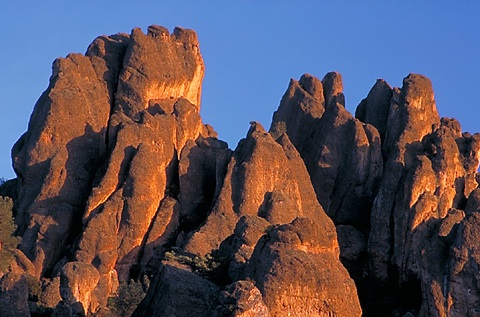
A congressman from California has introduced legislation to have Pinnacles National Monument renamed Pinnacles National Park. Photo of the High Peaks by Clayton Mansnerus.
There's a move afoot in Congress to have the name of Pinnacles National Monument changed to Pinnacles National Park. U.S. Rep. Sam Farr of California believes the monument's 14,500 acres with their unique geology and many species that are either threatened or endangered at the state or federal level deserve the title.
"Upgrading Pinnacles to a national park makes sense for historic, natural and economic reasons,” the Democrat said Friday. “This area is much more than rock formations. It’s a huge swatch of land with historical significance for the state, it provides an important refuge for the California condor and it has great potential for tourism revenue.”
The monument is one of the oldest ones in the National Park System, having been designated by President Theodore Roosevelt in 1908. It received its name from "rock spires and crags that are remnants of an ancient volcano," notes the National Park Service. "The volcano eroded over millions of years as it moved northward along the San Andreas Fault. Rock debris in the form of boulders has weathered and settled, leaving behind spires of volcanic rock and talus caves."
Pinnacles National Monument has two main areas of caves; the Bear Gulch Caves are near headquarters in the East District, and the Balconies Caves are near Chaparral Campground in the West District.
There is no known evidence of Native American habitation in any caves, though extensive archeological work is yet to be done, and local Native (Mutsun and Chalone) stories have largely died with their tellers. Non-Indian legends that have survived refer to the use of the caves as a hideout by the notorious central California bandito Tiburcio Vasquez, whose brutal contribution to local history ended with his hanging in San Jose, California, in 1875. Stories of hidden treasure and robber’s roosts still cycle through campfire stories and local lore, but the location of Tiburcio’s hides seem speculative, notes the Park Service.
The Civilian Conservation Corps built trails through the caves in the 1930's and these trails have endured many storms and travelers. The stairways and bridges they constructed were needed to navigate the caves without the use of ropes and ladders. Today, the Bear Gulch and Balconies caves are principle attractions for visitors at the Monument.
Rep. Farr's move drew quick praise from The Wilderness Society.
“Congressman Farr’s work to protect public lands and wild rivers in his congressional district should be lauded," said Sam Goldman, the society's California Wilderness coordinator. "The California Wild Heritage Campaign, a coalition of hundreds of businesses and organizations around the state, stands with Congressman Farr to highlight the importance of this ecological and geological gem in the Central Valley.”
Story Categories:
A copy of National Parks Traveler's financial statements may be obtained by sending a stamped, self-addressed envelope to: National Parks Traveler, P.O. Box 980452, Park City, Utah 84098. National Parks Traveler was formed in the state of Utah for the purpose of informing and educating about national parks and protected areas.
Residents of the following states may obtain a copy of our financial and additional information as stated below:
- Florida: A COPY OF THE OFFICIAL REGISTRATION AND FINANCIAL INFORMATION FOR NATIONAL PARKS TRAVELER, (REGISTRATION NO. CH 51659), MAY BE OBTAINED FROM THE DIVISION OF CONSUMER SERVICES BY CALLING 800-435-7352 OR VISITING THEIR WEBSITE. REGISTRATION DOES NOT IMPLY ENDORSEMENT, APPROVAL, OR RECOMMENDATION BY THE STATE.
- Georgia: A full and fair description of the programs and financial statement summary of National Parks Traveler is available upon request at the office and phone number indicated above.
- Maryland: Documents and information submitted under the Maryland Solicitations Act are also available, for the cost of postage and copies, from the Secretary of State, State House, Annapolis, MD 21401 (410-974-5534).
- North Carolina: Financial information about this organization and a copy of its license are available from the State Solicitation Licensing Branch at 888-830-4989 or 919-807-2214. The license is not an endorsement by the State.
- Pennsylvania: The official registration and financial information of National Parks Traveler may be obtained from the Pennsylvania Department of State by calling 800-732-0999. Registration does not imply endorsement.
- Virginia: Financial statements are available from the Virginia Department of Agriculture and Consumer Services, 102 Governor Street, Richmond, Virginia 23219.
- Washington: National Parks Traveler is registered with Washington State’s Charities Program as required by law and additional information is available by calling 800-332-4483 or visiting www.sos.wa.gov/charities, or on file at Charities Division, Office of the Secretary of State, State of Washington, Olympia, WA 98504.
INN Member

The easiest way to explore RV-friendly National Park campgrounds.

Here’s the definitive guide to National Park System campgrounds where RVers can park their rigs.
Our app is packed with RVing- specific details on more than 250 campgrounds in more than 70 national parks.
You’ll also find stories about RVing in the parks, tips helpful if you’ve just recently become an RVer, and useful planning suggestions.


Comments
I've been there, and it is an incredibly cool place (a volcano on a fault line? Wow!). But I have to say, I don't think it's worthy of National Park status. It's current status as a National Monument is adequate in my opinion.
If you abuse the crown jewel label of the National Park Service, you reduce the value of the moniker.
I would say I wish the eastern rim of the volcano, which is in Lancaster, was part of the NPS. I hadn't visited that site, so I'm not sure what it's like, but it would be cool to have both sections of the volcano as part of one unit, separated by 100 miles or so of continental drift.
===========================================
My travels through the National Park System: americaincontext.com
Pinnacles National Monument is gorgeous and the talus caves make it a fun place as well. It would already be a National Park if it were in, say, Ohio. But it raises that same debate; what makes a site "national park worthy"? I'm not sure I would consider "great potential for tourism revenue" a qualification. At this time this monument is not easlily accessible by California standards (near a freeway), even though it is not that far outside of a couple of major population areas. Increasing tourism revenue would absolutely require the need for a new highway to the site and probably a new road between the two halves of the monument. (No roads cross from one side to the other, requiring a considerable drive to get from the easier to reach west half to the more remote east side.) I guess the first decision to be made is which we want, preservation or tourism revenue? Due to the narrow canyons and difficult terrain I don't think you can easily have both at this site. I believe that the goal of obtaining more tourism revenue would require a considerable expansion of the infrastructure, both in and outside of the park.
The "....great potential for tourism revenue” is most likely the primary driving force behind the movement to make a National Park of Pinnacles National Monument. That is sad, reprehensible, and despicable. It would be a giant step toward commercialization. JF
Right now, access to much of Pinnacles is limited - not even by foot - to minimize impacts to condor breeding and foraging areas and the whole monument is closed to overnight backpacking. And this I feel is a good thing, but if it is given "Park" status, I'm not certain but I thought there are some requirements to provide more public accessibility. This might be one instance where "Monument" status may actually provide more protection than "Park" status.
Pinnacles NM is developing a new management plan right now. The time for comments from the public was one year ago. They offered three alternative management principles as can be seen in the public newsletter from August 3 2008: http://www.nps.gov/pinn/parkmgmt/upload/PINNGMPnewsletter3_alternatives_...
There the three alternatives were: Research and Learning, Backcountry Experience, and Disneyl^WEnhanced Visitor Experience. The fourth option is is to continue the park management as is. In the newsletter you can find maps that visualize how those guidelines would affect the use of park land.
I've been there, enjoyed Bear Gulch Cave when the entire length was open to the public, and wish to return for some real hiking.
I really don't see how the place would warrant full "National Park" status. It's really small and doesn't have one major feature or multiple smaller features that I would think would merit the big NPS designation. I don't see how it could support the kind of visitation that Congressman Farr envision. There frankly isn't that much to do other than hike. You can drive to a few overlooks and see the Pinnacles. Right now entry is closed off at night, although they have automated gates to allow people to leave. Maybe it's good if you're a climber, but that's a rather limited segment of the population.
It's actually pretty close to a major freeway (US-101). None of the full National Parks in California are that close to any freeways except maybe Redwood (US-101 passes through it) and Joshua Tree (I-10). Freeway access is hardly a disqualifying factor, since Yosemite, Lassen, and SEKI are miles away from freeways. People go to those places despite the distances.
However - this does demonstrate that in many ways the "National Park" status is a politically derived one. There are lightly visited national parks, such as Dry Tortugas and Great Basin (I know the ancient bristlecone forest is there) where it might be argued that there wasn't really anything special that merited the designation. Some member of Congress had a spot in their district that they thought could use some tourist dollars.
The Pinnacles is a great place. Fantastic vistas and the spires are awesome. It's a hefty drive from San Jose through Hollister so it's not crowded. It gets REAL hot during July and August and is very dry. The caves are very neat, but sometimes they are closed due to the bat situation. The small pond is also fun to sit by. I also don't think it merits the status of a National Park, but then I've not been to most of the dinky ones either.
Part of the deal is that POTUS can declare a National Monument without an act of Congress.
I'd agree with Paul. Having visited all the 58 parks, I'd probably "rank" Pinnacles slightly above Cuyahoga and Hot Springs. This is the "bottom," and certainly not the "middle of the pack" mentioned by congressman Farr does. I don't know how many of those Farr has seen in person, but his assertion that many National Parks in the East wouldn't qualify as California country parks sounds equally strange to me. I always thought of Cuyahoga as a politically motivated abuse of the designation, however it is kind of cool to have a restored area elevated to such a status. Hot Springs is a bit odd. It has been protected since 1832, making it older than Yellowstone (1872). Once you consider the hills and the planned transition from city to wilds it's quite interesting. Apart from those two, I wouldn't call any other Park dinky.
Tuan.
National Parks images
Pinnacles is a dramatic and inspiring place to me. I've hiked almost every mile of trail in the park, including the north and south wilderness trails. I've climbed dozens of the craggy spires, seen huge California Condors sail gracefully past (within 50 ft!), and watched the awesome peaks glow other-wordly orange and red in color with the last rays of sun light, then hiked back to the car in the darkness to view a clear starry sky from the parking lot before leaving.
The "Monument" seems reasonably well managed to me as is. I very much like the idea that it is often not very busy, except during the spring bloom when it is extremely busy on weekends. It doesn't much matter to me whether it is designated as a National Park or Monument, so long as it continues to receive the funding necessary to preserve and protect it.
It will be interesting to see what becomes of the National Park idea. I recall that Death Valley used to be designated a National Monument. In that case it seemed a no-brainer to make it a National Park. It also got expanded substantially as part of the deal, which was clearly a good thing (some people think that pristine sand dunes and dry lake beds are best used for ripping apart in ATVs!)
-Clayton
Split it. Let the part of the park at the East entrance enjoy National Park status with all its trimmings, but designate the more remote section that surrounds the West entrance as a primitive campground area. A typical National Park campground developed on the West side would absolutely ruin the area for what it is. It's remote, it's quiet, it has solitude, it has a pure black night sky uncontaminated by surrounding light sources, and it has a lot of wildlife that still roams the area unmolested. Please .. Leave the West side of the park alone.
To reach the East entrance one must pass through numerous communities that would benefit greatly from tourist dollars. Also, concentrating allocated National Park money on one segment of the park, the segment that surrounds the East entrance, rather than trying to spread that money over two very different areas would be more efficient and yield concentrated quality rather than spread out mediocrity.
It looks like Pinnacles will become a National Park. The bill has passed both House and Senate and is awaiting the President's signature. Surprised not to see anything on this website about it----this made the LA Times on Dec. 31st...
The Park vs. Monument designation is interesting---just visited Congaree for the first time a few days ago. Driving to the park's Visitor Center, I found it surprising that it was a National Park. However, once I got on that boardwalk behind the VC and saw all those cypress knees and big trees, I was pretty impressed. And I grew up in the swamp.
We've got a blurb coming Sunday on this. You could spend a couple months discussing/debating this sort of name change game. Kinda begs the question as to why some Colorado politicians think they need a pro bike race through Colorado National Monument to elevate it to "national park" worthy status;-) They have the power to do what Rep. Farr did for Pinnacles.
Frankly, Dinosaur National Monument more than deserves national park status it is so rich with geology and human history (both prehistoric and historic), not too mention a few paleontological resources and two fantastic rivers!