
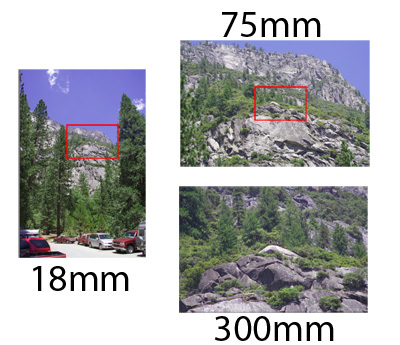
Which lens you carry in your camera bag makes a big difference in how you capture national park settings. Brett Gross photo-graphic.
How many lenses do you need for your camera to capture all the beauty of our National Park System? That's a question that can be costly if you're not careful in your selections.
If you own an interchangeable-lens camera (often called an SLR or DSLR) then you have probably been curious about the plethora of lens options that you have. At the very least I am sure you have asked yourself if the lens that came with your camera would be all that you need.
Each lens can be described by two main features: focal length and maximum aperture. We'll talk about each of these presently.
First off, there are two main categories of lenses: zooms and primes. A zoom lens covers a range of focal length while a prime lens has a single focal length. While, historically, prime lenses have been of higher quality than zooms, today's best zoom lenses deliver excellent quality. A lens' focal length is always expressed in millimeters with larger numbers indicating an ability to bring more distant objects closer.
When looking at the focal length of a lens, you must take one camera-specific factor into account: sensor size. Most digital SLR cameras have a sensor that is smaller than a traditional 35mm frame. This makes the camera function as if it had a small magnifier in it which usually means that you have to multiply a lens' focal length by 1.5 or 1.6 to determine how that lens will function on your camera. In general, if you paid less than $2,000 for the camera, then it most likely has this multiplier. If your camera is a Canon then use 1.6x and use 1.5x for most other manufacturers.
Traditionally, 50mm is considered a 'normal' lens (remember to take into account your camera's multiplier) meaning that it is sees the world pretty much as you do; providing no magnification. A 100mm lens provides about 2x magnification and a 400mm lens provides about 8x. With a Canon 1.6x camera that 400mm lens functions like a 640mm lens on a film camera while a 10mm lens functions like a 16mm. This means that you can get closer to wildlife but need wider lenses to get an entire panoramic scene.
Aperture is a measure of the size of the hole (aperture) that light passes through on the lens. For reasons of geometry, the smaller the number the larger the hole, thus more light gets through the lens. A lens with an f/2.8 aperture allows in more light than one with a f/5.6 aperture.
Lenses are rated on their maximum aperture at a given focal length but are capable of using smaller apertures (and usually do). A zoom lens will often have a range listed for aperture such as f/3.5-5.6. This means that at its shortest focal length it is capable of f/3.5 and at its longest focal length it is capable of f/5.6. Some lenses are capable of a constant maximum aperture throughout the zoom range and their aperture is listed as a single number such as f/2.8. Generally, a constant maximum aperture lens costs more than a variable maximum aperture lens.
A 70-300mm f/4.5-5.6 lens is capable of f/4.5 at 70mm and f/5.6 at 300mm with in-between focal lengths providing a maximum aperture between f/4.5 and f/5.6. A 24-105mm f/4.0 lens is capable of f/4.0 at any focal length.
Larger aperture (smaller the number) lenses tend to cost more but deliver better low light performance. They will usually focus better in low light and allow you to shoot without a flash in more environments. The largest aperture generally available on telephoto lenses is f/2.8. The largest aperture available on more affordable lenses is usually f/4.0 or so.
Larger aperture settings also provide more background blur and are used extensively for portraits. There are also some interesting creative uses for large aperture settings, but I'll save that for another time.
Essential lens: the walkaround
Your camera may have come with a perfectly good general-purpose 'walkaround' lens. Most do. For a walkaround lens I recommend a lens with a focal length range from about 20-100mm. 20mm or so is wide enough to capture most landscapes and 100mm can get you a little closer to wildlife. For this lens I consider stabilization a must: either in the lens or your camera body. Since this lens will be on your camera most of the time you will want to make sure it is a good quality lens. You may find that for landscapes you prefer a wider lens and most manufacturers offer lenses that start at about 17 or 18mm wide. Except for the most sweeping panoramas, 17mm should be wide enough.
Wildlife lens
Do not approach wildlife. Get a long lens to keep yourself and wildlife safe.
300mm is a good focal length for relatively close wildlife. Elk on the next hill will still be small but will be recognizable as elk. For better reach, you can usually find a lens that reaches out to 400 or even 500mm. However, to go beyond 300mm usually requires a serious investment. You may find lenses advertised as 500mm/1000mm. These lenses are manual focus lenses with a universal mount and a 2x converter. I don't generally recommend these lenses, but with careful focusing and a good tripod you can get decent results from them. 70-300mm is a very common range for this sort of lens.
You can also add a supplementary lens called a teleconverter that gets placed between the camera and lens. The teleconverter will usually provide 1.4x or 2.0x magnification, thus turning your 70-300mm lens into a 140-600mm lens. The downside to teleconverters is that they can degrade image quality and will reduce the amount of light that reaches your autofocus sensor, something that can cause autofocus problems. That said, a good 1.4x teleconverter might be a worthwhile investment if your longest lens is 300mm.
Macro
Macro lenses tend to have some of the best optics available from a manufacturer. While many telephoto lenses may contain the word 'macro' in their name, they generally fall short of what a true macro lens is capable of. All good macro lenses are capable of attaining 1:1 magnification, which means that an object that is 1" appears on the sensor as 1". Some lenses are even capable of greater than 1:1 magnification. These are very specialized lenses and not something found in most photographer's bags.
I highly recommend getting a macro lens if your bag has room for one. You will see the closeup world differently when you have a macro lens on your camera. You will find details that you never knew were there and, I hope, get more out of your park experience.
Ultrawide
Smaller-than-35mm-frame sensors have necessitated a new category of lens: the ultrawide. As mentioned earlier, these 'crop factor' cameras make long lenses longer, but they also make previous-generation wide angle lenses less wide. Thus the ultrawide. These lenses are great for scenic shots, but often do not provide long enough reach to be most people's general purpose lens. The ultrawide lens usually comes in a range from about 10-20mm. If you are comfortable with assembling multiple shots into a seamless panorama then this may not be an essential lens for you, but if you want a single shot that covers up to about one-half of the vista before you then the ultrawide is what you want. One downside with such wide lenses is that they tend to distort vertical lines near you, making trees appear to be growing at an angle. I used an ultrawide lens in Yosemite for most of a day and was thrilled with the results, although I did have to correct some images to straighten the trees.
The megazoom
Many lens makers have started to make a lens that tries to be the one lens for everybody. These lenses usually come in a range of 17 or 18mm to 200 or even 250mm. The first generation of these lenses did not provide the best image quality and often suffered from poor focusing accuracy and speed. These lenses have been updated and many now feature stabilization (for Canon & Nikon bodies). Reports have been better but I would advise reading reviews and trying the lens beforehand if possible. If the f-stop range of a lens goes beyond 5.6 then you will likely have troubles with autofocus in anything but bright daylight.
Other features
Dust/weather sealing is generally only featured on 'pro' lenses, but after getting caught in a dust storm in Utah I will never travel without weather sealed lenses. While the dust did work its way out of my old lens, it spent a few months with a 'crunchy' feeling zoom ring. Not so with my new, sealed lenses. Even after a photographer's tour of Antelope Canyon with its omnipresent airborne dust my sealed lenses are smooth.
Stabilization is now offered on most new lenses (or in-body, depending on your camera manufacturer). For lenses wider than about 100mm or so you may not find stabilization to be necessary, but on telephoto lenses I consider it a must. You will get a much higher percentage of keepers with a long stabilized lens.
In my bag
My main camera bag always has the following four lenses in (often a few more):
*Canon 100mm f/s.8 macro - Perhaps my all-time favorite lens
* Canon 24-105mm f/4.0L IS USM - My general-purpose walkaround lens. Super-sharp and weather sealed.
* Canon 70-300mm f/4.5-5.6 IS USM - My default telephoto lens. Not as sharp as my 100-400mm lens, but much smaller, lighter and less conspicuous
* Canon 50mm f/1.8 - This lens is very sharp and amazingly affordable. I rarely use it but it is very small and I keep hoping to find it useful
Happy shooting!
Story Categories:
A copy of National Parks Traveler's financial statements may be obtained by sending a stamped, self-addressed envelope to: National Parks Traveler, P.O. Box 980452, Park City, Utah 84098. National Parks Traveler was formed in the state of Utah for the purpose of informing and educating about national parks and protected areas.
Residents of the following states may obtain a copy of our financial and additional information as stated below:
- Florida: A COPY OF THE OFFICIAL REGISTRATION AND FINANCIAL INFORMATION FOR NATIONAL PARKS TRAVELER, (REGISTRATION NO. CH 51659), MAY BE OBTAINED FROM THE DIVISION OF CONSUMER SERVICES BY CALLING 800-435-7352 OR VISITING THEIR WEBSITE. REGISTRATION DOES NOT IMPLY ENDORSEMENT, APPROVAL, OR RECOMMENDATION BY THE STATE.
- Georgia: A full and fair description of the programs and financial statement summary of National Parks Traveler is available upon request at the office and phone number indicated above.
- Maryland: Documents and information submitted under the Maryland Solicitations Act are also available, for the cost of postage and copies, from the Secretary of State, State House, Annapolis, MD 21401 (410-974-5534).
- North Carolina: Financial information about this organization and a copy of its license are available from the State Solicitation Licensing Branch at 888-830-4989 or 919-807-2214. The license is not an endorsement by the State.
- Pennsylvania: The official registration and financial information of National Parks Traveler may be obtained from the Pennsylvania Department of State by calling 800-732-0999. Registration does not imply endorsement.
- Virginia: Financial statements are available from the Virginia Department of Agriculture and Consumer Services, 102 Governor Street, Richmond, Virginia 23219.
- Washington: National Parks Traveler is registered with Washington State’s Charities Program as required by law and additional information is available by calling 800-332-4483 or visiting www.sos.wa.gov/charities, or on file at Charities Division, Office of the Secretary of State, State of Washington, Olympia, WA 98504.
INN Member

The easiest way to explore RV-friendly National Park campgrounds.

Here’s the definitive guide to National Park System campgrounds where RVers can park their rigs.
Our app is packed with RVing- specific details on more than 250 campgrounds in more than 70 national parks.
You’ll also find stories about RVing in the parks, tips helpful if you’ve just recently become an RVer, and useful planning suggestions.


Comments
Great article! I must say I love my 17-40mm, but now you've got me wanting a macro lens.
Great introduction Brett, thank you for it. But in the end the most important factor in photography is the photographer. The image is created in your mind before you release the shutter. And a good photographer can make good to excellent pictures with (almost) any equipment. So the real advice to those who wish to improve their pictures is: You don't need much equipment, but get to know your gear and learn how to use it for the best results.
Regarding lenses and focal length, I believe that the magnifying is not the decisive factor. Usually you can substitute a telephoto lens by simply walking closer. The real effect of focal length is how a lens depicts depth. A wide angle exaggerates the foreground and distances there, while a telephoto lens compresses depth and make distant objects appear close behind each other. "Objects in the rear view mirror ..." may in fact be closer than they appear - a rear view mirror works like a small wide angle lens.
So if you own a zoom lens on your point-and-shoot or several interchangeable lenses on a SLR, experiment with the focal length. Try the obvious and its opposite. Take a telephoto lens (or the equivalent setting of your zoom) to photograph a single blossom - then take a wide angle and get very close to the flower. Get on your knees if necessary and physically possible for you, and take a picture. The blossom will be singled out of its surrounding because the wide angle exaggerates the distances and wide angles tend to blur the background, if focused on a very close object. Two different ways to guide the eye of the beholder to the important part of your picture: The small frame of a telephoto lens or the exaggerated perspective of a wide angle.
Now do the opposite: The usual way to take a picture of a valley, a mountain, a meadow would be to use a wide angle. Try it. Then take a telephoto lens and photograph the same setting from long distance away. The result will be dramatic. All depth in your objects will be compressed.
A normal lens, 50mm equivalent, depicts your objects like the human eye does. So those lenses (or settings in a zoom) are excellent for pictures with lots of details.
Explore and learn. With digital cameras the costs of an individual picture are nil. So we can take many and try new things easily. Experiment with shapes and motives. Use a telephoto lens over long distances as above for motives with a diagonal line in it, maybe a hiking trail or a fence or the tree line and the edge of a meadow.
For nikon digital slrs: I use my 18-200 zoom as a walking around lens, with a canon close-focusing ring that screws on at the filter end to make this almost a 1:1 macro when needed for flowers & insects. It has autofocus (I often override) and vibration-reduction, which helps in low light.
I also have the 12-24mm: I take crazy shots out on the playas, and have photoshop to automatically back-correct the curvature from 12mm.
I agree with MRC: the limitations of my photography in the parks are due to my limitations, not the equipment's, except for vivid color & resolution, where film still beats digital. I shoot thousands of digital frames (thousands of bad shots, a few keepers, but I'm learning), but when I have the time and light, I still shoot film for the best shots.
Thanks a lot for the write-up Brett! It's amazing how many photographers I see out and about without TRIPODS. This goes for wildlife, landscapes, macro, etc. You can set up your composition by walking around the scene without a tripod, but, always use a tripod when taking your shot. And, don't use one with a extendable center head. It's too unstable and defeats the purpose of having a tripod.
I use a Gitzo 1548. It's lightweight and extremely tough (it's expensive, but, you won't have to buy another one, for many years) and has enough weight to act as a support. A tripod too light is not much good and you end up having to stabilize it.
rob
---
Executive Director,
Crater Lake Institute
www.craterlakeinstitute.com
Robert Mutch Photography
@Robert Payne- thanks for the kind words. I also love my 17-40mm lens. Go get that macro lens, you won't regret it!
@MRC- Good points! The person pressing the shutter button really is more important than what the button is attached to. I've seen comsumer-level cameras generate amazng photos. I'm going to talk about aperture and its effects in one of my next articles- that goes hand in hand with the effect of focal length.
@Robert Mutch- I couldn't agree more. Tripods are perhaps the most underutilized tool for the beginning photographer. I do need to get myself a nice carbon-fiber tripod. My current Manfrotto is a real tank- solid but heavy!
Thanks all!