
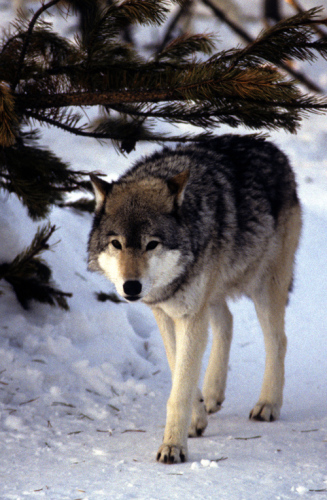
A federal judge has questioned whether the gray wolf can survive in the greater Yellowstone area under the government's plan to remove the species from Endangered Species Act protection. Kurt Repanshek photo.
A federal judge has restored Endangered Species Act protection for wolves in the greater Yellowstone ecosystem, rejecting the Interior Department's contention that the species is well on its way to recovery.
The ruling was handed down Friday by U.S. District Judge Donald Molloy is only a temporary stop. He granted the conservation groups a preliminary injunction to put a hold on the hunting of wolves until a trial can be held to fully explore the groups' claims that the Interior Department was premature in removing Endangered Species Act protections from the wolf in the greater Yellowstone ecosystem.
Still, some of the judge's comments were biting.
"In my view, Plaintiffs are likely to succeed on the majority of the claims relied upon in their request for a
preliminary injunction. In particular, (1) the Fish & Wildlife Service acted arbitrarily in delisting the wolf despite a lack of evidence of genetic exchange between subpopulations; and (2) it acted arbitrarily and capriciously when it approved Wyoming’s 2007 plan despite the State’s failure to commit to managing for
15 breeding pairs and the plan’s malleable trophy game area," Judge Molloy wrote (see attached ruling). "In both instances, the Fish & Wildlife Service altered its earlier position without providing a reasoned decision for the change based on identified new information.
"As recently as 2002, the Service determined genetic exchange between wolves in the Greater Yellowstone, northwestern Montana, and central Idaho core recovery areas was necessary to maintain a viable northern Rocky Mountain wolf population in the face of environmental variability and stochastic events. The Fish &
Wildlife Service nevertheless delisted the wolf without any evidence of genetic exchange between wolves in the Greater Yellowstone core recovery area and the other two core recovery areas. To justify its decision, the Service relied on the same information that was available to it when it determined genetic exchange was necessary in 2002."
Judge Molloy also opined that the wolf as a species could suffer irreparably if the Interior Department's decision stands.
"Plaintiffs have also shown a significant possibility of irreparable injury. More wolves will be killed under state management than were killed when ESA protections were in place. Idaho, Montana, and Wyoming each have public wolf hunts scheduled for this fall," he wrote. "Additionally, the states’ defense of property laws permit the killing of wolves in more circumstances than defense of property regulations under the ESA.
"The killing of wolves during the pendency of this lawsuit will further reduce opportunities for genetic exchange among subpopulations. Genetic exchange that did not take place between larger subpopulations under ESA protections is not likely to occur with fewer wolves under state management. Absent genetic exchange, the viability of the wolf will be threatened by future environmental variability and stochastic events."
The ruling was heralded by the conservationists.
“The federal court just offered a badly needed lifeline to wolves in the Northern Rockies,” said Louisa Willcox of the Natural Resources Defense Council. “Wolves have been getting killed at a rate of about one per day since the federal government stripped them of Endangered Species Act protections. Today’s ruling means the slaughter must stop.”
The conservation groups sued the U.S. Fish and Wildlife Service in late April, arguing that the government’s decision to delist the wolves was illegal. The groups asked the federal court to reinstate Endangered Species Act protections, while considering arguments that delisting the wolf was unlawful. The request for a court order to stop the killing was filed with a lawsuit challenging the federal government’s wolf delisting decision.
More than 100 wolves have been killed in the states of Idaho, Montana and Wyoming since the federal government delisted the wolves on March 28, 2008.
In their request for a preliminary injunction reinstating Endangered Species Act protections, NRDC and 11 other groups argued that “the killing of wolves that have been removed unlawfully from the endangered species list is sufficient to demonstrate irreparable harm.”
The reintroduction of wolves by the federal government 12 years ago has been widely hailed as a major success story. It has measurably improved the natural balance in the Northern Rockies and benefited bird, antelope and elk populations, according to NRDC. Many thousands of visitors flock to Yellowstone National Park each year to see and hear wolves in the wild, contributing at least $35 million to the local economy each year, the group said.
Thousands of gray wolves roamed the Rocky Mountains before being slaughtered and eliminated from 95 percent of the lower 48 states by the 1930s. The gray wolf was listed as endangered under the Endangered Species Act in 1973. Reintroduction efforts placed 66 wolves in Yellowstone National Park and part of Idaho in 1995-96.
The lawsuit was filed by Earthjustice on behalf of NRDC, Defenders of Wildlife, Sierra Club, Center for Biological Diversity, The Humane Society of the United States, Jackson Hole Conservation Alliance, Friends of the Clearwater, Alliance for the Wild Rockies, Oregon Wild, Cascadia Wildlands Project, Western Watersheds Project, and Wildlands Project.

Story Categories:
A copy of National Parks Traveler's financial statements may be obtained by sending a stamped, self-addressed envelope to: National Parks Traveler, P.O. Box 980452, Park City, Utah 84098. National Parks Traveler was formed in the state of Utah for the purpose of informing and educating about national parks and protected areas.
Residents of the following states may obtain a copy of our financial and additional information as stated below:
- Florida: A COPY OF THE OFFICIAL REGISTRATION AND FINANCIAL INFORMATION FOR NATIONAL PARKS TRAVELER, (REGISTRATION NO. CH 51659), MAY BE OBTAINED FROM THE DIVISION OF CONSUMER SERVICES BY CALLING 800-435-7352 OR VISITING THEIR WEBSITE. REGISTRATION DOES NOT IMPLY ENDORSEMENT, APPROVAL, OR RECOMMENDATION BY THE STATE.
- Georgia: A full and fair description of the programs and financial statement summary of National Parks Traveler is available upon request at the office and phone number indicated above.
- Maryland: Documents and information submitted under the Maryland Solicitations Act are also available, for the cost of postage and copies, from the Secretary of State, State House, Annapolis, MD 21401 (410-974-5534).
- North Carolina: Financial information about this organization and a copy of its license are available from the State Solicitation Licensing Branch at 888-830-4989 or 919-807-2214. The license is not an endorsement by the State.
- Pennsylvania: The official registration and financial information of National Parks Traveler may be obtained from the Pennsylvania Department of State by calling 800-732-0999. Registration does not imply endorsement.
- Virginia: Financial statements are available from the Virginia Department of Agriculture and Consumer Services, 102 Governor Street, Richmond, Virginia 23219.
- Washington: National Parks Traveler is registered with Washington State’s Charities Program as required by law and additional information is available by calling 800-332-4483 or visiting www.sos.wa.gov/charities, or on file at Charities Division, Office of the Secretary of State, State of Washington, Olympia, WA 98504.


National parks and their natural resources belong to you. The National Parks Traveler works to ensure you know how these essential places are being cared for.
Sign Up For Our Weekly Newsletter
Unsubscribe at any time.
INN Member

The easiest way to explore RV-friendly National Park campgrounds.

Here’s the definitive guide to National Park System campgrounds where RVers can park their rigs.
Our app is packed with RVing- specific details on more than 250 campgrounds in more than 70 national parks.
You’ll also find stories about RVing in the parks, tips helpful if you’ve just recently become an RVer, and useful planning suggestions.


Comments
Thanks for following this Kurt. This is an emotional issue. I do not want to see any species overrun, nor do I want to see one wiped out.
Now that is one step in the right direction! If the government would keep their "grubby" little hands out of everything, then maybe, just maybe, we could take more steps in the right direction. God put the animals on the earth, who are we to remove them???
Let's just hope the irate ranchers that despise Judge Molloy's ruling (and would be poachers) keep their long guns at bay. Empty the bullet chambers and let the wolves help balance nature once again...as it's intended to do!