
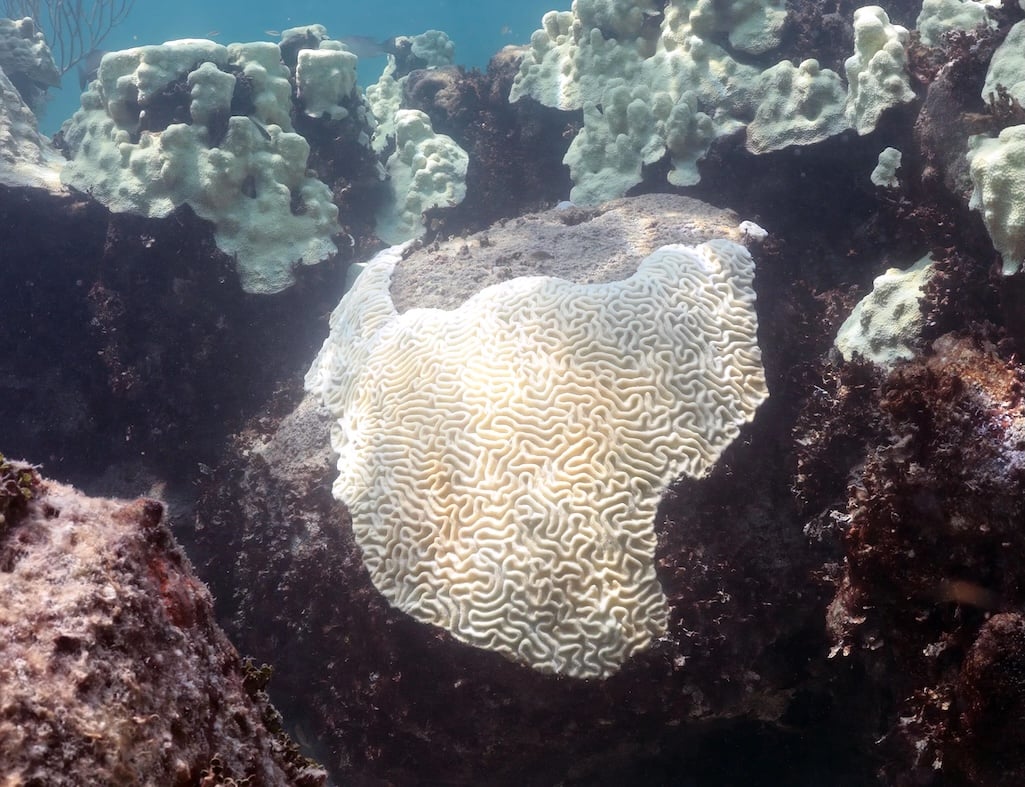
Though the record-breaking fourth global coral bleaching event apparently has ended, according to the National Oceanic and Atmospheric Administration, staff there say the rapidity at which those events are occurring makes it hard to define when they begin and end.
According to data tracked by NOAA’s Environmental Satellite, Data, and Information Service, the latest bleaching event that started in early 2023 apparently ended in 2025. That event impacted 84 percent of the world’s coral reefs in the Pacific, Atlantic, and Indian oceans. Since early 2025, however, global heat stress has been in decline, the agency reported this past week.
“We needed to confirm that no widespread, large-scale bleaching was reported anywhere during the austral summer which ran from December 2025 through February 2026, before we were confident the event had ended," said Derek Manzello, coordinator of NOAA’s Coral Reef Watch.
"We are now in the era where reefs will bleach on a near-annual basis, which means defining when global events begin and end is becoming increasingly difficult," he said. "The plan moving forward is to rely on field bleaching observations to determine if and when global events are happening."
The marine heat wave that spurred the bleaching event raised ocean waters along coastal Florida to 100° Fahrenheit and led to widespread damage to the Florida Reef Tract, which stretches from Dry Tortugas National Park below the Florida Keys to Biscayne National Park near Miami.
While the most recent global bleaching event likely is over, the building El Niño has raised concerns that another is in the wings.
NOAA’s four-month coral bleaching outlook shows a high risk to coral reefs throughout much of the north Pacific Ocean (including Hawai’i), as well as Florida and the Caribbean later this summer.
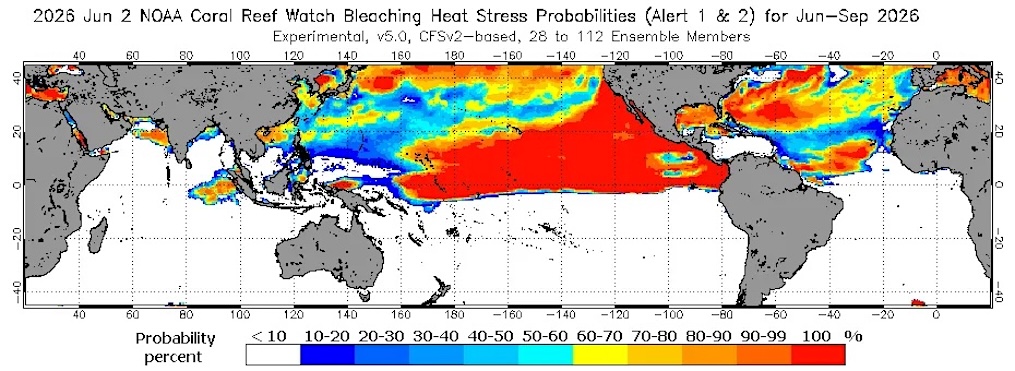
Since 1998, global coral bleaching events have coincided with every strong El Niño event with heat stress becoming more widespread and severe with each successive event. The 1st and 2nd global coral bleaching events occurred in 1998 and 2010, respectively, followed by the 3rd global coral bleaching event that spanned three years, 2014–2017.
Despite the massive scale of this fourth event, not all coral reef areas bleached even when exposed to high ocean temperatures. Scientists are looking into these locations to understand what factors may have contributed to their ability to resist bleaching.
“NOAA and its partners are studying multiple aspects of heat tolerance in corals,” said Jennifer Koss, Director of NOAA’s Coral Reef Conservation Program. “This will help us better understand resilience in corals and improve coral restoration strategies and techniques across the nation.”
In Florida, scientists have seen some corals that were raised in captivity and out-planted on the reef survive the hot waters of 2023.
“We have a lot of behind-the-scenes work that goes into our research before we even get to that out-planting phase,” Ashlyn Shattuck, a biologist who works at Mote Research Laboratory and Aquarium’s Key Largo, Florida, nursery told the National Parks Traveler in April. “We look into the varying genetics of the different corals that we have, and we find different resiliency traits that these corals have. Some corals tend to be stronger than others. They have different resiliency traits to things such as heat stress or pH changes. We can look into those and hand-pick corals that are going to survive in these bound-to-be-stressful conditions for years to come.”
The success of those efforts was seen after the 2023 heat wave.
“It was extreme heat. We were logging oceanic temperatures of over 101 degrees Fahrenheit,” Shattuck recalled. “This is where a lot of our behind-the-scenes work paid off, because we did have surviving corals. There were corals that had those heat tolerant resiliency traits to them that we had out-planted that did survive even those extreme conditions.”
Even with the end of the fourth global event, sea surface temperatures are still higher than 25 to 30 years ago, when the first global coral bleaching event occurred, noted NOAA.
“Thermal stress is now pervasive on our nation’s coral reefs,” said Manzello. “Frequent, regular monitoring is more vital now than ever before, as it is the only way to understand the biological and physical factors associated with bleaching resilience from the organism to ecosystem level.
Stories about:
Story Categories:
A copy of National Parks Traveler's financial statements may be obtained by sending a stamped, self-addressed envelope to: National Parks Traveler, P.O. Box 980452, Park City, Utah 84098. National Parks Traveler was formed in the state of Utah for the purpose of informing and educating about national parks and protected areas.
Residents of the following states may obtain a copy of our financial and additional information as stated below:
- Florida: A COPY OF THE OFFICIAL REGISTRATION AND FINANCIAL INFORMATION FOR NATIONAL PARKS TRAVELER, (REGISTRATION NO. CH 51659), MAY BE OBTAINED FROM THE DIVISION OF CONSUMER SERVICES BY CALLING 800-435-7352 OR VISITING THEIR WEBSITE. REGISTRATION DOES NOT IMPLY ENDORSEMENT, APPROVAL, OR RECOMMENDATION BY THE STATE.
- Georgia: A full and fair description of the programs and financial statement summary of National Parks Traveler is available upon request at the office and phone number indicated above.
- Maryland: Documents and information submitted under the Maryland Solicitations Act are also available, for the cost of postage and copies, from the Secretary of State, State House, Annapolis, MD 21401 (410-974-5534).
- North Carolina: Financial information about this organization and a copy of its license are available from the State Solicitation Licensing Branch at 888-830-4989 or 919-807-2214. The license is not an endorsement by the State.
- Pennsylvania: The official registration and financial information of National Parks Traveler may be obtained from the Pennsylvania Department of State by calling 800-732-0999. Registration does not imply endorsement.
- Virginia: Financial statements are available from the Virginia Department of Agriculture and Consumer Services, 102 Governor Street, Richmond, Virginia 23219.
- Washington: National Parks Traveler is registered with Washington State’s Charities Program as required by law and additional information is available by calling 800-332-4483 or visiting www.sos.wa.gov/charities, or on file at Charities Division, Office of the Secretary of State, State of Washington, Olympia, WA 98504.


National parks and their natural resources belong to you. The National Parks Traveler works to ensure you know how these essential places are being cared for.
Sign Up For Our Weekly Newsletter
Unsubscribe at any time.
INN Member

The easiest way to explore RV-friendly National Park campgrounds.

Here’s the definitive guide to National Park System campgrounds where RVers can park their rigs.
Our app is packed with RVing- specific details on more than 250 campgrounds in more than 70 national parks.
You’ll also find stories about RVing in the parks, tips helpful if you’ve just recently become an RVer, and useful planning suggestions.

