

Gusty winds helped the country's largest wildfire jump containment lines on the North Rim of Grand Canyon National Park, while extremely dry fuels challenged firefighters trying to make progress against a fire on the edge of Olympic National Park.
Dragon Bravo Fire, Grand Canyon National Park
While the Dragon Bravo Fire at the Grand Canyon grew to 130,520 acres over the past 24 hours, quick responses from the ground and air minimized the fire's spread after flying embers crossed containment lines on the northern edge of the fire.
"Firefighters continued their efforts to stop the steady growth in the southwest area but the intensity of the wind-blown fire behavior kept them from going direct," Wednesday morning's briefing report said. "Despite this, progress was made on containment lines in the area. On the Walhalla Plateau, crews made similar efforts but met with similar results."
The rim's rugged landscape and heavy fuels, and the extreme fire weather conditions, complicated efforts to contain the fire and keep firefighters safe.
"Ground and air resources will continue putting in fireline to keep the fire from extending north or northwest. This strategy will run it into territory where it will quickly run out of fuel," the morning briefing said. "In the southwest, firefighters will continue working to establish an anchor point from which they can safely build more containment lines. The roads group will assist them in approaching the fire from downwind.
"Managers are seeking a new strategy on the Walhalla Plateau to prevent fire below the rim from trapping firefighters if it spots on top of the plateau. On the remainder of the perimeter, crews are patrolling established lines and seeking areas that can be declared contained," the report added.
Sparked by lightning on July 4, the fire that destroyed the Grand Canyon Lodge and some 70 other historic cabins and concessionaire and Park Service facilities was being battled by more than 1,300 firefighters who had air support from retardant tankers and helicopters that were pulling water out of the Colorado River to dump on the flames. Nevertheless, just 13 percent of the blaze was considered to be contained as of Wednesday morning.
The North Rim closed to the public in mid-July and was not expected to reopen this year. Due to the smoke accumulation in the inner canyon resulting from the fire, and impaired emergency response access in the smoke-filled canyon, the Park Service also closed the following areas to all visitor use for the time being:
- North Kaibab Trail and South Kaibab Trail
- Bright Angel Trail below Havasupai Garden. River exchanges are allowed to pass through this area at their discretion.
- Phantom Ranch and Bright Angel Campground. Boat Beach is open for river runners to stop and refill water, however, they must continue to Pipe Creek beach for exchanges.
- River Trail between Pipe Creek and the South Kaibab
- Tonto East between Havasupai Garden and Tip Off
- All backcountry routes and canyoneering routes stemming from the North or South Kaibab, or the Bright Angel Trail.
Bear Gulch Fire, Olympic National Park
In the Pacific Northwest, just 3 percent of the 5,100-acre Bear Gulch Fire was contained. The more than 600 firefighters on the blaze, which was said to be human-caused on July 6, were confronted by steep topography, stands of towering cedar trees, and "dry and drought stressed fuels, heavy dead fuel loading." It was burning north of Lake Cushman and southeast of the Staircase area of Olympic National Park.
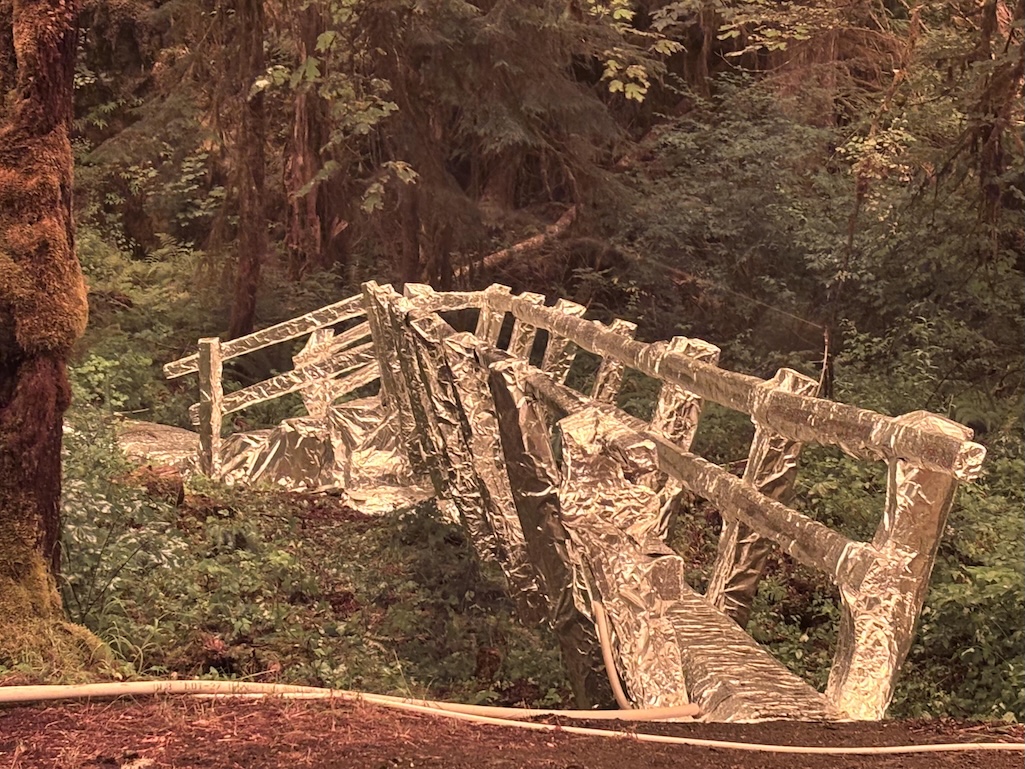
Along with directly attacking the flames, crews were strategically placing water sprinklers to protect private cabins, administrative facilities, bridges, and the Staircase Campground.
Along with the Staircase Campground, the following trails and backcountry campsites in the national park were closed:
Trails:
- Skyline Ridge Trail from Lake Beauty to Low Divide Camp
- North Fork Skokomish Trail
- Shady Lane Trail
- Home Sweet Home Trail at Upper Duckabush Camp
- South Fork Skokomish Trail at the park boundary
- Flapjack Lakes Trail
- Wagonwheel Lake Trail
- Four Stream Trail
- Six Ridge Primitive Trail
- Lake Sundown Trail at the junction with the Graves Creek Trail
- Black & White Lakes Primitive Trail
Wilderness Campsites:
- Belview
- Big Log
- Camp Pleasant
- Flapjack Lakes
- Home Sweet Home
- Lake Sundown
- Slide Camp
- Spike Camp
- Two Bear
- Wagonwheel Lake
Elsewhere in the National Park System, a small number of fires were burning in Yellowstone National Park, which has been under a storm of hundreds of lightning strikes in recent days. The largest fire, the Ash Fire in the Bechler region in the park's southwestern corner, covered about 26 acres. Two other fires considered to be active were an acre or less in size.
At Black Canyon of the Gunnison National Park in western Colorado, the 4,200-acre South Rim Fire was contained and crews and firefighting equipment were being removed. During the weekend fire activity remained isolated to interior pockets and inaccessible areas.
Stories about:
Story Categories:
A copy of National Parks Traveler's financial statements may be obtained by sending a stamped, self-addressed envelope to: National Parks Traveler, P.O. Box 980452, Park City, Utah 84098. National Parks Traveler was formed in the state of Utah for the purpose of informing and educating about national parks and protected areas.
Residents of the following states may obtain a copy of our financial and additional information as stated below:
- Florida: A COPY OF THE OFFICIAL REGISTRATION AND FINANCIAL INFORMATION FOR NATIONAL PARKS TRAVELER, (REGISTRATION NO. CH 51659), MAY BE OBTAINED FROM THE DIVISION OF CONSUMER SERVICES BY CALLING 800-435-7352 OR VISITING THEIR WEBSITE. REGISTRATION DOES NOT IMPLY ENDORSEMENT, APPROVAL, OR RECOMMENDATION BY THE STATE.
- Georgia: A full and fair description of the programs and financial statement summary of National Parks Traveler is available upon request at the office and phone number indicated above.
- Maryland: Documents and information submitted under the Maryland Solicitations Act are also available, for the cost of postage and copies, from the Secretary of State, State House, Annapolis, MD 21401 (410-974-5534).
- North Carolina: Financial information about this organization and a copy of its license are available from the State Solicitation Licensing Branch at 888-830-4989 or 919-807-2214. The license is not an endorsement by the State.
- Pennsylvania: The official registration and financial information of National Parks Traveler may be obtained from the Pennsylvania Department of State by calling 800-732-0999. Registration does not imply endorsement.
- Virginia: Financial statements are available from the Virginia Department of Agriculture and Consumer Services, 102 Governor Street, Richmond, Virginia 23219.
- Washington: National Parks Traveler is registered with Washington State’s Charities Program as required by law and additional information is available by calling 800-332-4483 or visiting www.sos.wa.gov/charities, or on file at Charities Division, Office of the Secretary of State, State of Washington, Olympia, WA 98504.


National parks and their natural resources belong to you. The National Parks Traveler works to ensure you know how these essential places are being cared for.
Sign Up For Our Weekly Newsletter
Unsubscribe at any time.
INN Member

The easiest way to explore RV-friendly National Park campgrounds.

Here’s the definitive guide to National Park System campgrounds where RVers can park their rigs.
Our app is packed with RVing- specific details on more than 250 campgrounds in more than 70 national parks.
You’ll also find stories about RVing in the parks, tips helpful if you’ve just recently become an RVer, and useful planning suggestions.

