
Technology can be a great thing with many benefits, but it also can cause deadly problems. A recent news article raises concerns about a controversial issue when it comes to the National Park System: e-Bikes and your safety.
The lengthy and well-reported article in The New York Times looked at the dangerous, and potentially deadly, mixture of e-Bikes and teenagers. The story, written by Matt Richtel, a Pulitzer Prize winner, explored the growing popularity of e-Bikes, how e-Bikes that supposedly can't go faster than 20 mph can go much faster (some can go up to 70 mph, wrote Richtel) once a wire is snipped, and how lax regulations are when it comes to safety and training.
The story raises the question of how the National Park Service will regulate e-Bikes in the parks. As we reported last month, Public Employees for Environmental Responsibility contends the Park Service has no idea what impacts e-Bikes are bringing to the park system.
A study the Park Service released in June "provides no current information on the actual number of roads and trails in which 130 park units are now approved for e-Bikes, or even whether 130 units remains accurate in 2023," PEER said. "It provides zero indication of how many backcountry trails, i.e., the most significantly impacted trails in the system, have been approved or where they are."
Furthermore, the advocacy group said the study "fails to adequately assess the conflicts created by the NPS’s approval of e-Bikes. It does not meaningfully quantify how e-Bikes can climb more elevation faster without stopping; maintain higher overall velocity; and pass other trail users more frequently which, when executed improperly (as is foreseeable), can disrupt single-track traffic and increase the risk of collision. Also because e-Bikes (typically 50-60 pounds) weigh more than non-motorized trail bikes (typically 25-30 pounds), any such collision carries a greater risk of serious injury."
We asked the Park Service about PEER's allegations, but the agency has not responded.
Electric bikes in the parks have been a controversial issue almost from the time they arrived on the scene back in 2019. Many folks who have disabilities say the bikes allow them to gain more enjoyment while visiting parks. Others worry about the speeds that can be reached, how quiet the bikes are (and so can surprise others on shared trails), and the potential for crashes.
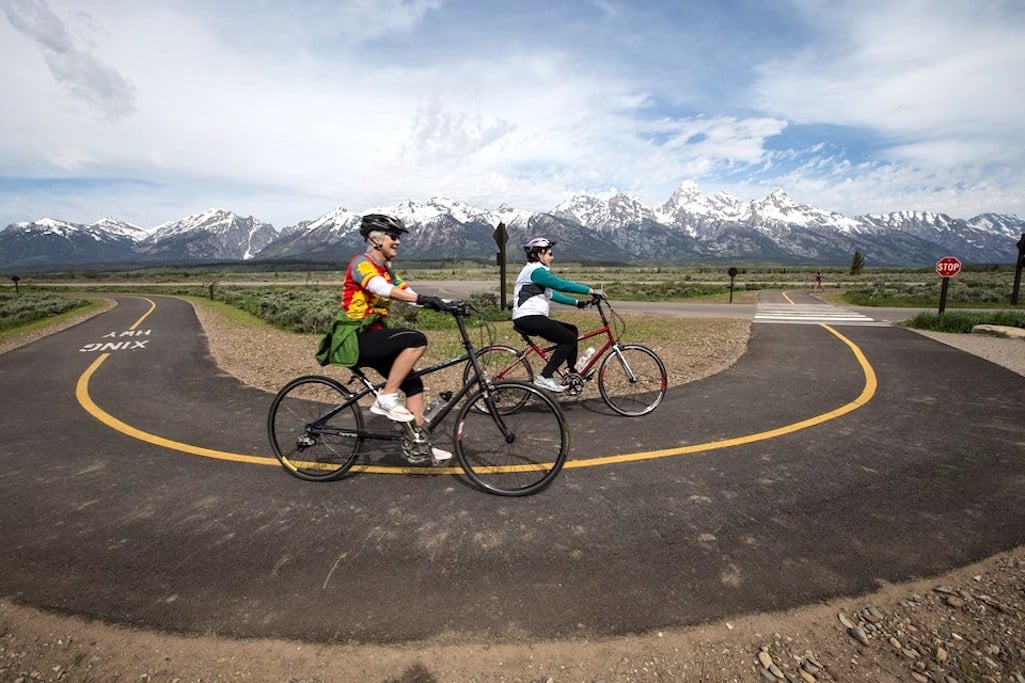
Should e-Bikes, which can go 20 mph or faster, be allowed on shared-use trails such as the multi-use pathways at Grand Teton National Park (photo above), the paved trail to Lone Star Geyser in Yellowstone National Park, or even the carriage roads in Acadia National Park? Do national parks have enough rangers to police e-Bikes? There have been concerns in the past raised on Cape Cod, where the 25-mile-long Cape Cod Rail Trail meanders through portions of Cape Cod National Seashore.
Have there been crashes, fires (their batteries have been known to cause fires), conflicts with hikers, natural resource impacts in the parks? If you know of any incidents, please let us know.
The Times' story should give the Park Service some pause in evaluating e-Bike use in the parks and when it comes to setting regulations.
Stories about:
Story Categories:
A copy of National Parks Traveler's financial statements may be obtained by sending a stamped, self-addressed envelope to: National Parks Traveler, P.O. Box 980452, Park City, Utah 84098. National Parks Traveler was formed in the state of Utah for the purpose of informing and educating about national parks and protected areas.
Residents of the following states may obtain a copy of our financial and additional information as stated below:
- Florida: A COPY OF THE OFFICIAL REGISTRATION AND FINANCIAL INFORMATION FOR NATIONAL PARKS TRAVELER, (REGISTRATION NO. CH 51659), MAY BE OBTAINED FROM THE DIVISION OF CONSUMER SERVICES BY CALLING 800-435-7352 OR VISITING THEIR WEBSITE. REGISTRATION DOES NOT IMPLY ENDORSEMENT, APPROVAL, OR RECOMMENDATION BY THE STATE.
- Georgia: A full and fair description of the programs and financial statement summary of National Parks Traveler is available upon request at the office and phone number indicated above.
- Maryland: Documents and information submitted under the Maryland Solicitations Act are also available, for the cost of postage and copies, from the Secretary of State, State House, Annapolis, MD 21401 (410-974-5534).
- North Carolina: Financial information about this organization and a copy of its license are available from the State Solicitation Licensing Branch at 888-830-4989 or 919-807-2214. The license is not an endorsement by the State.
- Pennsylvania: The official registration and financial information of National Parks Traveler may be obtained from the Pennsylvania Department of State by calling 800-732-0999. Registration does not imply endorsement.
- Virginia: Financial statements are available from the Virginia Department of Agriculture and Consumer Services, 102 Governor Street, Richmond, Virginia 23219.
- Washington: National Parks Traveler is registered with Washington State’s Charities Program as required by law and additional information is available by calling 800-332-4483 or visiting www.sos.wa.gov/charities, or on file at Charities Division, Office of the Secretary of State, State of Washington, Olympia, WA 98504.
INN Member

The easiest way to explore RV-friendly National Park campgrounds.

Here’s the definitive guide to National Park System campgrounds where RVers can park their rigs.
Our app is packed with RVing- specific details on more than 250 campgrounds in more than 70 national parks.
You’ll also find stories about RVing in the parks, tips helpful if you’ve just recently become an RVer, and useful planning suggestions.


Comments
E-bikes are a blessing for seniors and allows them to enjoy longer and more difficule rides than they could on a typical bike. But Class 1 e-bikes should be the only class allowed in parks. It is the best comprise, it allows for e-bike usage but limits to e-bikes with a top speed of 20 miles per hour with an electric motor that works only when the rider is pedaling - no throttle.
I just read your article and all the negative things you pointed out about E bikes can be done on many conventional and mountain bikes. So if you're using that as a reason to restrict E bikes and/or ban you bikes, I don't understand why all bikes would not be banned. The national parks belong to everyone and shouldn't make every effort possible to include all users recreational desires.
There are high powered sports cars that enter the parks and use the roads, so using your logic they should be banned to because someone could use it in a reckless way. Rules and regulations need to be in place so they can enforced and reported. I still believe that most people will and do follow the rules. Let's just publish the ones that break the rules and not everyone else.
I have ridden (on a human powered bike) the bike paths at Zion, Grand Canyon, Golden Gate NRA, Acadia, and extensively at Yosemite. The biggest thing that I notice when riding my bike and interacting with people on e-bikes is the large number of the e-bike users that ignore basic biking etiquette.
Things like staying on the right side of a path, riding in single file (or double on wider paths like the carriage roads), not stopping in the middle of the trail or in the middle of a trail junction, or yelling out "on your left" when passing, or swerving to the left when they hear "on your left" when being passed. In addition, there is almost always as great differential in the speed of most e-bike riders and those on regular bikes. I would guess that most people on regular bikes ride at about 8-12 mph while most people on Type 1 e-bikes are close to the max at 20 mph. It can be really disconcerting to be passed by another bike going at twice your speed with no warning about the e-bikes approach from behind. It can even be that way when an e-bike approaches from the opposite direction.
I would hope the NPS would require bike rental companies and e-bike users to have instruction in basic trail etiquette, not something I have noticed when I have rented a bike.
The agency’s decision to dismiss and exclude impacts to Wilderness from analysis in the proposed PEA reflects the agency’s legal obligations and poor and/or limited understanding of how and where its resources and visitors are actually affected by its policies.
The transport and operation of e-bikes may present additional increased fire and/or explosion risks to natural and cultural resources, visitors, commercial service providers, volunteers, and even Congressionally-designated Wilderness areas — that have not been thoroughly or properly evaluated.
E-bike fires are typically caused by the lithium batteries that power them. Lithium batteries include a highly combustible electrolyte fluid that can catch fire if the battery is overheated, damaged, or otherwise faulty in its construction. This can create a chain reaction that causes the battery to explode and create toxic gas. This can't happen with normal bicycles.
E bikes allow seniors and others accessibiltiy. Education and rules regarding acceptable trail use will solve alot. Our parks are for the use of all.
The PR geniuses who came up with "e-bike" should be handsomely rewarded. They are motorcycles, and should be treated as such. After being forced to jump into poison oak to avoid being run over by a group of e-motorcyclers speeding uphill around blind corners at Point Reyes, I have no inclination to ever support their use inNational Parks or other natural areas.