
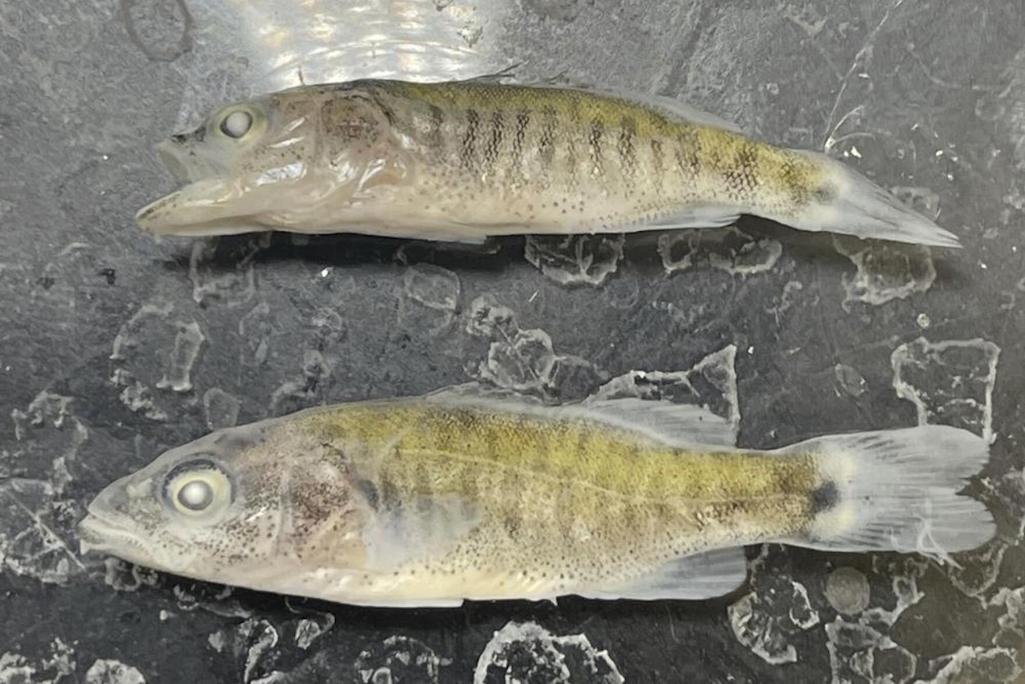
A scenario scientists feared has arrived at Grand Canyon National Park, where smallmouth bass have shown up, a non-native fish that somehow has passed through the Glen Canyon Dam to continue on down the Colorado River where it poses a serious threat to native humpback chub, a threatened fish.
Reaching the lower Colorado River was not an easy task for the bass. But as the level of Lake Powell behind the dam continues to fall due to reduced runoff, warmer water levels that the bass navigate brought them closer to the dam's penstocks, which funnel water to the turbines that generate hydropower. Apparently some bass survived being flushed through the turbines and were spotted by Jeff Arnold, Grand Canyon's fisheries biologist, while he was sampling the river's waters for fish species.
Now there are fears that smallmouth bass might be breeding in the river below the dam, and that's bad for the native humpback chub that fisheries experts have been working to recover from low numbers. A native of the Colorado River, the chub last fall was "uplisted" from endangered to threatened under the Endangered Species Act.
The chub, named for the distinctive hump on its back, was first documented in the lower Colorado River Basin in the Grand Canyon in the 1940s and the upper Colorado River Basin in the 1970s. It was placed on the list of endangered species in 1967 due to impacts from the alteration of river habitats by large mainstem dams. This fish is uniquely adapted to live in the swift and turbulent whitewater found in the river's canyon-bound areas. The fleshy hump behind its head evolved to make it harder to be eaten by predators, and its large, curved fins allow the humpback chub to maintain its position in the swiftly moving current, according to the Fish and Wildlife Service.
Recovery efforts in the Lower Basin population have raised the estimated population to more than 12,000 individuals in the Little Colorado River and the Colorado River at their confluence. There also have been increasing densities in the Grand Canyon's western end due to the receding Lake Mead exposing river habitat.
However, smallmouth bass eat humpback chub.
Dr. Jack Schmidt, professor of Watershed Sciences at Utah State University and head of the Center for Colorado River Studies, told the Traveler back in 2020 that climate change would open the door for invasive species in Lake Powell.
“The most obvious invasives, that are a direct function of climate change and water supply management, are nonnative fish. There are two kinds: cold water, mainly trout, and warm water, mainly smallmouth bass, gizzard chad (Dorosoma). As things get warmer nonnative reservoir fish might come up and swamp the system," he said at the time.
Stories about:
Story Categories:
A copy of National Parks Traveler's financial statements may be obtained by sending a stamped, self-addressed envelope to: National Parks Traveler, P.O. Box 980452, Park City, Utah 84098. National Parks Traveler was formed in the state of Utah for the purpose of informing and educating about national parks and protected areas.
Residents of the following states may obtain a copy of our financial and additional information as stated below:
- Florida: A COPY OF THE OFFICIAL REGISTRATION AND FINANCIAL INFORMATION FOR NATIONAL PARKS TRAVELER, (REGISTRATION NO. CH 51659), MAY BE OBTAINED FROM THE DIVISION OF CONSUMER SERVICES BY CALLING 800-435-7352 OR VISITING THEIR WEBSITE. REGISTRATION DOES NOT IMPLY ENDORSEMENT, APPROVAL, OR RECOMMENDATION BY THE STATE.
- Georgia: A full and fair description of the programs and financial statement summary of National Parks Traveler is available upon request at the office and phone number indicated above.
- Maryland: Documents and information submitted under the Maryland Solicitations Act are also available, for the cost of postage and copies, from the Secretary of State, State House, Annapolis, MD 21401 (410-974-5534).
- North Carolina: Financial information about this organization and a copy of its license are available from the State Solicitation Licensing Branch at 888-830-4989 or 919-807-2214. The license is not an endorsement by the State.
- Pennsylvania: The official registration and financial information of National Parks Traveler may be obtained from the Pennsylvania Department of State by calling 800-732-0999. Registration does not imply endorsement.
- Virginia: Financial statements are available from the Virginia Department of Agriculture and Consumer Services, 102 Governor Street, Richmond, Virginia 23219.
- Washington: National Parks Traveler is registered with Washington State’s Charities Program as required by law and additional information is available by calling 800-332-4483 or visiting www.sos.wa.gov/charities, or on file at Charities Division, Office of the Secretary of State, State of Washington, Olympia, WA 98504.


National parks and their natural resources belong to you. The National Parks Traveler works to ensure you know how these essential places are being cared for.
Sign Up For Our Weekly Newsletter
Unsubscribe at any time.
INN Member

The easiest way to explore RV-friendly National Park campgrounds.

Here’s the definitive guide to National Park System campgrounds where RVers can park their rigs.
Our app is packed with RVing- specific details on more than 250 campgrounds in more than 70 national parks.
You’ll also find stories about RVing in the parks, tips helpful if you’ve just recently become an RVer, and useful planning suggestions.


Comments
How is this breaking news? I live in Blythe, Ca and have been catching smallmouth bass here for decades? as far as i knew they have always been here. Lake Havasu has some pretty large smallmouth in it and the Parker strip holds a lot of them also.
Did you read the story, Adam? Smallmouth bass eat the native, and listed on the ESA, humpback chub. That's why it's news.
Good article, Kurt. I have been so absorbed by Yellowstone's battle to save cut-throat trout from lake trout that I have completely overlooked what is going on elsewhere. As an aside, I am happy to learn that the cut-throat are now holding their own, or doing a ittle better than that.
BTW, I saw your biographical data elsewhere at this site and congratulate you on what has been a useful life.