
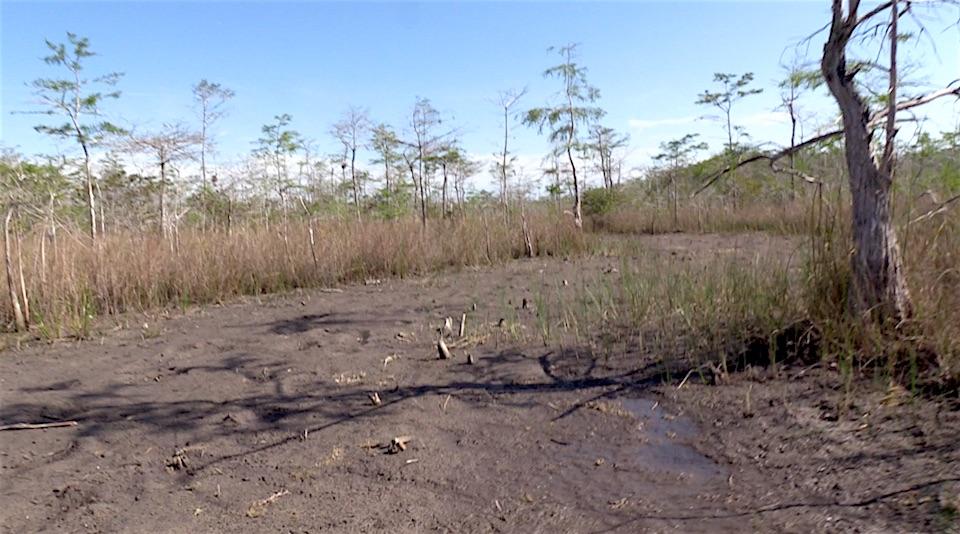
The U.S. Army Corps of Engineers has reversed its ruling that Burnett Oil Company would need a Clean Water Act permit to resume exploration in Big Cypress National Preserve/Kurt Repanshek file
In somewhat of a surprising reversal, the U.S. Army Corps of Engineers has told an oil exploration company that it can resume seismic operations in Big Cypress National Preserve in Florida without the Corps' oversight.
It was back on March 6 when Robert Halbert, the Corps' chief of compliance and enforcement in the Jacksonville, Florida, district, wrote Burnett Oil Co. President Charles Nagel to say the exploration work was in fact “mechanized land clearing, ditching and channelization,” activities that “caused an impact that resulted in a change in the bottom elevation of the wetland, that the activity caused an identifiable individual and cumulative adverse effect on aquatic function, and that the survey had the adverse effect of degrading a water of the U.S.”
Furthermore, Halbert told Nagel that the company would have to coordinate any future survey work “with the Corps in accordance with the Clean Water Act. A permit will be required of you unless and until you can demonstrate to the satisfaction of the Corps or Environmental Protection Agency, prior to commencing the activity involving the discharge, that the activity would not have the effect of destroying or degrading any area of waters of the United States.”
But this past Tuesday that directive was lifted by Col. Andrew D. Kelly, Jr., the district's commander who reached his decision after talking with Big Cypress staff.
"Jacksonville District rescinds the conclusions specified in the previous letter and asserts no further action is being taken by Jacksonville District or required of Burnett for its completed seismic survey," the colonel wrote in a letter to Nagel. "Given the environmental sensitivity in the Big Cypress National Preserve and your expressed commitment to environmental stewardship, Jacksonville District looks forward to working with you on any future actions to clearly and transparently identify and take the appropriate action on any regulatory requirements and communicate in a professional manner as we aspire to do with every potential applicant."
When I visited the preserve in early March, the very same day Halbert sent his letter to Nagel, I found scars 20 or more feet wide in places, and said to be running roughly 100 miles across the preserve. They were the footprints of oil exploration conducted by Burnett in 2017 and 2018. Some sections of these “seismic lines” are regaining their vegetative cover, others bear rutted troughs unnaturally holding water; certain sites are practically devoid of vegetation (above photo) despite the preserve’s subtropical climate and highly diverse botanical collection.
The seismic lines were created by Burnett’s use of ponderous “vibroseis” trucks that can weigh 30 tons to search for oil reserves. The vehicles, which some call “thumper trucks,” create ground-penetrating seismic waves by exerting all their weight onto a vibrating steel pad. Small instruments called “geophones” in turn receive the shock waves, and geologists use the waves to create three-dimensional maps of the underlying ground.
It's not known what those first two years of exploration detected, though the company did not return to Big Cypress this past winter to resume exploration.
"There isn’t any supporting science that we’re aware of," Alison Kelly, an attorney with the Natural Resources Defense Council, said of Col. Kelly's decision. "The reversal appears to have been based solely on conversations between the Corps and preserve staff."
It was past work hours when Traveler learned of the colonel's letter Friday evening, and too late to reach out for comment.

Stories about:
Story Categories:
A copy of National Parks Traveler's financial statements may be obtained by sending a stamped, self-addressed envelope to: National Parks Traveler, P.O. Box 980452, Park City, Utah 84098. National Parks Traveler was formed in the state of Utah for the purpose of informing and educating about national parks and protected areas.
Residents of the following states may obtain a copy of our financial and additional information as stated below:
- Florida: A COPY OF THE OFFICIAL REGISTRATION AND FINANCIAL INFORMATION FOR NATIONAL PARKS TRAVELER, (REGISTRATION NO. CH 51659), MAY BE OBTAINED FROM THE DIVISION OF CONSUMER SERVICES BY CALLING 800-435-7352 OR VISITING THEIR WEBSITE. REGISTRATION DOES NOT IMPLY ENDORSEMENT, APPROVAL, OR RECOMMENDATION BY THE STATE.
- Georgia: A full and fair description of the programs and financial statement summary of National Parks Traveler is available upon request at the office and phone number indicated above.
- Maryland: Documents and information submitted under the Maryland Solicitations Act are also available, for the cost of postage and copies, from the Secretary of State, State House, Annapolis, MD 21401 (410-974-5534).
- North Carolina: Financial information about this organization and a copy of its license are available from the State Solicitation Licensing Branch at 888-830-4989 or 919-807-2214. The license is not an endorsement by the State.
- Pennsylvania: The official registration and financial information of National Parks Traveler may be obtained from the Pennsylvania Department of State by calling 800-732-0999. Registration does not imply endorsement.
- Virginia: Financial statements are available from the Virginia Department of Agriculture and Consumer Services, 102 Governor Street, Richmond, Virginia 23219.
- Washington: National Parks Traveler is registered with Washington State’s Charities Program as required by law and additional information is available by calling 800-332-4483 or visiting www.sos.wa.gov/charities, or on file at Charities Division, Office of the Secretary of State, State of Washington, Olympia, WA 98504.


National parks and their natural resources belong to you. The National Parks Traveler works to ensure you know how these essential places are being cared for.
Sign Up For Our Weekly Newsletter
Unsubscribe at any time.
INN Member

The easiest way to explore RV-friendly National Park campgrounds.

Here’s the definitive guide to National Park System campgrounds where RVers can park their rigs.
Our app is packed with RVing- specific details on more than 250 campgrounds in more than 70 national parks.
You’ll also find stories about RVing in the parks, tips helpful if you’ve just recently become an RVer, and useful planning suggestions.


Comments
I don't get over to Florida much, not as often as I would like; but, many years ago, I was asked to review some information on the environmental dynamics of that area, not detailed so much as from a longterm strategic perspective. As I recall and from my notes, the Florida Peninsula rests on the geological equivalent of a bad sponge cake. In a few places, it’s solid and hard; in many other places, it’s riddled with tunnels and holes scoured out by groundwater; and, in the areas between, it’s loosely packed with porous sand and gravel only barely punctuated with any residual silt that has managed to keep from being washed away. It’s a huge saturated, if not downright flooded, storm drain, carrying rainwater both on the surface and under the surface, from north to south. Even before it reaches the little bit of higher ground around Orlando, the system has already started gathering enough head to hold off seawater intrusion and keep itself fresh on its way south to the Biscayne and Florida Bays. Two hundred years ago, these massive amounts of freshwater formed one huge, slow moving, cleansing wetland long before they even got as far south as Lake Okeechobee and it was this massive flow of freshwater that created the hard to survive, yet magnificent, natural paradise brimming with biological riches that was Florida.
Today, much of that water has been tamed. Upstream of Lake Okeechobee, the water has been redirected, channeled, and drained and the land has been dewatered to accommodate rampant development. Going south, both literally and figuratively, agriculture on an industrial scale, citrus, produce, and massive subsidized cane crops, have used pretty much all the water they ever wanted and this excessive development extends nearly all the way down to Interstate 75, which roughly passes along the northern boundaries of, on the west, the federal Big Cypress National Preserve and, on the east, the Everglades and Francis Taylor Wildlife Management Area, which is controlled by the Florida Fish and Wildlife Conservation Commission (FWC). Yet, even today, what’s left of that water oozes out to the east or flows out to the south and west to sustain what’s left of plentiful fisheries, lush birdlife, and beautiful environs in Biscayne Bay, Biscayne National Park, Everglades National Park, Florida Bay, and the Keys. The point is that all of these vast and priceless federally protected treasures and all of their biological riches are islands in and dependent upon those massive freshwater flows, flows that run for hundreds of miles, both on the surface and below the surface, bringing water and nutrients to sustain what's left of this natural paradise.
Surface disturbances in Big Cypress National Preserve will, as has already been documented, damage soil structure, alter soil chemistry, eliminate vegetative cover, expose soils to wind and water erosion and transportation, and result in pollution of the surface component of those freshwater flows. Silt activated by these surface disturbances will also find its way into those aforementioned porous sands and gravels and underground tunnels that are essential to the subsurface flows. Drilling directly through or thumping on the more solid limestone components of this relatively hollow geological sponge cake will irreparably weaken, crack, or otherwise damage subsurface structures that are esssential to the higher flowing links in this plumbing system and endanger everything that depends on the waters delivered by this plumbing system further south. It should not be done anywhere in that area, but especially not in what is supposedly a federally protected national preserve.
Now, the usual suspects will undoubtedly cry and moan about states' rights and other such corrupt nonsense and demand that we let the State of Florida handle it. But, let’s look at how that's been going so far. As we get closer to Florida FWC’s Everglades and Francis Taylor Wildlife Management Area, the flows are already showing the effects of overuse. Rising sea levels due to climate change and diminished flows of freshwater into Everglades National Park due to overconsumption further north are now allowing saltwater to intrude into areas formerly dominated by freshwater. So, has the State of Florida taken steps to reduce agricultural freshwater consumption to enable more water to flow south into these sensitive ecosystems? Not really; instead, six or seven years ago, the FWC instituted a controversial multi-million dollar program to spray herbicides into the water and onto wetland vegetation to clear channels and “improve recreational boating” in areas under their control upstream of Everglades National Park (Florida's war on weeds is killing fish and supercharging red tide… (https://www.cnn.com/2020/02/07/us/florida-weed-killer-spraying-red-tide/...)). Personally, I’m all for a reasonable amount of recreational boating; but, the truth is that 1) the vegetation being killed is what filters pollution from and adds oxygen to that water; 2) the water is now doused with herbicides before it enters Everglades National Park; 3) I’ve not found where changes in water quality caused by the spraying or the effects those changes on life in the Everglades or Florida Bay have been properly assessed; and 4) I’m not convinced the spraying is really intended to “improve recreational boating” and not just to reduce water consumption by native vegetation, increase flows by clearing natural channels, and thereby reduce the need to reduce agricultural water consumption further north. Anyone care for a nice plate of Gulf oysters with an aromatic herbicide glaze, yum? Ironically, the chairman of the Florida FWC at the time this spraying program was initiated subsequently moved on to become the CEO of a rightwing political lobbying operation masquerading as a conservation group, PERC, based in Bozeman and his wife is now on staff at Yellowstone Forever, which controls the federal bookstores in the NPS visitors' centers in Yellowstone. It all just goes to show that, down on the bayou, you never can tell.
The environmental situation down there, in Biscayne Bay, Biscayne National Park, Everglades National Park, Florida Bay, and the Keys, is already suffering even without the added effects of all this drilling and thumping in Big Cypress National Preserve. Without enough sufficiently clean freshwater, rising sea levels are intruding and altering inshore environments; toxic red tides are becoming larger, more frequent, and more intense; fisheries are changing and declining; and supposedly protected manatees are still getting chopped up, often lethally, by drunken nincompoops in speedboats. Dealing with any and all of these circumstances has stretched the funds available to the NPS down there to the breaking point already and things will get stretched further if, as an earlier NPT article (https://www.nationalparkstraveler.org/2020/01/groups-want-florida-purcha...) suggested, the NPS is extorted into preparing for some inflated buyout of this shabby oil exploration scam. Did anybody mention that there's an oil glut right now?
So, with all of this happening, the NPS has tried to mitigate their funding hemorrhage by raising user fees, which is usually the rightwing's preferred "milk the little guy" strategy; however, as a recent NPT article (https://www.nationalparkstraveler.org/2019/01/new-fees-florida-bay-angle...) reported, rightwing "sportsmen" squealed. I had the temerity to enter that fray by noting that monies doled out as tax cuts passed in 2017 could have instead been allocated to the NPS, to which one of our usual suspects responded by demanding to know, "what do the tax rate cuts have to do with park allocations?" I kid you not. The nincompoop probably owns a speedboat.
So trump finally got through to the Corps and made them go along with another of his lies?
Pay no attention to anonymous work. Since you want pay attention to my work I signed anonymous 2. As long as oil is cheap there will be no oil work in thE BICY. It's simple economics.
Smells of corruption to me. Just unbelievable Thanks for the great investigative reporting.
Burnett Oil Company Nobles Grade 3-D Seismic Survey
Big Cypress National Preserve » Burnett Oil Company Nobles Grade 3-D Seismic Survey » Document List
Texas-based Burnett Oil Company submitted to the National Park Service for approval a Plan of Operations (POP), a formal request to conduct a seismic survey of 110 square miles (70,454 acres) in the Preserve. A seismic survey is a preliminary research technique used to determine the presence of potential oil-bearing structures by introducing an energy source to the subsurface and recording and analyzing the returning sound waves. Stratigraphic anomalies detected by this technique may become future targets for oil and gas exploration drilling. An Environmental Assessment (EA), analyzing the environmental effects of the proposed survey and alternatives, was also prepared. The EA resulted in a Finding of No Significant Impact (FONSI), documenting selection of the preferred alternative. This alternative will utilize Vibroseis buggies as the energy source, as detailed in the POP. The NPS conditionally approved the POP on May 10, 2016. MAY 10, 2016. No doubt ordered by soon-to-be-President Trump
You will find on this website a copy of the POP, EA, FONSI, POP approval letter, and other documents and links.
Here is the text of a message sent to the administration by Phil Francis, chair of the Coalition to Protect Our National Parks:
“With reports that more than 700,000 Americans have lost their jobs, and more than 1000 people may die today as a result of the ongoing coronavirus pandemic, it is revealing that this administration is entertaining the requests of the oil and gas industry instead of looking out for the health and safety of our national parks and agency staff.
“This administration has refused to postpone oil and gas lease sales, suspend ongoing public comment periods, or delay new policy proposals.
“Make no mistake – this meeting further proves that the current administration, including the Department of the Interior, cares less about America’s public lands, the ongoing health crisis posed by keeping America’s National Parks open, and the National Park Service employees who have been put at risk because of this decision – than they do about their former business partners and friends in the oil and gas industry.”
The Coalition to Protect America’s National Parks represents over 1,800 retired, former and current employees of the National Parks Service.
Health crisis? Even with the padding, COVID deaths are about 1.5% of all deaths so far this year and only 1/5th of the deaths caused by influenza and pnuemonia. We don't shut down the Parks (or the rest of the country) for infuenza and pnuemonia and we shouldn't shut them for this. As Alfred pointed out, his beef is Hillary lost.
And finally, despite world wide unanimity of opinion, some of the cconspiracy theorists are leaking their carefully constructed fables out through the cracks and leaks in their tinfoil hats. Their thin social veneer of blending in with the rest of society is falling away.
Rick, you need to expand your "world" view. There is hardly unanimity on how to address the virus. Heck Fauci can't even tell the same story week to week. Carefully constructed fables? What was Aesopian about my comment. Other than my opinion at the end, which is clearly expressed as such, everything is pure facts.
My apologies - I intended to state "worldwide unanimituy of opinion that this is a health crisis". If you have documentation that the statistics are padded, you should state your case with documentation. And then shut up, as I'm about to. I've read the comments about the mudwrestling here in Kurt's comments area and am tlrying to minimize how much I contribute to it by shutting up. How about you?
Rick, Have you not seen the story reported by the NYTs that NYC added 3,700 cases well after the fact to their list of COVID deaths even though they had not been tested for COVID? Have you not seen the reports of code merging? Have you not heard the doctors that have come out to say they are being pressured to code deaths as COVID deaths even if they don't know if that is the cause?
https://www.nytimes.com/2020/04/14/nyregion/new-york-coronavirus-deaths....
https://www.youtube.com/watch?v=NjjybyJ59Lw&feature=share
http://www.informationliberation.com/?id=61367
https://knst.iheart.com/featured/garret-lewis/content/2020-04-09-doctor-...
Even with that padding, the numbers for COVID are a small fraction of other common diseases and ailments. For that we are selling out both our physical and economic future. The best way to get through this is not self isolation with the resulting depression, excessive alcohol, bad diet, lack of excercise and neglect of routine prophilactic measures (physicals, mamograms, colonoscopies ......). The answer, if you are healthy, which the overwhelming majority of us are, up your vitiman A, C & D and get outside for sunshine and fresh air. No better place to do than than a national Park.
From the CDC website:
What is a COVID-19 case?
CDC U.S. COVID-19 case counts and death counts include both confirmed and probable cases and deaths. This change was made to reflect an interim COVID-19 position statement pdf icon[10 Pages, 251 KB]external icon issued by the Council for State and Territorial Epidemiologists on April 5, 2020. The position statement included a case definition and made COVID-19 a nationally notifiable disease
Includes "probable" cases. Attribute the death to COVID without any evidence the deceased actually had COVID much less died from it. Naw, there's no padding.