
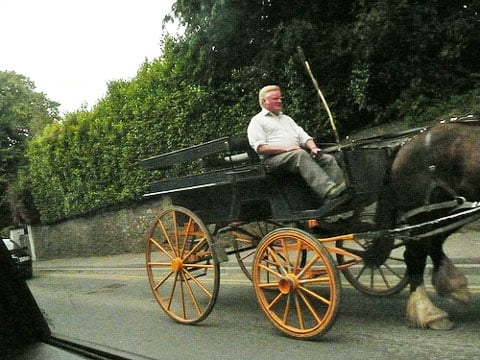
A "jaunting cart" in Ireland. Photo by donapatrick via Creative Commons and Flickr.
Editor's note: In an effort to better understand how other countries are managing their parklands, and to compare and contrast U.S. efforts to those from abroad, Traveler on occasion runs items from beyond U.S. borders. This post looks at livestock manure, a problem that arises from time to time with saddle- and pack-stock in our national parks.
Killarney National Park is the oldest national park in Ireland, and a popular tourist destination. In a controversy mimicking similar debates in U.S. parks, Killarney is currently the scene of controversy over a requirement that horse-drawn carts using the park be fitted with a "dung catcher device," referred to in some media reports as "nappies."
The issue of "exhaust emissions" from horses and mules on trails and even roads arises from time to time in parks here in the U.S. Hikers on heavily traveled routes such as the Bright Angel Trail at Grand Canyon National Park are often less than enthusiastic about the deposits left behind by the popular mule trips.
A similar problem in Ireland's Killarney National Park has apparently defied a lengthy search for a solution by the National Parks and Wildlife Service (NPWS). According to information from the NPWS,
Within the National Park, up to 66 jaunting cars [horse-drawn carts that carry tourists] ply their trade under licence from NPWS across a network of some 15 kilometers of internal roads within the Park. These paths are maintained and cleaned by NPWS at the taxpayer’s expense.
An unfortunate consequence of such a high volume of horses frequenting the Park is that the roadways are consistently fouled with horse dung...[this] has for a long time been a concern from the point of view of environmental, health and safety, aesthetic and tourism grounds. It should be noted that the majority of visitors to the Park navigate the roads by foot and as result of the horse dung on the roads, the NPWS has received numerous complaints.
The NPWS has been engaged in a lengthy consultation process with the jarveys [operators of the carts] since the end of 2007 to consider how best to deal with the issue and as part of this process also carried out trials with both a mechanical sweeper and with dung catchers.
After a lengthy series of meetings, trials and demonstrations, the Irish equivalent of the NPS concluded that a device attached to the cart (not the horse) to catch the dung was an effective solution.
NPWS is confident that the dung catcher device method is the way forward – they are already in widespread use in many European cities.
If you're interested in the full text of the NPWS press release on the issue, you'll find it here.
So what's the problem? The cart operators ("jarveys") have refused to embrace the idea.
"Although the dung catcher is attached to the car and not to the horse, jarveys have repeatedly signaled their complete opposition to the new devices but have never demonstrated where they perceive the problems to lie," says the NPWS.
Expense of the devices is not an issue—the NPWS has offered to pay for them.
Things came to a head on July 14, 2009, when the NPWS announced that carts which weren't equipped with the dung catchers would no longer be allowed in the park.
As proof things aren't much different in Ireland or the U.S., the jarveys have predicted an economic catastrophe for the tourism industry at the park and the neighboring town of Killarney as a result of the cart ban. Pickets protesting the new rules have reportedly been posted at entrances to the park.
The NPWS emphasizes that the park is open to all visitors and its business as usual—except for jaunting cars without the upgrade.
Situated in south-west Ireland ...the National Park covers over 25,000 acres (10,000 hectares) of mountain, moorland, woodland, waterways, parks and gardens. A major geological boundary occurs within the Park, and this, in combination with the climatic influence of the gulf stream and the wide range of altitudes in the Park, gives rise to an unusual and varied ecology.
Sounds like an interesting place for a jaunt...but don't count on using a jaunting cart in the near future.
Story Categories:
A copy of National Parks Traveler's financial statements may be obtained by sending a stamped, self-addressed envelope to: National Parks Traveler, P.O. Box 980452, Park City, Utah 84098. National Parks Traveler was formed in the state of Utah for the purpose of informing and educating about national parks and protected areas.
Residents of the following states may obtain a copy of our financial and additional information as stated below:
- Florida: A COPY OF THE OFFICIAL REGISTRATION AND FINANCIAL INFORMATION FOR NATIONAL PARKS TRAVELER, (REGISTRATION NO. CH 51659), MAY BE OBTAINED FROM THE DIVISION OF CONSUMER SERVICES BY CALLING 800-435-7352 OR VISITING THEIR WEBSITE. REGISTRATION DOES NOT IMPLY ENDORSEMENT, APPROVAL, OR RECOMMENDATION BY THE STATE.
- Georgia: A full and fair description of the programs and financial statement summary of National Parks Traveler is available upon request at the office and phone number indicated above.
- Maryland: Documents and information submitted under the Maryland Solicitations Act are also available, for the cost of postage and copies, from the Secretary of State, State House, Annapolis, MD 21401 (410-974-5534).
- North Carolina: Financial information about this organization and a copy of its license are available from the State Solicitation Licensing Branch at 888-830-4989 or 919-807-2214. The license is not an endorsement by the State.
- Pennsylvania: The official registration and financial information of National Parks Traveler may be obtained from the Pennsylvania Department of State by calling 800-732-0999. Registration does not imply endorsement.
- Virginia: Financial statements are available from the Virginia Department of Agriculture and Consumer Services, 102 Governor Street, Richmond, Virginia 23219.
- Washington: National Parks Traveler is registered with Washington State’s Charities Program as required by law and additional information is available by calling 800-332-4483 or visiting www.sos.wa.gov/charities, or on file at Charities Division, Office of the Secretary of State, State of Washington, Olympia, WA 98504.


National parks and their natural resources belong to you. The National Parks Traveler works to ensure you know how these essential places are being cared for.
Sign Up For Our Weekly Newsletter
Unsubscribe at any time.
INN Member

The easiest way to explore RV-friendly National Park campgrounds.

Here’s the definitive guide to National Park System campgrounds where RVers can park their rigs.
Our app is packed with RVing- specific details on more than 250 campgrounds in more than 70 national parks.
You’ll also find stories about RVing in the parks, tips helpful if you’ve just recently become an RVer, and useful planning suggestions.


Comments
So what is the problem? I don't see here why they are opposed to these "nappies." I assume it means the operator will be responsible for emptying the "nappy," but that doesn't sound too bad...
The biggest problem, from a business standpoint, that I can see is that the cause of an unpleasant odor will be with the passenger (the paying customer) for the balance of the trip. If a horse needs to evacuate at the beginning a trip around the park, it could make for a most unpleasant experience and one that not likely to be recommended.
Similar devices have been used for years on horse drawn carriages in US cities. I see no reason that they would not work in Irish parks
Seems like a reasonable solution to an awkward situation. The only "problem" the cart drivers have identified in the media reports I read is their claim the devices are a "safety problem" due to changing the weight distributions of the cart. However, I haven't read any information they've provided to bolster that argument. As others have said, this solution seems to work well in a lot of other locations.
If the tax payers are footing the bill why then wouldn't it be fair to pay a city worker to make 2-3 trips a day with a street sweeper. I am not all that familiar with street sweepers but assumed it would work or be modified to work.
Jeffrey -
The photo I found to illustrate the type of cart may have been misleading - the roads in question aren't in a city, they're out in a national park. Based on the photos I've seen of the park, this is a spectacular natural area.
Here's an answer to your question from the NPWS:
Since about 9 miles of road are involved, I'd think the cost of sweeping multiple times per day would be prohibitive, not to mention the unwelcome noise from a mechanical sweeper on otherwise quiet sections of the park.
Interestingly enough in most US parks, dog owners must pick their dog excrements but horse are free to defecate all over the trails.