
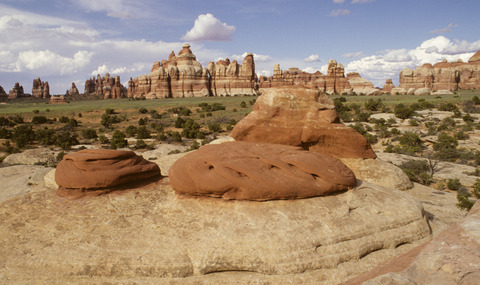
Southeastern Utah's national park units are vital to the region's economies, according to the latest report from the National Parks Conservation Association. Photo of Chesler Park in Canyonlands National Park by Kurt Repanshek.
National parks can, and do, provide an economic lifeline to their surrounding communities. In its latest report, the National Parks Conservation Association points out just how valuable southeastern Utah's parks are to their nearby communities.
Now, the Traveler in the past has been critical of stressing the value of national parks as economic engines, for it should be enough to point to them as reservoirs of rich and diverse natural, cultural, and historic resources when justifying both their existence and continued investment in the National Park System. That said, one can't discount the economics associated with the parks, because they do generate jobs and support communities that in turn serve vital roles for the parks.
In this new report, the NPCA looks at Arches and Canyonlands national parks as well as Natural Bridges National Monument and Glen Canyon National Recreation Area in portraying them as Landscapes of Opportunity.
The 20-page report was assembled not solely within the park advocacy group, but with input from National Park Service officials; an economic development specialist from the city of Moab, which relies dearly on Arches and Canyonlands for its lifeblood; an economist from Headwaters Economics, a group that specialists in studying the economies associated with public lands; the director of economic development and visitor services from San Juan County, a county with a deep history of being antagonistic towards public lands management, and; the director of the Wallace Stegner Center for Land, Resources, and the Environment at the University of Utah.
The overriding question of how national parks can affect local economies is not a new one, nor one likely to disappear soon. And it can be a highly polarizing one, as evidenced last year when the Bush administration auctioned off dozens of energy exploration leases in Utah, some in sight of national park lands. While Interior Secretary Ken Salazar put a hold on those leases to allow for more environmental review, the political ramifications were potent, as U.S. Sen. Robert Bennett, R-UT, temporarily blocked Senate confirmation of Deputy Interior Secretary David Hayes.
With this incident still fresh, the NPCA report -- drawing on various economic indicators -- offers hope, and more than a little proof, that well-protected national parks and sound economic vitality are not mutually exclusive in southeastern Utah.
“Our national parks are magnets for economic growth; civic leaders and residents of San Juan and Grand counties have a tremendous opportunity and responsibility to build a local economy that leverages the exquisite beauty of these special places, while also making sure these assets are preserved for our children and grandchildren,” said David Nimkin, director of NPCA’s Southwest regional office, which is based in Salt Lake City.
For instance, in 2006, the report notes, the 1.2 million visitors to Arches and Canyonlands spent $99 million during their visits, which one economist estimates supported 2,315 local jobs. Such numbers are not lost on the state of Utah, which even carries the image of Delicate Arch on its license plates.
"Our national parks are iconic, and brand the State of Utah for exceptional beauty, natural serenity and outdoor recreation," said Leigh von der Esch, managing director of the Utah Office of Tourism, an office in the Governor's Office of Economic Development. "We use pictures of our national parks on all of our domestic and international marketing pieces and find they are a major draw for attracting tourists and increased traveler spending from around the globe."
But southeastern Utah also holds many energy resources in the form of coal, uranium, natural gas, and oil, and their associated industries are economic engines in their own right. Can these two sectors -- energy development and tourism -- coexist?
"I think the purpose of this report was not to say the parks are just economic engines and they (the surrounding communities) need to leverage that into economic success," offers Mr. Nimkin. "What we’re trying to reinforce is as the planning ensues -- and clearly that is happening, and will happen -- the stakeholders, opinion makers, policymakers, whoever they would be, should be purposeful in finding ways to protect what they have."
To that point, he adds, those making the decisions should keep in mind the role the national parks serve for their communities and "recognize what these places are and not take them for granted."
“I want to underscore," Mr. Nimkin stresses, "that this is not a black-and-white issue. It’s not that the communities have to swing from extractive industries to tourism and service-oriented industries, but to really reinforce that increasingly tourism and the service industry is a growing part of the economic base.
"It’s probably not going to change, it’s going to grow. That can be cultivated, it can be manipulated to certain interests, hopefully, and certainly, not at the expense of the protected lands," he says. "But we’re certainly not saying that it’s either or, that it really does require a level of appropriate balance. So in San Juan County they’re not going to go away from extractive uses in certain parts of the country, nor should they. But our interest is that they would continue to be mindful of how important the parks are, and certainly the areas around the parks.”
To ensure the continued vitality of the national park sites and communities in southeast Utah, the NPCA report recommends enhanced business relationships between the National Park Service and local communities; coordinated regional branding and marketing, and careful, long-term planning and development to benefit local residents and avoid compromising the qualities of the national parks that are central to continued economic opportunity.
Story Categories:
A copy of National Parks Traveler's financial statements may be obtained by sending a stamped, self-addressed envelope to: National Parks Traveler, P.O. Box 980452, Park City, Utah 84098. National Parks Traveler was formed in the state of Utah for the purpose of informing and educating about national parks and protected areas.
Residents of the following states may obtain a copy of our financial and additional information as stated below:
- Florida: A COPY OF THE OFFICIAL REGISTRATION AND FINANCIAL INFORMATION FOR NATIONAL PARKS TRAVELER, (REGISTRATION NO. CH 51659), MAY BE OBTAINED FROM THE DIVISION OF CONSUMER SERVICES BY CALLING 800-435-7352 OR VISITING THEIR WEBSITE. REGISTRATION DOES NOT IMPLY ENDORSEMENT, APPROVAL, OR RECOMMENDATION BY THE STATE.
- Georgia: A full and fair description of the programs and financial statement summary of National Parks Traveler is available upon request at the office and phone number indicated above.
- Maryland: Documents and information submitted under the Maryland Solicitations Act are also available, for the cost of postage and copies, from the Secretary of State, State House, Annapolis, MD 21401 (410-974-5534).
- North Carolina: Financial information about this organization and a copy of its license are available from the State Solicitation Licensing Branch at 888-830-4989 or 919-807-2214. The license is not an endorsement by the State.
- Pennsylvania: The official registration and financial information of National Parks Traveler may be obtained from the Pennsylvania Department of State by calling 800-732-0999. Registration does not imply endorsement.
- Virginia: Financial statements are available from the Virginia Department of Agriculture and Consumer Services, 102 Governor Street, Richmond, Virginia 23219.
- Washington: National Parks Traveler is registered with Washington State’s Charities Program as required by law and additional information is available by calling 800-332-4483 or visiting www.sos.wa.gov/charities, or on file at Charities Division, Office of the Secretary of State, State of Washington, Olympia, WA 98504.


National parks and their natural resources belong to you. The National Parks Traveler works to ensure you know how these essential places are being cared for.
Sign Up For Our Weekly Newsletter
Unsubscribe at any time.
INN Member

The easiest way to explore RV-friendly National Park campgrounds.

Here’s the definitive guide to National Park System campgrounds where RVers can park their rigs.
Our app is packed with RVing- specific details on more than 250 campgrounds in more than 70 national parks.
You’ll also find stories about RVing in the parks, tips helpful if you’ve just recently become an RVer, and useful planning suggestions.


Comments
To what extent does official "partnering" between local economic entities and the NPS contribute to a potential managerial conflict of interest regarding the preservation and protection of park resources and the visitor's experience?
The effect of industrial tourism and the devlopment and rapid growth of gateway communities is most pronounced in Gatlinburg, Pigeon Forge, and Sevierville, TN (all adjacent to the Great Smoky Mountains National Park). In this day in age, I cannot imagine the Supt. of the Great Smoky Mountains being permitted to make any decision that would contribute to even a perceived reduction of park visitation. This includes any proposal to close of the Cades Cove Loop road to the private automobile (a "must-do" decision as far as I'm concerned).
We live within 90 miles of the Great Smoky Mountains National Park. We seldom visit, mostly because of the negative aspects of traffic conjestion encountered along all the major highways entering the park.
The experience of hiking in the evening to the top of the Clingman's Dome observation tower to enjoy the night sky above the park at above 6000 feet elevation is severly compromised because Gatlinburg, Pigeon Forge, and Sevierville, TN have become major sources of light pollution. Hopefully, one day the NPS might be able to encourage better lighting standards for these neighboring communities, as the night sky is one natural resource that can be easily regained through intelligent lighting.
Owen Hoffman
Oak Ridge, TN 37830
Thanks Beamis, I appreciate hearing about examples of successful efforts to reduce light pollution near our parks. I worked in Zion 40 years ago, when Springdale was a much smaller community. Butch Cassidy and the Sundance Kid was just about to be released. We used the front veranda of the old (then new) Zion visitor center near the mouth of Oak Creek Canyon for late night star gazing. From my room in the Zion Ranger Dorm, I would jog into the post office in Springdale to get my mail. This summer will be Zion's 100th Anniversary.
Owen Hoffman
Oak Ridge, TN 37830
tell that to the ppl who run business in the outer bancks of N.C do to the closeriers of the beaches to 4 wheel drives, has cost that economy ,upwards of over 8 million dollars ,has limited fishing areas for surf fishermen aka ppl. the nps there and at assateague island nat seashore. have been in battles for many yrs to preserve the right to drive on the beach for beach actives ,such as fishing , getting away from the crowds, just beach goers that want a little privicy an not have to lug cooler to the beach ,at AI permits are issued from about 90 dollars for day time to 170 dollars for camping in what they call the bullpen on the beach. There are over 5,000 permits issued each year an only 145 vehicels allowed on the beach at a time .which on wkends makes it inpossable to get on the beach if you get there past 8 am, there is 12 miles of beach there to drive on, which at time has closeriers where only 5 miles of the beach is open, closieres are for the pipeing plover endangered speices, there are ways to get around this closeier but the nps will not allow it aka there use to be a back road that you could go around these closeriers. but the nps will not open this road again so more ppl can enjoy THEIR national park.