
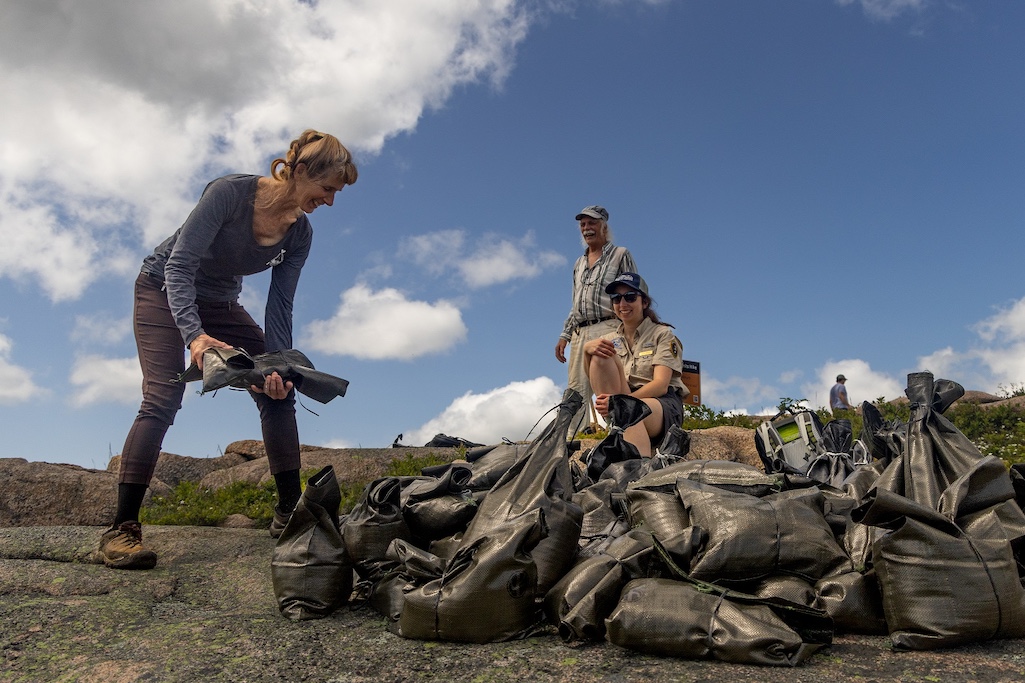
Take a hike, help the ecology along the roof of Acadia National Park in Maine.
That's the deal.
The national park staff, in collaboration with Friends of Acadia and Schoodic Institute, is seeking tenacious hikers to bring bags of soil to the summits of Penobscot and Sargent mountains.
This year, the recurring Save Our Summits Volunteer Program will take place every Wednesday from June through September. Hikes run from 8:15 a.m. to 12:15 p.m., weather permitting. Advanced registration is required. You can register for your Save Our Summits hike and learn more about how to prepare for the event on Friends of Acadia’s website.
Despite growing in hard conditions, Acadia’s mountain plants are not adapted to foot traffic, and decades of trampling by humans has damaged plant communities and eroded soil at the top of mountains. More frequent extreme weather events, which damage landscapes, cultural resources, and infrastructure, are speeding the loss of soil and making it harder for plants to grow back on their own.
For the last several years, Acadia National Park, Friends of Acadia, Schoodic Institute, and Native Plant Trust worked together to evaluate how to best restore Acadia’s summits. Turns out, replacing soil lost from the summits is a critical piece of the revegetation puzzle, providing a place for seeds to settle and grow. Last year, volunteers helped carry 3,765 pounds of soil to the summits. By carrying soil to the summits of Sargent and Penobscot Mountains, you’ll play an important role in the restoration of these vital ecosystems and their resilience to a changing climate.
Stories about:
Story Categories:
A copy of National Parks Traveler's financial statements may be obtained by sending a stamped, self-addressed envelope to: National Parks Traveler, P.O. Box 980452, Park City, Utah 84098. National Parks Traveler was formed in the state of Utah for the purpose of informing and educating about national parks and protected areas.
Residents of the following states may obtain a copy of our financial and additional information as stated below:
- Florida: A COPY OF THE OFFICIAL REGISTRATION AND FINANCIAL INFORMATION FOR NATIONAL PARKS TRAVELER, (REGISTRATION NO. CH 51659), MAY BE OBTAINED FROM THE DIVISION OF CONSUMER SERVICES BY CALLING 800-435-7352 OR VISITING THEIR WEBSITE. REGISTRATION DOES NOT IMPLY ENDORSEMENT, APPROVAL, OR RECOMMENDATION BY THE STATE.
- Georgia: A full and fair description of the programs and financial statement summary of National Parks Traveler is available upon request at the office and phone number indicated above.
- Maryland: Documents and information submitted under the Maryland Solicitations Act are also available, for the cost of postage and copies, from the Secretary of State, State House, Annapolis, MD 21401 (410-974-5534).
- North Carolina: Financial information about this organization and a copy of its license are available from the State Solicitation Licensing Branch at 888-830-4989 or 919-807-2214. The license is not an endorsement by the State.
- Pennsylvania: The official registration and financial information of National Parks Traveler may be obtained from the Pennsylvania Department of State by calling 800-732-0999. Registration does not imply endorsement.
- Virginia: Financial statements are available from the Virginia Department of Agriculture and Consumer Services, 102 Governor Street, Richmond, Virginia 23219.
- Washington: National Parks Traveler is registered with Washington State’s Charities Program as required by law and additional information is available by calling 800-332-4483 or visiting www.sos.wa.gov/charities, or on file at Charities Division, Office of the Secretary of State, State of Washington, Olympia, WA 98504.


National parks and their natural resources belong to you. The National Parks Traveler works to ensure you know how these essential places are being cared for.
Sign Up For Our Weekly Newsletter
Unsubscribe at any time.
INN Member

The easiest way to explore RV-friendly National Park campgrounds.

Here’s the definitive guide to National Park System campgrounds where RVers can park their rigs.
Our app is packed with RVing- specific details on more than 250 campgrounds in more than 70 national parks.
You’ll also find stories about RVing in the parks, tips helpful if you’ve just recently become an RVer, and useful planning suggestions.


Comments
"Turns out, replacing soil lost from the summits is a critical piece of the revegetation puzzle, providing a place for seeds to settle and grow. "
How so? They have never done this and this is a study project. They are just as likely to introduce some kind of invasive plant that exists in most soil in New England right now. I can think of poison parsnip, Japanese Knotweed, and Queen anne's lace as just a few plauging New England and its soil right now.
And considering how ancient that soil is- brining in a bunch of dirt and dumping it on top seems like a crime too me.
Chris, if you click through to the article on the Acadia NP website, you will see that this summer's project is part of a much larger study, conducted by professional ecologists, that has been going on for some time. The soil is being used in study beds, not just dumped on the summits, and it isn't randomly-collected soil from visitors' backyard gardens. You should contact the park staff and share your concerns - they would probably welcome the opportunity to talk about it!