
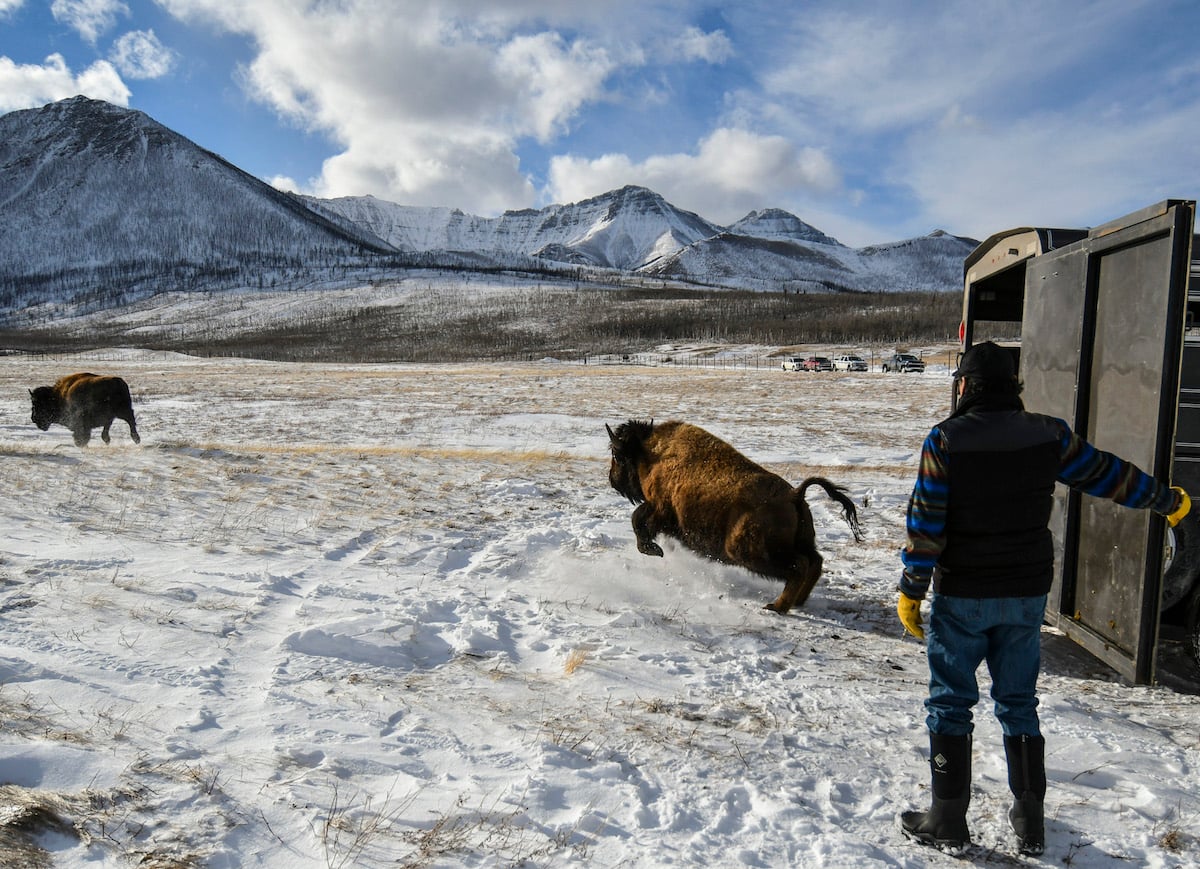
Six young plains bison have arrived at Waterton Lakes National Park, replenishing a small herd that had to be relocated during the 2017 Kenow Wildfire.
They came from Elk Island National Park and were released February 19 into the park’s isolated winter paddock where the rough fescue prairie they need to eat has finally regrown. In late spring, the bison — four females and two males — will be transferred to the summer paddock where visitors can safely view them from their vehicles.
“It was a very happy moment to see those hooves hit the ground,” says Kim Pearson, ecosystem scientist for the Waterton Lakes Field Unit. “They’re almost a year old and in another couple of years, they’ll be able to reproduce. We’ll see calves on the ground in spring 2023 — probably four, so we’ll have a herd of 10. In 2024, it would be a herd of 14.”
The southwestern Alberta park — which shares a border with Montana to the south and British Columbia to the west — has maintained a herd of five to 20 plains bison since 1952.
Before the Kenow Wildfire started in British Columbia in August 2017 and burned about 19,000 hectares (48,000 acres) in Waterton, the park had 10 bison. Nine were quickly evacuated to Grasslands National Park in Saskatchewan, but a bull that stubbornly refused to leave somehow survived the fire and eventually joined the Piikani Nation’s herd.
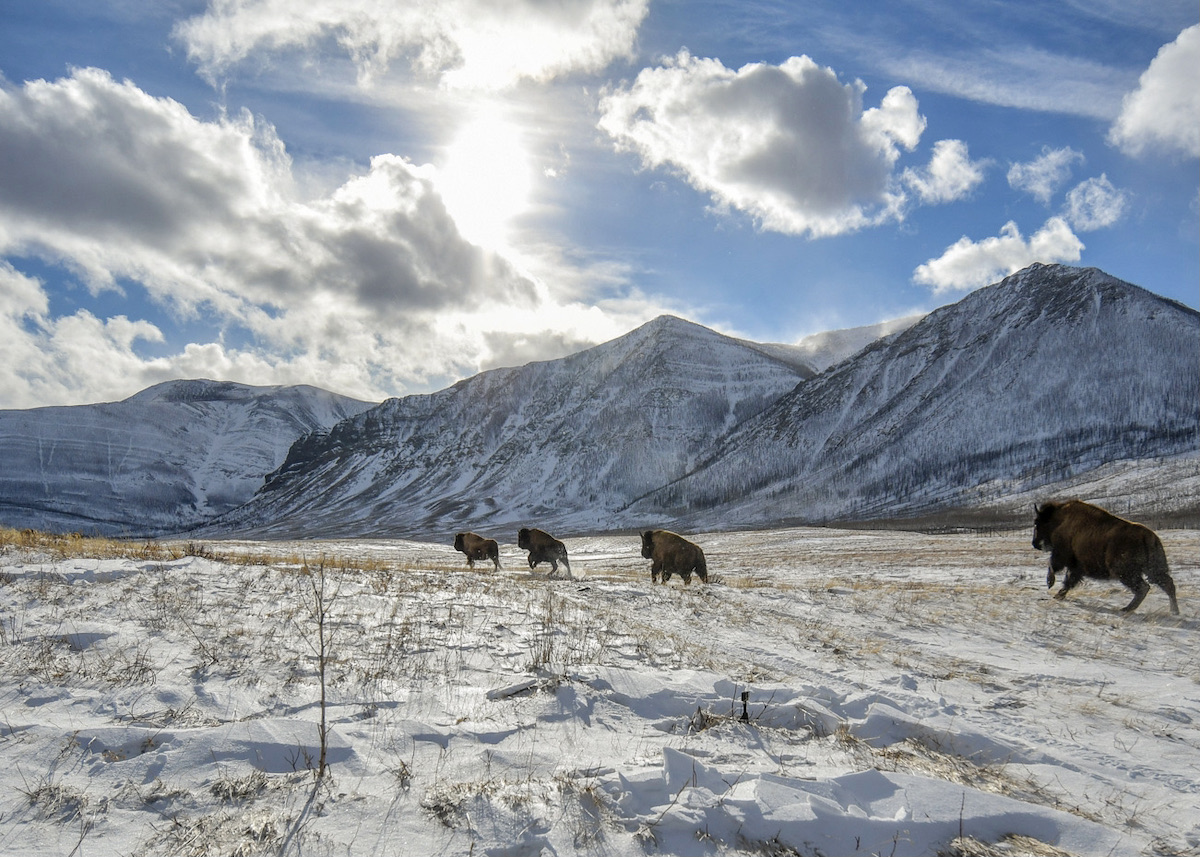
Parks Canada decided it was best to leave the bison in their new homes and “start fresh with a new group of animals” from Elk Island, says Pearson.
Blackfoot Confederacy elders from the Kainai, Piikani and Siksika nations welcomed the “iinnii” (bison in Blackfoot) back to Waterton, and blessed the animals and the land in a private and physically distanced prayer ceremony. Bison specialist and Kainai Nation member Dan Fox helped with the transport.
Parks Canada collaborates with Indigenous communities and organizations in habitat restoration, species at risk recovery and other conservation activities. It helped the Kainai Nation establish a cultural herd in February with 40 bison from Elk Island.
“Waterton Lakes National Park is proud to play a part in reconciliation through the return of bison to the landscape both in Waterton and the Kainai Nation,” says Pearson.
Waterton has two paddocks, enclosed with page wire fencing, where the bison roam. The winter paddock is 88 hectares (217 acres) and extends to the spot where the prairie abruptly turns to Rocky Mountains. The summer paddock is 124 hectares (306 acres).
Supporting landscape-scale conservation and Indigenous-led conservation that promotes healthy ecosystems through the Canadian government’s Nature Legacy program is a priority for Waterton Lakes, says Pearson.
Parks Canada calls bison a “keystone species” or “ecosystem engineer” because they “alter the landscape in ways that benefit virtually all other plants and animals.”
The Canadian government purchased one of the last herds of wild bison and between 1907 and 1912 shipped more than 700 animals by train to Alberta’s Elk Island, which is Canada’s only completely fenced national park. The fence protects the bison from disease and negative encounters with neighbours, but it also prevents natural migration and reduces the number of large predators in the park.
Elk Island started 2021 with about 600 plains bison north of the highway the divides the park, and 400 wood bison south of the highway. To control its herd size, the park transfers animals to other parks (like Banff National Park in 2017), conservation sites and Indigenous communities in Canada and the United States, charging a cost recovery fee of a few hundred dollars per animal. It sells some bison at auction to private herds.
“Essentially we’re replacing migration and predation on the herd to reduce numbers in the park,” explains ecologist team leader Jonathan DeMoor. Each year park staff handle either the plains or the wood herd, and so this year it reduced the plains bison herd by 30 per cent or about 180 animals.
“We dispersed the plains bison in February during the coldest, brutal cold snap,” DeMoor remembers. “The bison were happy about it. The handlers less so.”
The Poundmaker Cree Nation and Onion Lake Cree Nation welcomed bison to Saskatchewan this year, and the Frog Lake First Nation got some in Alberta.
Elk Island mainly transfers young bison, either calves that are about nine months old or yearlings that might be 18 months old. As well, a small number of animals must go to a disease testing and monitoring program each year so it can maintain its certification of a disease-free herd. These are usually bison that are older or sick and might be injured, walking stiffly or facing eye issues.
“I like to try to stress that the point of doing this management is not to send animals out,” says DeMoor. “The point is to manage numbers within the park. We have a population target we try to maintain. That being said, transfers are really exciting and we’re really trying to shift from selling these animals at auction to ranchers to working with conservation projects.”
Elk Island has knob and kettle topography, with pockets of upland grass and marshy areas. It’s in the transition zone between boreal forest and aspen parkland. There’s no internal fencing at the park and DeMoor says GPS collars that have been used since 2016 on select, rotating bison have started to provide “a good idea of the habitat areas that the bison use.”

Waterton Lakes, which is a six-hour drive south of Elk Island, will keep a close eye on the size of its new herd with an eye to research opportunities. Pearson says the six new bison are “getting to know the landscape at Waterton, which is quite different than Elk Island, especially because of the Waterton winds. They’re such resilient, amazing animals.”
Unlike Yellowstone National Park, where tourists continue to flout the rules and approach dangerous, wild bison, Waterton has only recorded one incident in 1984 involving a man who left his vehicle to take a photo.
Visitors can drive the Bison Paddock Loop Road in the spring, summer and fall when the animals are in their summer paddock. The short route just inside the park’s north boundary, off Highway 6, passes through fescue grasslands. People can drive slowly and stop, but must stay inside their vehicles.
“It’s very special to have an opportunity to view plains bison on the landscape,” says Pearson. “We just ask visitors to respect the bison and the spiritual significance of them. Waterton’s visitors have been very respectful of the bison and we’d like to keep it that way.”
Stories about:
Story Categories:
A copy of National Parks Traveler's financial statements may be obtained by sending a stamped, self-addressed envelope to: National Parks Traveler, P.O. Box 980452, Park City, Utah 84098. National Parks Traveler was formed in the state of Utah for the purpose of informing and educating about national parks and protected areas.
Residents of the following states may obtain a copy of our financial and additional information as stated below:
- Florida: A COPY OF THE OFFICIAL REGISTRATION AND FINANCIAL INFORMATION FOR NATIONAL PARKS TRAVELER, (REGISTRATION NO. CH 51659), MAY BE OBTAINED FROM THE DIVISION OF CONSUMER SERVICES BY CALLING 800-435-7352 OR VISITING THEIR WEBSITE. REGISTRATION DOES NOT IMPLY ENDORSEMENT, APPROVAL, OR RECOMMENDATION BY THE STATE.
- Georgia: A full and fair description of the programs and financial statement summary of National Parks Traveler is available upon request at the office and phone number indicated above.
- Maryland: Documents and information submitted under the Maryland Solicitations Act are also available, for the cost of postage and copies, from the Secretary of State, State House, Annapolis, MD 21401 (410-974-5534).
- North Carolina: Financial information about this organization and a copy of its license are available from the State Solicitation Licensing Branch at 888-830-4989 or 919-807-2214. The license is not an endorsement by the State.
- Pennsylvania: The official registration and financial information of National Parks Traveler may be obtained from the Pennsylvania Department of State by calling 800-732-0999. Registration does not imply endorsement.
- Virginia: Financial statements are available from the Virginia Department of Agriculture and Consumer Services, 102 Governor Street, Richmond, Virginia 23219.
- Washington: National Parks Traveler is registered with Washington State’s Charities Program as required by law and additional information is available by calling 800-332-4483 or visiting www.sos.wa.gov/charities, or on file at Charities Division, Office of the Secretary of State, State of Washington, Olympia, WA 98504.


National parks and their natural resources belong to you. The National Parks Traveler works to ensure you know how these essential places are being cared for.
Sign Up For Our Weekly Newsletter
Unsubscribe at any time.
INN Member

The easiest way to explore RV-friendly National Park campgrounds.

Here’s the definitive guide to National Park System campgrounds where RVers can park their rigs.
Our app is packed with RVing- specific details on more than 250 campgrounds in more than 70 national parks.
You’ll also find stories about RVing in the parks, tips helpful if you’ve just recently become an RVer, and useful planning suggestions.


Comments
Yes, this is good news. People will get to see a few bison in a pen and that's a public relations and teaching opportunity. But, let's face it; in terms of the conservation of this species or the ecosystems it fuels, this is neither. In fact, it may actually be counterproductive in the sense that it can provide an excuse for Parks Canada to celebrate their good intentions and claim that it "collaborates with Indigenous communities and organizations in habitat restoration" when, in truth, Parks Canada has really been beyond passive, perhaps just downright disingenuous, about its committment to species conservation for far too long. And, there isn't yet enough evidence to suggest that long history of dereliction has really changed.
I'm certainly not ignoring our shortcomings here in the United States and anyone who has followed me or my comments knows that I don't pull any punches in that regard. However, Waterton Lakes National Park covers roughly 125,000 acres. Admittedly, not all of that is bison habitat; but, this article is celebrating the return of bison to a couple of pens. Out of those roughly 125,000 acres, these bison and their descendents will get to freely roam a full 217 wire fenced acres all winter and then ecstatically scamper across an incredible 306 wire fenced acres in the summer. Really?
The article touts "landscape-scale conservation and Indigenous-led conservation" and "healthy ecosystems through the Canadian government’s Nature Legacy program" and how it's "a priority for Waterton Lakes." But, I fear that what is being done with these bison is truly not enough to prompt a euphoric celebration of Parks Canada's bold committment to species or ecosystem restoration. In fact, at 580 acres, Disney World's Animal Kingdom theme area is larger than what Waterton Lakes National Park is allocating to these bison.
And, it actually gets worse. The article admits that Waterton Lakes National Park "maintained a herd of five to 20 plains bison since 1952" and, by 2017 when the "herd" had to be evacuated from their pens due to the fire, the "herd' numbered ten animals. I sure hope they occasionally introduced additional genetic material into that "herd" over the course of those nearly seventy years; but, whether they did or did not, a "herd" of twenty head of bison is really not a herd at all. It's actually just a zoo exhibit destined to become an inbreeding risk.
The article seems to want to rationalize this failure of wildlife conservation by proclaiming it a victory in safety. The article shakes a codependent finger toward Yellowstone National Park, bemoaning how tourists there "continue to flout the rules and approach dangerous wild bison" and how, at Waterton, the tourists can "drive the Bison Paddock Loop Road in the spring, summer and fall when the animals are in their summer paddock" and "drive slowly and stop, but must stay inside their vehicles" just like at Disney World's Animal Kingdom. Now, I'll be the first to admit that, with roughly four million tourists annually in Yellowstone, you're inevitably going to get a number of immature, undisciplined, unstable, if not mentally deficient, visitors. That's life with four million tourists. However, I also remember that the first excuse used in the anti-conservation response to the reintroduction of wolves in both the northern rockies and the southern sky island areas was the great danger posed by those dangerous wild bison ...er, I meant to say wolves. Particularly in the southern sky island areas, underemployed hillbillies who each literally had packs of vicious semi-feral pit bulldog crosses living under their trailer homes or barns would emerge to erect rickety chicken wire cages around the school bus stops. Was that really a safety precaution? No, it was ignorance and an excuse, a "big lie" that they hoped would justify their refusal to accommodate a legitimate and laudable conservation initiative. After decades of wolf reintroduction, those vicious semi-feral pit bulldog crosses have continually proven to be a far greater safety risk than any of the wolves.
To ensure that I'm not picking on Canada while ignoring what's going on here in the United States, I need to also offer this example of what's happening under Gianforte in Montana, Backward Thinking Targets Bears And Wolves (https://mountainjournal.org/prominent-bear-conservationist-condemns-laws...). It shows no better behavior than what is going on further north.