
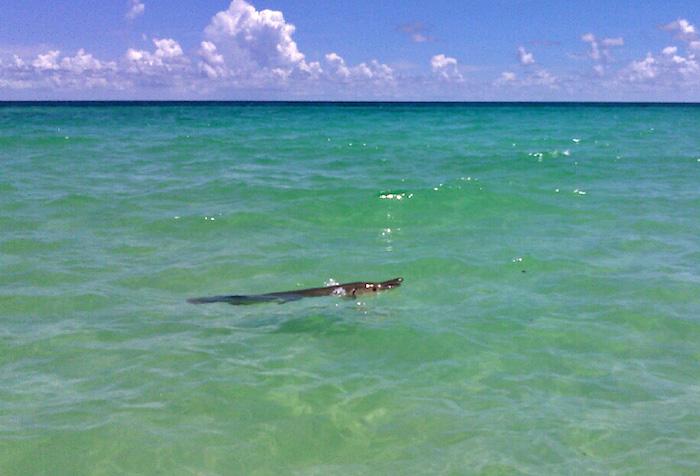
Brian Whalen stood at the edge of the Gulf of Mexico, staring out at bright green waves crashing along the Santa Rosa area of Gulf Islands National Seashore. Though it was the middle of the week, the beach was dotted with swimmers, sunbathers, and anglers like Whalen, enjoying a hot, sunny day in northwest Florida.
Suddenly, a dark shape swam past, longer than an adult is tall, with a powerful tailfin. Whalen watched the creature slowly as waders withdrew to the sand, pointing at the shadow and wondering aloud what it could be. Whalen followed what he now recognized as a fish rise to the surface, gulping down a breath of air before submerging once again: an alligator gar.
Alligator gar are found in Florida west of the Apalachicola River and throughout the coastal regions of Gulf Coast states. While these gar have gills to obtain oxygen, their additional ability to breathe air allows them to survive in low-oxygen conditions, like those of a drought.
According to the Florida Fish and Wildlife Conservation Commission, “Alligator gar once inhabited waters throughout the Mississippi River Valley, occurring as far north as Iowa and west to Kansas.” They can live for decades, and the world record for an alligator gar is 8.5 feet long and more than 300 pounds. In Florida, this species of gar is protected and cannot be fished for; the FWC is investigating exactly how many alligator gar currently call northwestern Florida rivers home.
Matt Wegener is a fisheries biologist for the FWC, in charge of the gar studies. “Many alligator gar researchers, including myself, believe the key in managing this species is in the details of when and why they move,” Wegener explains. “Which is still not completely understood.”
“First of all, their habitat movement use seemed to vary seasonally. We found that alligator gar have strong site fidelity during the winter months, meaning that several individuals can be found in a small area at the same time and may remain in that small area for up to several months," added Wegener. "Extreme, long-distance movements are much less understood. Spawning migrations and high-water events are theories normally associated with long-distance movements; however, these didn't entirely explain the extreme movements we observed.”
While most alligator gar are seen in the freshwater rivers and brackish bays, they are not unknown in saltier marine environments.
“There is some evidence that alligator gar venture into the Gulf of Mexico,” Wegener says. “We have received several pictures and heard reports from fishermen who have observed alligator gar from several gulf fishing piers along the Panhandle of Florida and coastal Alabama.”
Currently, these sightings are considered rare. Alligator gar can survive in saltwater environments, and, Wegener continues, “researchers in Florida, Louisiana, and Texas have recently began studying populations of alligator gar in saltwater environments to learn more about their life history (growth rate, survival, and habitat use) compared to populations in freshwater habitats.”
Though the science is still in its infancy stages, preliminary research in Texas suggests there are two populations: One in the upper, freshwater river sections, and, as Wegener explains, “a second ‘transient’ stock that inhabits the lower river and bay segments,” including along the waters of Gulf Islands National Seashore.
If Florida populations emulate those in Texas, the alligator gar that Whalen spotted swimming at the edge of the beach could be a member of the lower coastal river populations, including the Perdido, Escambia, Yellow, Blackwater, and the Choctawhatchee rivers.
National parks have always been excellent places to spot unique wildlife, and visitors to Gulf Islands National Seashore should keep their eyes peeled for alligator gar on both the Gulf and the intracoastal shorelines. Fishing for the gar is illegal, and they do not attack people or pets. If you do spot an alligator gar, let the local fisheries office of the FWC know at 850-265-3676.
Erika Zambello is the communications coordinator for the Choctawhatchee Basin Alliance, enhancing waterway stewardship in Northwest Florida since 1996.
Stories about:
Story Categories:
A copy of National Parks Traveler's financial statements may be obtained by sending a stamped, self-addressed envelope to: National Parks Traveler, P.O. Box 980452, Park City, Utah 84098. National Parks Traveler was formed in the state of Utah for the purpose of informing and educating about national parks and protected areas.
Residents of the following states may obtain a copy of our financial and additional information as stated below:
- Florida: A COPY OF THE OFFICIAL REGISTRATION AND FINANCIAL INFORMATION FOR NATIONAL PARKS TRAVELER, (REGISTRATION NO. CH 51659), MAY BE OBTAINED FROM THE DIVISION OF CONSUMER SERVICES BY CALLING 800-435-7352 OR VISITING THEIR WEBSITE. REGISTRATION DOES NOT IMPLY ENDORSEMENT, APPROVAL, OR RECOMMENDATION BY THE STATE.
- Georgia: A full and fair description of the programs and financial statement summary of National Parks Traveler is available upon request at the office and phone number indicated above.
- Maryland: Documents and information submitted under the Maryland Solicitations Act are also available, for the cost of postage and copies, from the Secretary of State, State House, Annapolis, MD 21401 (410-974-5534).
- North Carolina: Financial information about this organization and a copy of its license are available from the State Solicitation Licensing Branch at 888-830-4989 or 919-807-2214. The license is not an endorsement by the State.
- Pennsylvania: The official registration and financial information of National Parks Traveler may be obtained from the Pennsylvania Department of State by calling 800-732-0999. Registration does not imply endorsement.
- Virginia: Financial statements are available from the Virginia Department of Agriculture and Consumer Services, 102 Governor Street, Richmond, Virginia 23219.
- Washington: National Parks Traveler is registered with Washington State’s Charities Program as required by law and additional information is available by calling 800-332-4483 or visiting www.sos.wa.gov/charities, or on file at Charities Division, Office of the Secretary of State, State of Washington, Olympia, WA 98504.


National parks and their natural resources belong to you. The National Parks Traveler works to ensure you know how these essential places are being cared for.
Sign Up For Our Weekly Newsletter
Unsubscribe at any time.
INN Member

The easiest way to explore RV-friendly National Park campgrounds.

Here’s the definitive guide to National Park System campgrounds where RVers can park their rigs.
Our app is packed with RVing- specific details on more than 250 campgrounds in more than 70 national parks.
You’ll also find stories about RVing in the parks, tips helpful if you’ve just recently become an RVer, and useful planning suggestions.


Comments
Saw one TODAY in the shallows of Destin. Followed it for a while. Stayed in close within 2 feet when I was above water, but darted away when I went under. It was just cruising along the shallows.
was fishing at barefoot beach in Bonita springs, fl. Todaymarch 31 2021. I spotted this fish about 3-4 off shore . Went to my fish species of southwest Florida I carry in my tackle box. Until I got home and looked it up on my computer I wasn't sure what it was. 100% sure it was an alligator gar. People were calling it a barracuda, not even close. I also have a video of a sawfish from earlier this year in the same location.
Saw one today on the gulf side of Shell Island at St Andrews park in Panama City Beach. It was about 3.5 feet long and appeared to have an injured snout.
Saw someone catch a long nose gar off the pier in Cedar Key today. It was huge. about 4 foot long. Never seen one of those in salt water before