
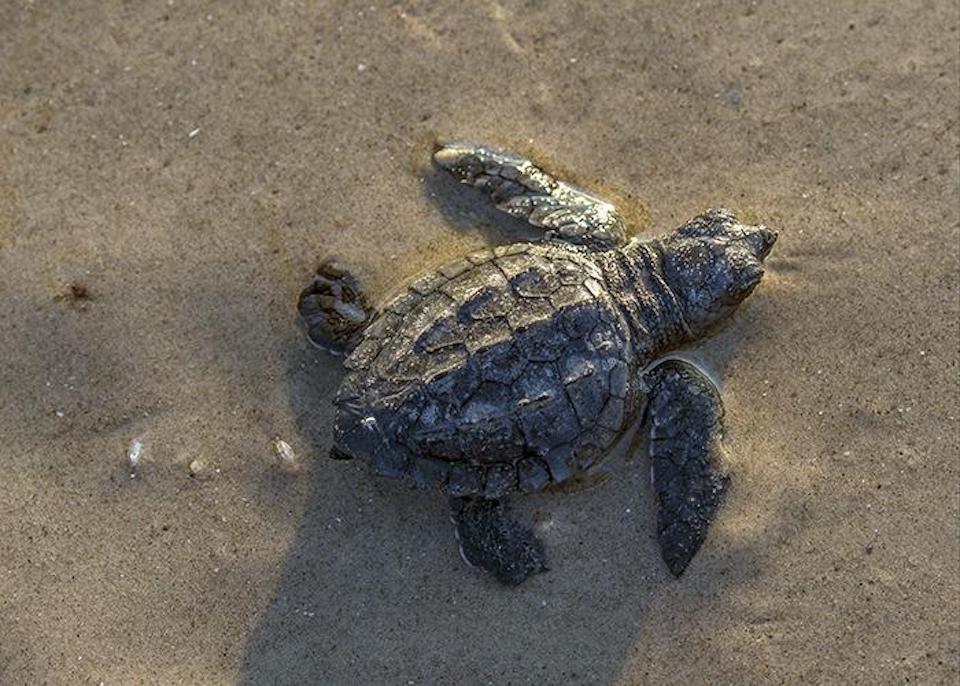
Scaling back the Sea Turtle Science and Recovery Program at Padre Island National Seashore is a mistake/Rebecca Latson file
A concerning story arose this past week from Padre Island National Seashore on the gulf coast of Texas. For decades biologists at the national seashore have run a Sea Turtle Science and Recovery Program. In short, this widely acclaimed and popular program has helped build the populations of the endangered Kemp’s Ridley sea turtle by taking eggs from turtle nests, incubating them, and then releasing the hatchlings into the Gulf of Mexico.
Today, more Kemp's ridley sea turtles nest at Padre Island National Seashore than any other locations in the U.S., according to the National Park Service.
Despite the successes of this program, Park Service officials now want to reduce funding to the program and make programmatic changes that Public Employees for Environmental Responsibly equates with “conservation malpractice.”
A 51-page review of the recovery program produced by the Park Service after the outgoing superintendent in 2019 questioned the program's expenses and financial stability says the program has become too costly and shouldn’t be working to boost populations of green and loggerhead sea turtles, two other endangered species that lay their eggs in nests on and near the national seashore.
Ironically, when it comes to whether the program should benefit green and loggerhead turtles, the report points out that the National Park Service is required "to protect rare, threatened, or endangered species and also actively work to recover and restore all species native to parks listed under the ESA."
The report also says the program shouldn’t run the incubation center, and that public events held for hatchling releases into the gulf should be scaled way back, to perhaps one week a year.
At the Center for Biological Diversity, Executive Director Kiernan Suckling told the Traveler that “There would be no Kemp’s ridley sea turtles in the United States were it not for Park Service’s incredibly successful, incredibly popular reintroduction program.”
Dr. Donna Shaver, one of the world’s foremost turtle experts who long has run the recovery program at Padre Island, unfortunately can’t discuss the 51-page report. The Park Service has gagged her. And other Park Service wildlife experts across the country. Why?
A Park Service spokesperson in Denver, at the Intermountain Region of the Park Service that oversees Padre Island, declined our request to discuss the report with Regional Director Michael Reynolds, who signed off on it. Instead, she replied that "(T)he National Park Service review not only underscores the importance of this program to the park, but also outlines goals to strengthen its mission, clarify its priorities, and expand opportunities for the program’s shared stewardship..."
Exactly how the program can be strengthened by cutting its funding by nearly a third, abandoning the successful incubation operation, discouraging peer-reviewed research, greatly reducing the public education component, and stopping the work to safeguard green and loggerhead turtles remains to be seen.

Public events to watch Kemp's ridley sea turtles released into the Gulf of Mexico have been extremely popular and a great educational opportunity/Rebecca Latson file
One of the criticisms made in the report is that the turtle recovery program's roughly $2 million annual budget represents nearly a quarter of the national seashore's entire budget, to the detriment of other programs.
Interestingly, in discussing the financial side of the program the review notes that funding is in place for the next six years, and it also notes the program has been successful in securing outside funding to supplement Park Service funding.
To justify slashing a program that not only is extremely popular with park visitors but also is vital to the future of the Kemp’s ridley turtle because of the size of its budget relative to the overall seashore budget is misguided, particularly when you appreciate that Dr. Shaver has secured more than $14 million in outside dollars since 1994.
If the Park Service is concerned about other programs at the seashore, it should boost their funding, not cut that of a program as successful and important as the Sea Turtle Science and Recovery program.
Former National Park Service Director Jon Jarvis, who honored Dr. Shaver in 2012 with the director's award for Natural Resource Research (she also was honored with the U.S. Fish and Wildlife Service 2013 Endangered Species Recovery Champion Award), shared that sentiment, telling me that "if the balance of the budget is off, then increase the budget for the other programs, not cut a successful program."
Beyond the on-the-sand successes of this program, Dr. Shaver and her team tracks Kemp's ridleys by satellite, analyzes the effects of egg incubation temperatures on sex ratios of hatchlings, and studies the foraging ecology of juvenile greens. The research, as the Park Service notes, is part of global efforts to conserve sea turtles. And yet, the review of the program says Shaver and her colleagues shouldn't spend so much time pursuing publication of their research.
If funding really was the issue, past superintendents at Padre Island National Seashore could have addressed any perceived inequities, yet they didn’t. And why shouldn't Park Service staff, whether at Padre Island or any other unit of the park system, seek outside funds to complement their agency budget?
If, as the report says on page 23, parks should ensure that ongoing programs are funded through base-appropriated dollars, "and not by special project funding that is meant to fund specific projects," think of the ramifications across the National Park System.
Would the Mariposa Grove of Sequoias at Yosemite National Park have been restored without the $20 million contributed by the Yosemite Conservancy? Would the Jenny Lake restoration project at Grand Teton National Park have been accomplished without the $14 million provided by the Grand Teton National Park Foundation? Would Yellowstone National Park's Wolf Project be as successful without the past support of dollars from Yellowstone Forever?
You can go on down through the list of national parks that have been able to accomplish needed projects thanks to outside dollars, not base-appropriated dollars.
There is a balancing act there, of course. Year-to-year programs that rely on outside funding can be hamstrung if that funding unexpectedly vanishes. We discussed that on the Traveler earlier this month. But with sound budgeting, such problems can be avoided.
Not to be overlooked in the case of the Sea Turtle Science and Recovery Program, either, is that no other park does this kind of “turtle farming” while also contributing to science and conservation biology.
While there might be some adjustments or refinements that need to be made with the program, the retrenchment being called for seems unwarranted and detrimental to an incredible program that benefits a critically endangered species. Cutting back on staffing to search out and protect turtle nests, shutting down the incubation side of the program, discouraging research that is then submitted for publication, and scaling back public education are the exact opposites of what we should hope the National Park Service would strive for.
Let’s hope this report doesn’t force Dr. Shaver out and see the Sea Turtle Science and Recovery program hollowed out.
Stories about:
Story Categories:
A copy of National Parks Traveler's financial statements may be obtained by sending a stamped, self-addressed envelope to: National Parks Traveler, P.O. Box 980452, Park City, Utah 84098. National Parks Traveler was formed in the state of Utah for the purpose of informing and educating about national parks and protected areas.
Residents of the following states may obtain a copy of our financial and additional information as stated below:
- Florida: A COPY OF THE OFFICIAL REGISTRATION AND FINANCIAL INFORMATION FOR NATIONAL PARKS TRAVELER, (REGISTRATION NO. CH 51659), MAY BE OBTAINED FROM THE DIVISION OF CONSUMER SERVICES BY CALLING 800-435-7352 OR VISITING THEIR WEBSITE. REGISTRATION DOES NOT IMPLY ENDORSEMENT, APPROVAL, OR RECOMMENDATION BY THE STATE.
- Georgia: A full and fair description of the programs and financial statement summary of National Parks Traveler is available upon request at the office and phone number indicated above.
- Maryland: Documents and information submitted under the Maryland Solicitations Act are also available, for the cost of postage and copies, from the Secretary of State, State House, Annapolis, MD 21401 (410-974-5534).
- North Carolina: Financial information about this organization and a copy of its license are available from the State Solicitation Licensing Branch at 888-830-4989 or 919-807-2214. The license is not an endorsement by the State.
- Pennsylvania: The official registration and financial information of National Parks Traveler may be obtained from the Pennsylvania Department of State by calling 800-732-0999. Registration does not imply endorsement.
- Virginia: Financial statements are available from the Virginia Department of Agriculture and Consumer Services, 102 Governor Street, Richmond, Virginia 23219.
- Washington: National Parks Traveler is registered with Washington State’s Charities Program as required by law and additional information is available by calling 800-332-4483 or visiting www.sos.wa.gov/charities, or on file at Charities Division, Office of the Secretary of State, State of Washington, Olympia, WA 98504.


National parks and their natural resources belong to you. The National Parks Traveler works to ensure you know how these essential places are being cared for.
Sign Up For Our Weekly Newsletter
Unsubscribe at any time.
INN Member

The easiest way to explore RV-friendly National Park campgrounds.

Here’s the definitive guide to National Park System campgrounds where RVers can park their rigs.
Our app is packed with RVing- specific details on more than 250 campgrounds in more than 70 national parks.
You’ll also find stories about RVing in the parks, tips helpful if you’ve just recently become an RVer, and useful planning suggestions.


Comments
Have the people currently running the National Park Service lost their minds? The Padre Island sea turtle program has had steady success over the decades in recovering not only the Kemp's ridley but other species as well. How many NPS programs can make that claim? There are many other places the NPS could scrounge up $2 million per year, which tells me this is more about ideology or NPS internal politics than the budget.
Where should the $2M come from Mike? Serious question. Name some other park that should have their base funding cut by $1M to $2M.
Nearly $1M of Congressionally authorized recovery funds expire in the next few years, which has been the bulk of the "project funds"... If this turtle project is such a priority, shouldn't Congress decide as much & re-authorize or extend that funding? And outside of the specific Padre Island work, why is the broader program not something that FWS and other science/recovery focused agencies deal with, since it is aligned with their missions? Why is a single NPS park unit taking the lead on recovery efforts outside of the park boundaries (& under what legal authorities is that even done)?
And I'll note that Kurt says "Would the Mariposa Grove of Sequoias at Yosemite National Park have been restored without the $20 million contributed by the Yosemite Conservancy? Would the Jenny Lake restoration project at Grand Teton National Park have been accomplished without the $14 million provided by the Grand Teton National Park Foundation? Would Yellowstone National Park's Wolf Project be as successful without the past support of dollars from Yellowstone Forever?"
This makes the opposite point of what Kurt thinks... All of those funds came from outside groups, philanthropy, and are entirely appropriate (if risky). The project funding noted as something not be planned on in perpetuity in this case is Federal, subject to appropriations, authorizations, and the need to compete against other (worthy) projects. If an outside group can work to support this - GREAT. If not, it is up to Congress to identify how to fund non-core mission areas of the NPS.
Okay, Anonymous, since you weighed in with your opinion, let me to reiterate mine. This current federal administration and its sycophantic and enabling minions, specifically including literally all of the current leadership of the Department of the Interior, stand completely disgraced and discredited on literally every topic and on pretty much every occasion, not by outside forces or the media or some deep state cabal, but by their own corrupt, incompetent, or usually corrupt and incompetent words and deeds. They, themselves, have proven themselves, through the accumulation of mountains upon mountains of documented evidence, to be, as I've said before, perhaps the most corrupt, malicious, ignorant, and incompetent administration in American history. And, absolutely nothing this administration or the party that backs it have done in regards to conservation, our national parks, or wildlife protection have been even close to trustworthy, benevolent, or even appropriate. They, themselves, have proven that they cannot be relied upon to do anything, on any topic, in a trustworthy and competent manner. The GOP and its supporters have truly soiled themselves, their reputations, and their nest.
Given this tragic reality and the fact that, if there is a God in Heaven, we only have perhaps seven months until a change in federal administrations and Congress, why has the current administration, this late in the game, frantically rushed to come up with what, based on ample experience with this administration, can only be assumed are fabricated grounds for smearing and quickly dismantling this particular program? I'm afraid that, at this point in the disgusting history of the GOP and this administration, Mike B. is probably a more credible source when he contends that these actions are "more about ideology or NPS internal politics than the budget."
With that said, I, a taxpaying American citizen, don't want this administration or this president or any one in the republican party making any more changes, to anything, before we can get them the hell out and let a new administration come in and review the propriety of whatever these degenerates may have proposed doing. If it needs changing, the next administration will get to it. Just leave it all alone over the next seven months and get the hell out.
Hay Anonomys ---- did you miss the part about "OUTSIDE funding has been secured...?"