
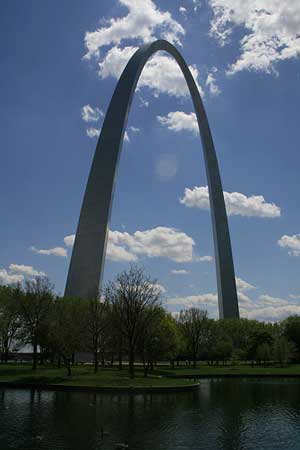
The "Gateway Arch" at JNEM. Photo by Antre via Flickr.
Jefferson National Expansion Memorial (JNEM) in St. Louis and the grounds around the "Gateway Arch" could look very different in the years to come, depending upon the outcome of a General Management Plan (GMP) that is currently being developed for the park. Public comments are currently being accepted on four different alternatives. Here's what you need to know if you care about the future of this park.
An update of the park's GMP is probably overdue—the last comprehensive master plan for the Memorial was completed in 1962. Such plans attract varying amounts of attention from park to park, but the stakes may be higher in this case, and the outcome could have implications far beyond the St. Louis waterfront.
This plan could help set the tone for how the NPS responds at other sites to local business interests who want a park to take a more active role in local economic development. How far that role should go is understandably controversial—especially if it involves additional development on park property. The stakes are even higher if that development involves private funds.
As previously described in the Traveler, St. Louis area business and political leaders have been pushing hard to develop the area around the Arch—including new uses for park property. Their goal is to "revitalize the St. Louis waterfront" and draw more people and business to the area.
An article in the October 22, 2008, St. Louis Post-Dispatch stated that former U. S. Senator John Danforth "is lobbying for a major museum or other world-class attraction designed by an internationally acclaimed architect. He and others said their plan would give St. Louis a boost at the cost of a few acres of open space on the Arch grounds."
The former Senator is apparently unimpressed with the open space that surrounds the Arch. An article in the St. Louis Business Journal included the following quote:
"We have an absolutely world class sculpture, which is an icon of our whole region, and it is surrounded by nothing or something worse than nothing," Danforth said.
Others have a different view of the design which integrates the arch and grounds into an award-winning landscape—and of the park's announced "preferred alternative" for the GMP now under development. A National Parks Conservation Association statement noted:
"…this majestic site is protected by the National Historic Landmark designation—something bestowed on less than a third of all properties in the National Park System. This important designation cannot be tossed aside every time there is local pressure to book hotel rooms. If we do, what national park is next in line for inappropriate development?
"Commercial development and historic preservation are compatible, and surely, with additional public input and a responsible approach to a design competition, a solution can be found that would locate new attractions nearby and on a site that doesn't mar the significance of the Gateway Arch itself."
The Coalition of National Park Service Retirees (CNSPR) has also expressed opposition to the agency's current preferred alternative, which it says:
"…includes an innocuous sounding plan for "heritage education and visitor amenities," and proposes a design competition to "revitalize the memorial grounds, expand interpretation, education opportunities and visitor amenities."
CNPSR Executive Council Member Don Castleberry has first-hand knowledge about the park. He is a former regional director of the NPS' Midwest Region, and in that role had management oversight over JNEM for more than eight years. Describing the agency's preferred alternative, he noted:
"In fact, what this would mean is the construction of a new, large building on the grounds. It would be completely inconsistent with the original Gateway Arch site design, and would conflict with the purpose of the grounds as backdrop to the arch.
We have to draw a line now and say that national parks are not up for sale. Eero Saarinen's iconic design, which is one of America's most recognized and admired monumental features, attracts over 250,000 visitors annually. The surrounding grounds are planned to complement and provide for the backdrop for the monumental Gateway Arch."
CNPSR officials said they have no concern with minor changes that are consistent with the original look and feel of the National Historic Site.
Local development proposals for the Arch grounds are separate from the park's GMP, but the two processes are running concurrently, and are thus inevitably related, especially when the political and financial stakes are this high. It's difficult to determine how much pressure has been—or will be—exerted by local interests on agency staff involved in the planning and decision-making process. At best, it's an awkward situation for public officials expected to develop and maintain good relationships with local leaders.
Ironically, the recent economic downturn may enter into the equation. Late last year, news reports indicated that Senator Danforth had written to now former Secretary of the Interior Dirk Kempthorne, reiterating Danforth's support for a major cultural attraction on the Arch grounds. However, he stating that previously announced plans for the Danforth Foundation to contribute $50 million toward a "major cultural attraction on the Arch grounds" would now be a "difficult challenge."
Whether or not private funds become available for a new "cultural attraction" in the park, expect to see a major push for that option by local interests during upcoming public meetings on the new GMP. Those events will be held at 5 p.m. February 23, 2009, at the Arch and at 6:30 p.m. February 24, 2009, at Washington University's Fox School of Design in St. Louis. More details about those events are available on-line.
Most of you won't be able to attend a meeting in St. Louis—and that's not a problem. You can submit your comments on the plan until March 16, 2009, in any of several ways:
• By U. S. Mail or fax. Click here for the mailing address or fax number.
• On-line. Click here for a link to the NPS comment page.
You obviously need some information about the proposals to make an informed comment.
The NPS planning team has developed four preliminary alternatives for how the park might look in the future. Alternative 1 ("No Action") essentially maintains the status quo. You won't find an Alternative 2, which was dropped earlier in the planning process. Alternatives 3, 4 and 5 provide different options for the future of the park.
Unless you want all the details, you can download the highlights at this link. I'd suggest you download the "Executive Summary" and scan pages "i" through "v," then download the "Alternatives" file. You'll find maps describing alternatives 3, 4 and 5 on pages 2-14, 2-18 and 2-24. Finally, Table 2.3 on pages 2-38 through 2-42 provides a comparison of all four alternatives.
You can also download the entire draft GMP, which has details about the alternatives being considered, including maps depicting the various options.
Alternative 3—the agency's current "preferred alternative" is generating the most controversy. It envisions "revitalizing" the Memorial "by expanded programming, facilities, and partnerships," and includes a "design competition, akin to the 1947 competition ...in close coordination with partners." The draft GMP notes,
The appearance of the Memorial within the design competition zone could be substantially changed and could include above-ground structures as a result of the proposed competition under this alternative...The boundaries of the design competition zone as presented in this draft plan are preliminary and would be further adjusted based on public review and comment on the Cultural Landscape Report.
Those potential "substantial changes for the site," possible new above-ground structures and vaguely defined boundaries for this design zone are among the issues raising concerns by groups such as the NPCA.
Here's a final point to keep in mind as you consider your position. Accompanying the Draft GMP is an Environmental Impact Statement (EIS). The EIS is required to identify an "environmentally preferable alternative"—one that "would best protect, preserve, and enhance historic, cultural, and natural resources, especially in regard to enhancing the physical resources."
Sounds like a logical choice for an NPS site, and in this case, the EIS determined that Alternative 5 ("Park into the City") is the environmentally preferable alternative.
Hmm... I stated earlier that the NPS has identified Alternative 3 as the agency's preferred alternative for this GMP. Why would the NPS recommend an option other than the one identified by the EIS as the environmentally preferable one?
They're allowed to do so under current guidelines—a discussion much too complex for this article. I'd simply suggest you consider this disparity as you draw your own conclusions, but I believe part of the answer lies in a brief excerpt from the "rationale for identification of the NPS preferred alternative."
The NPS believes that a design competition would once again serve as a catalyst for civic and economic rebirth. For these reasons the NPS has identified alternative 3 as the preferred alternative, rather than alternative 5, which is the environmentally preferable alternative.
I believe this brings us full circle, and back to the question I raised at the beginning of this article: How should the NPS respond to local business interests who want a park to "serve as a catalyst for civic and economic rebirth"—and how far that role should go if it involves additional development on park property?
A decision about the GMP—and the future of this park—won't be based merely on a "popular vote," but comments from the public are important, and the NPS does have the option of choosing a different alternative for the final plan in response to the public review process.
Those who favor increased development of the park's grounds are well-organized, have already been actively involved, and can be counted on to have a major presence in the next round of public comments.
It remains to be seen if those who value the integrity of the site's design—and preservation of a "few acres of open space"—will choose to get involved as well.
No matter which option you favor, the ball's in your court.
Story Categories:
A copy of National Parks Traveler's financial statements may be obtained by sending a stamped, self-addressed envelope to: National Parks Traveler, P.O. Box 980452, Park City, Utah 84098. National Parks Traveler was formed in the state of Utah for the purpose of informing and educating about national parks and protected areas.
Residents of the following states may obtain a copy of our financial and additional information as stated below:
- Florida: A COPY OF THE OFFICIAL REGISTRATION AND FINANCIAL INFORMATION FOR NATIONAL PARKS TRAVELER, (REGISTRATION NO. CH 51659), MAY BE OBTAINED FROM THE DIVISION OF CONSUMER SERVICES BY CALLING 800-435-7352 OR VISITING THEIR WEBSITE. REGISTRATION DOES NOT IMPLY ENDORSEMENT, APPROVAL, OR RECOMMENDATION BY THE STATE.
- Georgia: A full and fair description of the programs and financial statement summary of National Parks Traveler is available upon request at the office and phone number indicated above.
- Maryland: Documents and information submitted under the Maryland Solicitations Act are also available, for the cost of postage and copies, from the Secretary of State, State House, Annapolis, MD 21401 (410-974-5534).
- North Carolina: Financial information about this organization and a copy of its license are available from the State Solicitation Licensing Branch at 888-830-4989 or 919-807-2214. The license is not an endorsement by the State.
- Pennsylvania: The official registration and financial information of National Parks Traveler may be obtained from the Pennsylvania Department of State by calling 800-732-0999. Registration does not imply endorsement.
- Virginia: Financial statements are available from the Virginia Department of Agriculture and Consumer Services, 102 Governor Street, Richmond, Virginia 23219.
- Washington: National Parks Traveler is registered with Washington State’s Charities Program as required by law and additional information is available by calling 800-332-4483 or visiting www.sos.wa.gov/charities, or on file at Charities Division, Office of the Secretary of State, State of Washington, Olympia, WA 98504.


National parks and their natural resources belong to you. The National Parks Traveler works to ensure you know how these essential places are being cared for.
Sign Up For Our Weekly Newsletter
Unsubscribe at any time.
INN Member

The easiest way to explore RV-friendly National Park campgrounds.

Here’s the definitive guide to National Park System campgrounds where RVers can park their rigs.
Our app is packed with RVing- specific details on more than 250 campgrounds in more than 70 national parks.
You’ll also find stories about RVing in the parks, tips helpful if you’ve just recently become an RVer, and useful planning suggestions.


Comments
This is a park that screams for de-authorization. The park should have been removed from the park system when the historic building were torn down to build the arch. Let the city have it or give it to Disney to run as an amusement park - that's all it is. The courthouse would still be a National Historic Landmark run by someone else.
I love the open space -- one of the few greavistas of the Mississippi River available. And allfor free -- I don't that taken away.
I was still growing up when the Arch was growing up! The arch & park should remain the same,with only repairs & upkeep.I live two hours from St. Louis & go there frequently. As soon as I see the arch I still get excited. We go around the curve & there she is! She serves her purpose. She is the Gateway of the West. You look down from her or anywhere in the park & see the mighty Mississippi. That view should NEVER be obstructed by someone wanting to make more MONEY! When the river is high, you get a sense of what our ancestors faced as they were making there way west. Improvements could be made in the area below the arch. That seems to never change. That museum thing? Leave the green grass, what is the matter with you people, can you only see one color of green!? This city has museums, art galleries, ancient neighborhoods, Forest Park, some of the best medical facilities in the world. If they MUST build something new, let them go to the burbs & take their businesses there. Every suburb needs more money, right? How would you people like that!? Across the street FROM your house, there is a new museum going up, oh, they have to take part of your yard & driveway to make the new parking lot. But.....everything needs an improvement! Have you been to the other Nat'l Parks? How about knocking down the Grand Canyon into the Colorado River to build a new town! Think about what makes this country beautiful. Lord knows the Government can't figure it out!
I grew up in St. Louis as well. I always enjoy walking the grounds of the Arch, sitting on the steps and watching the river traffic. I have visited the museum below the Arch several times. The city, however, does need economic rebirth. The riverfront area is not what it could be and there needs to be a way to connect the heart of downtown with the riverfront over the highway corridor. The city and the park service should be able to find a solution that is a win- win for both. You shouldn't have to take away from the park to rebuild the downtown area .. integrate it in the plan. Build up both.
I repeat what I wrote here before on the issue: The arch, the river and the open space belong together. Only the ensemble makes the memorial.
And as someone who never was at St. Louis - and probably won't come there anytime soon - I still can read maps and areal imagery. The problem of St. Louis' waterfront is not the open space below the arch, the problem of the city are US 40 and particularly I 70. Get rid of them, force all through traffic on I 270 and I 255 and rebuild the interstates to normal inner city roads. This way you could reanimate the waterfront north of Martin Luther King Bridge and go north from there over the next two decades.
How much of the railroad knot between Martin Luther Kind Bridge and Salisbury St. and beyond is necessary and how much of it could be removed to somewhere else? Could the waterfront be developed up to Salisbury St within 20 years?
Again, not the open space of the memorial is the problem. The real problem are the highways in the inner city. They act as barriers and create huge no-mans-lands, no one likes to visit or even stroll around, go shopping and have a coffee at. The old town is gone, the new waterfront does not have to be exactly at the old site. It could very well be created north of the old part.
If the landscaping needs shoring up, then do so. But no business establishments on the park grounds. Should be the same for all these smallish urban sites. Develop outside the park. I'm sure there's plenty of run-down areas ready for that. Of course, that means they'd have to buy the land from the owners, instead of using eminent domain or something to take it from the NPS.
Someone refresh my memory, it's been so long since I've been there. Isn't there a historic district nearby?
==========================================
My travels through the National Park System: americaincontext.com
The Arch is beautiful. I grew up near it. I've gone back to it since I've left. I walk in the open spaces beneath it. It is a monument, not an amusement park. It is a feat of engineering. It is a marvel. The grounds are open and beautiful, and invite peace and enjoyment.
Whenever the Gateway Arch is mentioned on Traveler, I'm always disheartened when comments come out advocating its delisting. To me, the Gateway Arch is one of America's most-precious landmarks and is one of the crown jewels of the National Park System, along with the National Mall, the Statue of Liberty, and Mt. Rushmore. The Arch is simply a beautiful triumph of human achievement, and my heart always soars on cross-country trips when I first see that arch soaring above the St. Louis skyline.
With that being said, I think there is a need for additional visitor services in the overall Park. There's definitely a need for additional food/drink options in the area, and I could definitely see a role for additional museum space, a performing arts venue (perhaps outdoor?), or other visitor services. Hopefully there would be a way to expand the offering of what's available here without unduly impacting the Park's role as a Park, or the overall majesty of the views of the Arch from around the area.
Mr. Danforth said the St. Louis waterfront needs " a major museum or other world-class attraction designed by an internationally acclaimed architect."
Correct me if I'm wrong, but doesn't the Arch fulfill that criteria?
Sabattis: de-authorization is not the same as destruction! The country has many world-class structures that are not managed and maintained by the federal government: the Empire State Building, Golden Gate Bridge, and St Patrick's Cathedral to name a few. The Arch is magnificent architecture - but there is no reason to have the NPS manage it. The Park (Jefferson National Expansion Memorial) has more staff and a bigger budget than such parks as Redwood, Acadia, Zion, and North Cascades. Does that make sense? 150 FTE positions for 91 acres in the middle of a city? The NPS would save money just paying the St. Louis Police to do law enforcement at the place. .
Anonymous, the difference between those other buildings and the Arch is the Arch symbolizes a truly historic event: the launch of the Lewis & Clark expedition.
The other buildings are just buildings. Yes, they're historic, but they by themselves don't really symbolize anything.
Part of the NPS mandate is to protect sites of historic interest, even man-made ones such as this.
========================================
My travels through the National Park System: americaincontext.com
Our nation has a multitude of buildings, battlefields and other icons that qualify as being of historic import in one sense or other, but does that designation (being of high historical value) automatically assign them to the auspices of the NPS? To what criterion do we allow jurisdiction of denoting between say, the old lady in the harbor in New York and the granite faces in South Dakota, or the engineering feats that have become icons in St. Louis or San Francisco or Washington, or maybe all inclusive natural elements of the nation such as the string of volcanic islands in the Pacific, the ex-pristine landscapes of the Great White North and the massive wetlands in south Florida? I don't see delisting as being a slight to the prestige of the place, but more a prospective blow to the ego of those caretakers of said "monuments".
Cold War missile silos are of historical context. Ditto certain items of our Western heritage whose names are synonymous with our country world-wide, such as Tombstone, the OK Corral, Dodge City and some less savory addresses in our lore including 2122 N. Clark Street (site of the infamous St. Valentine's Day incident). All indeed historic beyond our shores, for better or mostly worse. But if the intent is to lure tourists to our "history", then they all merit inclusion in to the club. God forbid.
As I've posed the question in prior threads, and for a continuing example, do we establish a NPS unit for each and every "historic" event in our nation's timeline? If so, then the establishment of a memorial to the Great Alaskan Earthquake is long overdue, as is one to the New Madrid Quake, the Great Fires in Wisconsin and Chicago of 1871, the tragedy that was our nation's single greatest maritime disaster, the sinking of the Eastland in the Chicago River, one of the more popular legends of our time, the sinking of the Edmund Fitzgerald.........and what about the multitude of avionics incidents, mining tragedies, construction mishaps, etc. Then on the other hand, how about monuments to our expansionist history, our technological pioneering, for better and / or worse (e.g., the site of the first controlled atomic chain reaction coupled with the development of the cotton gin, for example), a place in the books for those manipulators of the economy such as the homies we all owe so much to (in more ways than one) like the Fords and the Rockefellers. How about NPS units dedicated to slavery, CERTAINLY near the tops of our nation's historical register. No, not the memorials to Freddy Douglass et.al. but to those without whom slavery would never have existed......the slave traders, plantation massers’ and politicians without whom the entire enterprise could not have existed. Remember, history contains both the notable and unsightly of a nation's achievements. You're doing a disservice to one to eliminate the other, as more often than not, one serves to better explain the other and how situations and circumstances were bred into and possibly removed from the conscience of a society.
Lone,
I hate arguments that take a simple notion and stretch it to the realms of ludicrosity. That's a logical fallacy. Clearly I was referring to sites of significant historical impact. Yes, define "significant", I know, but that's what the process for including sites into the NPS in the first place is for.
Besides:
Cold war missile silos -- in the NPS already
Western heritage -- in the NPS already
Various tragedies -- in the NPS already
Technological pioneering -- in the NPS already
Manipulators of the economy -- in the NPS already
Slavery -- in the NPS already
Plantations -- in the NPS already
Most of the rest of your examples are in state parks, or are privately owned & operated or otherwise supported, or simply no longer exist so there's nothing to mark.
I differ. Completely. Especially in this case where the cries for delisting are from those who simply want to tear up a site for commercial reasons.
===============================================
My travels through the National Park System: americaincontext.com
Well, Lone Hiker good buddy, Barky has a point, it would probably be good to remember from time to time to stay on the rails
Here is the link, for a little reality check, for "Criteria for Parklands" now followed pretty conscientiously by NPS and mostly even by Congress.
http://planning.nps.gov/document/criteria05final.pdf
The NPS website also has everything you'd like to know about NPS planning -- Director's Order # 2 -- and much more that explain how to address even excellent sites, that can be effectively managed by others. Lots of sites qualified to be national parks have gotten pushed aside because they can be protected as well or better elsewhere. So most of the parks we have have come to the American People for good reasons, and deserve our respect for the process of democracy. Just for an occasional touch of reality as a bracer, I can assure you I have seen a LOT of probing and examination as new parks are considered, pro and con, as well as reviews of what we have.
Whenever we can, lets try to find ways to protect these special places, instead of declaring that we lack the wit or resolve to do so, or even worse, pitting one important place against another.
C'mon guys....staying on the rails isn't any fun. The majority of the more significant discoveries I've made have come from a position tangential to the mainstream of conventional wisdom. Sorry though for the unintended irritation.
The major gist of the point was, as Barky noted, the definition of the term "significant" as it applies to this icon and in the general historical context. It is not universally accepted that the Lewis and Clark expedition was a defining moment in our country's history. Expansionism began at Jamestown, not in St. Louis. Charting the unknown was an undertaking from the onset of the European Occupation. And speaking from my obviously anal reality, I see not the import of the launching point nor the eventual end point, but more in the entire trail that is "significant". Beginnings and endings are mundane, but specific routes are what hold the true impact of an adventure.
But enough of that. This specific site aside, it appears that a common theme for delisting, deregulation, demotion and the like is from the standpoint of cost effectiveness within the system. From that position the above referenced comment was generated. Delisting for economic gain, such as is bandied about with certain of our eastern battlefields, who by the way, in my opinion, are of far greater historic significance than is the Arch, has unfortunately already been successfully attempted. And where encroachment has been achieved and any semblance of original site-lines obliterated by modern architecture, history is forever altered. So if as currently exist markers pertaining to many of my original examples in State Parks, those cute little "Historical Overlook" waysides, etc., a similar bronze plaque was run up a pedestal to denote the point of origin of some event such as was once represented by the Arch, Little Round Top, the Angle, Bunker Hill, Little Big Horn or the like, what would be the loss to history? If we see the value of the real estate as the greater good, then what of our heritage? Has placing flowers at the site of a fatal accident grown to be more in vogue than marking the highlights / lowlights of our path through time?
Nature reclaims through progression of the inevitable. Mankind distorts through the unnatural processes of remolding the landscape. The differences between those methods aren't at all subtle. So if it was good enough for inclusion under some initial judgemental process, for better or worse, it should remain in the network.