
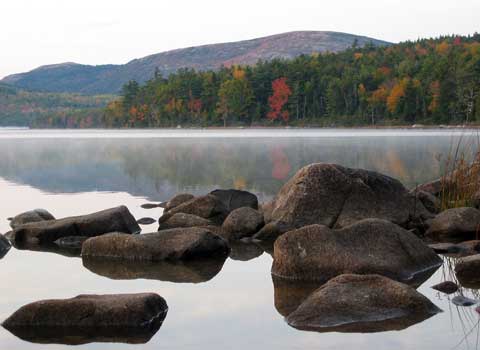
Eagle Lake is one of many scenic locations in Acadia National Park. NPS photo.
Home to the tallest mountain on the U.S. Atlantic coast, the first national park east of the Mississippi River celebrates an anniversary today. It's had three different names during its 93-year history—and the taxpayers got a real bargain when this area was added to the National Park System. The vast majority of the land in the park was donated to the people of the United States.
First proclaimed as Sieur de Monts National Monument in 1916, it was established as Lafayette National Park in 1919 and finally renamed Acadia National Park on January 19, 1929. Under any name, it has a lot to offer present-day visitors.
Acadia's 47,000-plus acres includes a rugged coastal island, dramatic cliffs, beautiful forests, excellent opportunities for wildlife watching and hiking and much more.
How spectacular is the scenery in this park? In the late 1800s, families with names such as Rockefeller, Ford, Vanderbilt and Astor could afford to spend their summers anywhere they wanted, and they chose Mount Desert Island, along the coast of Maine.
The Great Depression and World War II marked the end of that era, but visitors to Acadia can still enjoy the legacy of those former great estates. Between 1913 and 1940, John D. Rockefeller, Jr. constructed 45 miles of rustic carriage roads on Mount Desert Island for travel via horse and carriage.
Rockefeller took a personal role in design of the carriage road network and aligned the routes to follow the contours of the land, preserve mature trees and take advantage of scenic views. The result is a series of routes that blends harmoniously with the landscape. The Rockefeller family has since donated about 11,000 acres and the carriage roads to the park, where today they offer outstanding opportunities for walking and bicycling.
If you'd like a more rustic route for foot travel, Acadia is described as a hiker's paradise. A 125-mile system of trails offers a wide variety of terrain and views for anything from an easy stroll to a challenging hike.
Wildlife watchers will find plenty to occupy their time as well. The park is considered one of the premier sites in the country for bird-watching, with 338 bird species recorded so far in the park. Peregrine falcons, once on the brink of extinction, were successfully reintroduced the park in 1984, and along with bald eagles and loons are a favorite with birders.
At 1,530 feet, Cadillac Mountain is the highest mountain on the U. S. East coast, and it offers an outstanding vantage point for viewing raptors during their fall migration southward. Last year, 2,637 of these magnificent birds were counted during the park's HawkWatch program, including sharp-shinned hawks, American kestrels, osprey and merlin. Best time for viewing is typically mid to late September.
Incidentally, you'll find plenty of trees and other vegetation on Mount Desert Island. According to a park publication,
Samuel Champlain, a French navigator and cartographer, sailed by Mount Desert Island in 1604. He named it "Isles des Monts Desert," with the accent on the last syllable, as it is in the French language. He wasn't implying that it was a desert. The phrase means "island of barren mountains." That's why it's pronounced both as it is spelled and as the French meaning would be pronounced (dessert).
Get that pronunciation down before a visit so you won't immediately label yourself as a tourist!
A great way to enjoy—and learn about—this park's many attractions is on a ranger-guided program. From late May to early October, you can choose from a variety of walks, talks, hikes, narrated boat cruises, bike rides, and more. You'll find more information in the downloadable park newspaper or by stopping by one of the park visitor centers.
This is an easy park to see without a car. From late June until early October, propane-powered Island Explorer buses provide service between park destinations, local communities, and the Bar Harbor-Hancock County Regional Airport. Regularly scheduled buses stop at specific destinations in the park—including campgrounds, carriage road entrances, and many trailheads.
You can also flag down buses along their route; drivers will pick up passengers anywhere it is safe to stop. Here's the best news: You can ride at no charge, so you can feel virtuous about saving gas, reducing pollution and traffic congestion…and saving a little money.
Acadia is 264 miles from Boston and 50 miles from Bangor, Maine. Driving directions and other travel information are available on the park's website. The park is open all year, but this is Maine, and most facilities are closed during the winter. The "off-season" does offer special rewards for those who enjoy cold-weather activities. Check on-line for details on opening and closing dates and other key information.
This is a must-see on any park-lover's list, and allow plenty of time. The average stay for visitors is three to four days, but you could spend much longer. The rich and famous definitely got it right when they flocked here over a century ago.
Story Categories:
A copy of National Parks Traveler's financial statements may be obtained by sending a stamped, self-addressed envelope to: National Parks Traveler, P.O. Box 980452, Park City, Utah 84098. National Parks Traveler was formed in the state of Utah for the purpose of informing and educating about national parks and protected areas.
Residents of the following states may obtain a copy of our financial and additional information as stated below:
- Florida: A COPY OF THE OFFICIAL REGISTRATION AND FINANCIAL INFORMATION FOR NATIONAL PARKS TRAVELER, (REGISTRATION NO. CH 51659), MAY BE OBTAINED FROM THE DIVISION OF CONSUMER SERVICES BY CALLING 800-435-7352 OR VISITING THEIR WEBSITE. REGISTRATION DOES NOT IMPLY ENDORSEMENT, APPROVAL, OR RECOMMENDATION BY THE STATE.
- Georgia: A full and fair description of the programs and financial statement summary of National Parks Traveler is available upon request at the office and phone number indicated above.
- Maryland: Documents and information submitted under the Maryland Solicitations Act are also available, for the cost of postage and copies, from the Secretary of State, State House, Annapolis, MD 21401 (410-974-5534).
- North Carolina: Financial information about this organization and a copy of its license are available from the State Solicitation Licensing Branch at 888-830-4989 or 919-807-2214. The license is not an endorsement by the State.
- Pennsylvania: The official registration and financial information of National Parks Traveler may be obtained from the Pennsylvania Department of State by calling 800-732-0999. Registration does not imply endorsement.
- Virginia: Financial statements are available from the Virginia Department of Agriculture and Consumer Services, 102 Governor Street, Richmond, Virginia 23219.
- Washington: National Parks Traveler is registered with Washington State’s Charities Program as required by law and additional information is available by calling 800-332-4483 or visiting www.sos.wa.gov/charities, or on file at Charities Division, Office of the Secretary of State, State of Washington, Olympia, WA 98504.


National parks and their natural resources belong to you. The National Parks Traveler works to ensure you know how these essential places are being cared for.
Sign Up For Our Weekly Newsletter
Unsubscribe at any time.
INN Member

The easiest way to explore RV-friendly National Park campgrounds.

Here’s the definitive guide to National Park System campgrounds where RVers can park their rigs.
Our app is packed with RVing- specific details on more than 250 campgrounds in more than 70 national parks.
You’ll also find stories about RVing in the parks, tips helpful if you’ve just recently become an RVer, and useful planning suggestions.


Comments
Ok from a Mainer's perspective here are a few things you MUST do when visiting Acadia. First, Go hike around Jordan pond, and then stop at the Jordan Pond House for popovers and tea, this is a must do. Unfortunately you won't be able to see the old pond house, it burned several years ago, but the new one is just as nice. Secondly- you must visit Bar Harbor. This is a classic New England fishing village that has developed a slightly more modern feel to it. No doubt because of the big name shopping opportunities lining the narrow streets. There are nightly summer concerts and the seafood is obviously awesome. There are internet cafes, gourmet restaraunts, local artist stores, and fish markets all thrown together, and it works. Third- and conveniently you must drive to the top of Cadillac Mnt. It is located mere minutes from Bar Harbor. The reason you must go is to watch the sunrise; you will be the first to see it in the country. Hope for clear weather, no fog, and bring warm clothes. Cadillac is also a great hike if you've done moderate hiking before. Fourth- visit Northwest Harbor and take the mailboat cruise. This boat stops at most of the major islands in the near vicinity of the harbor and really does drop off the mail. Great Ride. Fifth-There is a great place to stay near Northeast Harbor, called the Assateague (?) Inn. There is a beautiful large ornamental garden on the hill above the Inn (as well as scattered throughout the park), and is well worth the visit. There's also a cute Chinese sand garden just down the hill from the Inn. All of the parks gardens are worth a visit, and they are all located close to the major attractions in the park and make a great first activity of the day or even end of the day unwind. Sixth- Rent a bike, pack a picnic, and ride the Eagle lake loop on the old carriage trails. Amazingly beautiful ride. Seventh- visit Sand beach and Thunder Hole. Sand beach can get pretty busy and the water isn't exactly warm, but the sand is very fine for an Atlantic beach and the rocks that surround the beach make it feel like you're in an amphitheater. If you go early enough when no one is there yet, you just might see red foxes down on the beach or patroling the stream that dumps into the ocean from the beach. Thunder Hole is a water carved hole in the rocks that traps the incoming tidal surge and creates a huge boom and spray. Fun to hear, and right down the loop road from Sand beach. Otter cliffs is also down the loop road from Thunder Hole, and worth a visit.
If you time your visit right and you're incredibly lucky, you might see tall ships and large schooners in places like Northeast Harbor and Bar Harbor. You can go on these and explore them, and there are occaisionaly sailing trips you can take on them... do it!! Tall ships are usually three and four and sometimes five masted giant schooners built back in the 30's, 40's, and 50's. The finest and most famous is called "Victory Chimes" so look for her. She is a four masted beauty. There are a few of them out there. They have been restored to their original glory and are litereally a part of sailing history. An unbelievable site with all sheets at full sail on the water. You would be a lucky person to sail on one of them. There are other smaller schooners in the harbors that you can take rides on and they are also worth the trip if the tall ships aren't there. There are several campgrounds on the island and it is fun to camp in Acadia. If you get there early enough in the morning you can snag a waterfront site. On your way to the park you'll pass several places that look like tourist traps where they are steaming lobster in giant barrels. Stop at one, it's the best lobster you'll have and it will be cheaper than when you get in the park. Don't worry about how to pronounce the name....locals call it "the island" and that's all you have to remember. Best times to go are early spring and late fall when everyone else is home. But if you want to see the gardens in all their glory, early summer is the best. Fly into Bangor, its a cute town with lots to do.
Those are some excellent suggestions, Anonymous.
To them I'd add: A visit to Somesville to snap a few photos of the picturesque footbridge, a stop at the Wendell Gilley Museum of Bird Carving in Southwest Harbor, and a stroll through the Asticou Azalea Gardens just north of Northeast Harbor.
True, these are all outside the national park, but they're so close and wonderful that to miss them would be a great misfortune.
Acadia was the first national park I ever visited. I was struck by the beauty of the place, and enjoyed myself so thoroughly, it started my hobby to collect them all. I'll always hold Acadia in high regard.
========================================================================
My travels through the National Park System: americaincontext.com
Anonymous-
Thanks for some great tips from an "insider."
It's been quite a while since my last visit to Acadia, but I'm planning a return visit, and your information will be a great help!
Acadia was the highlight of a fall trip to Acadia National Park and New England States Fall 2006
We plan to return soon.