
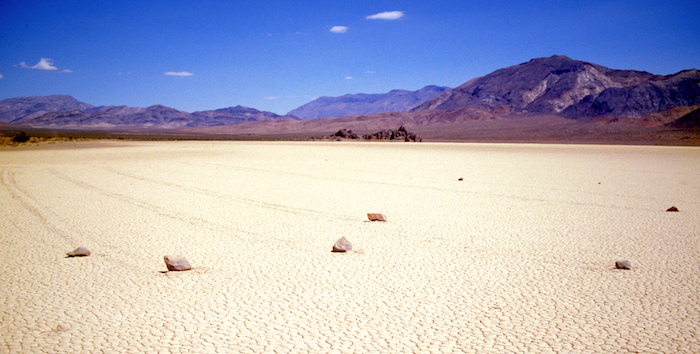
Death Valley National Park can take a little getting used to. It can be ridiculously hot, incredibly arid, and seemingly devoid of much to see or do. But if you spend a little time in the park and give it a chance...
... you'll find some intriguing history.
... you'll be amazed by the geology.
... you'll find an extreme contrast in elevation.
... and, if you're lucky, you'll find beauty in one of the most incredible blooms of wildflowers.
The park's geology captures your mind as you roam this more than 3-million-acre national park. The sand dunes. The eroded hillsides and carved canyons. The alluvial fans painted scarlet, lemon, orange, and purple with wildflowers after wet winters.
Death Valley exhibits one of the most incredible geologic displays not just in North America, but throughout the world. Some, citing Star Wars, Robinson Crusoe on Mars, and other Hollywood productions, might even call it otherworldly.
The centerpiece of this landscape is really not a true valley, one created by a river. Rather, it is a nearly 160-mile-long "rift valley" forged by the downward movement of the valley floor that separates two mountain ranges, the Armagosa Range on the east and the Panamint Range on the west.
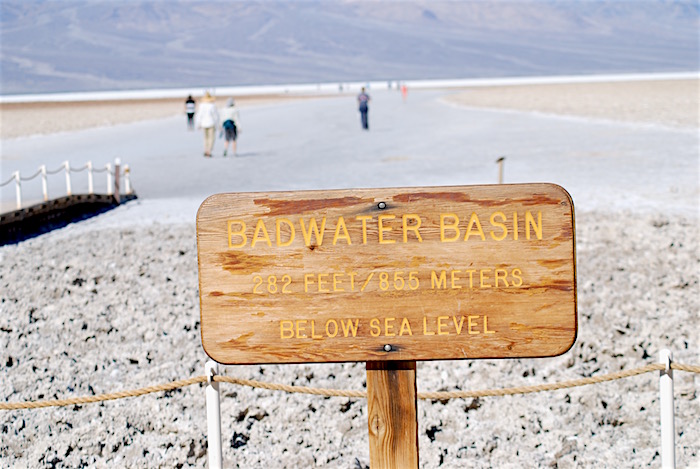
What is it about the hard salt pan, the shifting sand dunes, and the life-threatening temperatures that lures travelers to Death Valley National Park? When I first visited two decades ago, it was summer, and about the only other visitors I saw were Europeans. They seemed wonder-struck by the 100+-degree daily temperatures. I was stupefied to learn when, leaving my room around 6 a.m. one morning, that the temperature already had cleared the century mark.
That searing heat is why some carmakers test their new models at Death Valley in the middle of summer. If you find yourself in the park then, you might want to check out the Wildrose Charcoal Kilns on the western side of the park, where it will be decidedly cooler at around 8,000 feet than far down below at Furance Creek or Badwater (-282 feet). After exploring the kilns, hike up to the summit of 9,064-foot Wildrose Peak (4.2 miles one way) or make a longer, and somewhat more strenuous, 7-mile hike to the top of Telescope Peak, a walk with a 3,000-foot elevational gain along the way to the 11,049-foot summit that offers a great view down to Badwater.
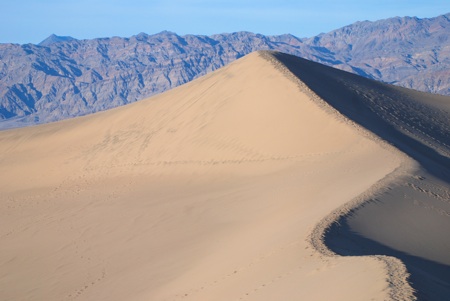
The sand dunes near Stovepipe Wells, roughly in the middle of the park, were created by erosion of the mountains that rim the valley floor. Walking them takes you into a giant sandbox, one complete with pockets of vegetation and intriguing displays of the park's fractured geology. Too, the dunes can hold traces of what slithered or scampered here and there before you. Just time your stroll appropriately -- either very, very early in the morning, or after the sun has set on an evening that promises a full moon.
Historically, one of the most intriguing aspects of Death Valley sadly is closed to the public until sometime in 2019 or even 2020. If you hold off your trip until then, definitely plan to visit Scotty's Castle. This Spanish-influenced mansion seems out of place in the high desert. But its design pushed the technological limits of the 1920s. Not only did Albert Johnson see that there was a solar heating system at work, but he also had a Pelton water wheel turbine installed to generate electricity for the place. Too, an evaporative cooling system employed indoor waterfalls and even wet burlap to keep things inside the castle relatively cool on those 100-degree summer days.
Unfortunately, an incredible thunderstorm back in 2015 flooded the area, undercutting and washing away sections of roads and utilities buried underground. The mansion and its outbuildings also suffered water and debris damage.
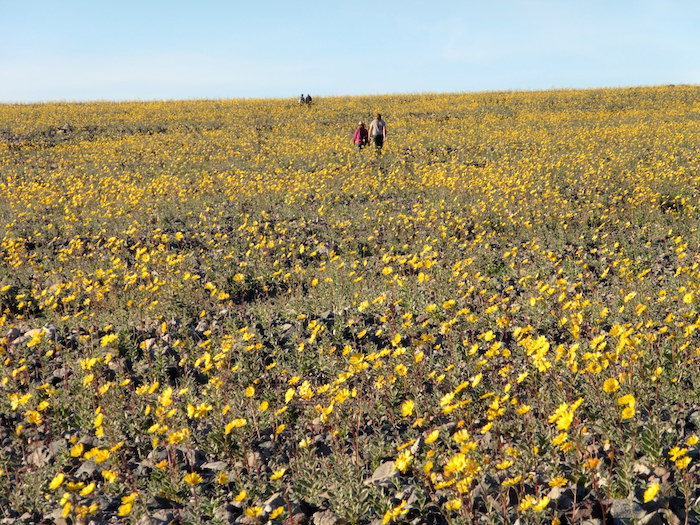
If you're flexible as to when you visit Death Valley, keep an eye on the fall weather in the park. An overly wet fall, you see, will spur an incredible bloom of the wildflowers whose seeds lay around dormant until enough moisture enables them to germinate. The park's last "super bloom" was in the early months of 2016. Radiating fields of Desert Gold lined the road from Furnace Creek south to the Ashford Mill Ruins and north along the road to Scotty's Castle. Walking out into the waving wildflowers, we spotted an occasional Desert Five Spot and delicate sprays of Indian Paintbrush. Were we more able botanists we no doubt would have identified Desert Gold Poppies, Golden Evening Primrose, and Fremont Phacelia.
There's much more to be seen and experienced at Death Valley National Park: The borax works at harmony, the view from Zabriskie Point, the colorful geology to be found along Artist's Drive, the mysterious moving rocks of the Racetrack, old mines, and the volcanic Ubehebe Crater that you can walk down into. With so much to see across the park's 3.4 million acres, one visit is not enough.
Stories about:
Story Categories:
A copy of National Parks Traveler's financial statements may be obtained by sending a stamped, self-addressed envelope to: National Parks Traveler, P.O. Box 980452, Park City, Utah 84098. National Parks Traveler was formed in the state of Utah for the purpose of informing and educating about national parks and protected areas.
Residents of the following states may obtain a copy of our financial and additional information as stated below:
- Florida: A COPY OF THE OFFICIAL REGISTRATION AND FINANCIAL INFORMATION FOR NATIONAL PARKS TRAVELER, (REGISTRATION NO. CH 51659), MAY BE OBTAINED FROM THE DIVISION OF CONSUMER SERVICES BY CALLING 800-435-7352 OR VISITING THEIR WEBSITE. REGISTRATION DOES NOT IMPLY ENDORSEMENT, APPROVAL, OR RECOMMENDATION BY THE STATE.
- Georgia: A full and fair description of the programs and financial statement summary of National Parks Traveler is available upon request at the office and phone number indicated above.
- Maryland: Documents and information submitted under the Maryland Solicitations Act are also available, for the cost of postage and copies, from the Secretary of State, State House, Annapolis, MD 21401 (410-974-5534).
- North Carolina: Financial information about this organization and a copy of its license are available from the State Solicitation Licensing Branch at 888-830-4989 or 919-807-2214. The license is not an endorsement by the State.
- Pennsylvania: The official registration and financial information of National Parks Traveler may be obtained from the Pennsylvania Department of State by calling 800-732-0999. Registration does not imply endorsement.
- Virginia: Financial statements are available from the Virginia Department of Agriculture and Consumer Services, 102 Governor Street, Richmond, Virginia 23219.
- Washington: National Parks Traveler is registered with Washington State’s Charities Program as required by law and additional information is available by calling 800-332-4483 or visiting www.sos.wa.gov/charities, or on file at Charities Division, Office of the Secretary of State, State of Washington, Olympia, WA 98504.


National parks and their natural resources belong to you. The National Parks Traveler works to ensure you know how these essential places are being cared for.
Sign Up For Our Weekly Newsletter
Unsubscribe at any time.
INN Member

The easiest way to explore RV-friendly National Park campgrounds.

Here’s the definitive guide to National Park System campgrounds where RVers can park their rigs.
Our app is packed with RVing- specific details on more than 250 campgrounds in more than 70 national parks.
You’ll also find stories about RVing in the parks, tips helpful if you’ve just recently become an RVer, and useful planning suggestions.


Comments
Good article on my favorite national park! You missed one major geographic item though; Death Valley ‘s amazing slot canyons. The park contains several hundred narrow canyons filled with dry waterfalls and plunge pools. Visitors can choose easy canyon hikes like Golden or Mosaic Canyons (both very popular) for hikes, or drive down the incredible Titus Canyon . Hundreds more difficult like Fall, Redwall and Sidewinder offer great day hikes. Make sure to do these trips in cooler weather!
You can also get married at the newly upgraded park concession. This provides a much more memorable experience than those Las Vegas wedding chapels. Best to visit in the summer if you don't like crowds.
Just one caveat. It's not technically a park concession. The "Oasis at Death Valley" and the "Ranch at Death Valley" is a private inholding owned by Xanterra. It's not owned by the NPS like a park concession would be, and it's not subject to NPS regulation on things such as prices. Back when there was a federal government shutdown years ago Xanterra was still operating it while national park concessions were closed.
https://www.xanterra.com/media/press-releases/death-valleys-inn-at-furna...