
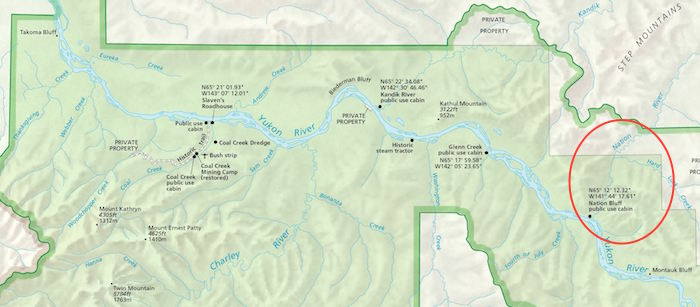
A tribunal from a federal appellate court has upheld the National Park Service's right to regulate watercraft on waters that pass through park units. The ruling, stemming from a case from Yukon-Charley Rivers National Preserve, rejected the claim that the state of Alaska had authority over the Nation River even though it flowed through the preserve.
The lawsuit against the Park Service was filed in 2007 by John Sturgeon, who was using a hovercraft on the river to reach a hunting area above the preserve. Park Service regulations ban the use of hovercraft, and rangers warned the man about that prohibition after he beached his hovercraft on a gravel bar in the river.
Mr. Sturgeon, joined by the state of Alaska, sued the Park Service. He had argued that in passing the Alaska Native Interest Lands Conservation Act, Congress took away the Park Service’s authority over rivers and lakes within Alaska’s national park sites. After the 9th Circuit sided with the National Park Service, he appealed the case to the U.S. Supreme Court. The Supreme Court did not rule on the issue, but sent it back to the 9th Circuit for reconsideration.
On Monday, three judges from the circuit court again upheld the National Park Service's authority.
"The panel held that ANILCA section 103(c) did not limit the Park Service from applying the hovercraft ban on the Nation River in the Yukon-Charlie preserve," the judges held in their ruling. "The United States had an implied reservation of water rights, rendering the river public lands. On remand from the United States Supreme Court, the panel again concluded that the federal government properly regulated hovercraft use on the Nation River in the Yukon-Charley preserve."
Some viewed the case as a "monumental conflict between state and federal rights" because of the interlacing of private and state lands within the federal landscape in Alaska.
“Today’s decision affirms that the Park Service are the best stewards for our country’s national parks," said Jim Adams, Alaska Regional Director for the National Parks Conservation Association. "The Yukon-Charley Rivers National Preserve was created to protect rivers, as were many other parks and preserves in Alaska. The Park Service must have a say in what people can do on rivers and lakes within parkland boundaries to protect these special places for all Americans and for future generations.”
Stories about:
Story Categories:
A copy of National Parks Traveler's financial statements may be obtained by sending a stamped, self-addressed envelope to: National Parks Traveler, P.O. Box 980452, Park City, Utah 84098. National Parks Traveler was formed in the state of Utah for the purpose of informing and educating about national parks and protected areas.
Residents of the following states may obtain a copy of our financial and additional information as stated below:
- Florida: A COPY OF THE OFFICIAL REGISTRATION AND FINANCIAL INFORMATION FOR NATIONAL PARKS TRAVELER, (REGISTRATION NO. CH 51659), MAY BE OBTAINED FROM THE DIVISION OF CONSUMER SERVICES BY CALLING 800-435-7352 OR VISITING THEIR WEBSITE. REGISTRATION DOES NOT IMPLY ENDORSEMENT, APPROVAL, OR RECOMMENDATION BY THE STATE.
- Georgia: A full and fair description of the programs and financial statement summary of National Parks Traveler is available upon request at the office and phone number indicated above.
- Maryland: Documents and information submitted under the Maryland Solicitations Act are also available, for the cost of postage and copies, from the Secretary of State, State House, Annapolis, MD 21401 (410-974-5534).
- North Carolina: Financial information about this organization and a copy of its license are available from the State Solicitation Licensing Branch at 888-830-4989 or 919-807-2214. The license is not an endorsement by the State.
- Pennsylvania: The official registration and financial information of National Parks Traveler may be obtained from the Pennsylvania Department of State by calling 800-732-0999. Registration does not imply endorsement.
- Virginia: Financial statements are available from the Virginia Department of Agriculture and Consumer Services, 102 Governor Street, Richmond, Virginia 23219.
- Washington: National Parks Traveler is registered with Washington State’s Charities Program as required by law and additional information is available by calling 800-332-4483 or visiting www.sos.wa.gov/charities, or on file at Charities Division, Office of the Secretary of State, State of Washington, Olympia, WA 98504.


National parks and their natural resources belong to you. The National Parks Traveler works to ensure you know how these essential places are being cared for.
Sign Up For Our Weekly Newsletter
Unsubscribe at any time.
INN Member

The easiest way to explore RV-friendly National Park campgrounds.

Here’s the definitive guide to National Park System campgrounds where RVers can park their rigs.
Our app is packed with RVing- specific details on more than 250 campgrounds in more than 70 national parks.
You’ll also find stories about RVing in the parks, tips helpful if you’ve just recently become an RVer, and useful planning suggestions.


Comments
This is essential. Great. It is true that everywhere riverways and the lands that border their banks are the vital wildlife corridors and critical habitat.
But, these riverways are even more crucial in Alaska. Life is stretched thin in many of the national park lands in Alaska. For examole we find the caribou routes follow the rivers, where "barren-ground caribou" and "barren-ground grizzlies" must work hard to find the nutrients, the energy, to survive in a harsh country. The rivers bring migratory fisheries as well, and those fish bring essential protein to a landscape otherwise barren indeed.
Yukon Charley Rivers as well as the other parks in AK have strong statements of congressional intent in the 1980 law that reinforced the Carter Monuments or expanded most of the older parks. Every one emphasizes the need to protect the waters and the habitat. Congress would have demanded none of this direction to the Park Service if they were not certain their is an underlying federal interest on all public lands. How could the NPS do the people's business if the most important part of all the parks had no park protection at all?
Imagine your camping trip-of-a-lifetime up the crystal-clear Charley River wgen a hovercraft of 120 decibels comes blasting through? Imagine the state opening a river to mining in the middle of those clean waters?
But more than that, this case goes directly to the State's insistence that it has sole authority to bait bears, kill wolf pups in dens, and kill off whole packs of collared wolves who have been the subject of scientific study for generations?
Both cases involve the State contention that the Statehood Act gave the State total control over wildlife and rivers on lands owned by all the people of America.