
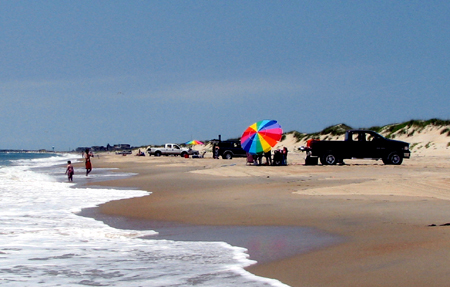
What's the correct image of ORV use at Cape Hatteras National Seashore, the top photo, taken by A. Pitt, or the bottom photo used by the Southern Environmental Law Center?
The spit of sand that buffers the North Carolina coast from the worst the Atlantic Ocean can toss at it carries an array of contentious issues that seemingly have no easy answers. Foremost among the issues at Cape Hatteras National Seashore these days is the use of off-road vehicles to negotiate beaches that are either far from parking lots or which are just far enough from those lots to make it difficult to carry all your gear for a weekend fishing trip.
Cape Hatteras, authorized as America's first national seashore in 1937 but not actually established until 1953, is a beach lover's jewel. The heart of North Carolina's Outer Banks, the cape offers some of the best beaches in the country, is renowned for its surf fishing, has some of the East Coast's best waves for surfing, and has a decided tinge of wildness that is a welcome respite from the Mid-Atlantic's metropolitan areas.
Off-road vehicles long have been allowed on the national seashore. Unfortunately, the seashore hasn't had a formal off-road management plan in place, and that's why discussions centered on Cape Hatteras often grow heated.
The hot button is the fact that the cape's beaches and dunes attract wildlife: of late much has been made of the nesting shorebirds and sea turtles and whether off-road vehicles are impacting them. The divisions over that question are well-defined. Perhaps no topic other than guns in the parks illicits as many comments to the Traveler as ORVs and Cape Hatteras.
Are ORVs out of control, as the lower photo used by the Southern Environmental Law Center might suggest, or does the top photo provided by A. Pitt better capture ORV use on the cape?
Mr. Pitt has been visiting the cape since 1972 and owns land in Frisco that provides him and his family a welcome escape from their Richmond, Virginia, home. He's well-versed on the ongoing dispute surrounding ORVs on Cape Hatteras; since April he's written hundreds of members of Congress to try provide an ORVer's viewpoint of the ongoing debate and to question points raised by Defenders of Wildlife and the National Audubon Society, the two groups who, through the Southern Environmental Law Center, sued the National Park Service for its failure to develop an ORV management plan for the national seashore.
The lawsuit was settled earlier this year when all involved signed a consent decree that was designed to provide short-term management of ORV and pedestrian traffic in shorebird and sea turtle habitat while a long-term plan is developed. Unfortunately, not everyone is thrilled with the consent decree's provisions. Anglers and families that long have used ORVs to reach their favorite spots on the seashore complain that the decree is too restrictive and over-reaching.
What's important for all to remember is not only that ORVs long have been permitted at the national seashore and more than likely will continue to be allowed access in some fashion, but also that there is wildlife habitat on the seashore that needs protection because it is utilized by species protected under the Endangered Species Act.
"I have a vested interest in the area," says Mr Pitt. "It's truly my paradise! Most of the folks who speak out on this issue are fishermen/women. I speak out for beach access for any reason, whether it be fishing, surfing, or just sitting there playing Parcheesi.
" ... I support BOTH species protection AND ORV access, as do most beach users in this area," adds Mr. Pitt. "I truly believe that they can both be attained, if the 'eco' groups will indeed negotiate in good faith."
To some, "ORV" is a pejorative, a word that equates with four-wheelers charging willy-nilly across the landscape. Is that the case at Cape Hatteras, or are the "ORVs" there more likely to be pickup trucks and SUVs their owners use to reach beaches that otherwise would take walks ranging from perhaps a half-mile to nearly 5 miles to reach?
As the attached map shows, there are quite a few ORV and pedestrian restrictions between May 15 and September 15 to protect shorebird and sea turtle nesting habitat. Are those restrictions excessive? There certainly are hard opinions on both sides of that question.
While that question will continue to generate heated comments, let's hope all those involved will arrive at an acceptable solution through the National Park Service's long-term ORV management plan and not insist on a legislated solution from Washington.

Story Categories:
A copy of National Parks Traveler's financial statements may be obtained by sending a stamped, self-addressed envelope to: National Parks Traveler, P.O. Box 980452, Park City, Utah 84098. National Parks Traveler was formed in the state of Utah for the purpose of informing and educating about national parks and protected areas.
Residents of the following states may obtain a copy of our financial and additional information as stated below:
- Florida: A COPY OF THE OFFICIAL REGISTRATION AND FINANCIAL INFORMATION FOR NATIONAL PARKS TRAVELER, (REGISTRATION NO. CH 51659), MAY BE OBTAINED FROM THE DIVISION OF CONSUMER SERVICES BY CALLING 800-435-7352 OR VISITING THEIR WEBSITE. REGISTRATION DOES NOT IMPLY ENDORSEMENT, APPROVAL, OR RECOMMENDATION BY THE STATE.
- Georgia: A full and fair description of the programs and financial statement summary of National Parks Traveler is available upon request at the office and phone number indicated above.
- Maryland: Documents and information submitted under the Maryland Solicitations Act are also available, for the cost of postage and copies, from the Secretary of State, State House, Annapolis, MD 21401 (410-974-5534).
- North Carolina: Financial information about this organization and a copy of its license are available from the State Solicitation Licensing Branch at 888-830-4989 or 919-807-2214. The license is not an endorsement by the State.
- Pennsylvania: The official registration and financial information of National Parks Traveler may be obtained from the Pennsylvania Department of State by calling 800-732-0999. Registration does not imply endorsement.
- Virginia: Financial statements are available from the Virginia Department of Agriculture and Consumer Services, 102 Governor Street, Richmond, Virginia 23219.
- Washington: National Parks Traveler is registered with Washington State’s Charities Program as required by law and additional information is available by calling 800-332-4483 or visiting www.sos.wa.gov/charities, or on file at Charities Division, Office of the Secretary of State, State of Washington, Olympia, WA 98504.


National parks and their natural resources belong to you. The National Parks Traveler works to ensure you know how these essential places are being cared for.
Sign Up For Our Weekly Newsletter
Unsubscribe at any time.
INN Member

The easiest way to explore RV-friendly National Park campgrounds.

Here’s the definitive guide to National Park System campgrounds where RVers can park their rigs.
Our app is packed with RVing- specific details on more than 250 campgrounds in more than 70 national parks.
You’ll also find stories about RVing in the parks, tips helpful if you’ve just recently become an RVer, and useful planning suggestions.


Comments
A couple important points stand out about the lower image at the top of the post. One, there is a fence on the sand a short way back from the surf-line, and all the vehicles are on the water side of the fence. There are no vehicle tracks in the sand inland from the fence. 'Out of control'? It would appear the vehicles are actually firmly controlled.
Second, the image is squashed sideways, to make the scene look more crowded than it actually was.
Look at the width of the vehicles that are face-on to the camera, especially the car driving the fence-line: it's too tall & too skinny. Vehicles that are sideways to the camera are too short, the wheels too close together, and again, they're too tall.
If this is Southern Environmental Law Center's picture, I think they have some explaining to do. This image has been modified to make it look like the vehicle-presence was denser than it actually was. This sort of distortion can be done with an exotic camera-lens, but today it is of course simple to alter images digitally.
Kurt, do you have a larger version of this picture? It appears to be deceitful, and it may have been intentional. A larger version would make it easier to tell just how it was altered.
Ted, that is just the effect of a large telephoto lens. The second picture was made from a long distance away with a SLR camera and a long (300+, probably more) lens. Pictures with those lenses show a very narrow angle and that looks like it condenses space. But there is no doctoring, no deciet, just an optical law. If you look at the shadows you see that the beach was crowded and that the cars had not much more space between them than on the parking lot of a WalMart.
The other important point to remember is that this photo was taken (by earlier posted info) on a Memorial Day Weekend. OF COURSE the beaches are more crowded on any holiday weekend. The first picture is MUCH more like my experiences over the past 25 years of visiting CHNSRA 4 or 5 times a year.
Thank you also for presenting a fair and balanced account of the problem.
I completely agree that beach driving and wildlife protection can co-exist, but it's not a question of the environmental groups' willingness to negotiate. The ORV groups at Cape Hatteras are a crass bunch that has insisted on 24/7 access to all portions of the seashore. They will not permit pedestrian only areas or wildlife areas as have been proposed in the negotiated rulemaking. And they chaffe at every single seasonal restriction that the Park Service tries to impose to protect nesting species. They want an ORV corridor through areas where there are chicks on the ground, significantly increasing the chance that native shorebirds and sea turtles can get run over.
The environmental groups want about 12 miles of 67 closed during the breeding season from April 1 to around August 15 as scientists recommend. They will even allow an ORV corridor in these areas so long as the US Fish and WIldlife Service recommended buffers for nests allow room for one. When there are chicks running around, vehicle use should stop in those areas for the few weeks it takes chicks to fledge. The environmental groups want night driving restricted during turtle season -- a commonplace regulation at most every other seashore. That's it.
So yeah, there can be balance. There can be ORV use on most of the seashore year round. But what will the ORV groups accept to protect wildlife during the breeding season? So far the answer is a big fat nothing.
MRC,
As I understand it, the main distortion-effect of a long telephoto lens is to shorten the apparent depth of field, and it happens uniformly all around the lens.
If telephotos caused a side-to-side compression, things would always look taller & skinnier than they should ('weird'), when viewed through a telephoto, but they don't: vertical & horizontal proportions are normal, through a telephoto.
The effect visible in this photograph isn't the normal side effect of any conventional lens: it took effort to achieve this distortion. We should view a larger version of the image: The oddness will really stand out ... as will the questions.
why would people park there cars right on the edge of a beach?no common sense perhaps?
Having seen, first hand, hundreds of cars parked at Cape Point in rows, I can attest to the validity of the photo you've called into question. It is no exaggeration and I have no doubt the photo has not been altered. Your suggestion of some devious manipulation is, itself, somewhat scurrilous. Check out the photos on the website of The Island Free Press and other websites that overtly oppose restricting ORV driving on our national treasurer.
http://images.google.com/imgres?imgurl=http://www.islandfreepress.org/20...
I have to agree with "Anonymous", that "[t]he ORV groups at Cape Hatteras are a crass bunch that has insisted on 24/7 access to all portions of the seashore." I spent some time at Cape Hatteras earlier this summer and, curious about the all the silly road-side signs that appear randomly along Hwy 12, I initiated conversation with several locals about the beach-driving issue. I was shocked at how ridiculous and misinformed some locals are. For example, the check-out staff at an Avon grocery store insisted the environmental groups' true intention is to close the CHNSS beaches to all human access, permanently, forever.
People need to know that not all local residents agree with the loud and threatening proponents of unrestricted beach driving. I brought the issue up about 7 times during my visit. In 2 conversations, the locals seemed overly angry about having beach driving restrictions of any kind. But on 3 separate occasions, the locals, out of earshot of others, expressed quiet support for the wildlife protection efforts. Of these, 2 long-time residents and merchants expressed fear of the unlimited-access proponents who, apparently, are threatening and intimidating locals who openly disagree with them. A couple of merchants refused to speak about it and were visably uncomfortable when I brought the subject up. It happened twice -- one store clerk just walked off hurriedly, disappearing into the back of his store. One check-out clerk said nothing, stared down nervously as she made change and handed me my fishing bait. (Yes, I surf fish, but I walk to the beach and my fishing spot!)
It is obvious Dare County and the ORV groups who oppose NPS's current efforts to protect CHNSS's natural resources are doing so for their own self-serving benefit and gain. They seem to forget the national park is for any and all who visit the park -- not just the ORV-driving few. They ignore the fact that the Park's mission to protect wildlife and its habitat is paramount to recreation. They also fail to acknowledge that driving on Cape Hatteras National Seashore remains illegal in the absence of a management plan, in spite of the consent decree -- a consent decree that all parties, including the counties and ORV groups, negotiated and agreed to. The deplorable methods they are using to further their own self interests reveal the extremes of selfishness and ignorance. They seem to hold no regard for non-driving users of park, for the creatures that need the Seashore to exist, or for the future generations of humans and animals (if they happen to survive) who will be forever harmed by its destruction and loss.
What country/state is CHNSS in ? The correct name is CHNSRA, and for those that are clueless the RA stand for RECREATION AREA,not reserve area. As far as the supposed endangered species there are none on CHNSRA. Both the plovers and turtles are threatened,not endangered. One of the reasons that these animals are in the threatened category ia that in numerous foreign countries they are table fare, some of the same foreign countries that we send taxpayer funded aid to. Maybe this gives some validity to the" tastes like chicken" adage. According to the Census Bureau by the year 2050 the US population will increase by almost 50% to 439 million, and if the wackos have their way the available beaches will decrease by the same 50%. If this happens the only beaches future generations will ever know will be the Ocean Cities,Virginia Beaches etc.
Some people seem to believe that Promises such as "Free and Open Beach Access " are meant to be broken. The disabled have no right to enjoy the beach in direct violation of The Americans with Disabilities Act. The safety of the American public is of no concern, ie the Bonner bridge, lightning shelters for beach users, means of access for the disabled and eldery, the animals are so way more important. Why is the American public being punished for the failure of the NPS to do its job? Do the plovers really need 1000 meter buffer zones, do all turtle nests magically require full beach closures on Sept 15? Show us the science, you can't because it doesn't exist and we all know it.
Having worked at Cape Hatteras NS as a ranger for many years I can identify the locations for readers in these two pictures. The top picture is Hatteras Island with Hatteras Village in the background. It was taken from South of Ramp 49 in an area that is open to ORV usage before it reaches a seasonal closed area in front of Frisco village during summer months. The amount of beach that is ORV accessible is relatively small when turning south from the ramp; most visitors prefer to go north towards Cape Point. During Saturday when most of the houses turn over the beach on Hatteras is empty which is probably when this picture was taken, or later in the fall as the beach may be this beautiful until late October or early November.
The second picture is Oregon Inlet. Yes, it can be absolutely this packed every day during the summer and fall weekends. This picture is not doctored. It is crazy, it is scary, and I wouldn't go to Oregon Inlet if you paid me a ton of money. Yes, there is a symbolic fence to protect bird nests and turtle nests but people run it over. The current and tides rip through the inlet and people drown because this isn't a safe place to swim and yet people continue to flock to this insanity. At night people have fires as large as their cars, dogs run loose biting people and rangers, it's Mardis Gras moved north. And before anyone shouts me down check the public record--FOIA requests can be your friend.
Now, many ORV users can be respectful. Many users--ORVers, walkers, birdwatchers support the seashore by volunteering and removing trash, presenting programs and helping in many ways. It's not just the ORV users that volunteer to clean the beach, it's a community effort.
S.R., please stop exaggerating. An inlet is where the tide and current flow into and out-of the sound. Just when was a beach user drowned from swimming in the inlet, not in a "rip current"? The swimmers I have seen have been on the calmer sound side by the bridge. Please list the the what's, whens, who's of these many dog bites. Plus just by chance is the symbolic fence you refer to being run over, one that cut off retreat from an unusual high tide by a few feet? Or was it just run down by civil disobedience? I am also curious about just how many times, and at what locations inside of CHNSRA did an organized trash collection effort involve "birdwatchers"?
Exaggerating has not gotten anybody anywhere in these times. Post up your FIOA info. Now tell us how bad it was at Oregon Inlet (Bodie Island Spit) this year 2008. If compared to the staggering figures from years past, they would have had to build a second story to the Inlet beach this year. Got any pictures to show how bad the ORVS were stacked up on the spit, this year, 2008?
S. please stop exadurating. Yes it is Oregon Inlet north side (Bodie Island Spit). The fact that it is an Inlet would mean there are currents and tides flowing back and forth to the sound. Tell us more about these drownings. Just by chance was the symbolic fence run down blocking retreat from an unusual high tide by just a couple of feet? Or, was it run down by civil disobedience? Could you also provide the dates and locations that "birdwatchers" organized and participated in a beach cleanup on the beaches of CHNSRA? Show us what fruit you have plucked with a FOIA search.
One should read the minutes of the case that resulted in the Consent Decree. Judge Doyle threaten to close the beaches entirely unless all the parties involved agree to his decree. I don't call that arbitration, I call it extortion. Judge Doyle should be impeached!
Anonymous (not verified),
There is no question that lots of cars drive out onto the Cape beaches. There is also no question that some are offended that this long-standing practice takes place. I accept those two things, at face value.
The issue I have raised is that one of the photographs Kurt Repanshek used to illustrate this article shows plain evidence of having been altered in a manner that exaggerates the density of the cars on the beach.
I have found the source of this image that Kurt uses here, on the Southern Environment Law Center website, labeled "©SELC". I see no opportunity to view a larger version of the picture.
It is possible to create this alteration unintentionally. We can stipulate the dimensions of an image as it displays on the webpage, in code. Normally, though, we are careful to keep vertical & horizontal proportions the same, since a picture 'looks funny' if we change them. This picture 'looks funny' in a way the creates a stronger impact than the picture would have in its original proportions.
It is unethical to modify an image - to use distortions of the facts - to increase the force of the message one hopes to convey. If Southern Environment Law Center is indulging in this practice, it would reflect adversely on them & their mission.
[hr]
I made a webpage to display the image in 3 widths: the width used in this article and on the SELC site, and at 2 wider widths. If you are not sure about the distortion-question, study these versions for a few seconds.
Increasing the width of the image does not make the cars go away. There are still lots of cars there. It does make it clearer, though, that the image was substantially altered.
It would be helpful to have access to a larger version of this image; preferably the original.
It seems to me that a recurring theme in the use of public recreational space in general, and National parks and recreational areas specifically, includes a battle between people who want to use machines in their recreation and those who do not. Another recurring theme seems to be whether the effect of mechanized enjoyment of public space is considered in its totality, including its effects on natural resources and wildlife. At Cape Hatteras National Seashore, both these points are in play, the second in particular.
In my view, public recreational space exists for the enjoyment of all. There should be no debate about this. For Cape Hatteras, the debate seems to center on whether the recreation of machine-based citizens collides with the purpose and mission of the Seashore – as a public resource for all, and as a natural resource and sanctuary and refuge for wildlife. ORV proponents at Cape Hatteras seem to discount that the national seashore and recreation area is for any and all who visit, not just for people who wish to drive on the beach – this includes sharing equally in the natural resource and its wildlife, and not unequally or involuntarily bearing any negative impact of ORV activity. More important, they forget – or are perhaps unaware – that the paramount mission of Cape Hatteras National Seashore is protecting wildlife and the natural resource, not serving people.
The enabling legislation creating the National Seashore is very clear on why the CHNS exists is clear – that it is to be a primitive wilderness, and that no development or plan for the convenience of visitors be undertaken which would be incompatible with the preservation of the unique flora and fauna or the physical structure prevailing. Given this mission and enabling legislation, it is very difficult for me to understand why efforts to protect the resource and its wildlife can be a point of objection. The law is the law.
Putting aside whether ORV activity has overwhelmed the natural structure capacity of the Outer Banks – the photo of door-to-door ORVs at Oregon Inlet is absolute and unquestionable fact, and if there were a photo of ORVs at Cape Point at the tip of the Outer Banks on a busy day, there would be a second line of ORVs parked behind the first; the damage to dunes and beach structures on the Outer Banks because of irresponsible driving cannot be denied – the effect ORV activity on wildlife must be considered.
It must be noted that the current situation with respect to ORV activity at Cape Hatteras and protection of wildlife is because the National Park Service has failed to develop an acceptable ORV management plan for CHNS as required by Executive Order and NPS regulations. Not because “eco-terrorists,” as they often are referred to in Outer Banks ORV circles, have hijacked a process, as the Outer Banks ORV community charges. A lawsuit brought by environmental and wildlife groups based on the NPS’s failure to develop an acceptable ORV plan led to a U.S. District Court Judge signing a consent decree which settled the suit, and which defines the regulations in place now. Provisions of the consent decree specifically protect wildlife that otherwise would be endangered by ORV activity. The law is the law. Worth noting is that the federal judge issuing the decree, rather than being a liberal activist judge legislating from the bench, was appointed by Ronald Regan, and at one point had been a Senate staff member of Jesse Helms.
The consent decree process included public consultation and comment, and was agreed to by the organizations bringing the case and the National Park Service. And agreed to by the two North Carolina counties directly affected by the case, and representatives of a coalition of local ORV and fishing groups – the counties and the groups having participated in the case as interveners.
I for one am very pleased that an objective approach toward protecting the Cape Hatteras resource is in place, based in law. Deciding what wildlife species or what natural resource is to be protected based on public pressure or which individuals’ or special interest groups’ purposes are served cannot be considered responsible – or fair to all – in any way.
First of all, that picture of the crowd at Cape Point is testimony to the popularity of the greatest fishing spot on the coast. It's a big attraction, and only accessible by ORV for most people. It's several miles from the nearest paved road, and the sand is very soft and difficult to walk in. What you can't see is cut out of the picture. The vehicles are "corralled" into a small space due to "closures" and the 4 miles of beach to the north have very few vehicles on them. On the South side, the beach is completely closed to people, so that area is vacant as well. These guys try to "spin" reality by claiming only 12 miles are closed. In fact, the areas they close eliminate total access to the areas they claim are open, barring a helicopter. As you can see by both the photos shown, over wash is a major culprit to bird nesting, along with natural predators(which the NPS are trapping and killing). ORV's are not the problem, they help many American citizens enjoy the beauty, and the dedicated fishermen that frequent the beaches do more to police the trash that washes up on the shore than the NPS by a long shot. I'm afraid the Audubon and Defenders groups are just using this to market for more money. Using SELC to spin "half truths" and "fake science", is nothing but "Tabloid" money soliciting. That's just my opinion of course, but I've been enjoying the OBX for 45 years, and my Dad before me, and my children were enjoying it before our access rights were taken away.
I do not think some of you know what is actually going on here even though you have visited recently.
1. The 08 restictions included pedestrians. No you could not walk on the beach without facing a $5000 fine/imprisonment and more beach closures. this was done by a federal judge without public/park input.
2. The seashore has had few improvements for access for pedestrians and ORV's in the last 30 years. In the meantime, the US population has grown to over 300 million people.
3. The pro-access groups that support ORV use are also proposing more access for pedestrian use that include more parking lots, bathrooms, and boardwalks for pedestrians. This would eliminate the overcrowding of vehicles as most would park in the parking lots. Yes there are a lot of vehicles in the pictures. Its most likely July or August. The other 10 months the beach is mostly a few fishermen or nature lovers. A few dozen at most.
4. Basically the NPS needs our help getting into the 21st century so the park can be enjoyed not closed. There is room for all if managed properly.
Go to islandfreepress to read the truth. Look for Dr. Mike Berry's comments.
http://forum.reddrumtackle.com/showthread.php?p=103427#post103427 (copy and paste to the browser you choose)
The above pictures (taken at 3:30pm 8/31/2007 on the with the same point in the background as the SELC) combined with the un-doctoring by Ted Clayton above clearly refute the SELC photo as both a doctored photo and an irregular occurance. This was Labor day weekend in 2007 without a consent decree in place. For all of those who care to comment without ever having set a foot in the sands of this paradise please shut up. I traveled out to the point that day around several bird closures as I have for several years. These species have been protected by both the NPS and the persons who enjoy these beaches. Please also note my son in the photos above is an prime example of what you will see if you ever get the courage to visit. Calling him crass and obnoxious is why I will repeat "YOU WILL NEVER WIN THIS BATTLE" because we fight for these memories and you fight for a few birds that really have not the sense to use the areas given to them already. PS I know Mr Pitt personally and he did not doctor his photo, but he did include it to show that the entire seashore (and the facts) are not what the SELC wants you to believe.
A picture taken on the Memorial Day/4th of July/Labor Day holidays ANYWHERE will show maximum human density. To say that the SELC photo taken was of an average day would be an outright falsehood. The picture is clearly out of scale, with the vehicles too tall for their width. Intentional or not, it is what it is. Many folks have seen said picture and believed it to be an every day occurence. We must tell them that the other picture offered is more typical.
However, half-truths and convenient science have been used throughout this issue by the Eco groups to achieve their own ends. Many journalists with well known newspapers have taken the SELC spin at face value and published it as fact without backchecking their data. This is shown in an article from the "Fayetteville (NC) Obsever" and a subsequent rebuttal by US Senator Elizabeth Dole. Link below.
Original Article: http://www.fayobserver.com/article?id=301365
Senator Dole's Rebuttal: http://www.fayobserver.com/article?id=301843
Makes you wonder what is really going on, doesn't it? The truth generally lies somewhere in the middle of every issue, but in this case the truth is being railroaded by a LARGE SPECIAL INTEREST GROUP, namely the Audobon Society.
A "Reg-Neg", (Regulation Negotiation), group is meeting several times yearly to hammer out the details of the "Permanent" ORV plan, which will replace both the now defunct "Interim" plan and the Consent decree, now in place. The SELC, DOW, and AS are all present at these functions, as well as Dare County officials, business owners, etc. They have a meeting coming up in a couple of weeks, and the wishes of all parties were recently published in the "Island Free Press". See link below:
http://www.islandfreepress.org/CatBeachAccessIssues.html
When all this began, in the days before the Consent Decree, the Eco groups said that they "Only wanted to be fair, and only wanted to SHARE the beach AND help widlife flourish". Well, the mask has come off, and their true intentions are now plainly visible. Note how they want YEAR ROUND closures to some of the most popular family oriented beaches on Hatteras Island, those being the "South Beach" areas.
Look at how the Dare County/ORV folks want a flexible, movable closure scheme that would allow for the transient nature of nesting as well as storm damage to nests, predation, etc. The SELC wants a private bird sanctuary. Period. They already have that in Pea Island NWR just a few miles up the road. Apparently, that is not good enough for them.
NPS reports show that the South Beach area produces very few bird nests. See link to report below.
http://www.nps.gov/caha/naturescienc...gs.%201-11.pdf
How can these numbers support TOTAL, YEAR-ROUND BEACH CLOSURES? This data clearly shows that closing the beaches in the name of the birds is not what's going on here. There's a saying amongst us that frequent the area and are up on what's going on on BOTH sides: "It's NOT about the Birds!"
The bottom line is, a "Special Interest Group", (Yes, that is what the AS/DOW/SELC conglomerate truly is, although they desperately try to distance themselves from this monicker), is directing a NATIONAL PARK, costing we taxpayes MILLIONS of dollars. Where would the monies come from to create additional parking, more dune overwalks, etc., as per their vision? Why, the localities that are losing revenue due to beach closures, of course! The Eco groups only open their coffers when suing the taxpayes. The NPS rangers have now added body armor, sidearms, tasers, and pepper spray to their uniforms. They used to dress like the "Crocodile Hunter". Now they look like a US Marine on patrol in Iraq, sans helmet. Who paid for all this hardware? You and I. Do they expect to be attacked? Apparently so. Rangers, on and individual basis, aren't that pleased with their new status either. Just ask one!
Sure, the basis to the lawsuit that created the Consent Decree is legally sound. The DOI and the NPS BOTH dropped the ball on creating a viable plan for 30 years, and the citizens of America are suffering becasue of it. Is there a need for better management of both ORV access and species protection? Absolutely. Do we dare allow such a dangerous precident to stand unapposed? Assuredly not. If the citizens of this country had not protested LOUDLY, would a Congressional bill seeking to change this situation appeared on its own? Said bill has congressional co-sponsors from Virginia to Hawaii, but yet the DOI does not support it, showing their lack of caring for the human species right to access. This in itself should call for a look at overhauling the DOI/NPS relationship, as has been suggested previously on this website.
My heartfelt thanks to Kurt Repanshek for offering up an objective look at this astoundingly beautiful part of the world. To have the human species removed from it entirely would be a travesty.
SamsDad,
I am taking the liberty of posting one your pictures of the Cape here. If you rather I not, let me know and I will remove it/replace it. Waiting your permission, I'd also like to use your 2 images in my page with the distorted SELC image.
Cape Point, Cape Hatteras Nat'l Seashore - Labor Day weekend, 2007
(photo reduced in size, but vertical & horizontal proportions retained)
Thank you, SamsDad!
Ted Clayton
I have no issue at all. I will ask though how did you get the picture in there? Thanks for your support.
The photo above is Cape Point, not Oregon Inlet, as shown in the SELC photo. They are not the same thing. Also, the above photo of Cape Point can be compared to the Island Free Press photos of Cape point, as shown in a different post above. In my experience, the Island Free Press photos are much more representative of what happens at Cape Point. This is a shortened link, for convenience: http://tinyurl.com/5dnlxo
I agree about the photo being Cape point ( I took it), but do you really believe that those picture both by the SELC and the Islandfreepress are typical? I am only guessing that you have had minimal contact with those areas. I have been to or by both of those locations and all major holidays (except 2008) for the past 8 years minimum. I have yet to see it that crowded more than maybe twice a year. Now what I want you Anti Beach Access Enviros to do is simply count of the number of vehicles in the SELC photo and the multiply that number by $500.00 (Conservative) per vehicle or you could use my average per trip at 1,000.00 per trip and now pull that from the local economy along with multiplying this by two because Cape Point has roughly the same traffic. OOPS I have seen how enviros do math and I guess as a beach loving fanatic I will have to redo your work anyway. After you have completed this divide that by 2 and now you have the cost per bird due to the consent decree. I am guessing you Enviros pay taxes? If so you will fund the next bridge, and rebuild the island after the next hurricane as the Tourist dollars for people who want to go to the beach will be dried up soon if we close the beaches.
The same arguments regarding the "need" to access a beach by vehicle because it is too far to walk could be used to justify roads in any park. About time! Some parts of the Grand Canyon, Yellowstone, and Death Valley are a long way from a road. We need a road into the Grand Canyon and I think the Bright Angel Train can be reasonably widened and opened to ORVs. In fact, motorcycles and ATVs can fit now - open it up! Why do we restrict snowmobiles to roads in the winter? It's all snow anyway and they won't leave any permanent tracks (just like beach driving). Open all areas of snow-covered park lands to snowmobiles, the inpact isn't permanent so what difference will it make. The SUV is what makes America great - we have to stop the tyranny of the able bodied youth from shutting off access to our parks just because they have a snooty prejudice against engines.
Rangertoo, Bless you! Until a reliable replacement is found and implemented, the internal combustion engine is the technology we have. Period. I'm all for an engine that runs on anything else, but as of today it only exists in either science fiction or some yet undiscovered inventor's workshop. The extremists would have us all go back to the pre-steam era, and operate solely under wind or human/animal power. I've often heard it stated that one volcanic eruption roughly the same size as Mt. St. Helens puts more hydrocarbons into the atmosphere that mankind has in its entire existence.
You are indeed correct that beach driving leaves no permanent marks. A windy overnight will totally erase all tire tracks from the previous day, as do tidal cycles, within their reach. The same can be said for snow and dirt. No permament impact. Extremists would have everyone believe that all motorized access proponents are drunken fools that go around ripping apart the environment, harassing, chasing down and killing animals. While that is indeed true of a percentage of ANY group of humans, it is generally the exception rather than the rule. Most people want to preserve the area they enter, so they and their families can come again and again for generations. Also, how can the young, aged, and infirm access remote areas? Not everyone in this country is in great heath and 22 years old.
These same naysayers would also tell us that we are too uneducated in environmental issues, and should therefore be excluded from entering, lest we reap destruction in all directions due to our blatant ignorance. That, my friends, is thinly-veiled Marxism.
Wait, that was sarcasm. Motor vehicles have no place on any beach and no place in the natural lands of national parks. These places are our escape from machines. What does this have to do with Marxism? Marxism is a system of socialism of which the dominant feature is public ownership of the means of production. Are national parks producing some commodity?
How To Put Pictures In Comments
To display a picture in these comments, the image must have its own link on the web, not be embedded in a page (theoretically, you might, but it's another trick..). In the case of SamsDad's pictures, the photo-host shows the final full-size image by itself: in other cases the final picture may be embedded in a page with other stuff. You could use this photo-host's link-URL for the picture (in this case), but it's better not to for 3 reasons.
[list=1]
I have a regular website of my own, and I also have a modest hosting-allowance with my ISP: many of you will have similar privileges with your ISP. It's extremely handy and worth learning how to use.
So I snagged SamsDad's picture off his photo-host, reduced it in size, and uploaded it (FTP - 'FileZilla') to my dinky little ISP website.
If you're not ready to do your own website & FTP right now, then stick with a nice photo-host who displays images "raw", like SamsDad's, but first reduce a copy of the picture to an appropriate size for the room in the comments (remember some folks have small screens...), and also reduce the compression-ratio or 'quality' of the pic, to make the file-size smaller. Then, upload the new, smaller copy of the pic back up onto your photo-host. Now you can hot-link to the comment-pic. (A host that shows pics 'raw' like this, probably knows you want to do hot-linking like that...)
OK - the pic is parked on the web with its own URL. Now you can do the special little comment-trick to make it show up. Here it is:
That's a picture of the code-trick, because the code won't show up in the comment. Replace the bogus link with the link for your pic. Make sure the square brackets & slash & img parts remain as shown, and your pic comes up in the comment.
Kurt has links right above the Preview & Post buttons for the comment-box to a page here on the Traveler that explains all the magic code-tricks you can do in post-comments, including the picture-code.
Cape Hatteras National Recreation Area was founded with the explicit statement that access would remain open for recreational activities. Fishing is stated specifically as a recreational activity. It is also stated that areas particularly suitable for such activities will be open.
There is not a more a suitable area for fishing than "the point".
Closing access is a clear violation of the founding legislation.
There is no argument about that. Go read the founding legislation if you don't believe me.
Cape Hatteras National Recreation Area exists for use by people, not for the birds.
Andrew,
You and others refer to Cape Hatteras as a "National Recreation Area." If you could point to where that is specified I'd appreciate it, as I've been unable to find it. Not that I'm doubting you, it'd just be good to have that reference.
As for the founding legislation, here's the pertinent section as quoted by the Park Service:
Except for certain portions of the area, deemed to be especially adaptable for recreational uses, particularly swimming, boating, sailing, fishing, and other recreational activities of similar nature, which shall be developed for such uses as needed, the said area shall be permanently reserved as a primitive wilderness and no development of the project or plan for the convenience of visitors shall be undertaken which would be incompatible with the preservation of the unique flora and fauna or the physiographic conditions now prevailing in this area . . .
I'm not an attorney, but this section doesn't seem to specify which areas of Cape Hatteras are "especially adaptable for recreational uses," and even if if did, changing circumstances can lead to changes in management. Some might look at that wording and note that it says nothing specific to ORV access.
As for birds and other wildlife, as I understand it if species -- resident or migratory -- are listed under the Endangered Species Act, the Park Service has no choice but to manage other uses so as not to impact those species.
I'm not saying there should be a blanket prohibition against ORVs, but rather simply pointing out some of the "ground rules," if you will, that have to be considered in finding a workable solution.
The argument that ORV access must be allowed because of the economic impact of ORV spending on the local economy is the argument I find most objectionable. And arrogant.
That ORV people are more important than other people because of the dollars they spread around outside the National Seashore? That because of their money, ORV people have a special and favored place – special rights – in the Seashore environment? That ORV people would presume to show arithmetic that justifies them and their money as more important than the very wildlife that the National Seashore was created to protect?
Someone mentioned the need to bring management of CHNS into the 21st century. Someone else mentioned the danger of the entire coast becoming Virginia Beach. This is exactly why CHNS was created: to preserve a natural resource, in its natural state, for all to enjoy equally. The challenges of the 21st century are the reason the Seashore must be protected.
Kurt, you are right. Cape Hatteras is a National Seashore, not a National Recreation Area, unless the National Park Service has a typo on its website. There is no mandate that ORVs be allowed.
Beamis, please don't perpetuate the myth that the National Park System has a lot of roads. The System has about 8,500 miles of road spread over 84 million acres. That totals about .0001 miles of road per square mile. Other than in federal wilderness areas (40% of which are in National Park System units), that's the lowest road density of any land system in the United States. I'm not a fan of ORVs. But it doesn't help to exaggerate the impacts of roads. Most of the National Park System is roadless designated or de facto wilderness. Rangertoo is correct.
Interestingly, the NPS Cape Hatteras FAQ says that actual off-road vehicles are forbidden:
The Cape Hatteras Park Planning page has links to an authoritative list of documents, most of which are preoccupied with the question of vehicles on the beaches. See the Cape Hatteras home page for the root-index into all aspects of the Seashore.
A "National Seashore" is a separate designation, like but distinct from Park, Refuge, Monument ... or Recreation Area. The Park Service pages appear to go out of their way to avoid providing a succinct definition of National Seashore. However, everywhere you look on the Cape Hatteras webpages you will see discussion of "recreation" and "vehicles".
The NPS plainly had no intention of trying to shut down the use of vehicles on the beaches of Cape Hatteras, and is prepared - explicitly - to spend "years" finding accommodations that will facilitate their continuing presence on the sand, while providing for the protection of fauna & flora that really need it.
Nowhere in the NPS Cape Hatteras webpages did I get the sense that sensitive species will be used as a pry-bar to get vehicles off the beaches. Exactly the opposite: The Park clearly aims to provide for continuing vehicle-based recreation, working around valid sensitive sites where necessary.
The best source of the words about the founding of Cape Hatteras National Seashore Recreational Area are found in Title 16 Of the U S Code;
U.S. Code collectionmain page faq index search
TITLE 16 > CHAPTER 1 > SUBCHAPTER LXIII > § 459a–2Prev | Next § 459a–2. Preservation of natural features; acquisition of additional property; reversion of property on failure of conditions
How Current is This? Except for certain portions of the area, deemed to be especially adaptable for recreational uses, particularly swimming, boating, sailing, fishing, and other recreational activities of similar nature, which shall be developed for such uses as needed, the said area shall be permanently reserved as a primitive wilderness and no development of the project or plan for the convenience of visitors shall be undertaken which would be incompatible with the preservation of the unique flora and fauna or the physiographic conditions now prevailing in this area: Provided, That the Secretary of the Interior may, in his discretion, accept for administration, protection, and development by the National Park Service a minimum of ten thousand acres within the area described in section 459 of this title, including the existing Cape Hatteras State Park, and, in addition, any other portions of the area described in section 459 of this title if the State of North Carolina shall agree that if all the lands described in section 459 of this title shall not have been conveyed to the United States within fifteen years from August 17, 1937, the establishment of the aforesaid national seashore recreational area may, in the discretion of the said Secretary, be abandoned, and that, in the event of such abandonment, the said State will accept a reconveyance of title to all lands conveyed by it to the United States for said national seashore recreational area. The lands donated to the United States for the purposes of sections 459 to 459a–3 of this title by parties other than said State shall revert in the event of the aforesaid abandonment to the donors, or their heirs, or other persons entitled thereto by law.
In the event of said abandonment, the Secretary of the Interior shall execute any suitable quitclaim deeds, or other writings entitled to record in the proper counties of North Carolina stating the fact of abandonment, whereupon title shall revert to those entitled thereto by law and no further conveyance or proof of reversion of title shall be required.
Here is more from Title 16 U S Code section 459 with the name changed to include Recreational Area. I think the Recreational Area name addition was so hunting could be allowed in the sound for ducks & geese.
TITLE 16 > CHAPTER 1 > SUBCHAPTER LXIII > § 459a–5aPrev | Next § 459a–5a. Addition of lands; Hatteras
How Current is This? The tracts of excess Federal lands and improvements thereon in the village of Hatteras, Dare County, North Carolina, bearing General Services Administration control numbers T–NC–442 and C–NC–444, comprising forty-three one-hundredths and one and five-tenths acres of land, respectively, the exact descriptions for which shall be determined by the Administrator of General Services, are transferred, without exchange of funds, to the administrative jurisdiction of the Secretary of the Interior to be administered as a part of the Cape Hatteras National Seashore Recreational Area, authorized by sections 459 to 459a–3 of this title, and shall be subject to all the laws and regulations applicable thereto. Search this title:
TITLE 16 > CHAPTER 1 > SUBCHAPTER LXIII > § 459a–6Prev | Next § 459a–6. Acquisition of non-Federal land within boundaries of recreational area
How Current is This? Section 452a of this title is amended to extend the authority of the Secretary of the Interior, contained therein, to the Cape Hatteras National Seashore Recreational Area. Search this title:
Kurt, does this help with understanding why we include the RA in the name of this National Seashore Recreational Area.
longcaster
You need to read this legislation in order, in which my Environmentalist friends fail to do every time. First and foremost, under US Code 16, Chapter 1, section 1A-1 note the words of the amendment “1978--Pub. L. 95-250 provided that the promotion and regulation of the various areas of the National Park System, as defined in section 1c of this title, be consistent with and founded in the purpose established by section 1 of this title, to the common benefit of all the people of the United States, and that the authorization of activities be construed and the protection, management, and administration of these areas be conducted in light of the high public value and integrity of the National Park System and not be exercised in derogation of the values and purposes for which these various areas have been established, except as may have been or shall be directly and specifically provided by Congress.”
That’s right, if you are going to derogate (change) the purpose of the Seashore (ie establish it as a Wildlife refuge), which was set up as a Recreational Area for the enjoyment of the people per US Code 16, Chapter 1, Section 459 and 459a-2, you better have specific Approval by congress.
You also need to review the Congressional record of congress during debates prior to passing this enambling legislation in 1937, and also the letter issued to the people of Hatteras Island by the Superintendant of CHNSRA in 1952. You also need to know that residents donated the land to the State of North Carolina, which in turn, turned over the deeds for the land to the United States Government.
Mr Repanshek, there is alot of things you need to know. Thanks for posting this article, its worthy of discussion in rational manner.
Respectfully Submitted
Scott Lambright
-----------
TITLE 16--CONSERVATION
CHAPTER 1--NATIONAL PARKS, MILITARY PARKS, MONUMENTS, AND SEASHORES
SUBCHAPTER I--NATIONAL PARK SERVICE
Sec. 1a-1. National Park System: administration; declaration of findings and purpose
Congress declares that the national park system, which began with establishment of Yellowstone National Park in 1872, has since grown to
include superlative natural, historic, and recreation areas in every major region of the United States, its territories and island possessions; that these areas, though distinct in character, are united through their inter-related purposes and resources into one national park system as cumulative expressions of a single national heritage; that, individually and collectively, these areas derive increased national dignity and recognition of their superb environmental quality through their inclusion jointly with each other in one national park system preserved and managed for the benefit and inspiration of all the people of the United States; and that it is the purpose of this Act to include all such areas in the System and to clarify the authorities
applicable to the system. Congress further reaffirms, declares, and directs that the promotion and regulation of the various areas of the National Park System, as defined in section 1c of this title, shall be consistent with and founded in the purpose established by section 1 of this title, to the common benefit of all the people of the United States. The authorization of activities shall be construed and the protection, management, and administration of these areas shall be conducted in light of the high public value and integrity of the National Park System and shall not be exercised in derogation of the
values and purposes for which these various areas have been established, except as may have been or shall be directly and specifically provided by Congress. (Pub. L. 91-383, Sec. 1, Aug. 18, 1970, 84 Stat. 825; Pub. L. 95-250, title I, Sec. 101(b), Mar. 27, 1978, 92 Stat. 166.)
References in Text
This Act, referred to in text, means Pub. L. 91-383, Aug. 18, 1970, 84 Stat. 825, as amended, known as the ``National Park System General
Authorities Act''. As originally enacted, Pub. L. 91-383 contained sections 1 to 4, the first 3 of which enacted sections 1a-1 and 1a-2 and amended sections 1b and 1c of this title. Pub. L. 94-458 amended Pub. L. 91-383 by adding sections 5 to 12, which enacted sections 1a-3 to 1a-7, amended sections 17j, 460n-5, 463, 470a, and 559, and repealed sections 10, 10a, 17b-1, and 415 of this title. Pub. L. 103-322 amended Pub. L. 91-383 by adding section 13, which enacted section 1a-7a of this title. For complete classification of this Act to the Code, see Short Title of 1970 Amendment note set out under section 1 of this title and Tables.
Amendments
1978--Pub. L. 95-250 provided that the promotion and regulation of the various areas of the National Park System, as defined in section 1c of this title, be consistent with and founded in the purpose established by section 1 of this title, to the common benefit of all the people of the United States, and that the authorization of activities be construed and the protection, management, and administration of these areas be conducted in light of the high public value and integrity of the National Park System and not be exercised in derogation of the values and purposes for which these various areas have been established, except as may have been or shall be directly and specifically provided by Congress.
--------------------------------------------
TITLE 16--CONSERVATION
CHAPTER 1--NATIONAL PARKS, MILITARY PARKS, MONUMENTS, AND SEASHORES
SUBCHAPTER LXIII--NATIONAL SEASHORE RECREATIONAL AREAS
Sec. 459. Cape Hatteras National Seashore Recreational Area; conditional establishment; acquisition of lands
When title to all the lands, except those within the limits of established villages, within boundaries to be designated by the Secretary of the Interior within the area of approximately one hundred square miles on the islands of Chicamacomico, Ocracoke, Bodie, Roanoke, and Collington, and the waters and the lands beneath the waters adjacent thereto shall have been vested in the United States, said area shall be, and is, established, dedicated, and set apart as a national seashore recreational area for the benefit and enjoyment of the people and shall be known as the Cape Hatteras National Seashore Recreational Area: Provided, That the United States shall not purchase by appropriation of public moneys any lands within the aforesaid area, but such lands shall be secured by the United States only by public or private donation.
(Aug. 17, 1937, ch. 687, Sec. 1, 50 Stat. 669; June 29, 1940, ch. 459, Sec. 1, 54 Stat. 702.)
Change of Name
Words ``national seashore recreational area'' substituted in text for ``national seashore'' pursuant to act June 29, 1940.
------------------------------------------------
TITLE 16--CONSERVATION
CHAPTER 1--NATIONAL PARKS, MILITARY PARKS, MONUMENTS, AND SEASHORES
SUBCHAPTER LXIII--NATIONAL SEASHORE RECREATIONAL AREAS
Sec. 459a-8. Limitation on expenditure
The total amount which may be expended for the land acquisition program at Cape Hatteras National Seashore Recreational Area, pursuant to the authorizations contained in sections 459a-6 to 459a-8 of this title, is expressly limited to $250,000. (Aug. 6, 1956, ch. 988, Sec. 3, 70 Stat. 1066.)
______________________________
SUBCHAPTER LXIII--NATIONAL SEASHORE RECREATIONAL AREAS
Sec. 459a-1. Administration, protection, and development; commercial fishing by residents; hunting
The administration, protection, and development of the aforesaid national seashore recreational area shall be exercised under the
direction of the Secretary of the Interior by the National Park Service, subject to the provisions of sections 1, 2, 3, and 4 of this title, as amended: Provided, That except as hereinafter provided nothing herein shall be construed to divest the jurisdiction of other agencies of the Government exercised on August 17, 1937, over Federal-owned lands within the area of the said Cape Hatteras National Seashore Recreational Area: Provided further, That the provisions of the Federal Power Act [16 U.S.C. 791a et seq.], shall not apply to this national seashore recreational area: And provided further, That the legal residents of villages referred to in section 459 of this title shall have the right to earn a livelihood by fishing within the boundaries to be designated by the Secretary of the Interior, subject to such rules and regulations as the said Secretary may deem necessary in order to protect the area for recreational use as provided for in sections 459 to 459a-3 of this title: And provided further, That hunting shall be permitted, under such rules and regulations as may be prescribed by the Secretary of the Interior in conformity with the Migratory Bird Treaty Act of July 3, 1918 (40 Stat. 755) [16 U.S.C. 703 et seq.], as follows: (a) Upon the waters of the sounds included within the national seashore recreational area, (b) in the area north of the Currituck County line, (c) on Ocracoke Island, and (d) within not more than two thousand acres of land in the remaining portion of said national seashore recreational area, as shall be designated by the Secretary of the Interior; except on lands and waters included in any existing or future wildlife or migratory bird refuge and adjacent closed waters. (Aug. 17, 1937, ch. 687, Sec. 3, 50 Stat. 670; June 29, 1940, ch. 459, Secs. 1, 2, 54 Stat. 702.)
References in Text
The Federal Power Act, referred to in text, was in the original the
``Act of June 10, 1920, known as the Federal Water Power Act,'' and was
redesignated as the Federal Power Act by section 791a of this title. The Federal Power Act is act June 10, 1920, ch. 285, 41 Stat. 1063, as
amended, and is classified generally to chapter 12 (Sec. 791a et seq.) of this title. For complete classification of this Act to the Code, see section 791a of this title and Tables. The Migratory Bird Treaty Act of July 3, 1918, referred to in text, is act July 3, 1918, ch. 128, 40 Stat. 755, as amended, which is
classified generally to subchapter II (Sec. 703 et seq.) of chapter 7 of this title. For complete classification of this Act to the Code, see
section 710 of this title and Tables.
Change of Name
Words ``national seashore recreational area'' substituted in text for ``national seashore'' pursuant to act June 29, 1940.
Transfer of Functions
For transfer of functions of other officers, employees, and agencies of Department of the Interior, with certain exceptions, to Secretary of the Interior, with power to delegate, see Reorg. Plan No. 3 of 1950, Secs. 1, 2, eff. May 24, 1950, 15 F.R. 3174, 64 Stat. 1262, set out in the Appendix to Title 5, Government Organization and Employees.
--------------------------------------------------
CHAPTER 1--NATIONAL PARKS, MILITARY PARKS, MONUMENTS, AND SEASHORES
SUBCHAPTER LXIII--NATIONAL SEASHORE RECREATIONAL AREAS
Sec. 459a-2. Preservation of natural features; acquisition of additional property; reversion of property on failure of conditions
Except for certain portions of the area, deemed to be especially adaptable for recreational uses, particularly swimming, boating, sailing, fishing, and other recreational activities of similar nature, which shall be developed for such uses as needed, the said area shall be permanently reserved as a primitive wilderness and no development of the project or plan for the convenience of visitors shall be undertaken which would be incompatible with the preservation of the unique flora and fauna or the physiographic conditions now prevailing in this area: Provided, That the Secretary of the Interior may, in his discretion, accept for administration, protection, and development by the National Park Service a minimum of ten thousand acres within the area described in section 459 of this title, including the existing Cape Hatteras State Park, and, in addition, any other portions of the area described in section 459 of this title if the State of North Carolina shall agree that if all the lands described in section 459 of this title shall not have been conveyed to the United States within fifteen years from August 17, 1937, the establishment of the aforesaid national seashore recreational area may, in the discretion of the said Secretary, be abandoned, and that, in the event of such abandonment, the said State will accept a reconveyance of title to all lands conveyed by it to the United States for said national seashore recreational area. The lands donated to the United States for the purposes of sections 459 to 459a-3
of this title by parties other than said State shall revert in the event of the aforesaid abandonment to the donors, or their heirs, or other persons entitled thereto by law. In the event of said abandonment, the Secretary of the Interior shall execute any suitable quitclaim deeds, or other writings entitled
to record in the proper counties of North Carolina stating the fact of abandonment, whereupon title shall revert to those entitled thereto by law and no further conveyance or proof of reversion of title shall be required. (Aug. 17, 1937, ch. 687, Sec. 4, 50 Stat. 670; June 29, 1940, ch. 459, Sec. 1, 54 Stat. 702; Mar. 6, 1946, ch. 50, 60 Stat. 32.)
Amendments
1946--Act Mar. 6, 1946, substituted ``fifteen years'' for ``ten years'' before ``from August 17, 1937''.
Change of Name
Words ``national seashore recreational area'' substituted in text for ``national seashore'' pursuant to act June 29, 1940.
Transfer of Functions
For transfer of functions of other officers, employees, and agencies of Department of the Interior, with certain exceptions, to Secretary of the Interior, with power to delegate, see Reorg. Plan No. 3 of 1950, Secs. 1, 2, eff. May 24, 1950, 15 F.R. 3174, 64 Stat. 1262, set out in the Appendix to Title 5, Government Organization and Employees.
-----------------------------------------------------
Sec. 459a-3. Migratory bird refuges not to be affected
Notwithstanding any other provisions of sections 459 to 459a-3 of this title, lands and waters on or after August 17, 1937, included in any migratory bird refuge under the jurisdiction of the Secretary of Agriculture, within the boundaries of the national seashore recreational area as designated by the Secretary of the Interior under section 459 of this title, shall continue as such refuge under the jurisdiction of the Secretary of Agriculture for the protection of migratory birds, but such lands and waters shall be a part of the aforesaid national seashore recreational area and shall be administered by the National Park Service for recreational uses not inconsistent with the purposes of such refuge under such rules and regulations as the Secretaries of the Interior and Agriculture may jointly approve. The proviso to section 459 of this title shall not limit the power of the Secretary of Agriculture to acquire lands for any migratory bird refuge by purchase with any funds made available therefor by applicable law.
(Aug. 17, 1937, ch. 687, Sec. 5, 50 Stat. 670; June 29, 1940, ch. 459, Sec. 1, 54 Stat. 702.)
Change of Name
Words ``national seashore recreational area'' substituted in text for ``national seashore'' pursuant to act June 29, 1940.
Transfer of Functions
For transfer of functions of other officers, employees, and agencies of Department of the Interior, with certain exceptions, to Secretary of the Interior, with power to delegate, see Reorg. Plan No. 3 of 1950, Secs. 1, 2, eff. May 24, 1950, 15 F.R. 3174, 64 Stat. 1262, set out in the Appendix to Title 5, Government Organization and Employees.
Longcaster,
The citation is much appreciated.
That said, to the best of my knowledge the "RA" suffix really doesn't set Cape Hatteras aside to be managed with recreation foremost in mind. In theory, all 391 units of the National Park System are to be managed the same, regardless of whether they're a "national park," "national military park," "national historic site," etc, etc., etc., and even "national seashore recreational area." That management plan, of course, being to conserve the resources unimpaired for the enjoyment of future generations.
Of course, specific enacting legislation can give the NPS slightly different marching orders, such as with national preserves that allow hunting or snowmobiling. And while the enacting legislation for Cape Hatteras certainly mentions recreation, it doesn't specify ORV use.
Of course, much of the current battle might have been avoided had CAHA long ago adopted an ORV management plan. That failure seems to be behind this poker game.
I think, judging from the many comments on this thread, that the key now is to somehow move beyond nomenclature and picture angles and reach a solution amenable to both sides. Flash-point rhetoric accomplishes little.
Now, as JohnAB pointed out earlier:
The consent decree process included public consultation and comment, and was agreed to by the organizations bringing the case and the National Park Service. And agreed to by the two North Carolina counties directly affected by the case, and representatives of a coalition of local ORV and fishing groups – the counties and the groups having participated in the case as interveners.
I think it's a sad fact of today that even when consensus supposedly is achieved groups don't hesitate to either 1) resort to a lawsuit to get their way, 2) try to legislate their way, or 3) all of the above. Rather than indulge in these excesses, I'd rather see the public get involved with the current process seashore officials are overseeing to draft an acceptable ORV management plan.
A very interesting document in the creation of the seashore. The following is an excert of US Senate testimony, with the original document scanned into the written testimony. Refer to the page numbers to read the history and see the portions provided below.
Link:
http://energy.senate.gov/public/_files/WarrenJudgeTestimony.pdf
Page 13 of the PDF link:
Subsequent comments by the NFS Director in 1952 when the land was acquired and the Park officially created bears out this intent. In an open letter to the People of the Outer Banks addressing the new boundary lines for the Cape Hatteras National Seashore Recreation Area dated October 27, 1952, NPS Director Wirth made it clear that the basic legislation authorizing the formation of the Seashore reserved fishing rights to the people and that access to the beach was fundamental to protecting those rights.
Conrad L. Wirth, A Letter to the People of the Outer Banks, The Coastland Times (Oct. 31, 1952), Alt. 1. Indeed, Director Wirth assured the residents that "there will always be access to the beach for all people, whether they are local residents or visitors from the outside." Id. This would include vehicular access. In his letter, he told the local residents that it will be necessary to establish "certain regulations within the Seashore such as designated places for vehicles to get to the beach in order to reduce sand dune erosion to a minimum; to manage ocean fishing where large numbers of bathers are using the beach and to confine bathing to certain areas." Id. (emphasis added). Director Wirth also acknowledged that the communities that lived in the area for generations would become responsible for caring for the tourists that would arrive at the newly-established Seashore, id., and recognized that these communities have a right to enjoy the prosperity that would flow from the creation of the Seashore. Id. Subsequently, former Director Wirth reaffirmed this position in
a letter to then-Interior Secretary Lujan. In commenting on lack of action in stabilizing the Oregon Inlet, former Director Wirth noted that, when the Seashore was created, he had made a promise of cooperation with the State of North Carolina and local government to work together as partners to "bring enjoyment to millions of visitors." Letter from Conrad L. Wirth, Former NPS Director, and Secretary of Interior Manuel Lujan (letter taken from the Coastland Times Sunday, May 18, 1993), Att. 1. He further stated that "this promise was made in response to local concerns as to how the park would affect local people, their businesses and their rights to
continue fishing and in recognition that man is an integral part of nature and a very important consideration of designing solutions in dealing with nature."
Original scanned document:
Page 26 bottom of page: (typo's are from the software used to copy and paste. The document is ol;d and was scanned - typos are from the less than quality font)
From the document:
Friday, October 31, 7 '2 THE COASTLAND TIMES, MAW N. C..
; ;
A LETTER TO THE PEOPLE OF THE OUTER BANKS
Concerning access to the beach (question 4),—when I met with you I explained that '••£ It when the Lauds for the Recrtjarioual Ar-.-ja arc acquired and become public property ' '•'/'{ |' thure will always be .access to the beach .for all people, whether they are local --.. j.~ residents or visitors from the outside. However, it will bo necessary to establish • i';, certain regulations, such -i: c-o nus'.gnatti platros fc-r vehicles to get to the beach " :''. in order to reduce sand dunu crosier, to a minJnum; to managu ocean fishing where '».: large numbers of bathers are using th« h<--ach; and to confine bathing to certain &•' areas.
You anti ORV people make me sick, Please tell me, just one at a time please, just how do you plan to raise your children with proper family values without access to our American Treasures, You people are promoting access to dead end roads to our childrens futures!
I can't Find it within myself to tell my child, it's ok, just watch TV instead of going outside.
Americas future learns more by campfire than neon,
Kurt, I am very disapointed with your direction of this thread, you say you're for the protection of our National Parks, but , you neglect to mention who it really affects.
How will our children ever benifit from areas meant for family use when access is denied?
I for one EXPECT an answer ,one way or the other, for my child and for myself!
Eric,
Sorry for your disappointment. Frankly, I'm not directing the thread, the community is. I don't feel it's my role to say one side is right or the other wrong, and I think I've made that pretty evident in my comments.
That said, I've been visiting national parks, including national seashores -- including CAHA -- and military parks and historic sites, and NRAs and on and on for roughly 40 years now and I've never had to resort to an ORV to enjoy my visit or transport my gear.
I have to admit there's a measure of irony in your comment about fires and neon. The same might be said about muscle power and gas engines I suppose.
I'm not denying that ORVs long have played a role in CAHA and I do believe they will continue to, but if that's the only way you get your kids outside....
[quote=Kurt Repanshek]That said, to the best of my knowledge the "RA" suffix really doesn't set Cape Hatteras aside to be managed with recreation foremost in mind....
The Recreation Area thing is important because of the manner in which Cape Hatteras National Seashore Recreation Area was founded. Hatteras has always been a must go to fishing destination. The "locals" did not want to lose access, and the founding of CHNSRA was contingent upon guaranteed access in the future. IMO, those who gave up their land should get it back if the agreement is not honored (and I think they could make a case in court).
This is the important part I was referring to.
[quote=The Law!]Except for certain portions of the area, deemed to be especially adaptable for recreational uses, particularly swimming, boating, sailing, fishing, and other recreational activities of similar nature, which shall be developed for such uses as needed,
CHNSRA is first and foremost a place for people to enjoy recreational activities. Conservation is explicit but only in a secondary manner to recreation.
The problem is "The Point" is the most famous surf fishing spot on the east coast. Absolutely world famous in fact. Surf fisherman have absolutely no problem with the conservation thing, but you don't go and close an area that is the Mecca of surf fishing, a closing that violates the law, done in a deceitful and underhanded manner, and then wonder why there's so much venom.
Personally I feel that the reason that this has turned out so ugly is that the Eco side of this battle suffered from a severe case of elitism. They view surf fisherman as stupid drunken rednecks and went to great lengths to fabricate a scenario in order to force their views on everybody. The Eco movement as a whole suffers from this, and people are starting to catch on.
The problem is that the nature of the gear required for surf fishing, pretty much precludes walking. 12' rods, bait that must be kept on nice, long hours on a hot beach. Then what happens when you catch fish you plan on eating (50lb+ fish)?
No vehicles on the beach = no fishing
And BTW, the closures also included pedestrian traffic as well.
Kurt, the language;recreational activities of similar nature, which shall be developed for such uses as needed, means that ramps will be cut through the dunes to limit where ORV access to the beach. They knew back then that we had to keep penetrations through the dunes to a minimum and at specific places, and built in certain ways. The villagers knew that also. When the Feds came down to the Islands in the '30's with the CCC and others to construct the dunes that have protected the Islands to this day, the Federal Government decided that the Island would migrate no more. They encouraged the locals to build homes and preserve the dunes to protect the villages. Now some of the wackos want to tear down the dunes and let the islands to overwash during storms (because that would be natural) well it is too late to let it go back to the way it was. The Fed encouraged the locals to build a business to attract tourists and take care of them. Guess what? They did just that. Now the wackos want to reverse history, and revise what the plans are for this tourist area. That is what we are fighting.
To fish for large Red Drum takes about 100lbs of tackle; that includes a large cooler of bait, water, & food (50lb) 2 or 3 rods with reels (12lbs) sand spikes (10lbs) waders (10lbs) extra clothes (15lbs) porta pottie (20lbs) Would you like to carry that gear out to the point for me? It is about 2 miles from the parking lot, one way. This is big fish fishing with the same prep as one would do to go off-shore on a charter boat, we just do it on land. It in no way resembles going to the pond in the back field with a can of worms to catch a stringer of bluegills. Come down sometime, some of us would be glad to show you how it is done. You could show us how to hump our gear over 2 miles of soft sand, and after fishing for 20hrs or so humping it all
back.
longcaster
Re the comment: "No vehicles on the beach = no fishing". Excellent! There should be no fishing allowed in the park or any park. Why do we prohibit killing mammals, birds, and even insects in most national parks but allow killing fish? Aren't they an important part of the ecosystem. Go somewhere else and kill fish.
See Kurt, this is what we are dealing with. No logic, no decisions based upon best available science, just pure emotion and pseudo science......and you wonder why we are having a hard time with the REG-NEG Committee appointed by DOI Secretary. They are not willing to negotiate in good faith
Respectfully submitted,
Scott Lambright
----------------
"Quote Rangertoo:
Re the comment: "No vehicles on the beach = no fishing". Excellent! There should be no fishing allowed in the park or any park. Why do we prohibit killing mammals, birds, and even insects in most national parks but allow killing fish? Aren't they an important part of the ecosystem. Go somewhere else and kill fish.Unquote"
For all of those who argue about the access in Cape Hatteras seem to think this is just an ORV thing. Well this only promotes our new Motto and proves without a doubt "IT IS AND NEVER WAS ABOUT THE BIRDS". Not one single person who has stated their opinion about this present day issue has said please do not run over the birds. EVERY comment against access was related directly to ORV's on the beach. Does this mean you folks are actually attempting to apologize for using a bird that really cannot adapt to the harsh conditions of Cape Hatteras as an excuse for shutting the beaches down to humans? It is simply amazing that we have so many people willing to put their opinions on this issue out there and they only make our point stronger by constantly pointing thier fingers at ORV's.
PS
These closures restrict access to humans, dogs, predator birds, raccoons, ghost crabs, feral cats, foxes, and anything that would possibly pray on a bird. This is a bird that chooses to build a tea cup size sand nest in the same area that has daily winds that can cover any tracks from any ORV out there. This is like closing all of the roads to prevent a certain type of roadkill. The NPS has direct orders to eliminate any and all of these possible distractions. They close the beaches to humans. They build shelters, trap and even kill predators of the non-human type and their website diplays their bounty with the numbers to prove it.
Kingfisher, your point is well taken, but in all fairness it can be ascribed to folks on both side of this issue.
Rangertoo,
To the fish killing rant you so recently went on: Sir, are you a strict vegan? Do you eat no meat products yourself? This is America, pal. As far as I know, it’s legal to take and consume fish from the majority of bodies of water in this country, especially the North Atlantic Ocean! If you have an issue with a few surf fishermen taking a handful of fish whose numbers run in the millions, then I must wonder how you feel about commercial fishing. But please, spare me…
You’re way off base, and purposely detracting from the original content of this thread, which happens to be Beach Access.
Pursuant to your only partially correct definition of “Marxism” from earlier yesterday, when taken in the context to the thread that we are all commenting on, these definitions apply:
Marxism: “Marxism has also had to engage with the rise in the Environmental movement. A merging of Marxism, socialism, ecology and environmentalism has been achieved, and is often referred to as Eco-socialism.”
Source: http://en.wikipedia.org/wiki/Marxist
Eco-Socialism: “Eco-socialism, Green socialism or Socialist ecology is an ideology merging aspects of Marxism, socialism, Green politics, ecology and the anti-globalization movement. Eco-socialists generally believe that the expansion of the capitalist system is the cause of social exclusion, poverty and environmental degradation through globalization and imperialism, under the supervision of repressive states and transstatal structures; they advocate the non-violent dismantling of capitalism and the state, focusing on collective ownership of the means of production by freely associated producers and restoration of the Commons.[1]”
Source: http://en.wikipedia.org/wiki/Eco-socialism
Sounds pretty scary to me, and it would appear that we are up against such mentalities in the fight over CHNSRA beach access.
I also don’t see why you have such a problem with fishing, sir. You troll this site like an old salt....
Rangertoo,
Please note that the NPS is banning killing and trapping (what they do after the animals are trapped is up for debate) any animal (including banning humans) that poses a threat to a couple of birds. This my friend is playing with forces of nature. When you play with these forces they will come back to haunt you. Just ask the birds that are lost every year to storms. Fishing my friend is only one form of recreational activity performed on the beaches. There is also swimming, shell collecting, and sand castle building. Would you also go to the extreme of stopping children from having access to the sand due to the fact that they are not complying to building codes and constructing a building in a national park. These types of remarks like eliminating fishing from the parks just proves who the real uneducated folks are in this little issue. Thanks again fro proving our point!!!!
I'll admit that I personally haven't set foot on the Outer Banks since the North Carolina Jam era, and back then this issue was a non-factor. But the whole ORV transgression versus environmental impact raised during multiple tangents to this central theme is growing rather tedious. The title of the article is intended to bring about suggestions for solutions to the ongoing debate about the long-term prognosis for the health of the ecosystem, not the convenience of tourists, locals, and those hell-bent on some off-roading adventure. Some of the topics raised in this thread point to a general "personal interest" rather than a sound overall understanding of factors to be considered in proposing some legitimate possible modifications, if such be required, to maintain at the very least, the current status of the area. Examples:
The whole idea of limiting or eradicating fishing is just silly. Fishing is permitted in many NPS units, such as those in which the Colorado River cuts a swath through the landscape. Indeed, temporary out-of-state fishing licenses, including trout stamps, aimed specifically at the tourist market, are available within the boundries of the parks. Insofar as the supplies required to do a decent day of surfcasting......golf courses across the nation provide "bag drop" areas conveniently located, generally right next to the club house, for anyone who cares to leave the bag at the door while they park their vehicle. I'll bet a similar circumstance could be arranged for the ocean fishers as well. Leave your gear and one person behind to watch it if you feel the need. Short-term lockers are another notion. There are ways this could easily be overcome.
The issue of temporary closure of segments of beaches while they are enlisted as nesting areas by certain species is bothersome? I read this as saying the area simply isn't big enough for more than just bipedal mammalians. Maybe protected nesting grounds aren't important to you personally. That can indeed be your opinion as is your right to express such. If you want the hard science behind the protected zones required by any given species, and are willing to read the studies conducted on any particular species, who all have a wide variance in their particular "comfort zone / personal space" during times of reproduction, and are actually of broad enough intellect to understand those reports, these data are readily available to you. The last comment is not intended to be a “dis” at anyone in particular. Scientific publications, especially statistical studies and the related data analysis such as of the manner typically conducted by wildlife biologists, is quite difficult to comprehend by the general public who have little or no training in the methods of scientific reading. But the information which you half-heartedly seek is indeed there for your perusal at a time and place of your convenience.
From the ORV crowd, most of what I've read is that they don't /can't drag their coolers, etc. miles from the parking areas to the beach. I guess well-stocked backpacks aren't an option. Sounds more like you want these access areas closer to the endpoint due to convenience rather than necessity. However, there exists a segment of society who CANNOT, as in physically unable to, make the journey from those remote areas to the beach, and thereby have quite justifiable reasons for the use of limited "convenience" areas. But to apply these same rules across the board is ludicrous. Maybe, just maybe, one should take a closer look at the inventory of supplies one is toting to the beach, as one is forced to when embarking on an extended backpacking sojourn. There I go, raining on your parade. Shame on me for planning ahead.
The title of the article is intended to bring about suggestions for solutions to the ongoing debate about the long-term prognosis for the health of the ecosystem, not the convenience of tourists, locals, and those hell-bent on some off-roading adventure.
I am guessing the ecosystem you are protecting is to be enjoyed by no one? Without the people you reference this wonderful place would be a bunch of empty islands off the coast of North Carolina. Those hell bent on an off-roading adventure do not come to Cape Hatteras. Even the above pictures show PARKED vehicles not matter how distorted the picture by SELC’s finest. People use the beach to access the shore for fishing, shell collecting and enjoyment of the Nations Recreational Seashore.
Some of the topics raised in this thread point to a general "personal interest" rather than a sound overall understanding of factors to be considered in proposing some legitimate possible modifications, if such be required, to maintain at the very least, the current status of the area.
SEE your post for a prime example!
Golf courses across the nation provide "bag drop" areas conveniently located, generally right next to the club house, for anyone who cares to leave the bag at the door while they park their vehicle. I'll bet a similar circumstance could be arranged for the ocean fishers as well. Leave your gear and one person behind to watch it if you feel the need. Short-term lockers are another notion. There are ways this could easily be overcome.
Man you just resolved the issue completely. Let’s just put lockers on top of the plover nests so we can keep the gear for thousands of fisherman locked up tight until needed. OOPS the next hurricane will wipe this off the map. Let’s just pave a parking lot over the plover nests and build a large structure to protect the lockers. OOPS that won’t work as we had to move an entire lighthouse because it was unsafe there. Wouldn’t we still have to drive on the beach to use a drop off area? How is that different than just parking out there? Brilliant minds really do exist, No really?!?
The issue of temporary closure of segments of beaches while they are enlisted as nesting areas by certain species is bothersome? I read this as saying the area simply isn't big enough for more than just bipedal mammalians.
We have been dealing with these closures for years. I am guessing since you have not been there since the dark ages you have not heard of this. We never complained or sued to have them removed. We simply coexisted with the closures. If you think that the SELC and friends only want Temporary closures you really are in the dark.
Maybe protected nesting grounds aren't important to you personally. That can indeed be your opinion as is your right to express such. If you want the hard science behind the protected zones required by any given species, and are willing to read the studies conducted on any particular species, who all have a wide variance in their particular "comfort zone / personal space" during times of reproduction, and are actually of broad enough intellect to understand those reports, these data are readily available to you. The last comment is not intended to be a “dis” at anyone in particular. Scientific publications, especially statistical studies and the related data analysis such as of the manner typically conducted by wildlife biologists, is quite difficult to comprehend by the general public who have little or no training in the methods of scientific reading. But the information which you half-heartedly seek is indeed there for your perusal at a time and place of your convenience.
You, the Autobahn, the Defenders of Wildlife, and the SELC really need a crash course in reading as well. Please also note that it has been documented that the conditions in Cape Hatteras are not exactly what I would call IDEAL for the piping plovers. They build a teacup size nest on a beach that has sustained winds year round that can and do cover the tracks of any SUV within hours. This makes it ideal for humans as it keeps most of the bugs away, but it covers plover nests even faster. Please note there are places that these birds if needed could succeed try Cora June Dredge Island and Pea Island to name a few as there are no human interferences. They do not succeed there either as the conditions for these little creatures are not IDEAL.
From the ORV crowd, most of what I've read is that they don't /can't drag their coolers, etc. miles from the parking areas to the beach. I guess well-stocked backpacks aren't an option. Sounds more like you want these access areas closer to the endpoint due to convenience rather than necessity. However, there exists a segment of society who CANNOT, as in physically unable to, make the journey from those remote areas to the beach, and thereby have quite justifiable reasons for the use of limited "convenience" areas. But to apply these same rules across the board is ludicrous. Maybe, just maybe, one should take a closer look at the inventory of supplies one is toting to the beach, as one is forced to when embarking on an extended backpacking sojourn. There I go, raining on your parade. Shame on me for planning ahead.
WOW again a home run of ideas. Let’s drag or even get pull carts to take our gear out to the point. OOPS that will not work as the tracks and drag marks left (per the SELC) will prevent Turtles from getting to the sea and prevent the plovers for accessing the feeding areas. Well let’s eliminate some of our inventory we THINK we need to survive. Well since they are too heavy to carry we can eliminate handicapped Uncle Joe, the kids and even Grandpa. There go some great memories down the drain. OOPS we can just photo shop them into our memories while they waste away on the couch playing Parcheesi (sorry Mr. Pitt) or video games about fishing. Well I got off track now back to lessening my load. I can pack a couple of fishing poles and some extra hooks, but I will need bait. Well that is another pole to catch bait with. What about food and water. Well I could bring dehydrated water, but what would I add? I could bring a desalination system out there I guess now for food. My options are either some healthy granola bars, like a lone hiker would choose, or just eat plover.
BOY OH BOY you people make it too easy. We should sign you up to represent the ENVIROS at the REG NEG committees and this thing would be long over.
Pages