
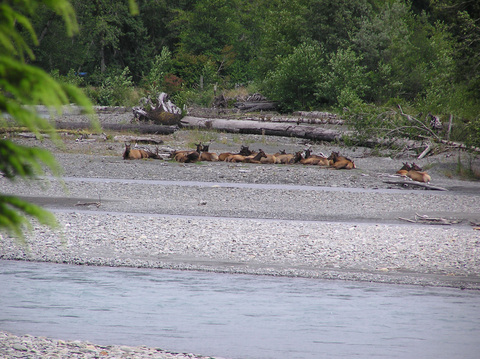
An over-abundance of elk is damaging the rainforest ecosystem of Olympic National Park, according to an Oregon State University study. OSU photo.
To many, the heart and soul of Olympic National Park is the temperate rainforest. There so much moisture falls that places such as the Hoh Rainforest and the Queets valley feel spongy, the air heavy with humidity.
Indeed, when the park was set aside in 1938, it was done so "to preserve the finest sample of primeval forests in the entire United States."
But there's trouble in this paradise, according to a study from Oregon State University. The loss of wolves from the park's ecosystem is causing a decline in those forests, for the predators are not around to keep Olympic's elk herds in check. As a result, the ungulates are over-grazing the forests.
This recently released study maintains that "the extermination of wolves in the early 1900s set off a 'trophic cascade' of changes that appear to have affected forest vegetation and stream dynamics, with possible impacts on everything from fisheries to birds and insects."
Published in the journal Ecohydrology, the report cites information gathered by the Press Expedition during its exploration of the Olympic peninsula in 1890. That expedition found the banks of the upper Quinault River “so dense with underbrush as to be almost impenetrable,” according to the OSU report. "Logs jammed the rivers, dense tree canopies shaded and cooled the streams, and trout and salmon thrived along with hundreds of species of plants and animals."
Such a scene is hard, if not impossible, to find today.
“Today, you go through the same area and instead of dense vegetation that you have to fight through, it’s a park-like stand of predominantly big trees,” says Bill Ripple, a co-author of the study and forestry professor at Oregon State University. “It’s just a different world.”
Elk, he says, are transforming Olympic's landscape as streamside ecosystems are losing young trees to the voracious animals.
Compounding the problem of wolf eradication was the creation of the national park in that it offered protection to the elk from hunters. As a result, their numbers soared and vegetation tumbled.
“Our study shows that there has been almost no recruitment of new cottonwood and bigleaf maple trees since the wolves disappeared, and also likely impacts on streamside shrubs, which are very important for river stability,” said Robert Beschta, lead author of the study and professor emeritus of forest hydrology at OSU. “Decreases in woody plant communities allow river banks to rapidly erode and river channels to widen.
“Tree and shrub species along stream banks and floodplains started crashing first,” Professor Beschta explains. “Then, apparently, the rivers began to unravel. Now we have large areas where the forest understory vegetation is mostly just grasses and ferns.”
The report notes that streams that once flowed in tight channels held in check by thick vegetation have broadened and become braided. Too, the scientists note that the water is open to the warming sun and less enriched by plants and insects. Nearly half of the terraces along the Queets River have disappeared because of accelerated erosion over a period of multiple decades.
“We’ve seen the impact of wolves on the ecosystem in Yellowstone, the effect of cougars in Yosemite National Park, the same basic story about the importance of key predators being played out in many different places,” Professor Ripple says. “What’s so surprising here is that it’s happening in a temperate rainforest, which is hugely productive and has such high levels of vegetation growth. But even there, when the ecosystem gets overwhelmed with many large herbivores, the vegetation just can’t keep up.”
An effort was considered to restore wolves to the park ecosystem in recent years, but no decision or actions have been undertaken to accomplish that.
Story Categories:
A copy of National Parks Traveler's financial statements may be obtained by sending a stamped, self-addressed envelope to: National Parks Traveler, P.O. Box 980452, Park City, Utah 84098. National Parks Traveler was formed in the state of Utah for the purpose of informing and educating about national parks and protected areas.
Residents of the following states may obtain a copy of our financial and additional information as stated below:
- Florida: A COPY OF THE OFFICIAL REGISTRATION AND FINANCIAL INFORMATION FOR NATIONAL PARKS TRAVELER, (REGISTRATION NO. CH 51659), MAY BE OBTAINED FROM THE DIVISION OF CONSUMER SERVICES BY CALLING 800-435-7352 OR VISITING THEIR WEBSITE. REGISTRATION DOES NOT IMPLY ENDORSEMENT, APPROVAL, OR RECOMMENDATION BY THE STATE.
- Georgia: A full and fair description of the programs and financial statement summary of National Parks Traveler is available upon request at the office and phone number indicated above.
- Maryland: Documents and information submitted under the Maryland Solicitations Act are also available, for the cost of postage and copies, from the Secretary of State, State House, Annapolis, MD 21401 (410-974-5534).
- North Carolina: Financial information about this organization and a copy of its license are available from the State Solicitation Licensing Branch at 888-830-4989 or 919-807-2214. The license is not an endorsement by the State.
- Pennsylvania: The official registration and financial information of National Parks Traveler may be obtained from the Pennsylvania Department of State by calling 800-732-0999. Registration does not imply endorsement.
- Virginia: Financial statements are available from the Virginia Department of Agriculture and Consumer Services, 102 Governor Street, Richmond, Virginia 23219.
- Washington: National Parks Traveler is registered with Washington State’s Charities Program as required by law and additional information is available by calling 800-332-4483 or visiting www.sos.wa.gov/charities, or on file at Charities Division, Office of the Secretary of State, State of Washington, Olympia, WA 98504.


National parks and their natural resources belong to you. The National Parks Traveler works to ensure you know how these essential places are being cared for.
Sign Up For Our Weekly Newsletter
Unsubscribe at any time.
INN Member

The easiest way to explore RV-friendly National Park campgrounds.

Here’s the definitive guide to National Park System campgrounds where RVers can park their rigs.
Our app is packed with RVing- specific details on more than 250 campgrounds in more than 70 national parks.
You’ll also find stories about RVing in the parks, tips helpful if you’ve just recently become an RVer, and useful planning suggestions.


Comments
Replace wolves with controlled hunting.
Need a better predator/pray balance...not control hunting! Keep the damn hunters and ranchers out of the equation and let nature do it's job.
Both of the comments do hold important issues in preserving the ecosystem. There are times that both are needed to bring an deterorating ecosystem back into check. Hunting by it's self isn't the answer, you need the balance of predator/prey to keep things under control after the ecosystem has been restored. The process of restoring the wolf population is only part of the equation, you will need to replant loss vegation along river/creeks bed to stop the erosion, and be able to manage those areas to ensure future growth and stability.
As I understand it, Olympic Nat'l. Park is pretty remote. That being the case, maybe some of the ranchers near Yellowstone could be mollified by transporting some wolves to your neck of the woods. Lots of places, livestock owners don't like the wolves, I know the actual numbers prove them wrong, and so do you, but it's still a tough sell.
Carry on, then.
Controlled hunting or "culling" of animals doesn't work. That was proven in Yellowstone, where elk numbers were kept artificially low for years through "culling". Yet the aspen, cottonwoods, beaver, songbirds, willows etc. did not make a comeback until the wolves were returned. Even when elk numbers were lower than they are now. Why? Because it is not just elk numbers, it is elk HABITS. Habits are not changed by human hunting or culling, they are changed by the constant threat of an apex predator. In fact this is a complaint that many hunters have about wolves. The elk no longer hang out in river bottoms munching willows and aspen shoots. They sneak in at night and then scatter. They are constantly on the move. Wild elk again instead of cattle waiting to be "culled". My guess is that, given half a chance, wolves will return on their own; but if not, reintroduction certainly should be considered.
Hunters with firearms are the main control on Olympic Peninsula elk-populations today. Hunters - both local rural folk and veritable hordes in pickup campers 'from the cities' - lobby heavily to manage the herds at the highest achievable levels - the better to successfully hunt them.
Present limits on the carrying capacity for elk are set primarily by the amount of clearcut logging being done outside the Park on public & private timberlands. Elk - as browsers - do best where most of the growth is in the form of brush and herbage. Once trees begin to dominate a site, they shade out such growth and the area offers insufficient food for them.
These are, bear in mind, Roosevelt Elk, bigger than typical North American Wapiti, and they travel, live & feed in large herds. Many dozens ... even hundreds in the old days when they had access to extensive forest fire regeneration areas. The limited size of today's clearcuts, may in turn be limiting the size of the herds we see.
Kurt, it is my understanding that originally, President Theodore Roosevelt set aside the Olympic Mountains (about 30 years before it was made a Park) explicitly as a refuge for the summer calving grounds of the elk herds. The herds head above the timberline for the meadows, as directly & early as the melting snowpack allows. Further, the really desirable forest stands were in the lowlands outside the rugged terrain of the Olympic Mountains ... and both Roosevelts failed to preserve those forests and have been criticized for demurring to timber and State economic interests. By the time Franklin made the Park, the big lowland trees - the real forest treasure that would have astounded people today (I've lived with the stumps all my life...) were gone.
There are good studies showing dramatic elk increase following large fires of the past (The Forks Burn, 1952, perhaps 50 square miles), and hunters today head directly for clearcut regions (in the lowlands) that have had a few years to 'jungle out', and the elk have learned where they are, but not enough time for tree-regeneration to start killing off the browse.
Wolves would be expected to drive the elk from low-quality understory where they might now be loitering in the fall within the Park (to avoid the hunters, possibly). Such 'elk parks' are a known habit of the herds, and they do chew-up & trample such sites rather noticeably. They shelter from hard weather and chew their cud within such open-understory, closed-canopy timber ... and will nibble on what little brush grows there, easily overpowering its ability to regrow. But that's just part of being elk ... and possibly avoiding the dominant predator today. [close to Franks' comment..]
The basic 'problem' with the idea to reintroducing wolves in the Olympics, is that they are expected to follow the herds out of the Park in the fall, as the elk return to the lowland wintering grounds, where they will compete directly with firmly entrenched & highly organized hunters. The assessment of the Park's wolf carrying capacity was about 50 animals. Their assessment-descriptor did not include the private & commercial timberlands, making key parts of the wolf-proposal a wink & blink game.
Small numbers of wolves have been moving into various parts of the region surrounding the Olympic Peninsula. Since these wolves are not generally being hunted or trapped, it is reasonable that a pack may establish on the Peninsula by it's own devices. This could be a considerably more interesting & valuable process to observe, than another head-butting contest by opposing human groups.
hunters need to stay the hell away and it would all be fine
the hunters need to stay away and the wolfs need a reservation to keep pochers away
From Sightline Daily
Bringing Wolves Back to Washington
Posted by Eric de Place
11/21/2008 11:05 AM
"In Washington, state officials are already drafting a Wolf Conservation and Management Plan. (The section on the history of wolves in Washington is especially fascinating.) The plan is undergoing scientific peer review now and will be available for public comment in early 2009. We expect that the plan will develop a management scheme for wolves that have returned to the state on their own; it likely won't have provisions for actively reintroducing them, not even into hard to reach places like Olympic National Park where they would surely thrive. I think that's a shame -- but the public comment period will be an excellent opportunity to offer corrections to the state's plan. Stay tuned."
we need to reintroduse wolfs, why? it is because, the elk and deer heards are tearing up our forests! they are eating the plants that contain river banks, they eat the shoots of new trees. if we allow controlled hunting, people from all over the USA will come to Washington, to hunt the elk, and even with the hunting being controlled the elk numbers will still drop like flies.
We should use hunting as a tool to get wolves back and nature doing its thing again.
if we send hunters in in huge numbers, poachers might kill the wolves, and more elk than can be safely killed, possibly causing underpopulation for the elks, and starving the wolves back out
I have lived on the Olympic Peninsula virtually all my life and seen the horrific effects of logging and hunting over the years. With virtually no regard for the lives and rights of the forest inhabitants hunters and loggers have forever altered the ecosystem and the losses are beyond calculation. We will not, within our lifetimes and possibly never, see the magnificence of the forest as I knew it as a child. My family made its living with logging and milling and were a part of the destruction,. realizing it with regret but feeling trapped by economic need. The agencies in charge let us down greatly by looking at the woods as a commodity to be mined and not a complex and holy thing. The wolves are part of the mysterious working of the forest as a living entity. They are clearly needed to help restore the Hoh and other river valleys and if we can only get started the wolves would work magic. There is no way we as people, no matter how egotistical we are, can know it all. Destroying the wolves and seeing the results proves this, if it needed proving. But we must not depend on the wolves migrating into these areas on their own. They cannot swim the Straits of Juan De Fuca nor can they swim Puget Sound, even if they could make it across I-5. The superhighway, the cities and the suburbs, the railroad and the waterways virtually guarantee they can not repopulate and the barrier, huge and dangerous, exists all the way from deep into Canada down into Mexico. We must help them and to hell with the hunters who complain. I eat almost no meat at all and am healthier for it. Humans don't need it. For all the gear and ammunition, gas and time off work, not to mention the beer, they could eat domestic cow steak every night if they must eat animals. Too many of them just enjoy killing and to me that is a disgraceful crime. There is something wrong with people who enjoy murdering. I can understand people who are truly poor but there are also now other options for them. The hunters upset the balance of the ecosystem and it is better left to nature who knows what she is doing.
you have a couple of valid points but besides the fact that the wolves cant get there on their own everything else is crazy talk. how do you think your alive today? all of your ansestors for thousands of years made it by eating meat. not cattle from the store but cattle they raised so it didnt have the preservitives and added chemicals and they hunted! you would not be here today if they did not eat meat. hunting when dobe correct is a great thing. i agree that most litter and do not respect the land but not all are like that. I live in wyoming and hunt and fish. i have not purchased meat from a store in 10 years. all i eat meat wise i harvested myself. I am a much healthier person for that. i would put my health as a 40 year old p.e/health teacher against anyone!
Dont assume ALL hunters are bad, and wolves are good. look at yelowstone in the spring time and tell me what is fair for elk? hundreds of calves killed and barely touched (extreme suffering) or a bullet to the vitals and a swift kill and the entire animal is used. Hunting is again good when done right!
What we need if I'm following Jennifer's line of reasoning is, with modern science, reintroduce all dinosaurs where they once roamed. We just need to experience the feeling that we aren't at the top of the food chain, we aren't by the way. I grew up in the same neighborhood as Jennifer and relate, some. Is it better for people to not experience the connectedness to nature but looking at their food source as nothing more than packages in a grocery store? To have someone else actually do the growing and butchering so we can live detached from reality? Seems LESS responsible to me. There are some more mature and respectable hunters, scientists, park managers, game managers, environmentalists than others. I believe there is no difference in the temptations they all face along their chosen paths. The most fond and emotional pleas that go out still have to live in the realities that have always been. I, personally, have felt more connected to nature when I've been in a very thick Spruce thicket looking down at a huge Brown Bear footprint in thick moss that is still rising fro the compression seconds before, but I don't think it's a good idea to reintroduce Grizzly Bears to California Middle School playgrounds :).
Reintroducing wolves to the ecosystem would be best but it is expensive and has politically implications. Let biologist decide a number of elk to cull from the heard each year and sell permits to hunters.