
It can take a long time to reach Theodore Roosevelt National Park, located as it is in southwestern North Dakota. Fortunately, there are some great hikes to do once you get there to stretch your legs. Here are five aspects of the park not to miss on your next visit.
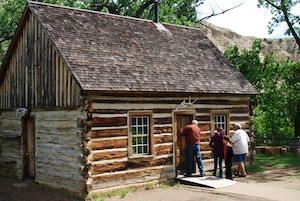
Roosevelt's Maltese Cabin is an interesting stop at the South Entrance. Kurt Repanshek photo.
1. Stop at the South Entrance at Medora and take a ranger-led tour of Theodore Roosevelt's Maltese Cross Cabin next to the visitor center. This cabin, transported from south of the park to its current location, gives you a great feel for the cramped quarters Roosevelt endured during his first few years in the then-Dakota Territory. Some of the furniture in the cabin is thought to have belonged to the young Roosevelt, including the rocking chair.
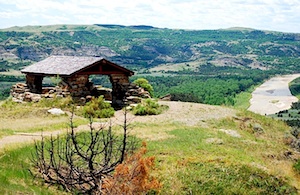
The Riverbend shelter built by the CCC overlooks the Little Missouri River. Kurt Repanshek photo.
2. Hike the Upper Caprock Coulee Trail in the North Unit of the park. Near the end of the trail, by a shelter built by the Civilian Conservation Corps, you have some of the best views of the badlands that are the hallmark of the park. The trail rises and falls, but mostly rises, as you leave your car farther and farther behind. Coming into eyesight not only are views of the Little Missouri River, but also flanks of striated badlands that the river eroded from the landscape down through the millennia.
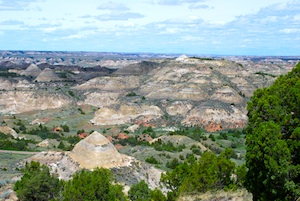
Sweeping views of the South Unit are possible from the Ridgeline Nature Trail. Kurt Repanshek photo.
3. Explore the Ridgeline Nature Trail in the South Unit located about 11 miles inside the park's South Entrance at Medora. What makes this short (0.6 miles) hike worthwhile is it 1) gets you out of the car, 2) quickly gains a little elevation that rewards you with sweeping views, and 3) has signage, if you grabbed the trail brochure at the trailhead, explains the vegetation and geology in front of you.
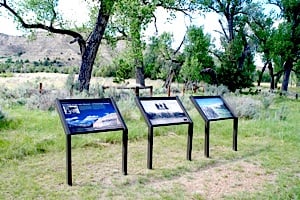
Placards lend some insights into Roosevelt's Elkhorn Ranch. The ranchhouse stood just beyond the placards, behind the row of cottonwoods. Kurt Repanshek photo.
4. Visit Elkhorn. Yes, it will take some determination, as you'll likely need to get back on Interstate 94 and head west for a bit before turning north on some county roads. But the payoff is seeing the site where Roosevelt built the headquarters of his Elkhorn Ranch. Sadly, the ranchhouse itself is no longer there, although the foundation stones it rested upon are. But you still can get a sense of place where, with the slow moving Little Missouri River fronting the homesite and the badlands across the river.
My home ranch lies on both sides of the Little Missouri, the nearest ranchman above me being about twelve, and the nearest below me about ten, miles distant. The general course of the stream here is northerly, but, while flowing through my ranch, it takes a greater westerly reach of some three miles, walled in, as always, between chains of steep, high bluffs half a mile or more apart. The stream twists down through the valley in long sweeps, leaving oval wooded bottoms, first on one side and then on the other; and in an open glade among the thick-growing timber stands the long, low house of hewn logs. -- Theodore Roosevelt, The Home Ranch
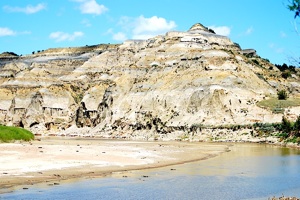
The Little Missouri bends past the Juniper Campground. Kurt Repanshek photo.
5. Camp out. There's something about sleeping under the open sky, and at Theodore Roosevelt National Park you have two campgrounds to choose from. Go with the Juniper Campground in the North Unit. You'll treasure the murmuring of the Little Missouri, the stars overhead, the swaying cottonwoods, and the resident bison that aren't bashful (so keep your distance!). Best of all, this 50-site campground is far, far away from Interstate 94, which you can hear from the Cottonwood Campground in the South unit.
Story Categories:
A copy of National Parks Traveler's financial statements may be obtained by sending a stamped, self-addressed envelope to: National Parks Traveler, P.O. Box 980452, Park City, Utah 84098. National Parks Traveler was formed in the state of Utah for the purpose of informing and educating about national parks and protected areas.
Residents of the following states may obtain a copy of our financial and additional information as stated below:
- Florida: A COPY OF THE OFFICIAL REGISTRATION AND FINANCIAL INFORMATION FOR NATIONAL PARKS TRAVELER, (REGISTRATION NO. CH 51659), MAY BE OBTAINED FROM THE DIVISION OF CONSUMER SERVICES BY CALLING 800-435-7352 OR VISITING THEIR WEBSITE. REGISTRATION DOES NOT IMPLY ENDORSEMENT, APPROVAL, OR RECOMMENDATION BY THE STATE.
- Georgia: A full and fair description of the programs and financial statement summary of National Parks Traveler is available upon request at the office and phone number indicated above.
- Maryland: Documents and information submitted under the Maryland Solicitations Act are also available, for the cost of postage and copies, from the Secretary of State, State House, Annapolis, MD 21401 (410-974-5534).
- North Carolina: Financial information about this organization and a copy of its license are available from the State Solicitation Licensing Branch at 888-830-4989 or 919-807-2214. The license is not an endorsement by the State.
- Pennsylvania: The official registration and financial information of National Parks Traveler may be obtained from the Pennsylvania Department of State by calling 800-732-0999. Registration does not imply endorsement.
- Virginia: Financial statements are available from the Virginia Department of Agriculture and Consumer Services, 102 Governor Street, Richmond, Virginia 23219.
- Washington: National Parks Traveler is registered with Washington State’s Charities Program as required by law and additional information is available by calling 800-332-4483 or visiting www.sos.wa.gov/charities, or on file at Charities Division, Office of the Secretary of State, State of Washington, Olympia, WA 98504.
INN Member

The easiest way to explore RV-friendly National Park campgrounds.

Here’s the definitive guide to National Park System campgrounds where RVers can park their rigs.
Our app is packed with RVing- specific details on more than 250 campgrounds in more than 70 national parks.
You’ll also find stories about RVing in the parks, tips helpful if you’ve just recently become an RVer, and useful planning suggestions.


Comments
Kurt, I love your format of this article. The only thing you left out is where to dine. I have always wanted to visit this out of the way park. Your links in the article are also very nice.
Thanks David. It's something we're playing around with, though it won't replace longer, more insightful articles.
As for dining, around your campfire, no? If that's too rustic, check out Theodore's Dining Room in the Rough Rider Hotel in Medora. I actually ran into the park superintendent there and we had a very enjoyable dinner catching up on park news!
I only mentioned dining because I have read there is no food available in the park and people should plan accordingly given its proximity to towns. Your tips sound perfect.
If you visit the north unit, be sure to take your own groceries.
I agree that this is a park well worth visiting! I tell people it's a "quiet favorite" of the 46 Parks I've visited so far. I was on the fence about whether to trek up there from a longer stay in the SD parks, but I'm so glad I did. I'd like to add a few more suggestions/comments:
If you like solitude, this is a gem of a park. I spent two days here in early May 2012 and saw perhaps 3 other cars in the park the entire time. I booked a room at the Rough Riders hotel in Medora, very nice. A little pricy for budget travelers but the rooms were really nice, like you might find in a resort, and I got a rate from TripAdvisor that included a free dinner, in their very nice restaurant, for around $110 total. I was told that after Memorial Day (presumably through Labor Day) they do get more crowded here, as most of the NP units do. There's a popular Wild West show in town that sounded a little too Disney for me, but families with kids supposedly like it.
Keep an eye out for the wildlife stars (IMHO) of Teddy Roosevelt, the 180 or so wild horses who call it home. Get to the park early and if you are lucky you may find a herd at the roadside and join them for breakfast as I did - I got out and watched them up close for 90 minutes before another car came through and busted our zen. (My pics: http://bit.ly/1mG0wOW) Keep an eye out along the park perimeter as you approach on the highway as well. These horses were real beauties, not mangy like the park's deer, and were not startled by my presence at all.
A lot of info about this park plays up the badlands attraction, so I feared maybe it would be too much like "the" Badlands and almost didn't go because of this. While there are neat badlands, these are quite different - the mighty Missouri cuts through them, along with other smaller riverbeds that make for cool hiking. The rock formations seemed much more diverse than at Badlands NP as well - do not miss the views from Wind Canyon Trail along the Missouri. And this park has trees and shrubs! (More pics showing the variety of terrain: http://bit.ly/1eAm7nu As always, try to hit sunrise and pre-sunset for best photos, and pray for a few, but not too many, of those terrific Dakota clouds.)
An encouraging note about just how far off the beaten track this park is. Google maps shows this as a 3 hr 51 minute drive north of Rapid City, SD. So if that's your base for a Badlands NP visit or Rushmore/Black Hills, don't let this distance deter you from a drive north for Teddy Roosevelt. You may be the only car on the highway for miles along the gorgeous rolling prairie, and let's just say you can make terrific time, MUCH better than the Google projection. Bonus: on the drive back to Rapid City, if you have time, Devil's Tower will seem like a relatively short detour, about an hour's scenic drive west through beautiful wooded hills from Spearfish (which itself boasts a beautiful canyon with nice waterfalls, rivers and ponds for hiking.) And heck, while you're out touring, might as well head down to Jewel Cave, then over to Wind Cave, and why not see Rushmore again? :)
As Kurt says, you may hear some highway noise from some outside edges of the south unit, mainly oil/gas industry trucks - curses to you, Haliburton! - but I rarely noticed this while deep in any of the terrific hikes in this unit. The influx of gas-holes also means you may be hard-pressed to find an affordable Motel 6 within miles of the park during high season. Good luck.
This is my favorite park. To add to the great information above, here are a few things that cannot be planned, but happened to a friend and me (and I'm guessing quite a few others):
Hiking off-trail in the Petrified Forest in order to go around a very, very large bison herd, and then spending the day seeing a lot more of the Petrified Forest than we had planned. (We were lost for about six hours.)
Camping with a wild horse in the Painted Canyon.
Getting caught in a bison stampede in the North Unit.
A bison stampede? And you lived to tell about it? As TR would say, bully for you!
Well said--or quoted!