
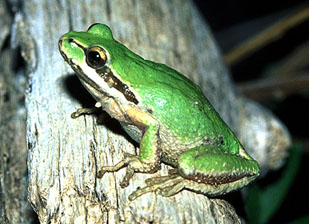
Pesticides used in California's Central Valley are poisoning Pacific Tree frogs high in the Sierra. USGS photo by Chris Brown.
Frogs living high in Sierra Nevada national parks such as Lassen Volcanic and Sequoia are slowly being "contaminated" by agricultural pesticides, according to a study that found the contamination even in "the most remote mountain locations."
Some frog species in the Sierras have faced other problems. Yellow-legged frogs in Sequoia and Kings Canyon national parks have been prey for non-native trout first introduced to the lakes in the 1850s, and chytrid fungus has been another blight on the population.
Pesticides used in California's Central Valley long have been suspected of contaminating these lakes, and now researchers with the U.S. Geological Survey have documented the connection.
Writing in Environmental Toxicology and Chemistry, they researchers confirm they've found pesticides in Pacific Tree Fogs in remote mountain areas, including national parks.
California’s Central Valley is one of the most intensely farmed regions in North America, producing 8 percent of U.S agricultural output by value, according to the USGS. While the use of pesticides such as triazines, endosulfan and organophosphates is common across the United States, California uses more pesticides than any other state.
“Our results show that current-use pesticides, particularly fungicides, are accumulating in the bodies of Pacific chorus frogs in the Sierra Nevada,” said Kelly Smalling, a research hydrologist from the USGS. “This is the first time we’ve detected many of these compounds, including fungicides, in these remote locations."
The Pacific Chorus frog Pseudacris Regilla can be found in abundance across California’s Sierra Nevada mountain range. As with other amphibians, agrochemicals potentially pose a threat to Chorus frogs, as exposure to pesticides can decrease their immune system, thereby increasing the risk of disease.
The USGS researchers collected frogs, as well as water and sediment samples, from seven ponds ranging from Lassen Volcanic National Park at the northern most point of Central Valley, to the Giant Sequoia National Monument in the valley’s southern extent. All sites were downwind of agricultural areas.
“The samples were tested for 98 types of pesticides, traces of which were found in frog tissues from all sites,” said Smalling. “We found that even frogs living in the most remote mountain locations were contaminated by agricultural pesticides, transported long distances in dust and by rain.”
Two fungicides commonly used in agriculture -- pyraclostrobin and tebuconazole -- and one herbicide, simazine, were the most frequently detected compounds. According to the researchers, this is the first time these compounds have ever been reported in wild frog tissue. Another commonly detected pesticide was DDE (Dichlorodiphenyldichloroethylene), a breakdown product of DDT that was banned in the United States in 1972. The continued presence of a DDT byproduct reveals how long this banned chemical can impact biodiversity, the USGS release pointed out.
Documenting the occurrence of these compounds is an important first step in figuring out the health consequence associated with the exposures.
“Very few studies have considered the environmental occurrence of pesticides, particularly fungicides which can be transported beyond farmland,” concluded Smalling. “Our evidence raises new challenges for resource managers; demonstrating the need to keep track of continual changes in pesticides use and to determine potential routes of exposure in the wild.”
Story Categories:
A copy of National Parks Traveler's financial statements may be obtained by sending a stamped, self-addressed envelope to: National Parks Traveler, P.O. Box 980452, Park City, Utah 84098. National Parks Traveler was formed in the state of Utah for the purpose of informing and educating about national parks and protected areas.
Residents of the following states may obtain a copy of our financial and additional information as stated below:
- Florida: A COPY OF THE OFFICIAL REGISTRATION AND FINANCIAL INFORMATION FOR NATIONAL PARKS TRAVELER, (REGISTRATION NO. CH 51659), MAY BE OBTAINED FROM THE DIVISION OF CONSUMER SERVICES BY CALLING 800-435-7352 OR VISITING THEIR WEBSITE. REGISTRATION DOES NOT IMPLY ENDORSEMENT, APPROVAL, OR RECOMMENDATION BY THE STATE.
- Georgia: A full and fair description of the programs and financial statement summary of National Parks Traveler is available upon request at the office and phone number indicated above.
- Maryland: Documents and information submitted under the Maryland Solicitations Act are also available, for the cost of postage and copies, from the Secretary of State, State House, Annapolis, MD 21401 (410-974-5534).
- North Carolina: Financial information about this organization and a copy of its license are available from the State Solicitation Licensing Branch at 888-830-4989 or 919-807-2214. The license is not an endorsement by the State.
- Pennsylvania: The official registration and financial information of National Parks Traveler may be obtained from the Pennsylvania Department of State by calling 800-732-0999. Registration does not imply endorsement.
- Virginia: Financial statements are available from the Virginia Department of Agriculture and Consumer Services, 102 Governor Street, Richmond, Virginia 23219.
- Washington: National Parks Traveler is registered with Washington State’s Charities Program as required by law and additional information is available by calling 800-332-4483 or visiting www.sos.wa.gov/charities, or on file at Charities Division, Office of the Secretary of State, State of Washington, Olympia, WA 98504.


National parks and their natural resources belong to you. The National Parks Traveler works to ensure you know how these essential places are being cared for.
Sign Up For Our Weekly Newsletter
Unsubscribe at any time.
INN Member

The easiest way to explore RV-friendly National Park campgrounds.

Here’s the definitive guide to National Park System campgrounds where RVers can park their rigs.
Our app is packed with RVing- specific details on more than 250 campgrounds in more than 70 national parks.
You’ll also find stories about RVing in the parks, tips helpful if you’ve just recently become an RVer, and useful planning suggestions.


Comments
Lassen Volcanic National Park is not in the Sierra, it is in the Cascade Range.
Hikertom, I'm guessing that since Lassen "lies at the crossroads of three great biological provinces: the Cascades range to the north, the Sierra Nevada mountains to the south and the Great Basin desert to the east," the researchers were somewhat liberal in their geographic description....