
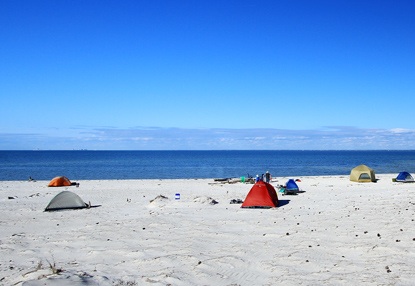
An area on Horn Island, an island in Gulf Islands National Seashore that offers primitive camping experiences, has been closed to the public following the discovery of hazardous materials, including, possibly, mustard gas. NPS photo.
Hazardous materials, possibly mustard gas weapons left over from World War II as well as asbestos, have been found on Horn Island in Gulf Islands National Seashore, leading the National Park Service to close part of the island to the public for the immediate future.
Park officials, who planned Monday to hold a press briefing on the matter, instituted a 1,000-foot closure around an area along the northwestern shore of the island, which is located just off the Mississippi coast, late last week. A military facility was located there during World War II, according to the Park Service.
"We received confirmation Thursday that there are asbestos materials on the ground on the northwestern shore of the island in an area that contains the remains of a military facility that was active in the 1940s," Superintendent Dan Brown said in a release. "A preliminary test also indicated the possible presence of a chemical agent known commonly as mustard gas. We are still awaiting confirmation of that."
The superintendent also announced that, "based on an initial records search that was done, we have reason to believe that some containers of mustard gas may have been deposited in the island's Big Lagoon. We are therefore closing the portion of the lagoon that we own and we are notifying the owners of those nearby privately-owned tracts of the potential hazard."
In his statement last week, the superintendent said a team of experts was being called in to help the Park Service assess the possible dangers surrounding the materials.
Although the National Park Service acquired the island in 1971, the matter of hazardous materials that might have been stored there when the military used the island during World War II didn't come up until this past June, when British Petroleum asked the Park Service to provide a list of potential chemical and biological hazards on Horn Island before the company deployed their cleanup crews team as part of the Deepwater Horizon response.
The NPS contracted with the environmental services firm Barksdale & Associates to conduct a preliminary site assessment and inspection, including tests for multiple contaminants. This led to the discovery of the contaminants.
The list of other potential contaminants came from an initial review of the site's historical records and includes: botulinum toxin, ricin, polynuclear aromatic hydrocarbons (PAH), pesticides, polychlorina ted biphenyls (PCB), dioxins and furans, as well as the Resource Conservation and Recovery Act (RCRA) metals (silver, arsenic, barium, cadmium, chromium, mercury, lead, and selenium).
Story Categories:
A copy of National Parks Traveler's financial statements may be obtained by sending a stamped, self-addressed envelope to: National Parks Traveler, P.O. Box 980452, Park City, Utah 84098. National Parks Traveler was formed in the state of Utah for the purpose of informing and educating about national parks and protected areas.
Residents of the following states may obtain a copy of our financial and additional information as stated below:
- Florida: A COPY OF THE OFFICIAL REGISTRATION AND FINANCIAL INFORMATION FOR NATIONAL PARKS TRAVELER, (REGISTRATION NO. CH 51659), MAY BE OBTAINED FROM THE DIVISION OF CONSUMER SERVICES BY CALLING 800-435-7352 OR VISITING THEIR WEBSITE. REGISTRATION DOES NOT IMPLY ENDORSEMENT, APPROVAL, OR RECOMMENDATION BY THE STATE.
- Georgia: A full and fair description of the programs and financial statement summary of National Parks Traveler is available upon request at the office and phone number indicated above.
- Maryland: Documents and information submitted under the Maryland Solicitations Act are also available, for the cost of postage and copies, from the Secretary of State, State House, Annapolis, MD 21401 (410-974-5534).
- North Carolina: Financial information about this organization and a copy of its license are available from the State Solicitation Licensing Branch at 888-830-4989 or 919-807-2214. The license is not an endorsement by the State.
- Pennsylvania: The official registration and financial information of National Parks Traveler may be obtained from the Pennsylvania Department of State by calling 800-732-0999. Registration does not imply endorsement.
- Virginia: Financial statements are available from the Virginia Department of Agriculture and Consumer Services, 102 Governor Street, Richmond, Virginia 23219.
- Washington: National Parks Traveler is registered with Washington State’s Charities Program as required by law and additional information is available by calling 800-332-4483 or visiting www.sos.wa.gov/charities, or on file at Charities Division, Office of the Secretary of State, State of Washington, Olympia, WA 98504.


National parks and their natural resources belong to you. The National Parks Traveler works to ensure you know how these essential places are being cared for.
Sign Up For Our Weekly Newsletter
Unsubscribe at any time.
INN Member

The easiest way to explore RV-friendly National Park campgrounds.

Here’s the definitive guide to National Park System campgrounds where RVers can park their rigs.
Our app is packed with RVing- specific details on more than 250 campgrounds in more than 70 national parks.
You’ll also find stories about RVing in the parks, tips helpful if you’ve just recently become an RVer, and useful planning suggestions.


Comments
And how many of those compounds discovered in the sand may also be the results of ordinary activities along the Gulf Coast? Coming possibly from some of the many chemical plants, oil refineries and other industries that are spread throughout that region?
But remember, the EPA kills jobs and needs to be eliminated according to some people of power.
Hey Lee, could you support the EPA's mission but admit to the overreach and abuses that are very evident within the administration? Ideologues?
Which administration? George W. Bush's?
Ok, ok, ok folks. I think we can agree that no one administration can claim a monopoly on over-reach and abuses. Perhaps a better question would be why the Army didn't clean up the island before giving it over to the U.S. Fish and Wildlife Service, which transferred it to the Park Service?
Yes Lee - how many? As far as you know - none. But that doesn't stop you from throwing out the accusation. I guess because mustard gas and asbestos come from chemical plants and refinaries. Perhaps we shouldn't have fought WWII because of those contaminets. YesLlewelyn, the EPAcjibs needlessly cost jobs and CAFE kills.
Who knows what else could still be left (or no longer where it's supposed to be) after Hurricane Katrina? Wouldn't this previous owners and possible hazardous contents list have been pulled then?
Maybe it's because I'm old enough to remember America before the Clean Air and Clean Water Acts. Have any of you traveled through the "Chemical Corridor" along the Gulf Coast and tried to breathe the air down there? You should have seen it back in the 1960's and earlier.
Or Cleveland, Ohio or Youngstown in those days when the Cuyahoga River caught fire once or twice a year and people had to brush a daily coating of red dust from their cars downwind of the steel mills. Or Farmington, New Mexico just after the Four Corners coal fire electric plant spewed such clouds of fly ash that I was unable to make a visual approach and landing at the airport downwind from the plant.
It seems pathetically ironic that people who claim to be conservatives keep talking and writing about something called "responsibility" but are unwilling to push businesses to actually use it. Perhaps "responsibility" is only for those who don't have enough power to force wealthy people and industrial conglomerates to accept responsibility for their actions and the consequences thereof.
For those of us who have witnessed the irresponsibility that is part of the history of America and the world, we are sometimes appalled by the apparent short sightedness of some people these days.
I don't think I was making an accusation above. I was asking a question. A question that probably really needs to be answered. For those who accuse people like me of being some kind of "liberal," there is one thing to remember. A "liberal" is really a responsible conservative who won't allow anyone to fool us.
Lee, according to your first post, if true, then these hazardous materials would we be found on all the islands, not just one little portion of one little island. This report is very specific on what was found and where it was found. It was neither political or environmental in nature. It is a well-written article on what was found and what they are trying to do about it. Leave them alone to work on it and quit second-guessing and throwing out accusations. They are not warranted in this instance.
My point is that contaminants such as these and others can be found almost anywhere in our environment. Many are the result of years of carelessness or perhaps just plain ignorance on the part of many industries.
The current push to roll back protections is alarming and should be fought by all of us.
Lee. Many of your so called contaminents don't contaminate a thing and I am not aware of any conservatives that believe people (corporations or individuals) should not be held responsible for their actions. The question is what is the damage caused by their actions. Your side says get rid of it all, no matter the cost, no matter the real damage. Our side says there is balance. The EPA and many other govt orgs are out of control and need to be reigned in. But then, this article had nothing to do with that. This article was about a corporation that was taking responsibility for damage it caused and found a hazard it had nothing to do with to the betterment of society and the environment.
Anonymous: The article is not about a corporation taking responsibility. It is about Hazardous materials being found on Horn Island. It is amazing how the comments morphed into a political forum.
Anon 4:59 And how we're those found? The EPA?
Lee, with respect to human failings including all the temptations that are universal those same saviors you attribute are also prone to the same temptations that any person in corporate or hold on to your hats, government! Everything good and redeeming face the same character flaws. As I've been reminded repeatedly, all that is NPS is not pure and nice nice. I learned that very early on with (not my description) pimp environmentalists. Many are just fine with their decks made with old growth Redwood. Get real is my point.
Lee,
I am a conservative. I love the outdoors, and I wouldn't want it destroyed with pollution. I have no problem with the EPA's existence. Its job is to enforce what environmental laws congress has enacted. It also gets its budget from congress (which refuses to even pass a real budget). Herein lies the problem. Every new law requires more money and staff to enforce. We talk about environmental sustainability, but our government is not sustainable the way it is going. I agree there must be a balance. I like having a job, so I can afford to enjoy my off time outdoors. If we go off the deep end and shut down everything, our economy will not be competitive with the rest of the world, and I will not have a job. Our government lawmaking and the cost to implement has gotten ahead of our private sector economy which pays for all that government does. I'm not against environmental protection or safety nets for some of the poor/elderly, but we need to keep things at a sustainable level. In my budget, I balance wants and needs. If I couldn't afford food I might borrow to buy it, but I won't borrow for a want. Government needs to learn to do this. The voters have needs and wants, and politicians think they have to satisfy all of them to be in power. That is not true. Economic security is a need just as much as military security is, and I don't feel very secure. Taking on debt to supply every voter's wants will be the death of this country.
On the original topic: I'm glad they found and plan to clean up anything dangerous on the island. I realize it will not be free. This is why the budget of the organization footing the bill should not be stressed to the limit with wasteful spending on "wants". Cleanup of dangerous manmade pollution on public lands I think should be a priority. If I'm saving for a new car, and I find mustard gas in my yard, I'd pay for the cleanup and keep saving the car. The government has no savings, so it would borrow to do the cleanup, buy the car, and set up separate offices to manage each action which cost more to run than the cleanup and car purchase and which are not dissolved when said cleanup is finished and said car is bought.
Ben Graham: Well said, Ben.