
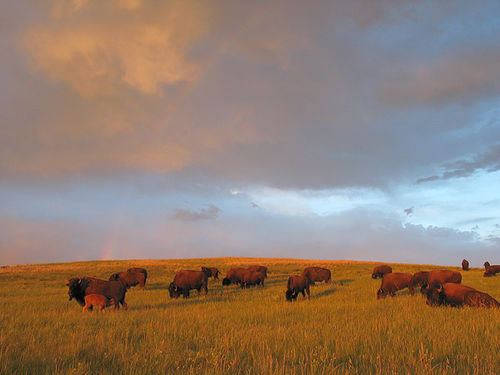
Bison herds roam the prairie at Theodore Roosevelt National Park much as they did 200 years ago. Rich Mason photo via Flickr.http://www.flickr.com/photos/richpix/38021979/
A tribute to Teddy Roosevelt, Theodore Roosevelt National Park sprawls across the same North Dakota landscape where Mr. Roosevelt established his Maltese Cross Ranch in 1883. Today the park marks its 29th birthday.
High, wind-swept prairie, cut here and there by the badlands, are the face of the park, which covers more than 70,000 acres. As with Badlands National Park, which also marks its birthday today, Theodore Roosevelt National Park is split primarily in two, with a "North Unit" and a "South Unit." There's even an "Elkhorn Ranch" unit that encompasses the ground where the young Mr. Roosevelt established a second ranch in 1884.
While President Roosevelt ranched the landscape from 1883 until 1887, and maintained his interests in the property until 1898, none of the buildings have survived, given over to recycled uses and time.
Roosevelt's last known visit to the Elkhorn was in 1892. He sold the ranch and buildings to Sylvane Ferris in 1898. Gradually the buildings were stripped of their furnishings and, according to a local stockman, by 1901 "every scrap of the Elkhorn Ranch had disappeared with the exception of a couple of half rotted foundations."
In his writings Theodore Roosevelt often referred to the Elkhorn as his "home ranch". His vivid descriptions of it, and of ranch life, enable his readers to imagine how things must have been.
My home ranch-house stands on the river brink. From the low, long veranda, shaded by leafy cotton-woods, one looks across sand bars and shallows to a strip of meadowland, behind which rises a line of sheer cliffs and grassy plateaus. This veranda is a pleasant place in the summer evenings when a cool breeze stirs along the river and blows in the faces of the tired men, who loll back in their rocking-chairs (what true American does not enjoy a rocking-chair?), book in hand--though they do not often read the books, but rock gently to and fro, gazing sleepily out at the weird-looking buttes opposite, until their sharp outlines grow indistinct and purple in the after-glow of the sunset.
As with Badlands National Park, Theodore Roosevelt National Park has extensive fossil fields. Millions of years ago swamps and lush forests dominated the landscape. Today the park has one of the largest petrified forests in the country, and extensive paleontological deposits from the Paleocene era. In addition to several plants and freshwater snails species, vertebrate fossils include crocodile-like creatures called champsosaurs, crocodiles and alligators, turtles and fish.
Today visitors to the national park bike on the paved and dirt roads that ramble across the landscape, head out on backcountry treks, canoe or kayak on the Little Missouri, camp at one of the three formal campgrounds, look for some of the many bird species that reside in or pass through the park, or go in search of the bison that call the park home.
Of the three campgrounds, the Cottonwood and Roundup sites are located in the South Unit while the Juniper Campground is in the North Unit. Juniper and Cottonwood can accommodate tents, trailers and recreational vehicles, though no hook-ups are available. Camping fees are non-refundable and are $10 per night per site.
The Roundup Campground is a group site that can hold 30 people without horses, or 20 people and 20 horses. It costs a minimum of $20 per night, or $2 per person per night and $1 per horse.
It currently costs $10 to enter the park by vehicle, and that fee is good for seven days. For those traveling on foot, by bike or by horse, the fee is $5.
Story Categories:
A copy of National Parks Traveler's financial statements may be obtained by sending a stamped, self-addressed envelope to: National Parks Traveler, P.O. Box 980452, Park City, Utah 84098. National Parks Traveler was formed in the state of Utah for the purpose of informing and educating about national parks and protected areas.
Residents of the following states may obtain a copy of our financial and additional information as stated below:
- Florida: A COPY OF THE OFFICIAL REGISTRATION AND FINANCIAL INFORMATION FOR NATIONAL PARKS TRAVELER, (REGISTRATION NO. CH 51659), MAY BE OBTAINED FROM THE DIVISION OF CONSUMER SERVICES BY CALLING 800-435-7352 OR VISITING THEIR WEBSITE. REGISTRATION DOES NOT IMPLY ENDORSEMENT, APPROVAL, OR RECOMMENDATION BY THE STATE.
- Georgia: A full and fair description of the programs and financial statement summary of National Parks Traveler is available upon request at the office and phone number indicated above.
- Maryland: Documents and information submitted under the Maryland Solicitations Act are also available, for the cost of postage and copies, from the Secretary of State, State House, Annapolis, MD 21401 (410-974-5534).
- North Carolina: Financial information about this organization and a copy of its license are available from the State Solicitation Licensing Branch at 888-830-4989 or 919-807-2214. The license is not an endorsement by the State.
- Pennsylvania: The official registration and financial information of National Parks Traveler may be obtained from the Pennsylvania Department of State by calling 800-732-0999. Registration does not imply endorsement.
- Virginia: Financial statements are available from the Virginia Department of Agriculture and Consumer Services, 102 Governor Street, Richmond, Virginia 23219.
- Washington: National Parks Traveler is registered with Washington State’s Charities Program as required by law and additional information is available by calling 800-332-4483 or visiting www.sos.wa.gov/charities, or on file at Charities Division, Office of the Secretary of State, State of Washington, Olympia, WA 98504.


National parks and their natural resources belong to you. The National Parks Traveler works to ensure you know how these essential places are being cared for.
Sign Up For Our Weekly Newsletter
Unsubscribe at any time.
INN Member

The easiest way to explore RV-friendly National Park campgrounds.

Here’s the definitive guide to National Park System campgrounds where RVers can park their rigs.
Our app is packed with RVing- specific details on more than 250 campgrounds in more than 70 national parks.
You’ll also find stories about RVing in the parks, tips helpful if you’ve just recently become an RVer, and useful planning suggestions.


Comments
Only been here once but it's still one of my favorite parks. Was moving the family from west coast to east and had the moving truck towing a trailer with the family vehicle on the back. I parked in the Cottonwood campground, pulled my bike off the top of our car, and spent the next day riding my bike throughout the park. Back to town a few times and once around the loop, and boy did I see a lot of critters... more than I've seen in any park except perhaps Yellowstone. Being on a bicycle really made all the difference as I was very quiet as I rounded each bend, often surprising both myself and the animals crossing the road. Around one of those bends was probably the biggest bison I've ever seen and he was standing right in the middle of the road, so I dared not pass him. I had to wait it out perched up on a nearby boulder and boy he sure took his time moving along. At night, several bison came rummaging through the campground, which was rather disconcerting but it really gave you the feeling that nature was in charge here and you were just a visitor. My cats were along for the trip and when that first coyote howled and those cats heard that for what I'm sure was the first time in their lives, it was amazing to see their instincts kick in -- that the coyote was something Baaaaaaad.
Three cheers for TRNP! Like Merrylnd, I've olny been once, but I loved it! I've been trying to save money for another trip up there, but going from TN to ND isn't cheap..
---
jr_ranger
"Good Planets are Hard to Find"
http://tntrailhead.blogspot.com
http://zinch.com/jr_ranger
http://picasaweb.google.com/north.cascades
President, CHS SPEAK (CHS Students Promoting Environmental Action & Knowledge)
Founder and President, CHS Campus Greens
Yeah, how many times can you say "I was just passin' through North Dakota when..."
haha i know, my parents go through there all the time, this summer we are taking a trip there and stopping to look at the views. :)
My wife and I stopped at TRNP South Unit for an afternoon on our way out to Olympic this past summer. We were really entertained by all the prairie dogs along the road. And the bison nursing her calf in the middle of the road. We had to wait for them to move! And the color of some of the rocks remind us of Zion NP. We hope to spend a night there next summer on our vacation and also catch the northern unit.
I was a seasona park ranger in Theodore Roosevelt back in the 70's for several summers. A day does not go by that I don't think of the wonderful experiences I had while working there. I am so glad to see how many other people feel the same way about this area as I do. I look forward to getting back there soon.
i love the park i want to come and see the wild horses there i love horses to much i have one of my own she is a palinminow named honey and i love her so much she is the best horse ever she is 20 years old so she cant do much but i am teachen her how to jump and she is also a drillteam horse. and she is used for showing.
Since mackenzie has revived this thread . . .
Between camping with wild horses in the Painted Canyon and narrowly escaping a bison stampede in the Achenbach Hills, I have to say this is my favorite national park.