
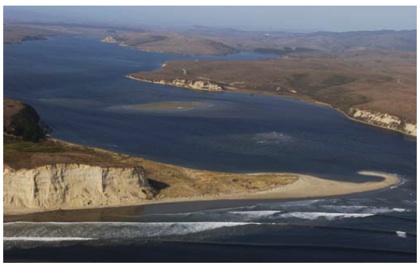
Due to pressure from U.S. Sen. Dianne Feinstein, the National Park Service is performing an exhaustive environmental impact statement on an oyster farm that operates in Drakes Estero at Point Reyes National Seashore. NPS photo of the estero.
Spurred by a U.S. senator determined to reverse congressional action from four decades ago, Point Reyes National Seashore officials are compiling a voluminous environmental impact statement on whether an oyster farm or official wilderness should occupy Drakes Estero.
The costly undertaking isn't without public appeal. While fewer than 200 comments were received on Grand Canyon National Park's mule rides, more than 4,000 comments were fielded by Point Reyes officials on whether Drakes Bay Oyster Co. should have its lease expire in 2012, as Congress directed in 1976, with the estero then being designated official wilderness.
That would have been the case if not for Sen. Dianne Feinstein, who in 2009 attached a rider to an appropriations bill giving Interior Secretary Ken Salazar the authority, but not a mandate, to extend the operation's lease another 10 years. With that nudging from the California Democrat, the Interior secretary saw that the Park Service conduct a full-blown EIS on the question of extending the lease, something it did not have to do.
An opinion from the Interior Department's solicitor in 2004 made it clear that the oyster farm would be incompatible with a wilderness designation. In that opinion, the solicitor's staff said "the Park Service clearly has the authority to terminate the Reservation and to direct (the oyster company) to vacate the property on which it operates," and that "(R)emoval of (the oyster company) from the Point Reyes National Seashore property and its oyster farming from the Estero, would allow the Service to begin the conversion of the area to wilderness status, which directive Congress charged the Park Service to accomplish."
Sen. Feinstein's pressure, however, gave the Interior Department and the Park Service the opportunity to officially examine the impacts of the oyster farm and hear what the public thought of it.
“It’s been debated in the press, it’s been debated in many forums, but this is actually the first time the public’s had an opportunity to weigh-in in a formal compliance process," said Brannon Ketcham, the park's hydrologist.
Along with examining water quality issues and biological impacts on the estero by the oyster operation, part of the environmental review, Mr. Ketcham said, will include revisiting the history behind the oyster farm's lease.
That history dates to November 1972 when Charles Johnson, owner of the Johnson Oyster Co., sold the 5 acres on the shores of Drakes Estero on which his processing facility sat, to the Interior Department for $79,200, with the understanding that he, or any successors to his company, could maintain operations for 40 years, or until November 30, 2012.
Four years later Congress passed the Point Reyes Wilderness Act, which directed the Park Service to manage the estero as official wilderness once the 40-year period was up. Since then, the oyster operation was purchased by the Lunny family, which has lived in the area for three generations.
The estero is a biologically rich and important landscape for wildlife, according to a Park Service fact sheet on the estero.
Drakes Estero is one of the most ecologically pristine estuaries in California and the only coastal waters in the California that are in the National Wilderness Preservation System. Biotically, the estuary is exceptional:
• Extensive eelgrass beds support rare and specially protected species
• Reduced presence of non-native species: recent surveys show that many invasive species are only found where mariculture and oyster racks occur, but not in Limantour Estero (on the eastern end of the estero).
• One of the largest harbor seal populations in California with numbers surpassing 1800
• Identified as significant area for the US Shorebird Conservation Plan: 86 Species of birds recorded in 2004, including Osprey and Black Brant.
• USFWS recognizes 18 species of concern, including Red-legged frog, Western Snowy Plover, Brown Pelican, Peregrine Falcon, and Marbled Murrelet.
• Recent fish survey identified over 30 species of fish, including rare and endangered species such as coho salmon, steelhead trout and three-spined stickleback.
• Rare plants occur along the shoreline of the estuary.
But controversy has dogged the Park Service's handling of the oyster company operations. The National Research Council was highly critical of a Park Service report that outlined the oyster operation's impacts to the estero. That report, the research council said in May 2009, was "selectively" manipulated in several areas, and inconclusive overall.
"...the adverse or beneficial effects of oyster farming cannot be fully understood given the existing data and analyses," stated a news release from the council, which is an arm of the National Academies that also includes the National Academy of Sciences, the National Academy of Engineering, and the Institute of Medicine. "Furthermore, the National Park Service report, 'Drakes Estero: A Sheltered Wilderness Estuary,' in some instances selectively presented, over-interpreted, or misrepresented the available scientific information on DBOC (Drakes Bay Oyster Co.) operations by exaggerating the negative and overlooking potentially beneficial effects."
A study of shellfish mariculture in Drakes Estero compiled by the Ocean Studies Board of the National Academy of Sciences pointed to both benefits and impacts of the oyster farm. That 2009 study pointed out that the native Olympia oysters were lost to over-harvesting in the mid-1800s and that while the Pacific oyster now being farmed "is not a direct replacement of the native populations of the Olympia oyster, it may be viewed as providing similar biogeochemical functions and ecological resilience."
But the study also noted that the lack of eelgrass below the suspended racks of oysters "represents a small-scale and localized impact on the biogenic habitat." Additionally, "(N)umerous boat propeller scars in the eelgrass beds, partially affecting a total area of about 50 acres, are also evident and attributable to oyster culturists because they are the only ones allowed to use motorized vessels in the estero.
"Nevertheless, the total percentage of eelgrass area lost (1%) or partially degraded by propeller scars (7%) and thus attributable to oyster mariculture represents about 8% of all eelgrass habitat in Drakes Estero as of 2007."
The estero is important habitat for harbor seals, according to the study, which notes that it supports "about 20 percent of the mainland California population."
Along with considering the findings of those studies, Mr. Ketcham said the seashore staff also would look into a wide-range of issues raised during the public comment period, including the socio-economic impacts of the oyster operation.
Park Service officials system-wide state that public comments should not be construed as votes that they have to follow. Nevertheless, according to an analysis of the public comments by the National Parks Conservation Association, a 3-1 majority opposes an extension of the oyster company's lease.
Point Reyes officials hope to have a draft EIS ready for public review late this summer, with a final EIS in the spring of 2012 with a record of decision signed before the current lease expires.
Story Categories:
A copy of National Parks Traveler's financial statements may be obtained by sending a stamped, self-addressed envelope to: National Parks Traveler, P.O. Box 980452, Park City, Utah 84098. National Parks Traveler was formed in the state of Utah for the purpose of informing and educating about national parks and protected areas.
Residents of the following states may obtain a copy of our financial and additional information as stated below:
- Florida: A COPY OF THE OFFICIAL REGISTRATION AND FINANCIAL INFORMATION FOR NATIONAL PARKS TRAVELER, (REGISTRATION NO. CH 51659), MAY BE OBTAINED FROM THE DIVISION OF CONSUMER SERVICES BY CALLING 800-435-7352 OR VISITING THEIR WEBSITE. REGISTRATION DOES NOT IMPLY ENDORSEMENT, APPROVAL, OR RECOMMENDATION BY THE STATE.
- Georgia: A full and fair description of the programs and financial statement summary of National Parks Traveler is available upon request at the office and phone number indicated above.
- Maryland: Documents and information submitted under the Maryland Solicitations Act are also available, for the cost of postage and copies, from the Secretary of State, State House, Annapolis, MD 21401 (410-974-5534).
- North Carolina: Financial information about this organization and a copy of its license are available from the State Solicitation Licensing Branch at 888-830-4989 or 919-807-2214. The license is not an endorsement by the State.
- Pennsylvania: The official registration and financial information of National Parks Traveler may be obtained from the Pennsylvania Department of State by calling 800-732-0999. Registration does not imply endorsement.
- Virginia: Financial statements are available from the Virginia Department of Agriculture and Consumer Services, 102 Governor Street, Richmond, Virginia 23219.
- Washington: National Parks Traveler is registered with Washington State’s Charities Program as required by law and additional information is available by calling 800-332-4483 or visiting www.sos.wa.gov/charities, or on file at Charities Division, Office of the Secretary of State, State of Washington, Olympia, WA 98504.


National parks and their natural resources belong to you. The National Parks Traveler works to ensure you know how these essential places are being cared for.
Sign Up For Our Weekly Newsletter
Unsubscribe at any time.
INN Member

The easiest way to explore RV-friendly National Park campgrounds.

Here’s the definitive guide to National Park System campgrounds where RVers can park their rigs.
Our app is packed with RVing- specific details on more than 250 campgrounds in more than 70 national parks.
You’ll also find stories about RVing in the parks, tips helpful if you’ve just recently become an RVer, and useful planning suggestions.


Comments
I'm from New Orleans, Louisiana and own the oldest continually operating oyster company in America. My mother and a number of Aunts, Uncles, and cousins are from there and live there. So my comments are made for the love of the State of California and the citizens who utilize Drakes Estero. Anyone who opposes extending Drakes Bay Oyster Company's lease to operate their oyster farm and processing facility on the shores and in Drakes Estero do not know the importance of the filtering capabilities of oysters. The Lunny's have, through no expense to the citzens of California or the USA, have spent millions of dollars planting and growing oysters in Drakes Estero cleansing the Bay system while making a habitat for all other marine life thrive. Ask the citizens who live along the Chesapeake Bay who has seen the decline in the water quality of the what used to be most productive Bay system in the United States. The citizens of the USA have spent millions of dollars of taxpayer money trying to reestablish oysters in the Chesapeake Bay in hopes of bringing it back to the days when you could walk accross the bay on oyster reefs.Everyone in northern California should do whatever than can to keep the Lunny's in business at Drakes Bay Oyster Company because without them, oysters do not grow there naturally which will cause a deterioration of the water quality of Drakes Estero. REMEMBER THIS COMMENT BECAUSE IF THE LUNNY"S LEASE IS NOT RENEWED YOU CAN COUNT ON THE DEMISE OF THAT IMPORTANT ESTUARY IN CALIFORNIA.
This is a terribly dishonest post.
It is not true that the oyster farm is or was slated to be removed when its lease expires in 2012. The lease is renewable.
It is not true that Senator Feinstein’s legislation was undertaken to “reverse congressional action from four decades ago” or that this legislation gave Interior the authority to extend the lease another 10 years. They already had that authority, but were pretending not to, so the Senator was trying to call their bluff.
While it may be true that the Interior’s lawyer “made it clear in 2004 that the oyster farm would be incompatible with a wilderness designation,” that is entirely irrelevant. The area in question is in a National Seashore that gets about three million visitors a year. The estero gets pedestrian traffic from birdwatchers and is a prime spot for kayaking. These activities, like the oystering, are strictly limited during seal-pup season. The rest of the time, all of these activities take place in harmony with nature. Nobody is talking about restricting the area to pure, actual wilderness. So there is no earthly reason to worry about “wilderness designation.”
It is not true that the Point Reyes Wilderness Act “directed the Park Service to manage the estero as official wilderness once the 40-year period was up.” The intent—as you should know by now, since several of those closest to the story have corrected you on this point several times—was that the estero would be managed as it is now, as official “potential wilderness,” in other words, as close to wilderness as you can get for a recreational and commercial area.
Your recounting of the National Academy of Sciences report is a confusing mishmash that seems designed to hide the fact that the Park Service’s claims of harm to the estero were all found to be wrong. The Park Service exaggerated the negatives and overlooked the positives—it’s right there in your quote from the report in your paragraph 12, and yet you continue in your subsequent paragraphs to imply that there is some truth to these discredited claims. You selectively cite tiny amounts of damage so you can use the words “boat propeller scars” and “eelgrass area lost” in an apparent attempt to obscure the real findings. The eelgrass is FINE here. It has DOUBLED.
After trying to confuse people about the eelgrass, you add the obligatory reference to seals. “The estero is important habitat for harbor seals, according to the study, which notes that it supports ‘about 20 percent of the mainland California population’.” That’s all you say, but the implication is that there is some impact on the seals.
The truth is that the seals are in great shape. There is a mammal study of Drakes Estero under way right now, and the preliminary finding is that the estero is about at its carrying capacity for seals. That’s right, there is a danger that soon there will be TOO MANY seals there. Harbor seals are well known to get along just fine near human activities. This is a non-issue.
You end your dishonest story—and headline it—with a dishonest statistic. “A 3-1 majority opposes an extension of the oyster company’s lease.” That is absolutely false. Majority of what? Not people, for sure. Not independently held opinions. That statistic is extremely misleading because it lumps together all types of comments, which range from thoughtful letters and emails written by experts in the field to off-the-cuff comments provided anonymously to flip-chart holders at the public meetings. People were allowed to supply as many comments as they wanted, with no guidelines whatsoever. The comments were not even required to make sense, much less be true. I attended these public meetings, and I saw with my own eyes that the usual suspects were out in force making as many negative comments as possible, over and over. The process is a sham, there is no accountability to the truth here.
Al Sunseri is correct. The estero will suffer if the oyster farm is removed. Why do you think they are replanting oysters in San Francisco Bay? Yes, to clean the water. Yes, it is working. Fun fact: Kevin Lunny is the one who made that project possible by donating oyster shells for substrate. He even donates the trucking—the Lunny family cares a lot about the environment.
You are on the wrong side of this issue, Kurt. If you really care about the health of Drakes Estero, you should support the oyster farm. And if you really care about the vibrancy of our National Park system, you should consider the benefits of mixed use. We’re not talking about snowmobiles here, this is a local food source that enhances both the environment and the economy.
You clearly have a bias in favor of the Park Service. That’s not surprising, given the focus on the blog, and given the many positive aspects of that venerable organization. And of course it is your right to be biased, since this is your blog.
But since you seem to be blogging for the public, and not simply as a house organ of NPS, I challenge you to seek out new sources. Kevin Lunny is a very patient and reasonable person. He is always willing to go more than halfway to correct misunderstandings. I know he would take your phone call if you reached out to him in good faith.
Since you claim your blog is about news, not just commentary, I believe you have an obligation to get your facts right.
So WHAT is the message that is being sent across the country with the MANY examples of slanted or absent factual informations put out by NPS. It really IS an epidemic everywhere you look (NPS is but one example here). Those people and their aquaculture are the ones grounded here and you'll know it by visiting with them, coming away the better for it, really.
Sarah,
I admire your moxie, but I respectfully disagree with your points.
* As you note, without Sen. Feinstein's amendment, the NPS would not be doing an EIS on this issue. Indeed, as the solicitor's opinion notes, the NPS was within its rights to simply close the door on the oyster operation in November 2012.
* The lease signed by Charles Johnson in November 1972 cleared showed it would expire in November 2012.
* The solicitor's opinion, along with clearly pointing out that the oyster farm is a non-conforming use in a wilderness area, also pointed out that the NPS could terminate the lease at any time, and clearly noted congressional intent when it stated "that "(R)emoval of (the oyster company) from the Point Reyes National Seashore property and its oyster farming from the Estero, would allow the Service to begin the conversion of the area to wilderness status, which directive Congress charged the Park Service to accomplish.
* The article above clearly points out the faults the National Academy of Science's Research Council found in the Park Service's report on the oyster farm's impacts to the estero.
* As for the mariculture study on the estero, the article above quite matter-of-factly points out both the positives and negatives of the oyster operation.
* Finally, as to the 3-1 margin, the article clearly points out that that was the NPCA's conclusion from an analysis it made of the comments.
Now, as far as obligations, perhaps you should identify yourself as a PR consultant? As such, you have an obligation to say whether you're being paid by the oyster company to search the Internet for stories on Drakes Bay, or whether you're doing it pro bono.
Yes, it would be better to acknowledge if one was a PR Specialist in this case. How many PR Specialists are on the NPS payroll? I'd guess just the officially designated salaried Public Relations Specialists that NPS has on staff number in the many hundreds then add on all those associated employees that further the message, has to be in the MANY thousands. So what's the point about pushing for Sarah to acknowledge if she is one or not (I don't know).
These points are largely non-responsive, Kurt.
No, I don’t work for the Lunnys. As has been pointed out by another commenter here, I’m a freelance writer working on a book about this story.
You raise a good point, though. It does make sense to pay attention to the nature of the source when evaluating information. I know quite a few people who, like me, take the time to try to counter misinformation about the oyster farm when they see it, and they are all doing it on their own initiative and on their own dime. Most of the people I know about who take the time to weigh in against the oyster farm are paid to do so. Neal Desai at NPCA, for example, and Amy Trainer at the so-called “grassroots” organization EAC, are both paid PR professionals, although that context is often dropped.
I do have the privilege of knowing the Lunnys. Have you ever communicated with Kevin Lunny directly? Or with Dr. Corey Goodman, who is the whistleblower here? They are both really great to interview. I guarantee that if you contact them you will get much better information than you are getting from the NPCA press releases.
Didn't the least (actually a reservation of use I think) clearly have a renewal clause in it? That's been a subject of contention as to whether subsequent law would allow it, but it was definitely there in 1972.
I'd just point out that I have no financial or other considerations other than being a fan/customer of DBOC and a semi-frequent Point Reyes visitor.
http://www.sarahrolph.com/what.html
Could this be yet another jobs killing action that always seems to be aimed at the private sector?
Those that live and work in concrete jungles pointing fingers at people who live and work out in it. Thought we're in a national effort to create, sustain and in the words of President Obama,"Jobs Saved." How does any of this, the way it's going, help the country ?
Maybe that's not the point. With the massive population base that surrounds the SF Bay that is so detached and disconnected to how the food chain works, I'm surprised that the ratio isn't 100-1 against. That minority that does know where and how to support (and educate) those that don't see how the food chain works past the Von's, Safeway or Albertson's (I know I'm leaving many out:) are the ones looked down upon for getting their hands dirty and working WITH nature. Only the elitist (there's that word again:) would feel it was their duty to take down a perfectly good enterprise that visitors support with their stomachs and the education they might gain from actually having interp tours of the operation showing how the NATURAL process works. That would be something that everyone would benefit from. What IS natural is that we ARE part of the food chain and can't be separated from it in the REAL world no matter how much some try. Good dose of REAL would be appreciated:).
While it's true that eelgrass growth has been less underneath the racks, there can be means to alleviate this in the future. I've actually heard that overall eelgrass growth in the area **around** the oyster racks has been much improved, although light restriction might restrict eelgrass growth. The following report cites sources that suggest that it could be mitigated via different spacing of the racks to allow more light in.
http://www.alsamarin.org/pdfs/CSG%20report1%20070508.pdf
YPW,
I'm impressed, really to see such a logical, practical and factual presentation. Not often seen or acknowledged in present day environmentalism from the demonization of the public, private sector, mules in the Canyon, loss of range or even existence for Wolverines EXCEPT in instances of allowing Sierra Club Members to ride mules to catch their raft trips on the Colorado or hike the John Muir Trail at the expense of very shy Wolverines (none exist there anymore). You can look throughout NPS and their relationship with SC and other radical organizations that have created an industry funded by the tax payers paying for attorney led suits against ourselves. Environmental pimps clinging to their message. If these organizations could refrain from filing lawsuits against the governments that EMPLOY their co-conspirators it would help the deficit if that's not to much to ask. What IS the amount that the taxpayers pay for the suits that are filed against, yes, the taxpayers. Just bringing a topic of conversation. Inquiring minds want to know, especially when it's on their ticket. I would like to hear a rebuttal if I'm wrong in anything I've presented.
YPW, I'm saying this as a big supporter of wild things on the California coast and how much it means to the people that connect to it "and get a little dirty."
I just wanted to clarify what the 40 year reservation of use actually says:
http://www.marinmagazine.com/Marin-Magazine/November-2008/The-Oyster-War/
As far as I'm concerned, the oyster farm is a net plus for the environment of Drakes Estero. If you really want to do something to benefit the wildlife, it's going to take banning kayaks from the waters and removing the hikers from nearby trails. And good luck keeping aircraft from flying overhead.
y_p_w, I'm not sure what the point is of underlining the language concerning extending the special use permit. The lease also clearly states its initial duration was 40 years. Four years after that lease was signed, Congress passed the wilderness legislation for Point Reyes and, according to the solicitor's office, made clear its intent that the estero should become wilderness.
So it would seem that that permissive clause pretty quickly became moot, no? And even if the wilderness intent wasn't made clear, the language does not mandate the Park Service to extend the lease. If anything, the lease language gave the agency ample ways to terminate the lease.
And the beneficial or negative merits of the farming operation also would seem to be moot if one accepts the solicitor's finding that the operation -- good, bad, or indifferent for the estero -- on its face is a non-conforming use in a wilderness area.
Change the Wilderness designation for Drakes Bay. That would accomplish the right thing rather than make the reality moot. Change it to make the designation right with the facts or is it the intention of NPS decide against reality? Oh man, did I say those words, LOL!
Democracy is two wolves and a lamb voting on what to have for lunch. Liberty is a well-armed lamb contesting the vote!".....Benjamin Franklin
Deep, you do raise the obvious solution, though I wonder whether that would open yet another can of worms? Would the entire 1976 Point Reyes National Seashore Act have to be dispatched, or could Congress do selective surgery?
Kurt, pretty obvious that government has got the idea they can do anything they want. Doesn't matter whether it's good for the country or not. Just crazy out there.
I am POSITIVE there could be an amendment correcting a wrong. There could be willingness, I suppose, by some to lay off the pressure on the Oyster operation and renew the lease rather than take the chance of scrutiny going beyond this singular issue. Pretty frustrating for individuals working day in and day out being productive in one of the most compatible uses when their fate is tossed around in a purely political way. Need to get rid of POLITICAL CORRECTNESS and the world would be better off, LOL!
Terminate the lease? Maybe let it run its course, but probably not terminate. I do understand that former Supt Neubacher even threatened to have the lease terminated early for some permit and other violations that dated back to the Johnson ownership. I've heard that the Lunnys would like to fix them, but how do you justify extensive repairs if it's only going to condemned in less than two years.
Also - I wanted to point out the renewal clause because someone reading your article without background would be under the impression that in 1972 it was written up as a strict 40 year term with no means of renewal. I know it gets complicated because of the 1976 Point Reyes Wilderness Act, and it gets even more complicated with Senator Feinstein's rider in that omnibus appropriations bill.
y_p_w,
The lease documents specifically state the government can condemn the property to acquire title outright. And, as I noted in an earlier story on this issue, the solicitor's office in 2004 stated that:
As far as the violations that did or did not exist when the Lunnys bought the property and justifying the cost of repairs, shouldn't the Lunnys have known that the lease ran out in 2012 and what violations needed to be addressed either before they purchased the property or once they actually took over operations?
Kurt - I certainly understand your points, but it could get interesting if they ever went to court. Over the years the NPS knowingly allowed these violations under the Johnsons to continue without the threat of shutting down the operation before the lease ran out. A good lawyer could argue that it wasn't a big enough deal to the NPS until really late in the game. I'm trying to think of what the legal terminology for this thought is, but I'm drawing a blank. I really doubt they would have terminated early because the NPS would very much be lawsuit averse.
I thought that the Lunnys believed in good faith that they could at the very least run the operation until the lease ran out. Most of the reporting is that Supt Neubacher was happy that the Lunnys bought out the farm because of their stewardship of the G Ranch. I've read that he told Kevin Lunny that it would be no problem obtaining several missing permits that the Johnsons had failed to get, but later changed his tune to where he refused to issue them until the Lunnys signed a statement that they wouldn't try to renew the lease on the oyster farm.
Referencing the 3-1 public comment ratio against renewing the lease and the mention of the Grand Canyon Mule Ride EA Comments; The ratio between those who wanted the Mules be removed to those that wanted them eliminated was 6-1 supporting the Mules. NPS response was that it wasn't a popularity contest. The Mules and Oysters need to stick together, apparently. What else is on the Endangered Specie List and by the way, last year was a huge year for NPS construction with their $700 million windfall while the country tanked and continues to tank.
Anonymous, just don't mention Rocky Mountain Oysters too loudly around the mules and things should be fine.
Re the NPS construction "windfall," more than a few of those dollars went to private construction companies. I bet they appreciated the investment, as do the parks' gateway communities, the concessionaires and, indeed, the park visitors. And there were quite a few visitors last year, as the records counted at Yosemite, Yellowstone, Glacier, Indiana Dunes and Bryce Canyon indicated.
Yes, most of those dollars did go to unions, retirements and am not sure whether the in-park construction was union or not but the point is that an appreciation for private sectors and those attitudes that create jobs (not Gov't), wealth and strength is needed if not required to regain our footing. There are so many examples of priorities run astray even the contempt of the courts as if the constitution is something of a hindrance. You know, Kurt, you have me thinking of branding time and those great Mt. Oyster oerdoerves/horsedovers! Thanks for the imaging!
There was an interesting discussion on this back in 2009, featuring a lot of the principals in this fight, including Sen Feinstein, Kevin Lunny, Corey Goodman, Gordon Bennett (representing the local chapter of the Sierra Club), and Tess Elliott of the Point Reyes Light:
http://www.kqed.org/a/forum/R906301000
There's some well written opinion pieces in the Point Reyes Light, including this one:
http://ptreyeslight.com/Point_Reyes_Light/Opinion/Entries/2010/11/18_Wha...
I don't necessarily agree with the entirely of her comment about John Muir. In his later years he had the financial means to keep his rambles going because his in-laws' fruit orchards were extremely profitable.
Also - I'd just comment about the Pine Cone Diner. Once my wife and I arrived there very hungry and eager to get eating. We were seated outside (it was a very nice day) and had menus and water. We were looking over the menu (and waiting for service) for almost a half hour when another couple sat down, got their menus, and ordered with the server heading back in without even looking at us. That was just unacceptable, so we got up and high-tailed it to the market where we got a couple of hot sandwiches and ate them outside the Bear Valley Visitor Center. To this day I would talk people out of going there because of the service that day.
ypw,
Excellent background!
It seems like the overall tone that NPS pervades is that to separate people from our natural resources as much as they can and are only limited by those efforts by cumbersome public outrage and the occasional Congressman that values the hands on connection to our natural world. It really is an assault on the "grounding that people need and seek." I would hope that there would be a welcome change and have respect for the "deep" needs for growth and grounding by the individuals that make up the public sector.
NPS on display here is not an isolated event, apparently.
There have been several opinion pieces (pro and con Re: DBOC) in the Marin Independent-Journal and this one was posted today:
http://www.marinij.com/opinion/ci_17417336
Couldn't let this stand after recent reporting indicates that was clearly not correct.
Former legislators back Point Reyes oyster company's claims
http://www.marinij.com/westmarin/ci_18672190
And just in case the Marin IJ article expires, the following article probably won't:
3 ex-Calif lawmakers wade into oyster farm dispute
http://www.sfgate.com/cgi-bin/article.cgi?f=/n/a/2011/08/15/state/n12342...
And one more:
Marin Voice: History sides with oyster farm
http://www.marinij.com/opinion/ci_18656522
I would also add that former Rep. McCloskey was a well-known environmentalist, was one of the founders of Earth Day, and was a co-author of the Endangered Species Act.
"McCloskey believes that the Park Service "secretly feels very uncomfortable about administering privately leased lands." But he believes that that discomfort — or the beliefs of those who would like to see the entire seashore become "pure" wilderness — do not justify a misreading of the laws he authored."
So many of these expressed thoughts and impressions of NPS secretly held thoughts and actions are applicable here at Grand Canyon (and others) with the forced acquisition of the VerKamps Family store after 100+ years, preceding park status. Those beliefs (secretly held) are not the ideal that, I believe, was intended. Well, unless NPS properties and governors are seeking to become a country of it's own separate from the US (and apply for foreign aid) lol!
Thank you, Kurt!; Your site is interesting, thoughtful and fun for those seeking the light of transparency on the important issues of our beloved parks. Thank you for your efforts.