
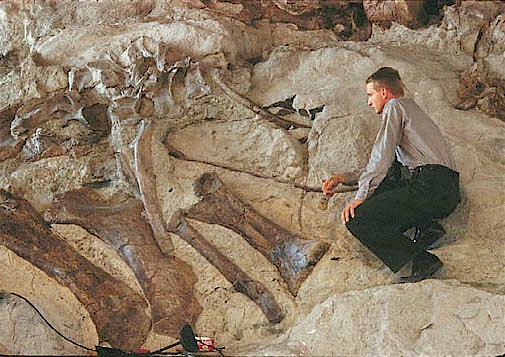
Will Park Service scientists go the way of the dinosaurs? Northern Arizona University photo.
The other day I told you about the diminished role of paleontologists at Dinosaur National Monument. Now I'll touch on the motivation behind that decision.
For a number of years there's been a move, at least in the National Park Service's Rocky Mountain region, to evaluate the agency's "core operations." The idea is that once each park completes this analysis, it will have a blueprint for how best to spend its funding.
Well, apparently at Dinosaur that analysis indicated that law enforcement, maintenance work, and interpretation, not paleontological research, are at the top of the monument's core operations. Here is a section of that document:
Dinosaur National Monument – Implementation of Core Operations
Core Operations is the strategy that the National Park Service has developed to accomplish its highest priorities with available funds. In the past, many National Park Service units have lived with eroding buying power of the dollar by lapsing positions when they became vacant. While that strategy allowed parks to operate within their budget, it did not ensure that the core operations and highest priorities of a park were being met. The core operations process was developed to provide a systematic approach to ensure funds are allocated to high priorities and core needs. This process focuses on functions that are essential to meeting the park’s needs and that have to be accomplished by NPS employees.
Over the last decade, the emphasis of the paleontology program at Dinosaur National Monument has gradually shifted from a focus on the development of the Carnegie Quarry to a broader effort directed at fossil resources throughout the monument. With this change there is a greater need for flexibility and efficiency so we can target funds, personnel, and resources to much needed scientific resource management projects.
The park plans to streamline the geology, paleontology, and museum programs to eliminate duplicate or overlapping responsibilities. Funds will be shifted to accomplishing those tasks that are core to the mission of Dinosaur National Monument and must be accomplished by NPS employees, such as law enforcement, interpretation, and maintenance.
Paleontology project work will be accomplished through avenues other than full-time permanent National Park Service positions, such as partnerships with universities and museums, contracts, volunteers, etc. Under this approach, staffing and resources can be easily adjusted to meet the needs of changing program projects under the direction of the monument’s Ph.D. Paleontologist. Some of the funding that is freed up through reorganization can be used as seed money to leverage grants for scientific research and attract more researchers to Dinosaur National Monument.
This strategy and emphasis on research also dovetails nicely with the construction of the curatorial facility and paleontology laboratory in Vernal. Planning for the facility continues with the next step being the development of construction drawings. The National Park Service is working with Utah State Parks to develop a partnership agreement for the State Parks to manage the Dinosaur’s museum collection. When completed, the facility will not only serve as a repository for state and Federal collections, but will also attract researchers from outside the area.
Read that last paragraph again. Not only is Dinosaur's superintendent planning to invest in a state-owned and run curatorial facility and paleontology laboratory in Vernal, but she wants Utah to "manage the Dinsoaur's museum collection."
I alluded the other day to the possibility of the diminished stature of Dinosaur National Monument if the park superintendent succeeded in firing two of her three staff paleontologists. By doing that, and shifting the monument's collections and curatorial responsibilities to the state of Utah, that will be accomplished.
What's disconcerting about these plans is that they reveal a conscious decision to phase-out the Park Service's research and curatorial mission, at least at Dinosaur. That seems to run contrary not only to the core mission of the National Park Service but to the stated strategies of the Centennial Challenge as laid out by Interior Secretary Dirk Kempthorne and Park Service Director Mary Bomar just about a year ago. Under the challenge's "Stewardship" heading here's what they had to say:
The National Park Service leads America and the world in preserving and
restoring treasured resources.Our national park system concept has been described as "America's best idea" and we are
dedicated to setting the global standard for park system management, landscape design, and
maintenance. We remain steadfast in sharing the history of our American heritage while ensuring its preservation for future generations. And we are tenacious in connecting youth to the servicewide missions of conservation and natural and cultural resource stewardship.
Of course, I suppose that mission could be contracted out. But if the Park Service opts out of its responsibility and allows universities and museums to take over the paleontological research at Dinosaur, or the ecosystem research at Yellowstone, or the archaeological research at Mesa Verde, will that put those resources and research that much more out of reach of the park-visiting public?
Independent researchers long have worked in the park system, and many in collaboration with Park Service scientists. Nevertheless, when a park dismantles its science staff and outsources its curatorial responsibilities, isn't it cutting at the core of its mission?
Is the Park Service getting out of the science business? Surely, if the Dinosaur plan is a model, why would any budding scientist now in college consider the Park Service for a career?
Story Categories:
A copy of National Parks Traveler's financial statements may be obtained by sending a stamped, self-addressed envelope to: National Parks Traveler, P.O. Box 980452, Park City, Utah 84098. National Parks Traveler was formed in the state of Utah for the purpose of informing and educating about national parks and protected areas.
Residents of the following states may obtain a copy of our financial and additional information as stated below:
- Florida: A COPY OF THE OFFICIAL REGISTRATION AND FINANCIAL INFORMATION FOR NATIONAL PARKS TRAVELER, (REGISTRATION NO. CH 51659), MAY BE OBTAINED FROM THE DIVISION OF CONSUMER SERVICES BY CALLING 800-435-7352 OR VISITING THEIR WEBSITE. REGISTRATION DOES NOT IMPLY ENDORSEMENT, APPROVAL, OR RECOMMENDATION BY THE STATE.
- Georgia: A full and fair description of the programs and financial statement summary of National Parks Traveler is available upon request at the office and phone number indicated above.
- Maryland: Documents and information submitted under the Maryland Solicitations Act are also available, for the cost of postage and copies, from the Secretary of State, State House, Annapolis, MD 21401 (410-974-5534).
- North Carolina: Financial information about this organization and a copy of its license are available from the State Solicitation Licensing Branch at 888-830-4989 or 919-807-2214. The license is not an endorsement by the State.
- Pennsylvania: The official registration and financial information of National Parks Traveler may be obtained from the Pennsylvania Department of State by calling 800-732-0999. Registration does not imply endorsement.
- Virginia: Financial statements are available from the Virginia Department of Agriculture and Consumer Services, 102 Governor Street, Richmond, Virginia 23219.
- Washington: National Parks Traveler is registered with Washington State’s Charities Program as required by law and additional information is available by calling 800-332-4483 or visiting www.sos.wa.gov/charities, or on file at Charities Division, Office of the Secretary of State, State of Washington, Olympia, WA 98504.


National parks and their natural resources belong to you. The National Parks Traveler works to ensure you know how these essential places are being cared for.
Sign Up For Our Weekly Newsletter
Unsubscribe at any time.
INN Member

The easiest way to explore RV-friendly National Park campgrounds.

Here’s the definitive guide to National Park System campgrounds where RVers can park their rigs.
Our app is packed with RVing- specific details on more than 250 campgrounds in more than 70 national parks.
You’ll also find stories about RVing in the parks, tips helpful if you’ve just recently become an RVer, and useful planning suggestions.


Comments
I have been to Dinosaur National Monument twice. Thie second time I took my granddaughter who is interested in anthropology and geology. It is a shame that the Superintendent is putting himself before the interests of the public. Maybe he needs to find another job.
I think this is a very good move on the part of the Superintendent. This work CAN be done more than adequately in partnerships with universities.
What is most important is, what does the VISITOR (American taxpayer) want?...as has been proven poll after poll, CLEAN RESTROOMS (maintenance) and RANGER TALKS (interpretation). And the visitor should be made to feel safe (law enforcement).
Nuff said.
Whether or not the work at DNM can be done by other partners by outsourcing is irrelevant. The point is, why get rid of a dedicated, knowledgeable and skilled curator/collections manager (Ann Elder) and geologist/fossil preparator (Scott Madsen) when their work of 20+ years is tried and true? Why create a situation that is likely to turn into a management and supervisory nightmare by bringing in people who may not be anywhere near as familiar with the resource as Ann and Scott. Where is the quality control? If it ain't broke, don't fix it!
I live and work in in the Uinta Basin and I am frequently asked by tourists "How do I get to the quarry", "Where can I go to see dinosaur bones", "where can I go to see a dinosaur dig?", "My kid wants to be a paleontologist when he/she grows up, where can he go to talk with a real live working paleontologist?" , "can I sign up for a dinosaur dig?". "what?..the quarry is closed?..but we came all this way just to see it!"
"What does the visitor want?"
Tourists from all over the country and all over the world come to this area SPECIFICALLY to see dinosaur bones. They want to SEE people doing legitimate paleontology. They want the opportunity to talk and interact with a scientist who is prepping out a fossil or making a mold and cast, not read a sign next to a makeshift temporary exhibit thrown together to try and make up for the quarry being closed.
"Ranger talks" (Interpretation)
Yes...interpretation is essential. However, there would be no ranger talks and nothing to interpret, if it wasn't for these two talented people who dedicated a large chunk of their lives to DNM doing the fieldwork, preparing the fossils, cataloging, organizing, and caring for the fossil collection, and gathering the scientific information so that it can be made available for research and the edification of the general public.
"The visitor should be made to feel safe " (law enforcement)
Safe from what exactly? Safe from dinosaur bones? Safe from sunburns and bugbites while hiking? Safe from muggers and pickpockets? While safety is indeed important, law enforcement is primarily there to help protect and preserve the resource and prevent and enforce mischevous and criminal behaviour such as vandalism of petroglyphs, illegally collecting fossils in the monument, defacing monument property, dumping your trash in the Green River, etc. ,etc.
"Clean restrooms" (maintenance)
While clean restrooms are nice, I really don't think that's one of the most important things to a visitor.
Besides, If you are out on a 2 hour hike, chances are you won't see a restroom (let alone a clean one) for a while until you get to the end of the trail or back to the parking lot. You end up peeing behind a rock or watering a shrub anyway so who really gives a crap? (pun intended). Maybe those fru-fru types do...they'll just have to hold it until they get back to civilization. Sheesh.
NO....cutting Ann and Scott from the paleontology program, the core mission of DNM, is NOT a very good move on the part of the superintendent. It's ignorant, plain and simple.
C'mon Kurt, too d*#m much money is spent on scientists now, puttin' jewelry (collars, tags) on animals to study 'em to death! Sheesh!
The people want ranger talks and walks, concessions (good food), and clean restrooms!
I bet if it had oil under it, or small foreign country surrounding it the Feds would be interested. The War on Science has many battlefields - this is one them. Perhaps the new regime will actually spend a little money on America.
The last time I was to yellowstone the extensive geologic exhibit was replaced with a wild life exhibit. All well and fine for eco systems , but yellowstone park is probably the most significant geologic area in North America if not the world. Maybe some one can say if the geologic exhibit has been restored? So this has been going on at lot longer than you think. As our government employees demand more and more in terms of salaries and benefits what is left over for science and our services declines. We are now working for them.
This is not an unusual arrangement. Many agencies rely on partnerships to get this type of work done. Partners are frequently better equipped to do certain jobs and this is one of them.
As long as we are hiring out, let’s put up all the maintenance jobs for contract bidding. Certainly they should go first. Actually I am sure there are private Americans who will work for less than government employees and still provide good service. After that we can cut costs further by contracting to firms that hire illegals. Then we can call them "jobs Americans won't do". Is it time for government workers to experience wage competition just like the rest of us? If the parks need funds why should government blue collar jobs be protected when neither politcal party cares about the plight of citizens doing the same jobs in the private sector?
I agree with Kurt's reading of the situation at Dinosaur. I have worked with the paleo staff as a volunteer for many years. This program actually moved out of the Carnegie Quarry significantly in 1985. The discoveries, excavations, assistance to researchers, cooperation with other agencies and assistance to other NPS units is impressive. This program has been active, creative and highly respected. The pressure on the program began suddenly in 2002 when then Superintendent Chas Cartwright announced the Position Management Plan eliminating the three Paleontology positions while adding a mechanic and his own secretary among other changes. After public opposition that plan fell into limbo. When management was asked what what they should do the employees were told to bring in people and money. Here is what they have done since 2002.
GEOLOGIST
Found external funding sources for 7 Geologist in the Parks (GIP) interns.
Hired 4 seasonal employes through the Student Conservation Association (SCA) program.
Recruited numerous volunteers that have contributed 10,733 hours of work.
Brought on one international preparation intern, for 5 months, with funding from the Society of Vertebrate Paleontology.
Brought in outside professionals to do work at Dinosaur National Monument. These were two individuals from the Utah Geologic Survey and one from the Iowa Geological Survey. (Attempts to bring in two other researchers were blocked by management)
Arranged for State Radiological experts to evaluate radiation and radon issues with specimen storage.
Received a $7,000 grant from the Colorado Plateau - Cooperative Ecosystem Studies Unit for dating the Cedar Mountain Formation using pollen.
Obtained hundreds of dollars worth of equipment from outside organizations and private individuals.
Obtained thousands of dollars worth of in-kind work from the Utah Geological Survey and Iowa Geological Survey.
Actively participated in the design of the proposed Curatorial Facility.
CURATOR
Secured over $900,000 in Park Service funds for the all collections of Dinosaur NM. not just Paleo. Some of the funds are for future needs of the proposed Curatorial Facility.
Actively participated in the design of the proposed Curatorial Facility.
Utilized contract help to work on the curation backlog.
If Dinosaur NM. is looking for someone to attract funding, researchers, partnerships, contracts, volunteers and interns to meet the needs of changing program projects, these people have demonstrated their knowledge, skills and abilities to do that. What Dinosaur should do is get out of the way and let them continue an excellent program.
As someone who has visited Dinosaur numerous times to see the granduer of what was the wall of bones I was deeply saddened to find the building closed that housed this magnificent display. Now the Superintendent is letting the only 2 people who maintained the wall go? How can that be outsourced to the state of Utah and to University students? Why not the research paleontologist? What do you need interpreters for? To show which trail to walk, and what plant is there? That's not why I went to Dinosaur National Monument and paid $10 to get in. This shows the bias in the management of Dinosaur National Monument, that the reason the Monument was created is being deemed unnecessary. The Superintendent and management should be ashamed of their actions.
This is typically what is happening in all parks. Outsourcing and finding other agencies and volunteers to do the jobs employees used to do. Look at Corp of Engineer parks at lakes to see how well it has turned out. This could soon happen in our National Park areas also.
This is nutso -- now we potentially have the influence of a young-earth-believing state government in charge of a national paleo resource? Just what we need... local "control" of what the public sees, doesn't see, and is told about the resources of Dinosaur National Monument. Why don't we just move all the stuff to the Creationist Museum in Kentucky and save a few steps?
iam going to school to be a paleontologist and i wanted to know how much money do paleontologist make a year and what classes do you have to take to become a paleontologist and is worth the time,money and the schooling.
Paleontologists typically make between $20,000, with a college degree and $50,000 dollars a year with a PhD. You will need to take 4 years of college majoring either in Geology or Biology, 2 year Masters of Science Degree in either subject, and 4 to 5 years for a Doctoral degree. A Post-doctorate is highly recommended. Paleontologists typically work either for non-profit museums or universities (teaching anatomy or geology), but a growing number of paleontologists work for various companies conducting fossil surveys and savage for industry compliance. Currently there are more opportunities for paleontologists in China and Europe so you might pick up a foreign language. If you interested in science, paleontology is clearly worth all the effort and heart-ache. Clearly the most fascinating subject science has to offer is paleontology, the study of ancient life across the incredibly long history of our amazing planet. Money, well who cares, as long as you are doing what you love.