
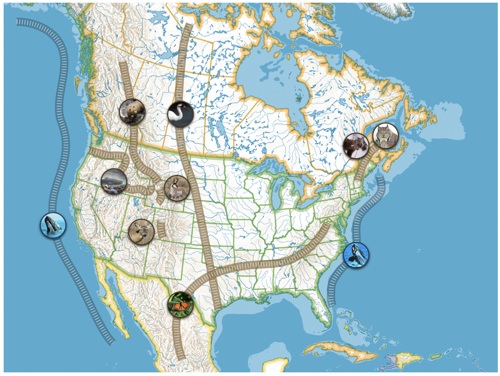
Legislation has been introduced into Congress that would create a means for identifying and protecting corridors necessary for wildlife to migrate in response to climate change. Map showing examples of wildlife corridors from the Freedom to Roam Coalition.
With some impacts of climate change already evident, and others projected, wildlife will need a means to move across the landscape to cope with the changes. With that in mind, two Democratic congressmen have introduced legislation to identify and protect wildlife corridors across the country.
Drafted by U.S. Representatives Rush Holt of New Jersey and Jared Polis of Colorado, the "Wildlife Corridors Conservation Act" is intended to help officials identify and protect wildlife corridors that cross both public and private lands.
The Wildlife Corridors Conservation Act comes on the heels of a Presidential Memorandum released April 16 that defines a 21st century strategy for preserving America’s Great Outdoors that also recognizes the importance of wildlife corridors and connectivity.
“It is vitally important that we identify and maintain habitat connectivity and migration corridors for fish and wildlife in response to the effects of climate change and other landscape level impacts on these critical resources. This bill will facilitate meaningful cooperative endeavors to this end between states, federal agencies, tribes, industry, and private landowners,” said Gary Taylor, legislative director of the Association of Fish and Wildlife Agencies.
The Wildlife Corridors Conservation Act would create a national wildlife corridors information program within the U.S. Fish and Wildlife Service to collect and disseminate information among states and federal agencies about essential wildlife movement areas. It would also establish a Wildlife Corridors Stewardship and Protection Fund to provide grants to federal agencies, states, local governments, nonprofits, and corporations for the management and protection of essential wildlife corridors. Finally, it would require the Departments of Agriculture, Interior, and Transportation to consider the preservation of these movement areas in their management plans. This legislation incorporates and builds on the wildlife habitat and corridors provisions of the Climate Change Safeguards for Natural Resources Conservation Act (H.R. 2192), sponsored by Rep. Raul Grijalva, and ultimately incorporated into the House-passed climate bill (H.R. 2454).
“The lives of the American people always have been interwoven with the movement of wildlife. Today, wildlife corridors are vital to the outdoor traditions that are a central part of our national character,” Rep. Holt said. “As we celebrate Earth Day this week, we recognize that protecting our planet entails protecting all of its inhabitants. Passing this legislation and preserving wildlife corridors would honor the ideals of Earth Day.”
“Wildlife corridors connect natural areas and allow animals to move, migrate, and adapt in a warmer, more crowded world,” said Jeffrey Parrish, executive director of the Freedom to Roam Coalition, which represents a broad group of businesses, non-profits, and government agencies. “Corridors also connect people to the outdoors, and ensure that all our citizens can hunt and fish, watch wildlife, and recreate while still developing our nation's economy and addressing our energy challenges sustainably.”
Support for the Wildlife Corridors Conservation Act includes the Association of Fish and Wildlife Agencies, National Wildlife Federation, Freedom to Roam, the Society for Conservation Biology, Wildlife Conservation Society, World Wildlife Fund, the Wildlife Alliance, National Parks Conservation Association, Defenders of Wildlife, the Wildlife Society, Wildlands Network, Sierra Club, the Humane Society, Conservation Northwest, American Wildlands, Yellowstone to Yukon Conservation Initiative, New Jersey Conservation, Oregon Natural Desert Association, Center for Large Landscape Conservation, and the Western Environmental Law Center.
Story Categories:
A copy of National Parks Traveler's financial statements may be obtained by sending a stamped, self-addressed envelope to: National Parks Traveler, P.O. Box 980452, Park City, Utah 84098. National Parks Traveler was formed in the state of Utah for the purpose of informing and educating about national parks and protected areas.
Residents of the following states may obtain a copy of our financial and additional information as stated below:
- Florida: A COPY OF THE OFFICIAL REGISTRATION AND FINANCIAL INFORMATION FOR NATIONAL PARKS TRAVELER, (REGISTRATION NO. CH 51659), MAY BE OBTAINED FROM THE DIVISION OF CONSUMER SERVICES BY CALLING 800-435-7352 OR VISITING THEIR WEBSITE. REGISTRATION DOES NOT IMPLY ENDORSEMENT, APPROVAL, OR RECOMMENDATION BY THE STATE.
- Georgia: A full and fair description of the programs and financial statement summary of National Parks Traveler is available upon request at the office and phone number indicated above.
- Maryland: Documents and information submitted under the Maryland Solicitations Act are also available, for the cost of postage and copies, from the Secretary of State, State House, Annapolis, MD 21401 (410-974-5534).
- North Carolina: Financial information about this organization and a copy of its license are available from the State Solicitation Licensing Branch at 888-830-4989 or 919-807-2214. The license is not an endorsement by the State.
- Pennsylvania: The official registration and financial information of National Parks Traveler may be obtained from the Pennsylvania Department of State by calling 800-732-0999. Registration does not imply endorsement.
- Virginia: Financial statements are available from the Virginia Department of Agriculture and Consumer Services, 102 Governor Street, Richmond, Virginia 23219.
- Washington: National Parks Traveler is registered with Washington State’s Charities Program as required by law and additional information is available by calling 800-332-4483 or visiting www.sos.wa.gov/charities, or on file at Charities Division, Office of the Secretary of State, State of Washington, Olympia, WA 98504.
INN Member

The easiest way to explore RV-friendly National Park campgrounds.

Here’s the definitive guide to National Park System campgrounds where RVers can park their rigs.
Our app is packed with RVing- specific details on more than 250 campgrounds in more than 70 national parks.
You’ll also find stories about RVing in the parks, tips helpful if you’ve just recently become an RVer, and useful planning suggestions.


Comments
WAY TO GO! LET'S HOPE THIS LEGISLATION PASSES!
Gee. Seems there is no wildlife at all in the Midwest! I guess those bird migrations through the Great Lakes are a mirage.
Bird migrations need food stops. increasing monoculture doesn't give them that. Surrounding lakes with houses and resorts has long been a problem for birds and wildlife in the upper midwest.
If a purpose of the Act is to "Help wildlife cope with climate change, then the former longgrass prairiewhich included part of Illinois as well as west of the Mississippi, need to have wildlife linkage. But the species that once roamed there, are pretty much extinguished, and the land taken over privately now by large corporations (I was aronud when the smaller farmers with fallow land and let-grow areas were losing their land to those corps.) and sprawling urbanization, and the giant interstate freeways.
Land species are an important issue because they cannot fly by even the width of a freeway. LOTS of work needs to be done to keep the fast loss of birds, plants, animals, from disappearing forever.
Rangertoo,
The map was only for illustrative purposes, not to highlight what's currently being considered.
I can see "endangered species act" written all over this. Living in Central Texas, I have not seen any problems with the snows, ducks and monarchs going to their wintering grounds. I see these as a way of certain groups to further limit our freedoms and to interject their views on everyone else.
Humans are not the only living things on this planet!
THe difference between accurate counting - science - and one person's intermittent and biased observations, is monumental. ornithologists have relatively accurate information, as does Wildlife dpeartments of federal and state government. That is their job. Merely posting something "i have not seen" leads to more inaccuracy and politicization of issues far greater than attempting to prop up conspiracy theory.
If anyone wants to see where this is headed, look at this;
http://www.propertyrightsresearch.org/images/wildlands_map.jpg
This legislation would benefit land animals, like buffalo, bears, pronghorn and so many others who have had their habitat stolen or completely fragmented by livestock grazing, highways, and other human development. The bill is very sensible and badly needed. Migration corridors that can connect all the islands of protected land will help ensure evolutionary potential and ultimate survival of this continent's migratory species. As it stands now, these islands of parks, refuges and forests are isolated pockets of extinction waiting to happen.
How does the southwest get leftout all together???
The Wildlands Network, run by biologists and concerned citizens, looks at the possible lands that can be used for healthy continuance of our native plants and animals, who need ground connections to keep from inbreeding, and extincition.
They propose linkages from Alaska to Baja through the cascades and Sierra Nevada, and through southern CA mountains and desert, as well as the necessary Rocky Mountain wil corridors for preserving everything from native cone-bearing trees to necessary predators, in the face of habitat fragmentation and global warming.
Desert areas are important for their species, and are increasingly linked. Just look at the places like Death Valley National Park (now the largest National Park in America) and Mojave Preserve, and Joshua Tree/ Anza Borrego. Mexico has a problem with little of the land being public.
I don't know the answer to uncontrolled immigration, but the steel wall prevents animal and even plant passage across boundaries, and that issue must be taken up by the agencies whose job it is to keep legal boundaries from being transgressed by humans.
Anon, the map is for illustrative purposes only.
Right on, we should bring the grizzlies back to the putrid sound where they use to roam free.
If this is for illustrative purposes only, where is a factual map, or do they even know yet which lands to grab?
By the way, I am here to discover the fate of this legislation, so that if it failed, maybe it can be reintroduced.
If a purpose of the Act is to "Help wildlife cope with climate change, then the former longgrass prairiewhich included part of Illinois as well as west of the Mississippi, need to have wildlife linkage.If a purpose of the Act is to "Help wildlife cope with climate change, then the former longgrass prairiewhich included part of Illinois as well as west of the Mississippi, need to have wildlife linkage