
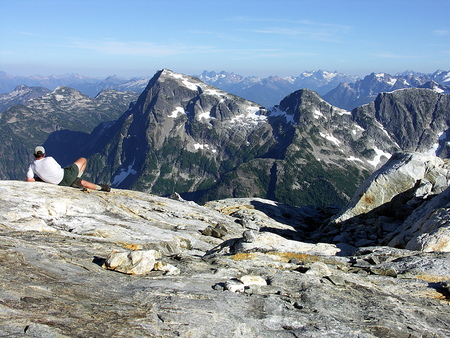
A climber relaxes near Luna Col in the Picket Range, the wild heart of the North Cascades. NPS photo by Michael Kirshenbaum.
Located less than 90 miles from Seattle, Washington’s sprawling North Cascades National Park Service Complex is a treasure trove of ecological diversity and a rugged wilderness playground for sightseers, hikers, climbers, and boaters.
684,303
Total acreage of North Cascades National Park (504,781 acres), Ross Lake National Recreation Area (117,575 acres) and Lake Chelan National Recreation Area (61,947 acres). These three separately designated (but contiguous) NPS units are administered as a single entity called the North Cascades National Park Service Complex.
634,614
Acreage of the Stephen Mather Wilderness Area (designated Nov. 16, 1988), which includes about 93% of North Cascades National Park and portions of the adjoining Lake Chelan and Ross Lake National Recreation Areas. There are also five federally designated wilderness areas in three adjoining national forests (Mount Baker-Snoqualmie, Okanogan, and Wenatchee). The North Cascades National Park Service Complex forms the core of more than two million acres of federally designated wilderness, one of the largest such areas in the 48-state U.S. Three Canadian provincial parks to the north (Chilliwack Lake, Skagit Valley, and Manning) preserve additional large tracts of wilderness.
349,984
Recreational visitors in 2009, including 288,458 at Ross Lake NRA and 34,554 at Lake Chelan NRA. The tally at North Cascades National Park was just 26, 972. Among the National Park-designated NPS units, only Michigan's Isle Royale National Park gets fewer visitors.
236,000
Acres of old-growth forest. The ancient forests of the North Cascades are remarkably lush. In fact, they have as much biomass per square mile as any place on earth.
More than 9,000
Feet of vertical relief. The steepness and heavily glaciated character of this mountainous terrain makes it a favorite with climbers and alpine trekkers.
At least 1,630
Vascular plant species documented in the eight distinctive life zones of North Cascades National Park. The great variations in rock and soil types, exposure, slope, elevation, and precipitation make the North Cascades one of the most ecologically diverse places on earth.
Nearly 400
Miles of trails. North Cascades is a hiker’s smorgasbord, offering trails ranging from short and easy to long, steep, and grueling.
About 312
Documented glaciers, most of which are melting and retreating due to climate warming. About half of the glaciers in the 48-state U.S. are in the North Cascades Range.
260
Documented prehistoric sites, some 8,500 or more years old. There are also 81 significant historic sites, including homesteads, sawmills, mines and mining camps, sheep herder camps, fire lookouts, and even a “lost” hotel.
About 240
Number of natural alpine lakes. Waterfalls are abundant too (and in fact, inspired the name North Cascades).
Almost 200
Backcountry campsites available by permit. Demand is light in most areas, but permits for popular cross-country zones and climbing areas tend to go quickly. The odds improve when visitors keep group size small, visit midweek, and arrive early at the ranger station.
Almost 140
Designated backcountry camps within trail corridors, where camping is allowed only in designated sites. (No cross-country camping is allowed within one-half mile of a trail or one mile of a designated camp) Each designated site in the trail corridors has a flat tent pad area, pit or composting toilet, and access to water. Designated camps at lower elevations also have fire rings.
57
Switchbacks on the 7.5-mile long Purple Trail.
50
Minimum length (feet) of the light line each camping group must bring so as to be prepared for hanging food, etc. at least 15 feet up and 5 feet out from the trunk of a tree. Regulations call for using wildlife-resistant food storage lockers or canisters (“bear cans”) where appropriate and available.
34
Miles of paved road. Gravel roads are the standard in the North Cascades National Park Service Complex.
12 or 6
Maximum party size for backcountry use. Since the backcountry camps in the cross-country zones and climbing areas vary in capacity, the party size limits (which are strictly enforced) vary by area/zone. The limit in certain high-use areas is 12 pairs of eyes (including horses, mules, donkeys, and llamas), but for most other areas it is just six. Oversize groups are required to divide into smaller groups that remain spaced at least a half-day’s travel apart and stay at different backcountry camps.
6
Miles of road (all unpaved) inside North Cascades National Park. One of these roads starts in Stehekin, a community so remote that it has to be reached by boat or floatplane. The other is the Cascade River Road, which takes about an hour to drive and leads only to trailheads for fairly steep trails.
5
Research Natural Areas, including Silver Lake, Pyramid Lake, Boston Glacier, Stetattle Creek and Big Beaver Valley. Research Natural Areas are pristine areas that typify certain habitat types or environments having unique characteristics of scientific interest.
1
Number of times since 1976-77 that State Road 20, the only the only road that traverses the park from east to west, has remained open the entire winter. During a typical winter, heavy snow and frequent avalanches bury the highway beyond Ross Lake Trailhead from mid-November to April.
0
Entrance fee. No component of the North Cascades National Park Service Complex charges an entrance fee.
Story Categories:
A copy of National Parks Traveler's financial statements may be obtained by sending a stamped, self-addressed envelope to: National Parks Traveler, P.O. Box 980452, Park City, Utah 84098. National Parks Traveler was formed in the state of Utah for the purpose of informing and educating about national parks and protected areas.
Residents of the following states may obtain a copy of our financial and additional information as stated below:
- Florida: A COPY OF THE OFFICIAL REGISTRATION AND FINANCIAL INFORMATION FOR NATIONAL PARKS TRAVELER, (REGISTRATION NO. CH 51659), MAY BE OBTAINED FROM THE DIVISION OF CONSUMER SERVICES BY CALLING 800-435-7352 OR VISITING THEIR WEBSITE. REGISTRATION DOES NOT IMPLY ENDORSEMENT, APPROVAL, OR RECOMMENDATION BY THE STATE.
- Georgia: A full and fair description of the programs and financial statement summary of National Parks Traveler is available upon request at the office and phone number indicated above.
- Maryland: Documents and information submitted under the Maryland Solicitations Act are also available, for the cost of postage and copies, from the Secretary of State, State House, Annapolis, MD 21401 (410-974-5534).
- North Carolina: Financial information about this organization and a copy of its license are available from the State Solicitation Licensing Branch at 888-830-4989 or 919-807-2214. The license is not an endorsement by the State.
- Pennsylvania: The official registration and financial information of National Parks Traveler may be obtained from the Pennsylvania Department of State by calling 800-732-0999. Registration does not imply endorsement.
- Virginia: Financial statements are available from the Virginia Department of Agriculture and Consumer Services, 102 Governor Street, Richmond, Virginia 23219.
- Washington: National Parks Traveler is registered with Washington State’s Charities Program as required by law and additional information is available by calling 800-332-4483 or visiting www.sos.wa.gov/charities, or on file at Charities Division, Office of the Secretary of State, State of Washington, Olympia, WA 98504.
INN Member

The easiest way to explore RV-friendly National Park campgrounds.

Here’s the definitive guide to National Park System campgrounds where RVers can park their rigs.
Our app is packed with RVing- specific details on more than 250 campgrounds in more than 70 national parks.
You’ll also find stories about RVing in the parks, tips helpful if you’ve just recently become an RVer, and useful planning suggestions.


Comments
Your by the numbers posts are always among my favorite. I am surprised at just how few people visit this park.
The visitation numbers in the National Park proper are certainly low (2nd least visited park in the continental US, second only to Isle Royale) for a park close to Seattle. That's easier to understand if you add the following number:
6
Miles of road (all unpaved) inside North Cascades National Park.
One of these roads starts in Stehekin, a community so remote that it has to be reached by boat or floatplane. The other is the Cascade River Road, which takes about an hour to drive and leads only to trailheads for fairly steep trails.
@ QTLuong: Thanks for the information about visitation and roads, which I have incorporated into the BTN stats. As you've so aptly pointed out, North Cascades is not exactly a windshield touring park!
Thanks for the stats. I've been looking at the NP site for North Cascades as we plan to visit in Sept. May have to alter plans. I had no idea there were so few roads in the park complex. That's okay. We'll enjoy day hikes.
North Cascades is unique as the National Park is composed of only the higher elevations in the Cascade Mountains. The valleys are designated as National Recreation Areas, because the rivers have been dammed into reservoirs and are used for water sports. So a number of nice day hikes start on trailheads in Ross Lake NRA and only after a few miles of hiking you get into the National Park.
I would say that ones visit to our North Cascades National Park Service Complex is not complete until the hike from the end of the Cascade River Road up to the pass and onward to the Sahale Glacier has been done.
It is simply, awe inspiring..
Cascade Pass / Sahale Arm Trail