
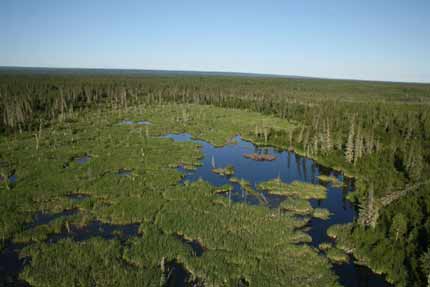
Aerial view of the beaver dam in Wood Buffalo National Park. Photo by Wood Buffalo National Park of Canada.
Editor's note: In an effort to better understand how other countries are managing their parklands, and to compare and contrast U.S. efforts to those from abroad, Traveler on occasion runs items from beyond U.S. borders.
Not so many decades ago, the beaver population in North America was in decline, thanks largely to the fur trade. Beaver numbers are on the rebound, and the animals can be found in a number of national parks. Do you know which park can claim it's home to the world's largest beaver dam?
A clue is found in the first sentence of this story, because the answer is a park in North America… but not the U.S. A.
Wood Buffalo National Park, in northern Alberta, is the largest Canadian national park, and according to Parks Canada, the second largest protected area in the world.
Most American's have a difficult time visualizing 44,807 square kilometers—the size of this park—so here's some perspective: that's an area larger than the country of Swizerland. Wood Buffalo is a place of plenty of superlatives: it's home to the largest land mammal native to North America (a herd of 5,000 Wood Bison), one of the largest inland fresh water delta ecosystems on the planet, and the place where new whooping cranes are born each year.
Thanks to a sharp-eyed researcher studying aerial photos, the park can also claim the largest beaver dam in the world.
The dam is large enough that it's visible from space; it was spotted in 2007 by Jean Thie, an environmental scientist who was using Google Earth to study environmental change in Canada's Boreal and Sub arctic Ecoregions.
Based on aerial reconnaissance and further analysis of additional photos, the beaver dam is believed to be about 850 meters long or about 2,790 feet, which is roughly the length of nine football fields. A more typical beaver dam is under 100 meters long, although this part of Canada also holds other dams ranging in length from 300 to 500 meters.
According to information posted on the website for Thie's company, EcoInformatics International, the beaver dam was discovered by "flying over the earth" with Google Earth. "It is unlikely that this dam would have been discovered without Google Earth and its high resolution image data base, in this case provided by Digital Globe."
Scientists are yet to see the impressive structure except from the air, and the area is so remote, park officials weren't even aware of its existence before Thie's photo discovery. The area is too heavily wooded to allow aircraft to land, and the area where the dam is located doesn't even have any trails, much less roads. According to a park spokesman, it would take several days of paddling and serious bushwhacking to reach the site.
Even though the dam is visible on NASA LandSat photos taken in 1990, it's not exactly obvious to the untrained eye. Apparently the work of at least several generations of beavers, the dam itself is covered with vegetation. "It doesn't look like much," park spokesperson Mike Keizer said. "It looks like a bog against a dense forest."
The terrain may be one reason for the dam's unusual length—the area is rather flat, so the animals couldn't simply tie into opposite sides of a narrow river channel, and it takes a lengthy structure to impound the amount of water desired by the animals.
The big dam apparently resulted from the connection of two smaller dams, and the growth of the impressive natural structure may not be over. Aerial photos show new beaver dams are being built nearby which could ultimately join the main dam and increase the overall length by another 50-100 meters in the next decade.
Parks Canada staff described the area the beavers have chosen as "incredibly remote and undisturbed. It is positioned in prime wetlands between the Birch Mountain highlands and the Peace Athabasca Delta. The run-off from the highlands provides the beavers with lots of water and the dense boreal forest provides them with plenty of food and wood to build the dam and lodges."
A visit to this impressive beaver dam isn't likely to be on your schedule, but if you're interested in a trip to other parts of Wood Buffalo National Park, some sections of the park are accessible by vehicle. The park website includes information to help you plan a trip.
Jean Thie, the scientist who first spotted the beaver dam, is President of EcoInformatics International Inc, a Consulting Company "specializing in strategy mapping, knowledge management and decision support systems for science and natural resource management organizations." If you're interested in more details about the beaver dam, you'll find them on his company's website.
Story Categories:
A copy of National Parks Traveler's financial statements may be obtained by sending a stamped, self-addressed envelope to: National Parks Traveler, P.O. Box 980452, Park City, Utah 84098. National Parks Traveler was formed in the state of Utah for the purpose of informing and educating about national parks and protected areas.
Residents of the following states may obtain a copy of our financial and additional information as stated below:
- Florida: A COPY OF THE OFFICIAL REGISTRATION AND FINANCIAL INFORMATION FOR NATIONAL PARKS TRAVELER, (REGISTRATION NO. CH 51659), MAY BE OBTAINED FROM THE DIVISION OF CONSUMER SERVICES BY CALLING 800-435-7352 OR VISITING THEIR WEBSITE. REGISTRATION DOES NOT IMPLY ENDORSEMENT, APPROVAL, OR RECOMMENDATION BY THE STATE.
- Georgia: A full and fair description of the programs and financial statement summary of National Parks Traveler is available upon request at the office and phone number indicated above.
- Maryland: Documents and information submitted under the Maryland Solicitations Act are also available, for the cost of postage and copies, from the Secretary of State, State House, Annapolis, MD 21401 (410-974-5534).
- North Carolina: Financial information about this organization and a copy of its license are available from the State Solicitation Licensing Branch at 888-830-4989 or 919-807-2214. The license is not an endorsement by the State.
- Pennsylvania: The official registration and financial information of National Parks Traveler may be obtained from the Pennsylvania Department of State by calling 800-732-0999. Registration does not imply endorsement.
- Virginia: Financial statements are available from the Virginia Department of Agriculture and Consumer Services, 102 Governor Street, Richmond, Virginia 23219.
- Washington: National Parks Traveler is registered with Washington State’s Charities Program as required by law and additional information is available by calling 800-332-4483 or visiting www.sos.wa.gov/charities, or on file at Charities Division, Office of the Secretary of State, State of Washington, Olympia, WA 98504.
INN Member

The easiest way to explore RV-friendly National Park campgrounds.

Here’s the definitive guide to National Park System campgrounds where RVers can park their rigs.
Our app is packed with RVing- specific details on more than 250 campgrounds in more than 70 national parks.
You’ll also find stories about RVing in the parks, tips helpful if you’ve just recently become an RVer, and useful planning suggestions.


Comments
I keep hearing people say things like, "this is the biggest beaver dam ever", but we don't really know that. Who's to say what gigantic dams have been built since (or even during) the last ice age? Which makes me wonder if there are any geographic features in North America that may actually have been created by these marvelous creatures.
This dam is certainly not claimed as "the longest beaver dam ever". Historical records and folklore mention much larger dams. Nowadays with exceptional tools like Google Earth, we can find such long dams and provide 'proof' to the world, as well as a visual record. The original post for this dam was in october of 2007 in the Google Earth Community forum with a challenge to anyone to find a longer dam. So far no longer dam has been found. By the way, the longest dam in Europe is claimed to be 180 meters long!
Although beaver dams themselves may not create permanent geographic features ( in fact beavers are smart and tend to use geography to their benefit and minimize the need construction of (large) dams, in colonies they can have major impacts on wide landscapes. There are some imposing beaver landscapes in Canada and the US where beavers are 'managing' every stream or creek . For example: 'highest beaver density in Canada': http://www.geostrategis.com/b_beaverdensity2.htm
or Beaver landscape: http://www.geostrategis.com/b_beaverlandscape1.htm