
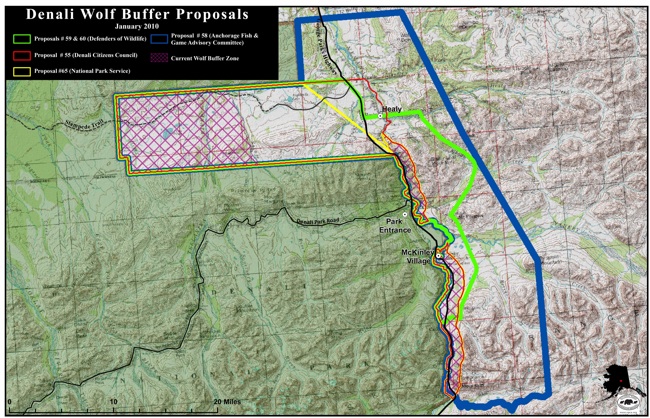
There are several proposals before the Alaska Game of Board this week to enlarge a wolf buffer zone in a notch of land surrounded on three sides by Denali National Park. Some proposals would use the George Parks Highway as an eastern-most boundary, another would use the Nenana River. The Park Service proposal is in yellow, the Defenders of Wildlife proposal is in green, and the largest proposal, outlined in blue, was submitted by the Anchorage Fish and Game Advisory Committee. The purple crisscrossed area reflects the current buffer zone.
During its lengthy meeting in Fairbanks this week the Alaska Board of Game is expected to consider a proposal to extend a wolf protection buffer zone that is surrounded on three sides by Denali National Park and Preserve.
There once was a proposal to turn over to the park this rectangular block of land due west of Healy, Alaska, that follows the Stampede Trail, but it never got off the ground. As a result, wolves that leave the park and follow caribou to wintering grounds on this landscape are subject to trapping in some places. Currently, there is a buffer zone that comprises roughly half of the rectangle on the western end in which wolves can't be hunted or trapped.
“They go there a lot and they’ve been trapped a lot. There have been a couple of packs that actually have been eliminated by trappers in that area," says Joan Frankevich, the program manager in the Alaska office of the National Parks Conservation Association. "There have been, last year or the year before, two that got snared but they broke free of the snares and in the summertime were seen along the park road with swollen necks.”
While the trapping is not having an overall negative effect on Denali's wolf population, said Ms. Frankevich, it does impact research on the park's wolf packs. Many of those that frequent this landscape wear radio collars that allow biologists to track their movements, she explained.
"It is a problem for the knowledge and the longevity of the wildlife studies that have gone on, the knowledge that gets passed down and the viewing for visitors," she said.
At the National Park Service's Alaska office, John Quinley, the assistant regional director for communications and partnerships, said the agency would support a larger buffer zone for this area.
"We’ve got several years of radio-collar data that shows the wolves -- we have a lot of 'park wolves', packs that spend a lot of their time in Denali -- come outside of the park for a portion of the year, and are frequently in that notch," he said. "And a lot of them have been tracked into the portion of the notch that is open to the taking of wolves. Denali has pushed forward a proposal for this Game Board meeting to extend the closed area to cover that piece of the notch where we have been seeing wolves frequently."
The current buffer zone is 90 square miles, according to the NPCA. Packs that frequent it and which often are viewed by Denali visitors include the East Fork Pack, the Grant West Pack, and the Nenana Pack. Packs that were wiped out by hunting and trapping include the Headquarters Pack, Savage Pack, and Sanctuary Pack, according to the group's records. Not every individual of a pack must be killed for the pack to collapse. And in some cases, new packs have re-established themselves in similar territory and have new names.
One of the proposals before the Board of Game would use the George Parks Highway as an eastern-most boundary for the buffer zone, while another would use the Nenana River. The Park Service proposal would use a diagonal line.
“I find their buffer difficult in that diagonal line. For people on the ground it’d be virtually impossible to follow," said Ms. Frankevich. "That’s why either following the park’s highway or the Nenana River makes more sense, because it's an easily defined boundary on the ground.”
Story Categories:
A copy of National Parks Traveler's financial statements may be obtained by sending a stamped, self-addressed envelope to: National Parks Traveler, P.O. Box 980452, Park City, Utah 84098. National Parks Traveler was formed in the state of Utah for the purpose of informing and educating about national parks and protected areas.
Residents of the following states may obtain a copy of our financial and additional information as stated below:
- Florida: A COPY OF THE OFFICIAL REGISTRATION AND FINANCIAL INFORMATION FOR NATIONAL PARKS TRAVELER, (REGISTRATION NO. CH 51659), MAY BE OBTAINED FROM THE DIVISION OF CONSUMER SERVICES BY CALLING 800-435-7352 OR VISITING THEIR WEBSITE. REGISTRATION DOES NOT IMPLY ENDORSEMENT, APPROVAL, OR RECOMMENDATION BY THE STATE.
- Georgia: A full and fair description of the programs and financial statement summary of National Parks Traveler is available upon request at the office and phone number indicated above.
- Maryland: Documents and information submitted under the Maryland Solicitations Act are also available, for the cost of postage and copies, from the Secretary of State, State House, Annapolis, MD 21401 (410-974-5534).
- North Carolina: Financial information about this organization and a copy of its license are available from the State Solicitation Licensing Branch at 888-830-4989 or 919-807-2214. The license is not an endorsement by the State.
- Pennsylvania: The official registration and financial information of National Parks Traveler may be obtained from the Pennsylvania Department of State by calling 800-732-0999. Registration does not imply endorsement.
- Virginia: Financial statements are available from the Virginia Department of Agriculture and Consumer Services, 102 Governor Street, Richmond, Virginia 23219.
- Washington: National Parks Traveler is registered with Washington State’s Charities Program as required by law and additional information is available by calling 800-332-4483 or visiting www.sos.wa.gov/charities, or on file at Charities Division, Office of the Secretary of State, State of Washington, Olympia, WA 98504.


National parks and their natural resources belong to you. The National Parks Traveler works to ensure you know how these essential places are being cared for.
Sign Up For Our Weekly Newsletter
Unsubscribe at any time.
INN Member

The easiest way to explore RV-friendly National Park campgrounds.

Here’s the definitive guide to National Park System campgrounds where RVers can park their rigs.
Our app is packed with RVing- specific details on more than 250 campgrounds in more than 70 national parks.
You’ll also find stories about RVing in the parks, tips helpful if you’ve just recently become an RVer, and useful planning suggestions.


Comments
Appreciate the Park Service taking a stand finally. This an important issue to those of us who live in Alaska.
These winter feeding grounds are essential to contributing to the genetic diversity and strength of the Park wolves and other wolves in the vicinity.
Park wolves are declining in numbers and young wolves are losing important training when their family units get disrupted with too much trapping and hunting.
People in Alaska go overboard on hunting and trapping. It's time for more appreciation and respect for these wolves and all wildlife in Alaska.
There is a lack of reverence for nature by a few. There has to be a mind set change a slight one. The whole romantic idea of rugged individualism the frontiersman hunting his own food, supporting his family and defending his ranch (sorry Nugent you are hardly threatened or need to hunt)is fine, but when it morphs into hunting as a hobby whether its a wolf or any other animal then it becomes recreation.
Once it becomes recreation and it involves alcohol then it ceases to be rugged individualism and survival of the fittest, and just something to do to pass them time. At that point we all need to recalibrate.
No ones right to recreate trumps sustainability. On another level it would be nice if we all were extremely aware of and realize this world and all of us and everything in it are gods creation. Man created none of this. We are mere residents, tenants subject to our own demise through our own devices whether its commerce, vice or stupidity. Put here by some unknown creative power (ourselves included) we need to pause from learned behavior and see how we are applying it.
I am not an anti culling person. Proper management of ALL our resources will insure long term sustainability not only for our four legged friends but our two legged ones as well.
We need to live in balance with the world as presented to us. It can be done and if done well a sustainable ecosystem leads to a sustainable economy and a sustainable world for all.
Reckless abandonment applied to any habit, hobby, practice, or lifestyle is mind numbingly short sighted. Heck even too much exercise can ruin you, as well as overeating, drinking, and smoking. Too much television can turn your brain to mush and make you a zombie for someone else's ideas or marketing. Too much hunting has a domino effect, like too much pollution. Now we don't have enough bees to pollinate seems insignificant right bees (ha, ha) those little annoying stingers good riddance right - WRONG - they directly impact our food chain and supply. Ignorance is not bliss and being stupid is definitely not cool.
Lack of moderation is making a wreck of the world, our country, our mountains and valleys, our water, our air, our people, and our soil and food.
So as an old friend told me long ago - EVERYTHING IN MODERATION. Those old sayings pack a lot of wisdom and quite frankly if applied across the board even into politics we would all be living in a better world!
Paul Burke
Author-Journey Home
McKinley Park was originally set aside to preserve one spot for all big game and hunting. In the 1970s wildlife was abundant in the Park. Visitors saw moose, sheep, caribou, grizzlies and wolves all the time every trip. The local caribou herd was last seen way north of the Park on a dead run with a pack of wolves on their tail. That herd is now extinct. Sheep numbers are all but extinct in many areas of the Park. Moose numbers are very low considering the habitat. Game numbers are higher all around and outside the Park. Wolves leave the Park in search of something to eat because there is little left in the Park. That is the sole reason wolf numbers have dramatically dropped. The Park managers are on record saying they do not know why wolf numbers are decreasing. This is in fact what is known as the end result of a predator pit. When prey species get so low, the predators begin to decline through starvation and reduced breeding, conception rates, low birth rates and poor survivability. It is a natural cycle just like the hare and fox cycle only it takes much longer to happen. And recovery is not likely until predator numbers fall substantially. The key difference between what is happening in the Park and the hare and fox cycle is the prey species do not reproduce rapidly enough during the low predator years to make the jump from the predator pit like hares can. Predatators, especially wolves, will match any prey specie abundant with immediate population increases when the factors mentioned above reverse.
The Park personel is not doing anything or anyone any favors by increasing the buffer zone. For more viewing opportunities the Park should increase access to other areas of the Park.
The wolves need all the protection they can get from the various programs that the AK wildlife
agencies do to slaughter wolves on a regular basis.