
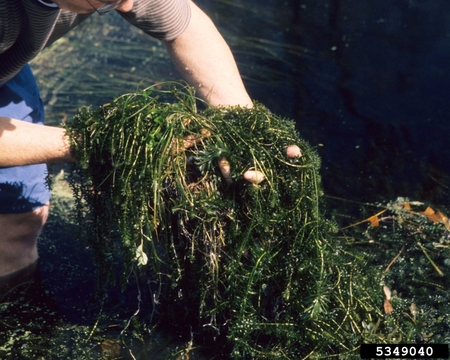
The dense, tangled mats that Brazilian egeria tends to produce can be very problematic. USDA photo by Ann Murray.
This is the basic information you got in yesterday’s National Park Mystery Plant quiz:
It’s an alien from way down south. Intentionally brought into this country by people who needed to provide oxygen in confined spaces, it’s been loose in America for over a century. You can now find it in scattered locations from border to border and coast to coast.
Everywhere you find this plant growing where it wasn’t invited, you’ll find people who despise its nasty habits. Perhaps its worst habit is producing dense stands or mats that crowd out native vegetation.
To know this plant well is to appreciate its oddities. For example, it doesn’t need soil to grow, and even though it is a seedless flowering species, all of the problem plants are males.
Identifying this plant can be tricky. People often mistake it for a plant whose common name rhymes with the most common ice cream flavor.
The places where this plant causes the most trouble are places where drawdowns are most likely to play an important role in its control or eradication.
From this you should have been able to deduce that the mystery plant is the submerged aquatic perennial Brazilian egeria (Egeria densa Planchon). Formerly identified scientifically as Elodea densa (Planchon) Caspary, this member of the Hydrocharitaceae family is usually branded anacharis when sold for aquarium use. It has many colloquial names, including Brazilian waterweed, Brazilian elodea, giant elodea, leafy elodea, South American waterweed, dense waterweed, and large-flowered waterweed.
Having “weed” as part of this plant’s descriptor is certainly understandable. Although prized as an aquarium plant that looks pretty while oxygenating the water and supplying nutrients, Brazilian egeria (i-JEER-ee-a) inspires nearly universal hatred in people who’ve had to deal with this highly invasive plant’s impacts on freshwater impoundments, canals, ditches, slow-moving streams, pools, and sloughs.
Brazilian egeria is a tall-growing (up to 12 feet) plant native to Brazil, Paraguay, and coastal areas of Uruguay and Argentina. It was brought to America as an aquarium plant in the late 1800s, and it’s been loose in this country since at least 1893. It can now be found, usually rooted at depths of less than 15-20 feet, in bodies of fresh water throughout the United States except in colder areas of the northern, Midwestern, and north-central states. (It can survive under ice for only brief periods, and prolonged near-freezing temperatures will kill it.) Acadia National Park, Colonial National Historical Park, and Everglades National Park are a few of the NPS units that have documented Brazilian egeria within their borders.
This plant looks a lot like another noxious aquatic import, the hydrilla (rhymes with vanilla). However, the midrib on the underside of the Brazilian egeria leaf is smooth, whereas the midrib on the underside of the hydrilla leaf has small teeth.
Once it is well established, Brazilian egeria tends to grow into densely tangled subsurface mats or stands that can interfere with swimming, boating, water skiing, fishing, and other recreational pursuits. Hydropower facilities may suffer from loss of storage capacity as well as clogged or damaged grids, pumps, and intakes. In dense enough concentrations, this weed can even interfere with commercial navigation in canals and shallow channels. Ecological damage results when native aquatic plants are crowded out, the movement of anadromous fish is impeded, water clarity and quality are reduced, and the aquatic ecosystem’s natural flows of water, sediment, and energy are disrupted. Aerobic decomposition following diebacks or herbicide use can excessively reduce dissolved oxygen levels. This is not to mention the aesthetic insults of dense mats in shallow water in the vicinity of residences, vacation homes, and resorts. Some individual impoundments have tallied millions of dollars in damages and control costs.
Since Brazilian egeria can grow while floating in water, and its stem fragments can root at nodes, it is readily dispersed. If plants are chopped up or torn by boat propellers, the stem fragments can drift away to colonize new locations. When mechanical equipment is used to mow and remove plants from heavily infested areas, unharvested clumps can sink to the bottom and take root or drift to colonize new areas.
Once Brazilian egeria is established in a water body, controlling or eradicating it can be easy or maddeningly difficult, depending on the degree of infestation, the size of the area needing treatment, and other physical and cultural factors. If all you need is some local control, as in the vicinity of swimming areas or docks, covering the mats or sediment with an opaque fabric will block sunlight and kill the plants. If more extensive treatment is needed, the main tools available are pesticides (such as Floridone or diquat), mechanical removal (harvesting), biological controls (such as grass carp or a fungal disease), and in some case, lowered water levels (drawdowns). All of these measures have significant drawbacks, and none is simple, easy, or cheap.
Using drawdowns is an attractive, if limited option. While the managers of some reservoirs or lake systems are at liberty to lower water levels in order to control aquatic plants, others may be restricted to drawdowns done primarily for maintenance, repair, or safety reasons. Drawdowns for Brazilian egeria control tend to be most effective when they are done repeatedly and when sediments are either dried for prolonged periods or frozen to depths of at least 8 to 12 inches.
Postscript: The Brazilian egeria is a flowering species, with male and female flowers produced on separate plants. So far, all of the Brazilina egeria plants found in U.S water bodies have been male clones that reproduce vegetatively.
Story Categories:
A copy of National Parks Traveler's financial statements may be obtained by sending a stamped, self-addressed envelope to: National Parks Traveler, P.O. Box 980452, Park City, Utah 84098. National Parks Traveler was formed in the state of Utah for the purpose of informing and educating about national parks and protected areas.
Residents of the following states may obtain a copy of our financial and additional information as stated below:
- Florida: A COPY OF THE OFFICIAL REGISTRATION AND FINANCIAL INFORMATION FOR NATIONAL PARKS TRAVELER, (REGISTRATION NO. CH 51659), MAY BE OBTAINED FROM THE DIVISION OF CONSUMER SERVICES BY CALLING 800-435-7352 OR VISITING THEIR WEBSITE. REGISTRATION DOES NOT IMPLY ENDORSEMENT, APPROVAL, OR RECOMMENDATION BY THE STATE.
- Georgia: A full and fair description of the programs and financial statement summary of National Parks Traveler is available upon request at the office and phone number indicated above.
- Maryland: Documents and information submitted under the Maryland Solicitations Act are also available, for the cost of postage and copies, from the Secretary of State, State House, Annapolis, MD 21401 (410-974-5534).
- North Carolina: Financial information about this organization and a copy of its license are available from the State Solicitation Licensing Branch at 888-830-4989 or 919-807-2214. The license is not an endorsement by the State.
- Pennsylvania: The official registration and financial information of National Parks Traveler may be obtained from the Pennsylvania Department of State by calling 800-732-0999. Registration does not imply endorsement.
- Virginia: Financial statements are available from the Virginia Department of Agriculture and Consumer Services, 102 Governor Street, Richmond, Virginia 23219.
- Washington: National Parks Traveler is registered with Washington State’s Charities Program as required by law and additional information is available by calling 800-332-4483 or visiting www.sos.wa.gov/charities, or on file at Charities Division, Office of the Secretary of State, State of Washington, Olympia, WA 98504.


National parks and their natural resources belong to you. The National Parks Traveler works to ensure you know how these essential places are being cared for.
Sign Up For Our Weekly Newsletter
Unsubscribe at any time.
INN Member

The easiest way to explore RV-friendly National Park campgrounds.

Here’s the definitive guide to National Park System campgrounds where RVers can park their rigs.
Our app is packed with RVing- specific details on more than 250 campgrounds in more than 70 national parks.
You’ll also find stories about RVing in the parks, tips helpful if you’ve just recently become an RVer, and useful planning suggestions.


Comments
E. densa is regulated or prohibited in several states. It is illegal to possess it in Michigan, but I see it in pet stores all the time. There are also a lot of school teachers using it the classroom, and the kids often get to take the little pop-bottle aquatic containers home with them. Undoubtedly, a lot of those plants are getting "free-willied" into a local waterway. This plant is the poster boy for the need to have better education about invasives and exoitcs.
Unfortunately, Egeria densa was discovered at a neighboring lake, and we've been attempting to eradicate it without using herbicides (some residents use the lake for drinking water). I am curious about your source of the information that Egeria densa doesn't survive well under ice. So far it's seemed to thrive even with long ice-ins and snow covered ice.
Many thanks for bringing this plant to people's attention. There are far too many people who seem to think this is the ideal plant for their outdoor ponds and streams.
Egeria densa (Brazilian egeria or Brazilian elodea) doesn't survive well under ice, anon, nor even in prolonged near-freezing conditions. What survives well under ice is Elodea canadensis -- aka common elodea, American elodea, pondweed, Canadian waterweed, American waterweed, broad waterweed. Unlike Brazilian egeria, common elodea is a North American native. Unfortunately, it's often confused with non-native egeria densa or hydrilla. BTW, Elodea canadenis is now a significant invasive species in many areas of Europe and some parts of Asia.
All of this said, I'm moved to point out that we may very well have reason to hedge our bets on these non-native invasive species. We thought that kudzu couldn't grow in places that have serious winter cold, but guess what? There is kudzu growing in Massachusetts, in at least one northern Michigan county (Benzie), and in other surprising places. We thought that "killer bees" couldn't survive in cold climates and would become much less aggressive through hybridization, but guess what? They can survive cold climates, they will still chase you as far as you can run, and some scientists are predicting that they'll be in every state (including Alaska) in less than 20 years. Burmese pythons have proven surprisingly adaptive to colder climates, too, and the list could go on and on. So, on the matter of the Brazilian elodea, be sure to check back with me in, say, ten years.
I'd still love to get the scientific evidence about the Egeria densa. It seems you may doubt that what we found was Egeria densa. It is true that we have both Elodea canadensis and Elodea nuttallii in the nearby lakes. However, the identification of Egeria densa has been verified by numerous plant and lake experts, government employees, and invasive plant specialists. It has been photographed, and it has been subjected to DNA analysis. There's no doubt - what we have is unfortunately really Egeria densa. I agree that we don't always know how invasive species may adapt, even those that don't have sexual reproduction to help the evolution along.
To try to figure out how the E. densa behaves, I've had it growing in some buckets in my back yard. (I'm far away from any water body). I have a bucket in my compost pile but I also had buckets frozen solid on the patio, and in our January thaw, the pieces of plant seemed to be green and thriving. This is incredibly surprising to me, and maybe they just don't know they're dead yet. In all my research on this plant, I find a lot of reports but few documents of original research, which is why I'm hoping you can point me to some. I'd really appreciate the information. Many thanks!
Your experience with that plant is indeed surprising, anon. May I ask what state you live in? Though your little experiment with the bucket can't be called scientific by any stretch of the imagination, it's an empirical result that does demand explanation. Can anybody else out there help with this line of questioning? It's way, way outside my area of expertise. (Hey Kirby, how about signing in on this one!)
I'm glad to give more details. The plant was found in Lake Waccabuc, in Westchester County, NY. There's another lake in Orange County, NY, Lake Guymard, that found E. densa a year before we found it in Lake Waccabuc, and they tried herbicides. Despite ice cover, snow, and herbicides, unfortunately they have even more of the plant than we have - at least before the ice came in this winter. As far as we know, this is the first location of E. densa in Westchester County.
It could be that the people who have water features in their gardens and have planted this stuff are having problems getting it to overwinter when there's ice. We had hopes that it wouldn't overwinter in the lakes, but unfortunately it sure seemed to do just fine.
I am glad you are helping to communicate the need to be careful with aquarium plants. And I add my voice to all those who ask people with koi ponds or water features to use native plants. All it takes is one rip-roaring storm to spread these non-native pesky plants to neighboring bodies of water.